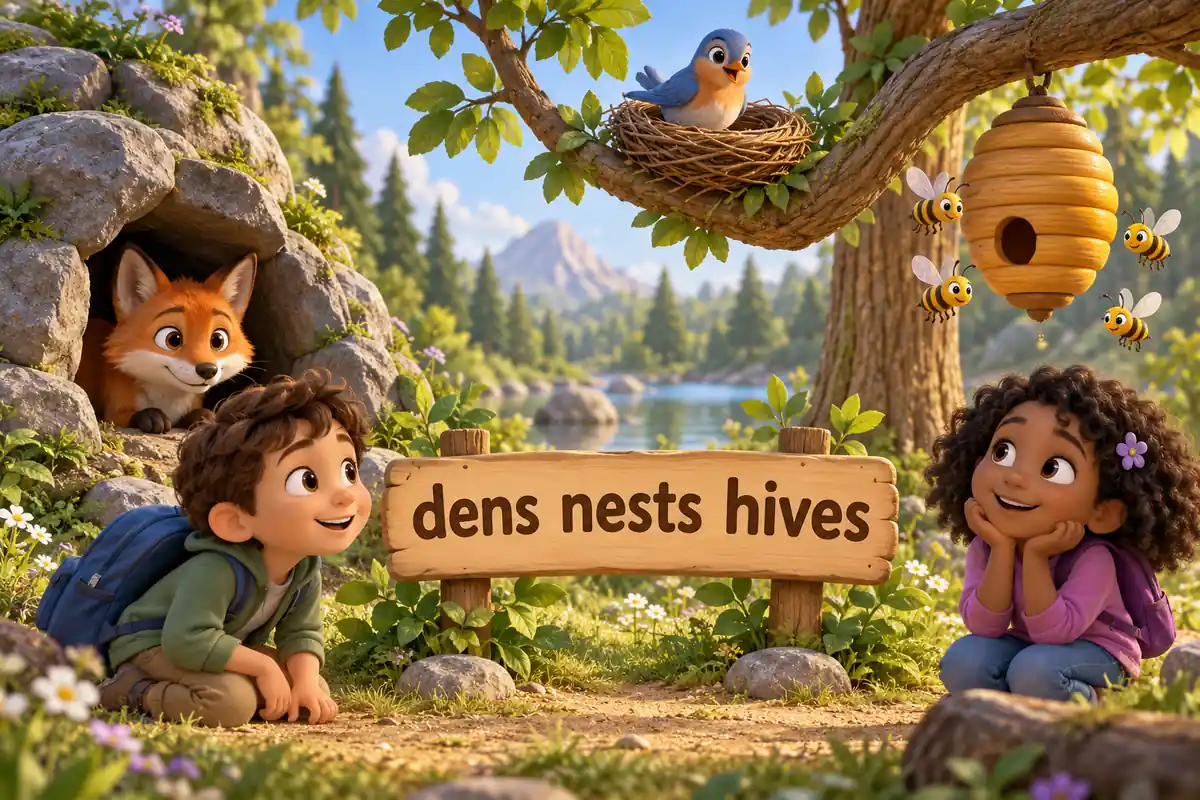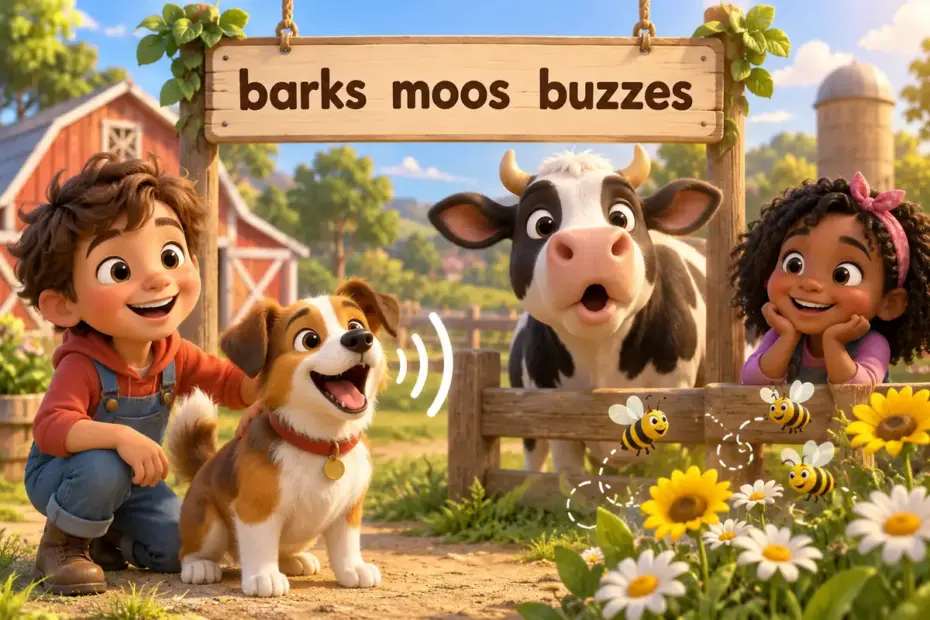
Animal sounds in English are usually verbs rather than nouns, so a dog barks, a cow moos and a bee buzzes. Each animal has its own sound word, and the verbs follow regular patterns, which makes the list easy to learn and to use in both speech and writing.
Animal sounds in English at a glance
- Most animal sound words in English are verbs.
- The verb names the sound, so a dog barks and a cat meows.
- Some animals share a verb, such as small birds that chirp.
- The sound word often comes from the noise itself.
- The commonest error is using a noun where a verb is needed.
What are animal sounds called in English?
English turns the noise an animal makes into a verb, and the verb carries the animal as its subject. There is no single general word, so each creature has its own sound verb, and a few animals can use more than one. Verb agreement with sound words follows the same logic as sound good or sounds good.
| Animal | Sound verb | Example |
|---|---|---|
| dog | bark, growl, howl | The dog barked at the postman. |
| cat | meow, purr, hiss | The cat purred on the cushion. |
| cow | moo, low | The cows mooed in the field. |
| horse | neigh, whinny | The horse neighed at the gate. |
| sheep | bleat, baa | A lamb bleated for its mother. |
| bird | chirp, tweet, sing | Birds chirped at dawn. |
| bee | buzz | Bees buzzed round the flowers. |
| lion | roar, growl | The lion roared across the plain. |
A small number of these words also name the sound itself, so buzz, hoot and bark double as nouns. The noun form takes an article, as in a loud bark, while the verb form stands alone, as in the dog barked. The animal stays the subject in the verb pattern.
How do animal sound verbs work in a sentence?
Sound verbs are mostly intransitive, so the animal is the subject and no object follows. A few can also take a sound as a quotation, and the present tense suits vivid narration.
| Pattern | Example | What it signals |
|---|---|---|
| animal + sound verb | The dog barked. | a plain report of the sound |
| animal + sound verb + at + noun | The dog barked at the cat. | the sound aimed at someone |
| animal + sound verb + in/on + place | Frogs croaked in the pond. | where the sound comes from |
| animal + sound verb, “…” | The parrot squawked, “hello”. | the sound as a quotation |
| sound verb + -ing | The bees were buzzing all morning. | a continuous sound |
| the + sound noun + of + animal | the hoot of an owl | the sound as a noun phrase |
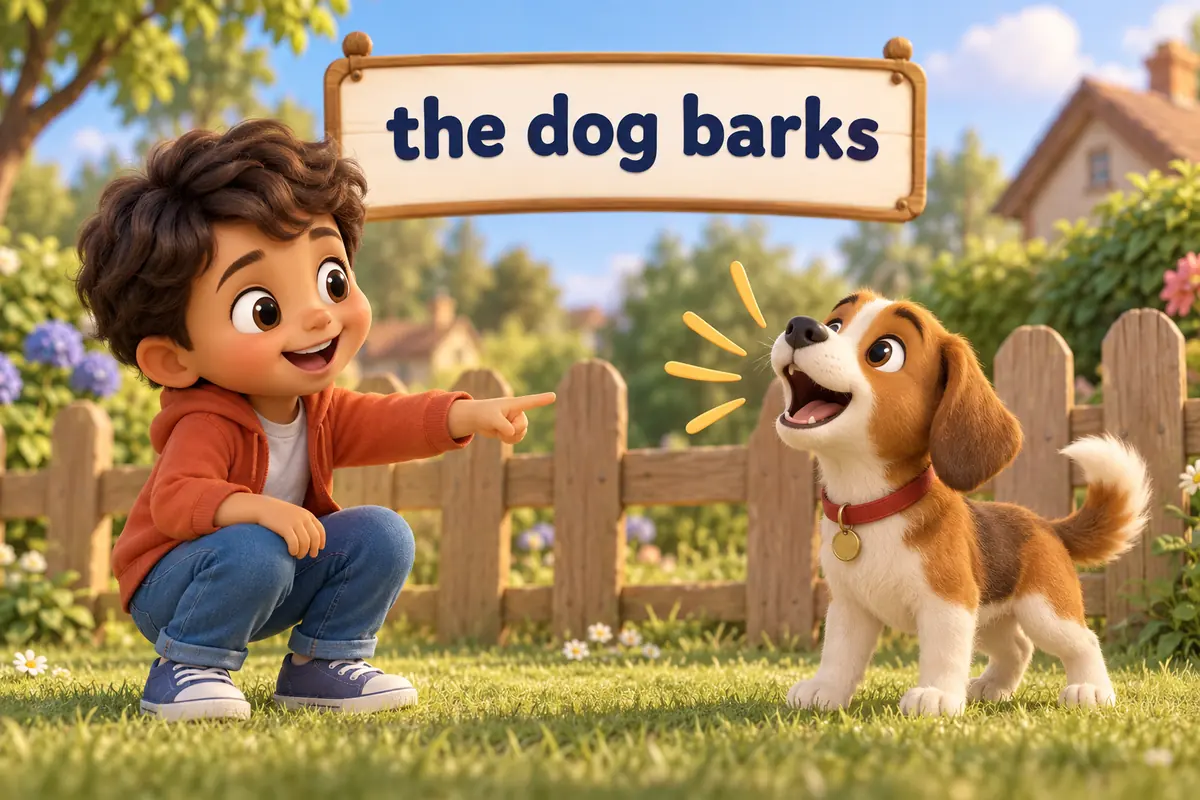
Animal sounds in English in sentences across contexts
Sound verbs fit children stories and field notes alike, and the tense and the setting decide how vivid the line becomes. The creatures that make these noises appear in animal in a sentence, which helps place each verb.
| Context | Example sentence | Why this works |
|---|---|---|
| Classroom | A cow moos when it wants to be milked. | links the verb to a clear cause |
| Story | The wolves howled at the rising moon. | a dramatic, vivid sound verb |
| Farm note | The hens clucked softly in the coop. | quiet verbs suit calm scenes |
| Nature writing | Frogs croaked from every corner of the marsh. | places the sound in a habitat |
| Everyday speech | My cat meows at the door each evening. | a routine, countable action |
| Poem | The bees buzz and the birds sing. | rhythmic present-tense verbs |
| Field guide | The owl hoots to mark its territory. | a sound verb with a reason |
| Children book | Quack, quack went the duck on the pond. | the sound used as a quotation |
| News report | Loud cicadas buzzed through the interview. | a sound verb as background |
| Travel writing | Goats bleated on the rocky hillside. | a sound verb that paints a place |
| Science lesson | Bats squeak at frequencies we cannot hear. | links the verb to a fact |
| Zoo sign | The lions roar at feeding time. | a familiar, exciting sound |
The tense controls the effect more than the choice of word. Present-tense verbs bring a scene to life, as in the bees buzz, while the past tense reports what happened, as in the bees buzzed. Choose the tense that matches the rest of the passage and keep it consistent.
Which word: bark, howl, or growl?
The three dog sounds are not interchangeable, and the volume and the mood decide which verb fits. The familiar pets and farm animals belong in domestic animal in a sentence.
| Question | bark | howl | growl |
|---|---|---|---|
| Volume | loud and sharp | long and far-reaching | low and quiet |
| Mood | alert or excited | lonely or calling | threatening or warning |
| Typical animal | dog, seal | wolf, dog, coyote | dog, bear, lion |
| Duration | short, repeated | long, drawn out | sustained and low |
| Common frame | bark at someone | howl at the moon | growl at a rival |
| Everyday sense | the commonest | wild and dramatic | a warning |
Loudness and mood decide between these dog sounds. A short, sharp noise is a bark, a long call is a howl, and a low warning is a growl. Because all three belong to the same animal, the surrounding words, especially the preposition, tell the reader which is meant.
Word forms and grammar of sound words
Most sound words are verbs, and their -ing forms and noun forms appear when the sound matters more than the action. Barnyard sounds such as cluck and bleat fit the frames in farm animal in a sentence.
| Form | Part of speech | Example |
|---|---|---|
| bark | verb | The dog barks at strangers. |
| barking | verb, -ing | A barking dog woke the street. |
| bark | noun | Her bark is worse than her bite. |
| moo | verb | The cows moo at milking time. |
| meow | verb or noun | The cat gave a small meow. |
| buzz | verb or noun | The buzz of bees filled the air. |
| squawk | verb | The parrot squawked loudly. |
The -ing form makes a continuous action, so a barking dog is making the sound now, while a dog that barked has finished. The noun form is countable for a single sound, as in a bark, and uncountable for the quality, as in her bite is worse than her bark.
Common mistakes with animal sound words
Mistake 1: noun where a verb is needed. Incorrect: The dog Correct: The dog barked at the stranger. Rule: the animal is the subject, so a verb follows it.a bark at the stranger.
Mistake 2: sound verb with the wrong animal. Incorrect: The cow Correct: The cow mooed in the field. Rule: each animal has its own sound verb in English.barked in the field.
Mistake 3: missing -ed in past narration. Incorrect: Last night the owl Correct: Last night the owl hooted till dawn. Rule: past time needs the past form of the verb.hoot till dawn.
Mistake 4: the wrong preposition. Incorrect: The wolves howled Correct: The wolves howled at the moon. Rule: the fixed phrase is howl at the moon.on the moon.
Mistake 5: sound verb made transitive with an object. Incorrect: The frog Correct: The frog croaked all night. Rule: sound verbs are intransitive and take no direct object.croaked a song.
Practice using animal sound words
- Fill in the blank: A cat ___ when it wants food.
- Choose the better word: A bee (barks / buzzes) around the flowers.
- Correct the error: The wolves howled on the moon.
- Build a sentence: use the verb chirp to describe small birds at sunrise.
- Spot the register: which suits a story for children, (a) The birds vocalised, or (b) The birds chirped?
- Fill in the blank: The lion ___ across the plain at dusk.
Answers
- meows, because meow is the verb for a cat sound.
- buzzes, because bees make a buzzing sound.
- The wolves howled at the moon; the fixed phrase uses at.
- The sparrows chirped as the sun rose over the roof.
- (b), because chirped is the simple, vivid verb for young readers.
- roared, because roar is the verb for a lion sound.
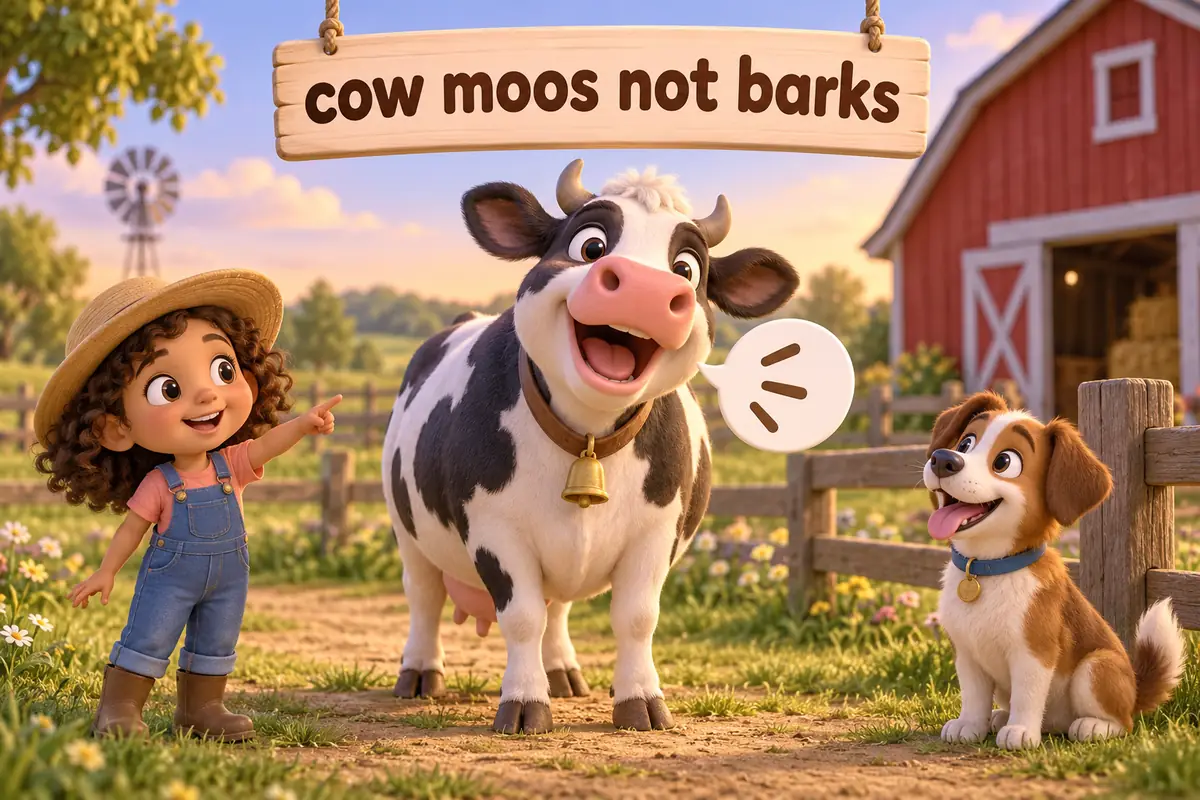
The bottom line
Animal sounds in English sit mostly in verbs, so the animal becomes the subject and the sound becomes the action. Learn each verb with its animal, keep the verb intransitive, and use the past form for narration. A few shared verbs, such as chirp and buzz, cover whole groups of small creatures.
Frequently asked questions about animal sounds
Are animal sounds nouns or verbs in English?
They are mainly verbs, so we say the dog barks and the cow moos. A small group also works as nouns, as in the bark of a dog or the buzz of bees. Choose the verb form when you describe an action, and the noun form when the sound itself is the subject of the sentence.
What sound does a frog make in English?
The usual verb is croak, as in the frogs croaked all night. A frog can also be said to ribbit in children books, though that word copies the noise rather than naming it. Croak is the safe choice for school and formal writing.
Do all animals have their own sound verb?
No. Many small animals share a verb, so birds chirp, insects buzz and rodents squeak. The large and familiar animals tend to have their own words, such as bark, moo and roar, while rarer creatures often take a general verb like hiss or grunt.
Why is the verb intransitive?
The animal itself makes the sound, so there is no separate object to receive the action, which makes the verb intransitive. You can add a prepositional phrase such as at the moon or in the field, but a direct object after a sound verb is a clear sign of an error.