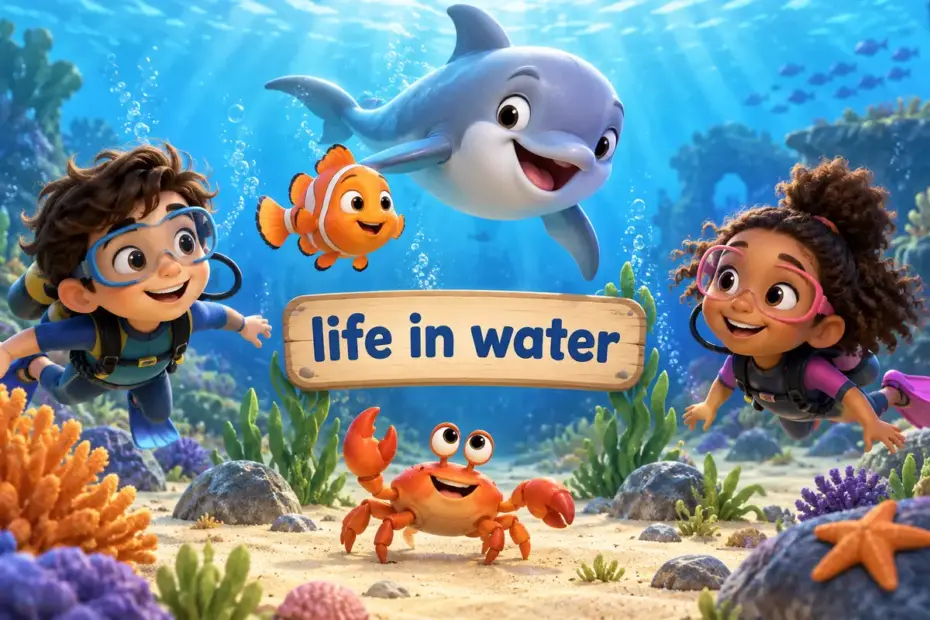
Aquatic animals names cover every creature that lives in water, from fish and sharks to dolphins, crabs and jellyfish. English separates them by body type and by whether they live in fresh water or salt water, and the name usually tells you the group.
Aquatic animals names at a glance
- Aquatic animals live in water for all or most of their lives.
- Salt-water animals live in the sea; fresh-water animals live in rivers and lakes.
- Fish, whales, crabs and jellyfish belong to different groups.
- A few aquatic animals, such as seals, also come onto land.
- The commonest error is calling every aquatic animal a fish.
What are aquatic animals?
Aquatic animals are creatures that spend their lives in water, and the group splits by body type and by habitat. Fish breathe through gills, whales and dolphins breathe air, and shellfish such as crabs and lobsters wear a hard shell. The adjective behind these names appears in aquatic in a sentence, which sets up the group words below.
| Group | Feature | Common names |
|---|---|---|
| Fish | gills, fins, scales | salmon, tuna, cod, eel, seahorse |
| Marine mammals | breathe air, feed young milk | whale, dolphin, seal, walrus, otter |
| Crustaceans | hard shell, many legs | crab, lobster, shrimp, prawn |
| Molluscs | soft body, often a shell | octopus, squid, oyster, clam |
| Jellyfish and corals | stinging tentacles | jellyfish, coral, sea anemone |
| Echinoderms | spiny skin, five-part body | starfish, sea urchin, sea cucumber |
| Reptiles | scaly skin, air breathing | sea turtle, sea snake, crocodile |
Breathing method separates the groups more clearly than body shape. Fish and shellfish take oxygen through gills in the water, while whales, dolphins and seals must reach the surface for air. The sea turtle belongs to the air breathers too, and it comes ashore to lay its eggs.
How do aquatic animal names work in a sentence?
The names behave like ordinary count nouns, and the frame usually names the water the animal lives in or the group it belongs to.
| Pattern | Example | What it signals |
|---|---|---|
| live in + water | Dolphins live in the ocean. | the habitat |
| a + group + such as + name | a fish such as a cod | the group and one example |
| the + name + is a kind of | A whale is a kind of mammal. | group membership |
| swim / feed / hunt | Sharks hunt smaller fish. | the animal action |
| salt-water or fresh-water + name | a fresh-water turtle | the water type |
| a school of + fish | a school of tuna | a group of fish |

Aquatic animals names in sentences across contexts
The names appear in science lessons, aquarium signs and everyday talk about the sea, and the context decides how much detail you add. Descriptive words such as sleek and graceful come from adjectives for animals and suit the creatures here.
| Context | Example sentence | Why this works |
|---|---|---|
| Classroom | A crab has a hard shell and ten legs. | ties the name to a feature |
| Aquarium sign | The octopus changes colour to hide. | a vivid single fact |
| Science report | Whales are mammals that breathe air. | corrects a common error |
| Nature writing | A school of tuna moved through the blue water. | a group noun for fish |
| Everyday speech | We saw a seal on the rocks. | a familiar coastal animal |
| Story | A shy seahorse drifted past the coral. | a gentle single image |
| Travel writing | The reef was full of bright fish. | a habitat with its animals |
| Food lesson | Prawns and lobsters are crustaceans. | names the group and the food |
| Field guide | The sea turtle returns to the same beach. | a reptile in water |
| Zoo sign | The walrus lives in cold northern seas. | a marine mammal and its range |
| Poem | Jellyfish float like pale moons. | a soft, drifting image |
| Fact sheet | Starfish are not fish at all. | corrects the misleading name |
Precision rises with the audience, so a classroom says fish, a guide says a reef fish, and a report names the species. The group word keeps the sentence safe when the exact species is unknown, and the species name adds detail when accuracy matters. Choose the level that fits the reader.
Which word: fish, mammal, or shellfish?
The three words are easily mixed because they all live in water, so the test is the body and the breathing method. For land species that contrast with these, browse animals that start with A to Z.
| Question | fish | marine mammal | shellfish |
|---|---|---|---|
| Breathes with | gills | lungs, at the surface | gills |
| Body covering | scales and fins | skin and blubber | hard shell |
| Feeds young with | no milk | milk | no milk |
| Examples | cod, tuna, salmon | whale, dolphin, seal | crab, lobster, oyster |
| Comes to the surface? | not to breathe | yes, to breathe | no |
| Common error | used for every water animal | called a fish | called a fish |
The leg count and the breathing method do the work here. A fish has gills, fins and scales, a marine mammal has lungs and feeds its young milk, and a shellfish wears a hard outer shell. Sort the animal by those three features and the group word becomes obvious.
Word forms and grammar of aquatic words
The word aquatic has related forms, and the animal names keep ordinary noun grammar with a few irregular plurals.
| Form | Part of speech | Example |
|---|---|---|
| aquatic | adjective | Ducks are aquatic birds. |
| marine | adjective | Marine animals live in the sea. |
| freshwater | adjective | A freshwater fish needs a river. |
| fish | noun, plural often fish | We caught three fish. |
| fishes | noun, plural for species | The reef holds many fishes. |
| shellfish | noun, uncountable | Shellfish are sold fresh here. |
| swim | verb | Otters swim with ease. |
The plural of fish is usually fish, as in three fish, but the form fishes appears when several species are meant, as in the fishes of the reef. Marine and aquatic are both adjectives, so they describe a noun rather than replacing it, as in a marine animal or an aquatic plant.
Common mistakes with aquatic animal names
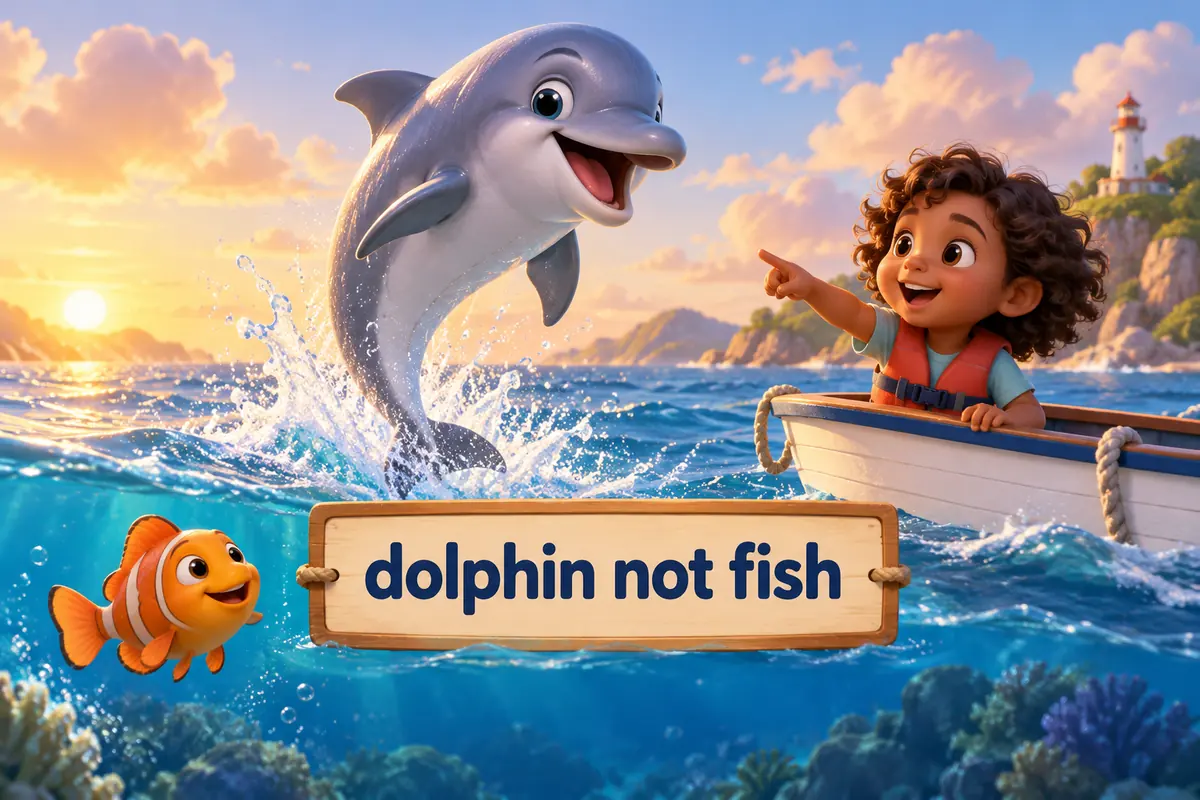
Mistake 1: fish for every water animal. Incorrect: A dolphin is a kind of Correct: A dolphin is a kind of mammal. Rule: a dolphin breathes air and feeds its young milk.fish.
Mistake 2: starfish taken literally. Incorrect: The starfish is a kind of Correct: The starfish is not a fish. Rule: the starfish name is misleading and it is not a fish.fish.
Mistake 3: wrong plural for species. Incorrect: The tank holds five different Correct: The tank holds five different fish. Rule: fish has an unchanged plural for the general sense.fishs.
Mistake 4: wrong preposition. Incorrect: Whales live Correct: Whales live in the ocean. Rule: animals live in water, not on it.on the ocean.
Mistake 5: a before an uncountable noun. Incorrect: We bought Correct: We bought some shellfish for dinner. Rule: shellfish is uncountable and takes some.a shellfish for dinner.
Practice using aquatic animal names
- Fill in the blank: A whale is a marine ___, not a fish.
- Choose the better word: A crab is a (crustacean / mammal) with a hard shell.
- Correct the error: The dolphin is a fast fish.
- Build a sentence: use a school of to describe many fish swimming together.
- Spot the register: which suits an aquarium sign, (a) Big sea thing, or (b) Sea turtle: a gentle reptile?
- Fill in the blank: Whales live ___ the ocean.
Answers
- mammal, because a whale breathes air and feeds its young milk.
- crustacean, because a crab has a hard shell and many legs.
- The dolphin is a fast mammal; it breathes air and is not a fish.
- A school of tuna surged past the reef in the morning sun.
- (b), because an aquarium sign gives the species and a precise fact.
- in, because animals live in water, not on it.
The bottom line
Aquatic animals names sort by body type rather than by water alone, so the group word prevents most mistakes. Fish have gills and scales, marine mammals breathe air, and shellfish wear a hard shell, while the many named species sit inside those groups. Learn the group first and the species name second.
Frequently asked questions about aquatic animals
Is a whale a fish or a mammal?
A whale is a mammal, not a fish. It breathes air through lungs, feeds its young with milk and is warm blooded, while a fish breathes through gills underwater. The body shape of a whale looks like a fish because of life in water, but its biology places it firmly with mammals.
What are the main groups of aquatic animals?
The main groups are fish, marine mammals, crustaceans, molluscs, jellyfish and corals, echinoderms and a few reptiles such as sea turtles. Each group has a clear feature, such as gills, a hard shell or stinging tentacles, which makes the group word the easiest way to place any species.
Why is a starfish not a fish?
A starfish has no gills, no fins and no backbone, so it is not a fish despite the name. It belongs to the echinoderms, a group with spiny skin and a body built in five parts. The misleading name is a historical label, and many guides now prefer the term sea star.
Which aquatic animals come onto land?
Seals, sea lions and walruses come onto rocks and ice to rest and breed, and sea turtles climb onto beaches to lay eggs. Otters rest on land as well. These animals are still aquatic, because they feed and travel in water, but they are not confined to it.