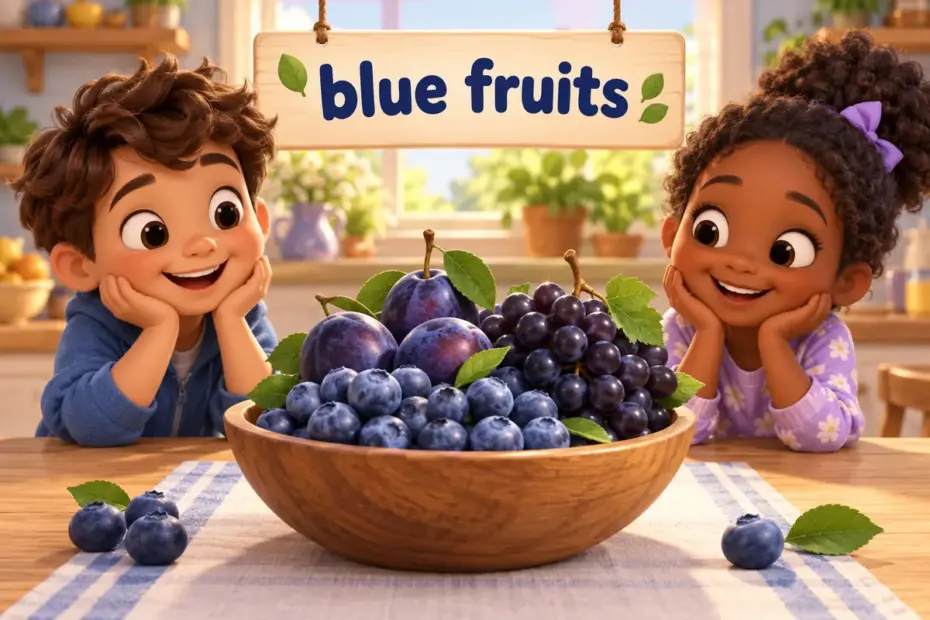
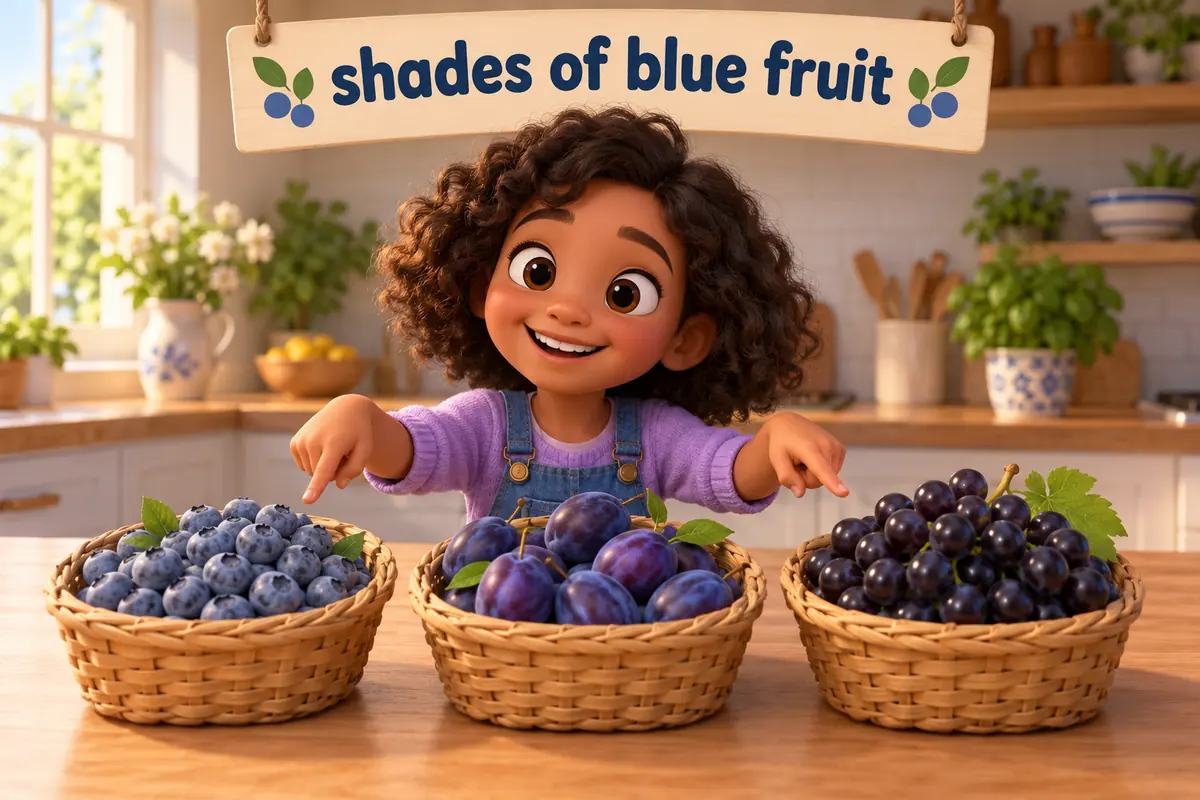
Blue fruits names with pictures help learners match a word to the fruit in front of them, from the dusty bloom of a blueberry to the deep blue-purple of a damson. Many so-called blue fruits are really blue-purple or blue-black, and a picture shows that range at once.
Blue fruits at a glance
- Most blue fruits are blue-purple or blue-black rather than a pure, bright blue.
- A dusty coating called bloom sits on blueberry, damson and grape skins.
- Bilberry, elderberry and huckleberry grow on bushes and hedgerows.
- Blueberry, grape and plum names are countable, so they take a plural.
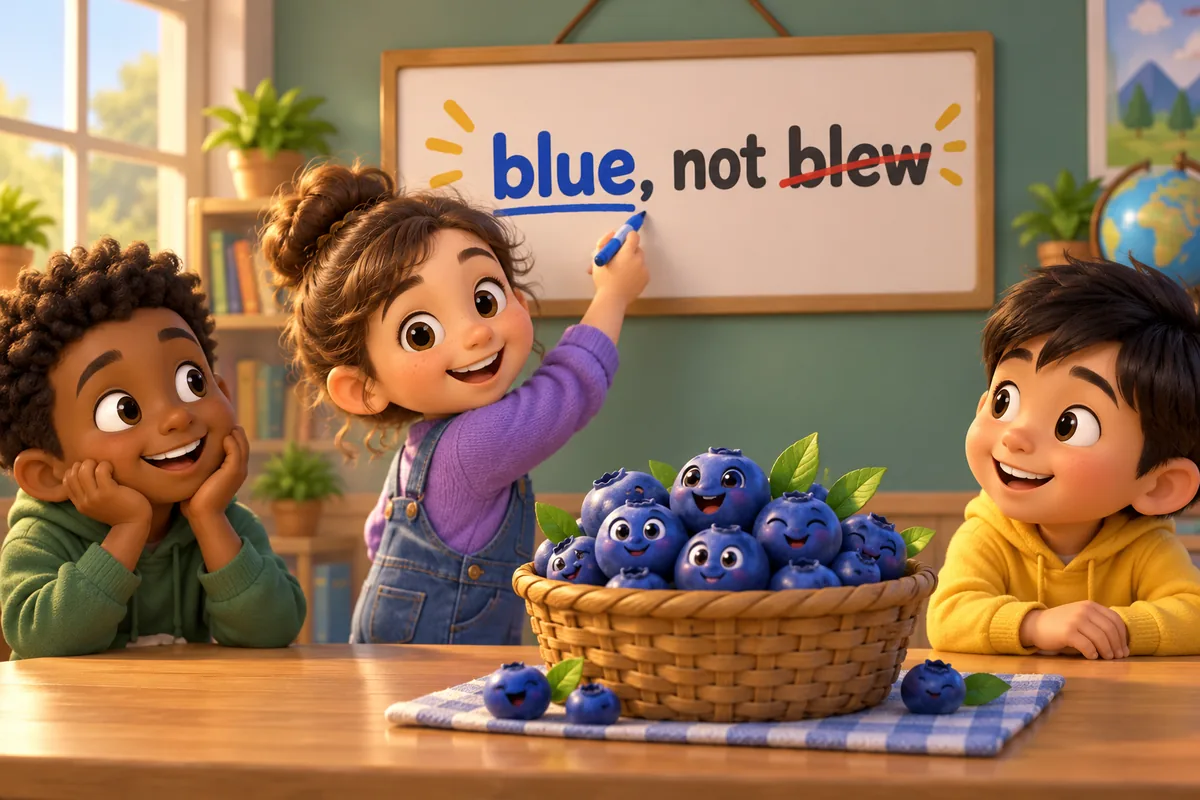
- The commonest error is writing blew, the past of blow, for the colour blue.
What are blue fruits?
Blue fruits are berries, plums and grapes whose skins look blue, blue-purple or blue-black, often because of a waxy coating over a dark pigment. That coating, called bloom, scatters light and gives the fruit its hazy blue look. A wider set of colour words sits in adjectives for blue.
Colour in fruit usually comes from pigments, and the blue group leans on a family of dark pigments called anthocyanins. Anthocyanins give red, purple and blue tones in different conditions, so the same pigment can look red in a cherry and blue-black in a grape. The waxy bloom then adds the final pale blue haze on top, which is why two fruits with the same underlying pigment can still look different in a bowl.
| Fruit | Colour | Where it grows |
|---|---|---|
| Blueberry | dusty blue with a pale bloom | bushes in cool regions |
| Bilberry | dark blue-purple | heathland and woods |
| Blackcurrant | near-black with a blue sheen | garden bushes |
| Damson | deep blue-purple | plum trees |
| Concord grape | dark blue-purple | vines in North America |
| Elderberry | dark purple-black | hedgerows |
| Acai berry | very dark purple | palm trees in the Amazon |
| Saskatoon berry | blue-purple | shrubs in North America |
| Huckleberry | blue-black | wild shrubs |
| Juniper berry | blue-grey | conifer shrubs |
| Blue plum | blue-grey with a bloom | plum trees |
| Fig | some deep purple-blue | warm-climate trees |
One honest limit belongs here. Very few fruits are a true bright blue, so the list collects the blue-purple and blue-black types that people call blue in everyday speech rather than one narrow colour. In a fruit salad or a jam, the exact shade rarely matters, and the plain word berry or plum serves well. The named fruits matter most when a recipe or a market stall needs an exact match, which is where a picture beside the word is worth more than a long description.
How do you use blue fruit names in a sentence?
Fruit names are countable nouns, and the colour words around them follow simple patterns.
| Pattern | Example | What it signals |
|---|---|---|
| a + fruit name | A blueberry is small and round. | one fruit |
| fruit name + plural verb | Bilberries grow on low bushes. | a group |
| the colour of + fruit | The colour of a damson is deep blue-purple. | a colour reference |
| fruit + that + clause | A berry that turns blue-black is often ripe. | a defining trait |
| in + colour + fruit | Look for the dusty bloom on blue fruit. | a picking cue |
Blue fruits names with pictures: examples across contexts
The fruit names move from a kitchen recipe to a nature walk, and each setting draws on a different word. The same colour family appears in adjectives for blue eyes, and a figurative use of the colour appears in blue blood in a sentence.
| Context | Example sentence | Why this works |
|---|---|---|
| Classroom | Match each blue fruit name with its picture on the board. | a matching task |
| Recipe | Fold the blueberries into the batter last. | a cooking instruction |
| Preserving | Damson jam sets well because the fruit is tart. | a kitchen tip |
| Conversation | Are those wild bilberries or blueberries? | an everyday question |
| Nature walk | Elderberries hang in dark clusters along the hedge. | a scene detail |
| Smoothie bar | Acai berries give a deep purple colour. | a menu note |
| Fruit packing | Blue plums are picked while firm and left to ripen. | a practical detail |
| Cookbook | A handful of Concord grapes sweetens the sauce. | a measured tip |
| Botany note | The bloom on a grape skin protects the fruit. | a scientific fact |
| Story | She filled her basket with dark blue huckleberries. | narration |
Which blue fruit name should you use?
Match the name to the fruit in your hand, because the words for a berry and a plum are not interchangeable.
| Situation | Pick | Example |
|---|---|---|
| Baking muffins | blueberry | Fold the blueberries into the batter last. |
| Making jam | damson | Damson jam sets well and tastes tart. |
| A smoothie bowl | acai | Acai berries give a deep purple colour. |
| A hedgerow walk | elderberry | Elderberries hang in dark clusters. |
When a recipe simply needs a blue fruit, the blueberry is the safe default in baking, while a damson belongs in jam and an acai in cold bowls; the pick usually follows the dish rather than the colour alone. A second cue is season: blueberries and bilberries arrive in summer, elderberries and damsons in early autumn, and grapes in late summer. Naming the season beside the fruit, as in autumn elderberries or summer blueberries, gives a writer a precise phrase and reminds a reader when to look for each one.
Word forms and grammar of blue fruit names
The colour word and the fruit names change shape in predictable ways, and one plural rule catches most learners.
| Form | Part of speech | Example |
|---|---|---|
| blue | adjective | A blue bowl sat on the table. |
| blue | noun | She chose blue for the kitchen walls. |
| berry | noun | Each berry ripens in late summer. |
| berries | plural noun | The berries turned dark as they ripened. |
| blueberry / blueberries | noun singular / plural | One blueberry; a bowl of blueberries. |
| bluish | adjective | The plum had a bluish bloom. |
Common mistakes with blue fruit names
Mistake 1: writing blew for the colour. Incorrect: Blew berries grew on the bush. Correct: Blue berries grew on the bush. Rule: blue is the colour, while blew is the past tense of blow.
Mistake 2: a faulty plural. Incorrect: a bowl of blueberrys. Correct: a bowl of blueberries. Rule: a consonant plus y noun changes y to ies.
Mistake 3: expecting one narrow colour. Incorrect: Every blue fruit is bright blue. Correct: Most blue fruits are blue-purple or blue-black. Rule: the everyday colour name covers a wide range, so bright blue is too narrow.
Mistake 4: a plural after the article a. Incorrect: A berries is round. Correct: A berry is round. Rule: a comes before a singular noun.
Mistake 5: a singular after a number. Incorrect: I ate three blueberry. Correct: I ate three blueberries. Rule: a number greater than one takes the plural.
Practice using blue fruit names
- Fill in the blank: A ___ is small, round and covered with a pale bloom.
- Choose the better word: Damsons are deep (blue-purple / pure blue).
- Correct the error: She picked a handful of blueberrys.
- Build a sentence: use a berry that to define a ripening fruit.
- Spot the register: which line suits a recipe, (a) Chuck some berries in, or (b) Fold the blueberries into the batter last?
- Fill in the blank: Elderberries hang in dark ___ along the hedge.
Answers
- blueberry, because a blueberry has a dusty bloom on its skin.
- blue-purple, because a damson is blue-purple rather than pure blue.
- She picked a handful of blueberries; the plural turns y into ies.
- A berry that turns blue-black is often ripe.
- (b), because a recipe gives a clear, specific instruction.
- clusters, because elderberries grow in hanging clusters.
The bottom line
Blue fruits names with pictures turn a colour into a short, useful list of berries, plums and grapes, most of them blue-purple or blue-black under a dusty bloom. Use blueberry as the everyday default, reserve damson and acai for their own dishes, and keep blue the colour apart from blew the verb. More describing words sit in adjectives for color blue.
Frequently asked questions about blue fruits
What fruits are blue?
Fruits commonly called blue include blueberries, bilberries, blackcurrants, damsons, Concord grapes, elderberries, acai berries, saskatoon berries, huckleberries, juniper berries and blue plums. Most of them are really blue-purple or blue-black, and a pale waxy bloom on the skin gives them their hazy blue look.
Are blueberries really blue?
Blueberries look blue because a waxy coating on the skin, called bloom, scatters blue light over a dark pigment beneath. Without the coating the fruit looks almost black, so the blue colour is partly a trick of the surface rather than the flesh inside.
Is a blueberry a true berry?
Yes. In botanical terms a blueberry is a true berry, a fleshy fruit that grows from a single flower and holds several seeds inside. The everyday sense of berry is looser, so people also call strawberries berries even though those are a different kind of fruit.
What is the difference between blue and blew?
Blue is the colour, used for the sky, a shirt or the skin of a fruit, while blew is the past tense of the verb blow, as in the wind blew hard. They sound the same, so the spelling is the only clue, and more on the pair sits in blew vs blue.