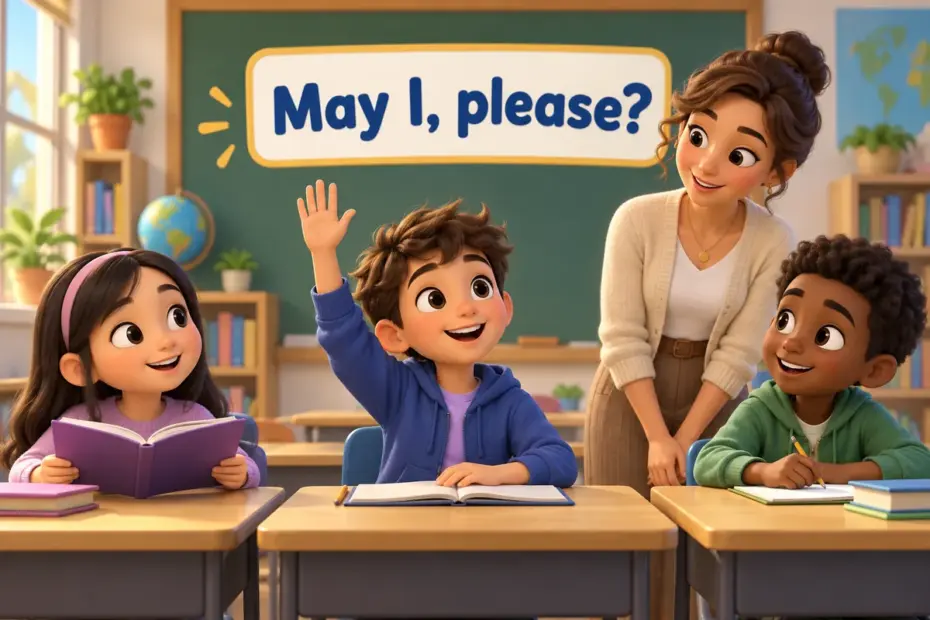
Classroom sentences for students are the short, polite lines that carry a lesson forward, from a morning greeting to a request for help. They follow a few steady patterns, so a student who learns the frame can build any of them. A simple example is “May I borrow a ruler?”
Classroom sentences for students at a glance
- The common jobs are greeting, instructing, requesting, asking, praising and moving on.
- Most classroom sentences are short, because a clear lesson needs clear lines.
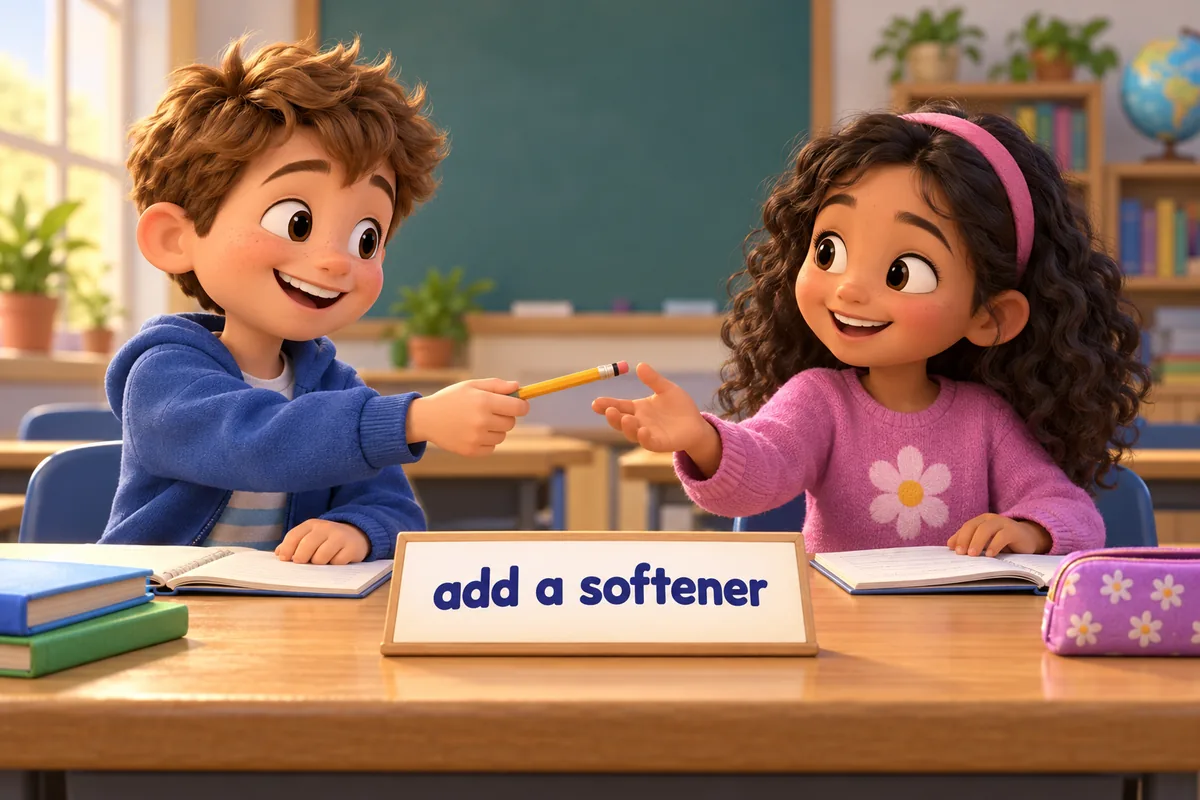
- A softener such as please or could you turns a want into a polite request.
- Questions put the verb before the subject: Is the answer nine?
- The same words work at a desk, at the board or in a group, so the frames travel.
What are classroom sentences for students?
Classroom sentences for students are the everyday lines used inside a lesson to greet, instruct, ask, request and praise. They share one aim, which is to move the lesson on without friction; a longer set of ready lines sits in classroom sentence examples.
| Job | Example | When a student uses it |
|---|---|---|
| Greeting | Good morning, everyone. | at the start of a lesson |
| Instruction | Open your books to page ten. | when a task begins |
| Request | May I sharpen my pencil? | when a student needs something |
| Question | Could you explain that again? | when something is unclear |
| Praise | Well done, that was clear. | when work is finished well |
| Transition | Let us move on to the next task. | between two activities |
Every job above uses the same small grammar, so a student who can greet can also request and praise by changing one or two words. The polite word does most of the work, and the rest of the frame stays fixed.
How do you build a classroom sentence?
A classroom sentence usually adds one polite word to a plain pattern, and the polite word is what makes it fit the room; describing words for the setting are gathered in adjectives for a classroom.
| Pattern | Example | What it signals |
|---|---|---|
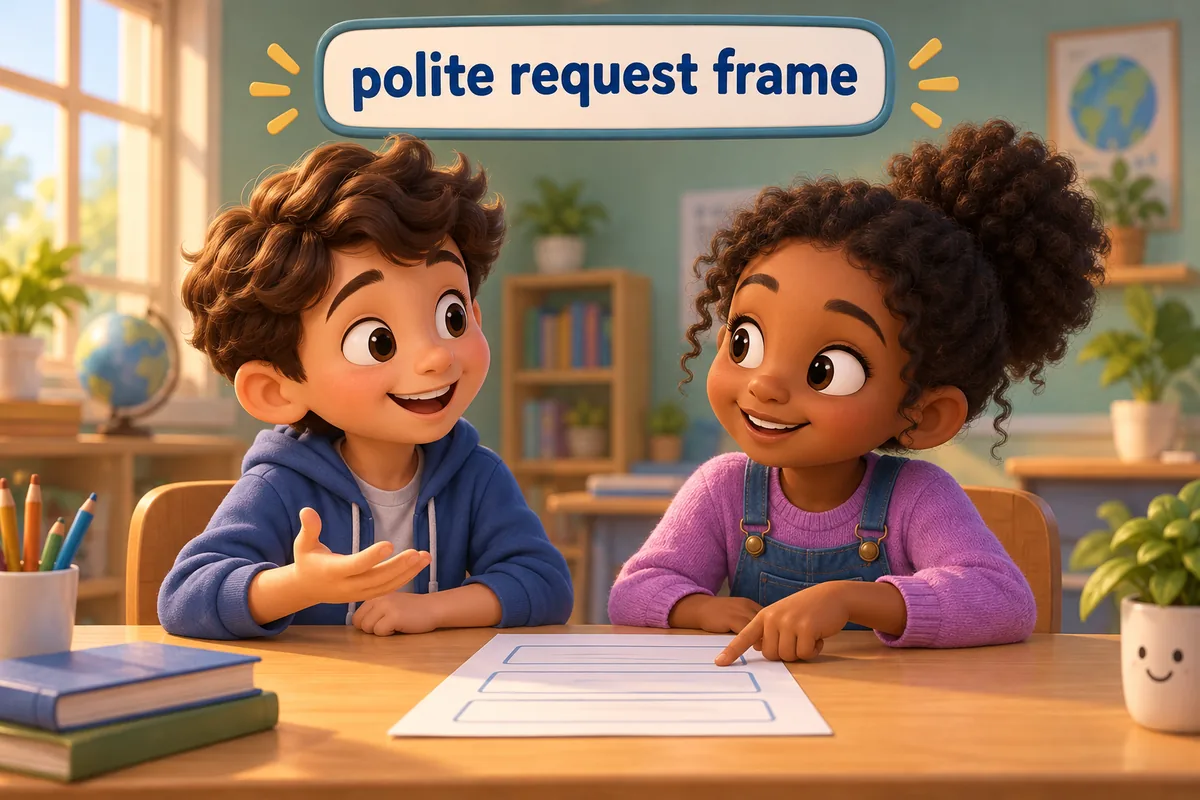
| polite opener + request | Could you help me, please? | a request with a softener |
| modal + I + verb | May I go to the nurse? | a request for permission |
| please + verb + object | Please close the door. | a direct instruction made polite |
| question word + verb | Why does water freeze? | asking for a reason |
| subject + verb + object | The class solved the puzzle. | a plain statement |
| would like + to + verb | I would like to add a point. | a gentle opinion or offer |
A useful habit is to keep the verb close to the person it belongs to, so the line never leaves the listener guessing. Putting please at the front or the end, but not both, keeps a request smooth rather than fussy.
Classroom sentences across contexts
Each setting below shows the same short frames at work across a single school day, and every line could be copied straight into real use.
| Context | Example sentence | Why this works |
|---|---|---|
| Morning | Good morning, Miss Lee. | a greeting that opens the day |
| Instruction | Please take out your notebooks. | a clear direction with please |
| Request | May I borrow a pencil, please? | permission asked politely |
| Question | Can you show me that step again? | asking for help without blame |
| Group work | Let us share one idea each. | invites turn-taking |
| Praise | That is a neat solution. | names what went well |
| Transition | Line up quietly by the door. | moves the class between rooms |
| Presentation | I would like to add one point. | joins a discussion politely |
| Apology | Sorry I am late; the bus was delayed. | explains a small problem calmly |
| Dismissal | Have a good afternoon. | a friendly closing line |
| Peer help | Let me show you the first step. | offers help without taking over |
| Permission | May I open the window, please? | asks before making a change |
Notice that the greetings and closings bookend the day, while the middle lines do the practical work of asking, explaining and moving on. A student who knows the whole set can follow the rhythm of a lesson from the first bell to the last.
Which classroom sentence should a student use?
The right frame depends on the need, and matching the sentence to the moment keeps the lesson calm; words for the people involved are collected in adjectives for students.
| Situation | Sentence type | Example |
|---|---|---|
| Needs to leave the room | request for permission | May I go to the washroom? |
| Does not understand | clarifying question | Could you say that again? |
| Finishes early | offer to help | May I help someone else? |
| Disagrees politely | softened opinion | I see it a little differently. |
| Wants to join in | polite addition | May I add one idea? |
Matching the frame to the need is quicker than searching for a special phrase, because the situation itself tells a student whether to ask, tell or offer. A permission line and a clarifying line rarely cause trouble, while a bare want usually does.
Word forms and grammar of classroom sentences
The frames change shape with the job, and a longer line simply joins two ideas; how those clauses combine is shown in adjective clauses in complex sentences, while fuller adjective patterns sit in how to use adjectives in sentences and phrases.
| Form | Example | Note |
|---|---|---|
| statement | The answer is nine. | subject then verb |
| question | Is the answer nine? | verb before subject |
| request | Please pass the glue. | imperative with please |
| modal request | Could I try again? | the modal softens the ask |
| complex sentence | When the bell rings, we line up. | two clauses joined by when |
| negative | I do not understand yet. | do not marks the negative |
Turning a statement into a question is only a matter of moving the verb, so Is the answer nine? and The answer is nine carry the same content in two shapes. A classroom line usually picks the shape that invites a reply.
Common mistakes with classroom sentences
Most slips come from dropping the polite word or the subject, and each fix restores a frame the room already expects.
- Incorrect: Give me the pen. Correct: Could you pass the pen, please? Rule: add a softener to a bare command.
- Incorrect: I want to go toilet. Correct: May I go to the washroom? Rule: use a permission frame for leaving the room.
- Incorrect:
Explain again.Correct: Could you explain that again? Rule: make a request a polite question. - Incorrect: Me finished. Correct: I have finished. Rule: use a subject pronoun and a full verb.
- Incorrect:
You are wrong.Correct: I see it a little differently. Rule: soften a disagreement.
Each fix adds a word or a frame rather than changing the meaning, so a student can repair a line without learning a new idea. The polite version usually takes fewer than ten words.
Practice using classroom sentences
- Fill in the blank: ___ I borrow your ruler, please?
- Choose the better line: (Give me that / Could you pass that, please?)
- Correct the error: Me not understand.
- Build a sentence: ask politely to leave the room.
- Spot the job: which line names praise, (a) Well done, or (b) Open your book?
- Fill in the blank: Please ___ the window; it is warm.
Answers
- May, because it asks permission politely.
- Could you pass that, please, because it carries a softener.
- I do not understand; use a subject and the full verb.
- May I go to the washroom, please?
- (a) Well done, because it names what went well.
- open, because please plus a verb makes a polite instruction.
The bottom line
Classroom sentences for students work because they pair a plain pattern with one polite word, so a request, a question or a greeting all stay short and clear. Learn a few frames, such as May I plus a verb or Could you plus a verb, and add please when the line asks for something. Match the frame to the moment, and the words carry the lesson without friction. A steady set of lines makes the room calmer for everyone. Because the frames are fixed, a student can rehearse a handful and use them all day, and a teacher hears the same clear register in return.
Frequently asked questions about classroom sentences
What is a polite way for a student to ask a teacher for help?
A clear, polite request uses could you or may I with a please, as in Could you help me with this step, please? Starting with the softener and naming the exact problem keeps the line short. Adding why you are stuck, rather than saying it is too hard, helps the teacher answer in one go.
Should students say please and thank you in class?
Please and thank you mark a request as courteous and a reply as grateful, so they fit almost every classroom sentence. Please usually sits before the verb or at the end, while thank you answers something received. Using them once, not repeated, keeps a line warm without sounding forced.
How do classroom sentences change during group work?
Group work swaps instructions for invitations, so let us, shall we and I would like take the place of a teacher’s commands. Turn-taking frames such as one idea each keep every voice in the group. The aim is the same as in a whole-class line: keep the talk clear, fair and easy to answer.
Why do teachers use short sentences in lessons?
A short sentence is easier to follow than a long one, so a lesson instruction told in ten words lands sooner than the same idea spread over thirty. Short lines also travel well, since a student can repeat Open your books to page ten without losing the middle. Clarity, not formality, is the goal.