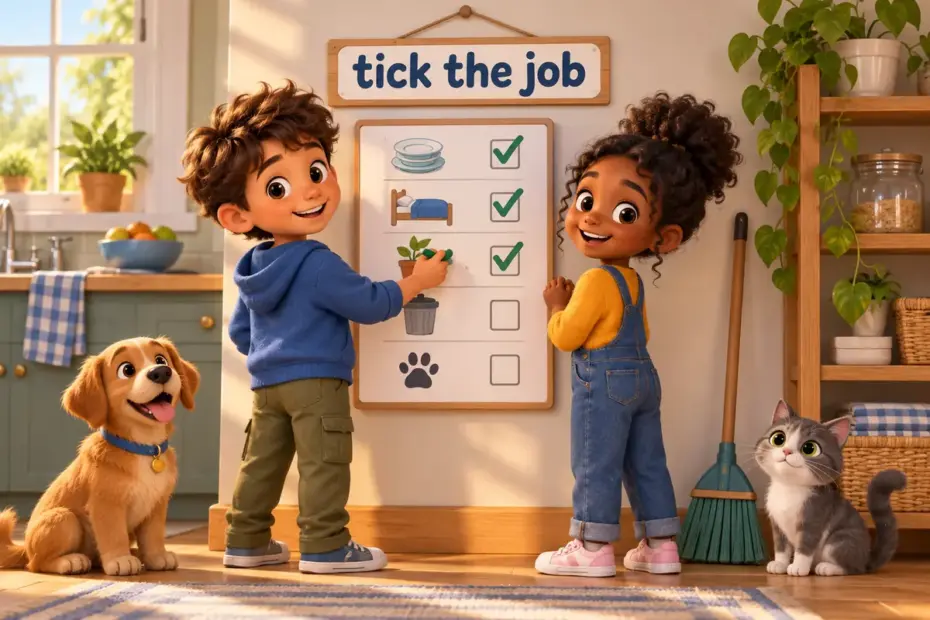
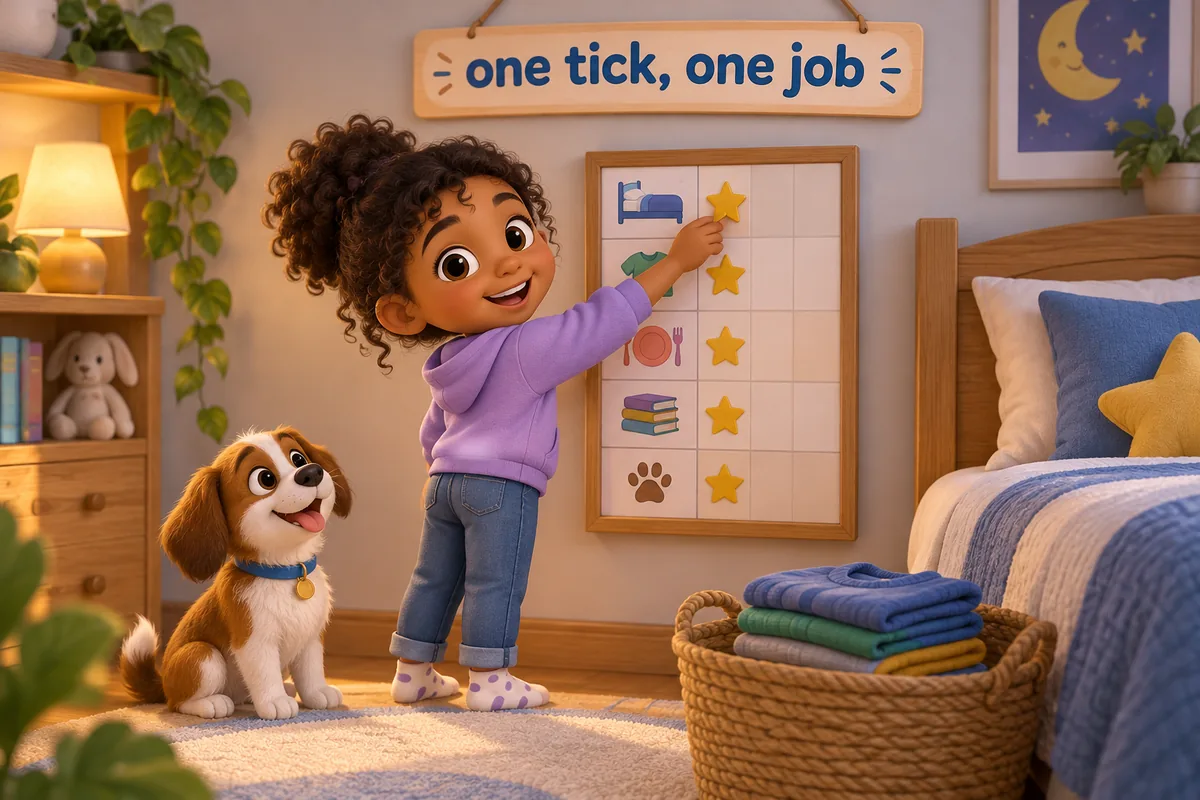
Chores for kids with chart turn everyday jobs into a short, tickable list a child can see. The chart names each job, shows who does it, and records the tick when it is done. A simple start is “Set the table, then tick the Monday row.”
Chores for kids with chart at a glance
- A chore is a small household job that helps the whole family.
- A chart lists the jobs, the days and the person responsible.
- Chores should match the child’s age and reach.
- The tick or star is the reward that keeps the routine alive.
- The commonest mistake is setting chores that are too hard for the age.
What are chores for kids?
Chores for kids are small household jobs that a child can do on their own or with a little help. They teach useful skills and share the work of the home. A chart makes the jobs visible, so a child knows exactly what to do and when, and the whole family can see progress.
| Chore | What it involves | Skill it builds |
|---|---|---|
| Set the table | Plates, cups and cutlery for each seat | Counting and order |
| Make the bed | Smooth the sheet and stack the pillow | Daily routine |
| Feed a pet | Food and fresh water on time | Caring for others |
| Fold clothes | Match pairs and stack neatly | Patience and sorting |
| Water plants | A set amount for each pot | Steady attention |
Chores by age
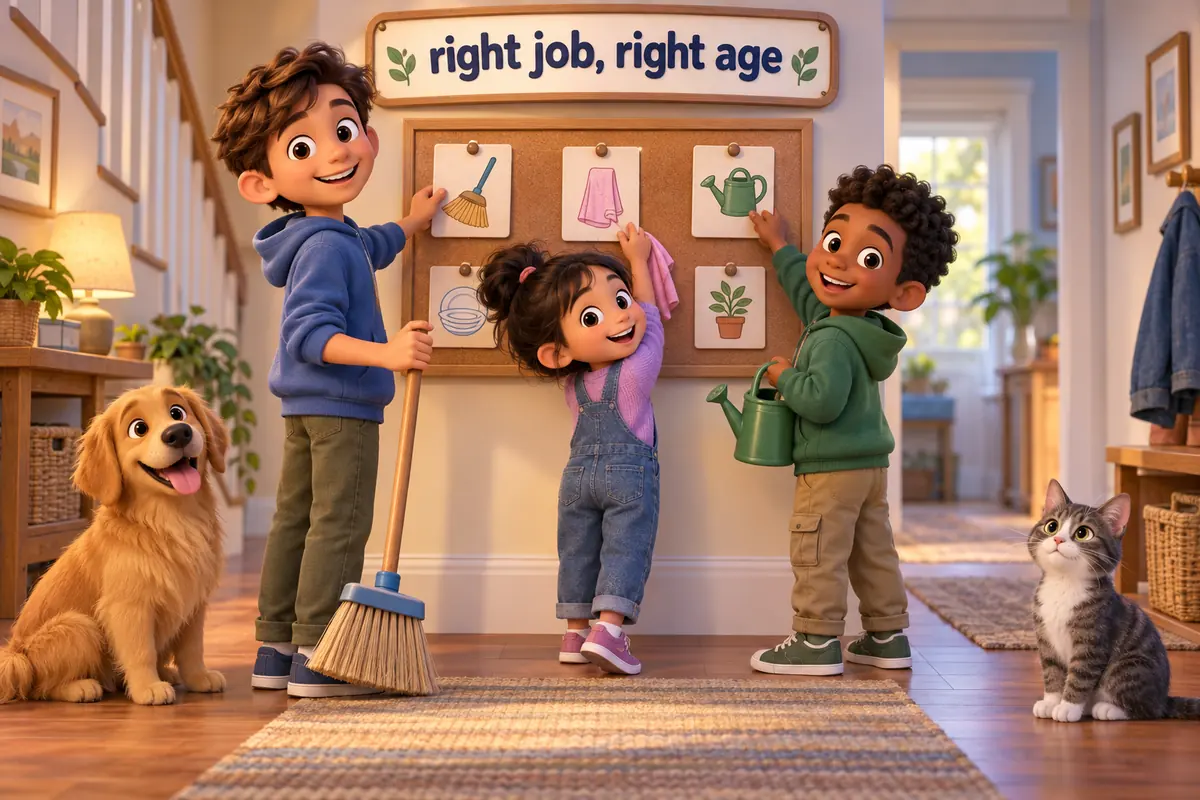
Age is the best guide to the right chore. A young child needs one simple step, while an older child can plan a longer job and finish it alone. The chart below pairs each age band with suitable jobs and the skill behind them.
| Age band | Good chores | Skill it builds |
|---|---|---|
| Age 3 to 4 | Put toys in a box; place socks in a drawer; wipe a small table | Sorting and following one step |
| Age 5 to 6 | Set the table; feed a pet; water a plant; make the bed | Simple care and routine |
| Age 7 to 8 | Tidy a room; sweep a floor; sort laundry; pack a school bag | Responsibility and order |
| Age 9 to 10 | Wash dishes; take out bins; fold clothes; help with cooking | Care and teamwork |
| Age 11 to 12 | Cook a simple meal; clean a bathroom; mow a lawn; walk a dog | Planning and independence |
How do you make a chore chart?
A good chart is short, clear and easy to reach. Write the jobs down the side and the days across the top, then let the child tick each finished job. Keep the list to five or six chores so it never feels like a wall of work.
| Step | What to do | Why it helps |
|---|---|---|
| Choose the jobs | Pick five or six age-suitable chores. | A short list is easy to finish. |
| Draw the grid | Jobs down the side, days across the top. | A grid shows the whole week. |
| Add the names | Write who does each job. | Naming the person removes doubt. |
| Set the tick | Let the child tick or add a star. | The tick is the visible reward. |
| Review weekly | Change one job each week if needed. | A fresh list keeps interest. |
The chart words are easy to spell with help from chart in a sentence, and a clear title uses adjectives for kids. Younger children can sound out job names from a words for kids, and two small words make new job titles, as the list of compound words for kids shows.
Chores with a chart compared with chores without one
The same jobs feel different with and without a chart. The chart does not change the work; it changes who can see it and how it is remembered.
| Point | With a chart | Without a chart |
|---|---|---|
| Clarity | Each job is written down | Jobs are remembered loosely |
| Fairness | Names show who does what | One person often does more |
| Motivation | A tick marks progress | Effort can go unseen |
| Routine | The same jobs repeat each week | Jobs come up at random |
| Change | One job can be swapped weekly | Old jobs drag on |
What rewards work on a chore chart?
A reward should mark progress, not buy effort. Small, immediate tokens such as a tick or a star work for young children, while older children often prefer a weekly privilege. Keep the reward simple and let the chart itself carry most of the motivation.
| Reward | Good for | Why it works |
|---|---|---|
| A tick | Ages three to six | It is instant and easy to see. |
| A star sticker | Ages five to nine | Collecting stars adds a small goal. |
| A family treat | All ages | It rewards the whole group, not one child. |
| A weekly privilege | Ages nine and up | It suits a child who wants choice. |
| Praise out loud | All ages | It costs nothing and works every time. |
Words for a chore chart
A few plain words help a family design a chart and talk about it calmly.
| Word | Part of speech | Example |
|---|---|---|
| chore | noun | Feeding the cat is a daily chore. |
| rota | noun | A weekly rota shares the jobs. |
| tick | verb | Tick the box when the job is done. |
| reward | noun | A star is a small reward. |
| steady | adjective | A steady routine beats a big effort. |
Common mistakes with a chore chart
Most charts that fail share one of a few faults, and each fault has a quick fix.
- Incorrect:
The chores is too many.Correct: The chores are too many. Rule: a plural subject takes a plural verb. - Incorrect:
She don’t do her chore.Correct: She does not do her chore. Rule: use the correct verb form. - Incorrect:
Give the child a chore for to help.Correct: Give the child a chore to help. Rule: use the plain verb after to. - Incorrect:
He did not did the dishes.Correct: He did not do the dishes. Rule: use the base verb after did not. - Incorrect:
We have six chore’s on the chart.Correct: We have six chores on the chart. Rule: a plural noun takes no apostrophe.
Practice with a chore chart
Try each task, then read the reason beside the answer to check your thinking.
- Fill in the blank: ________ the box when the job is done.
- Fill in the blank: The chores ________ too many this week.
- Choose the better job for a young child: washing dishes or putting toys in a box?
- Correct the error: She don’t do her chore.
- Build a chart: name three chores and the day each is done.
- Spot the reward: what small thing can mark a finished job?
- Build a sentence: write one sentence naming a chore and its skill.
Answers
- Tick, because tick is the verb for marking the box.
- Are, because a plural subject takes the plural verb are.
- Putting toys in a box, because it is one simple step for small hands.
- She does not do her chore: not needs the full verb does not.
- Sample: water the plants on Monday, fold clothes on Wednesday and set the table on Friday.
- A star or a tick, because a visible mark shows progress.
- Sample: Feeding the cat is a chore that teaches care.
The bottom line
Use chores for kids with chart to make small household jobs clear, fair and easy to finish. Match each job to the child’s age, keep the list short, and let a tick or a star record the work. A steady weekly routine teaches more than a long list that nobody finishes.
Frequently asked questions about chores for kids
At what age should children start chores?
Children can start very simple chores around age three, such as putting toys in a box or placing socks in a drawer. The job should need only one or two steps at that age. The aim early on is the habit of helping, not a perfect result.
Should chores be tied to pocket money?
Families decide this in different ways. Some link a few extra jobs to pocket money, while keeping basic chores as a fair share of family work. A chart can show both sets clearly, so a child knows which jobs earn money and which are simply part of the day.
How many chores are reasonable each week?
Five or six short chores a week is a common and manageable number for a child. Spreading them across the week beats piling them into one day. An older child can take on longer jobs, but the total should still leave time for school, play and rest.
What if a child refuses to do the chart?
Check first whether the chore is too hard or the list too long. Then offer a choice between two jobs so the child keeps some control. A short chart, a clear tick and steady praise usually work better than a bigger reward or a louder argument.