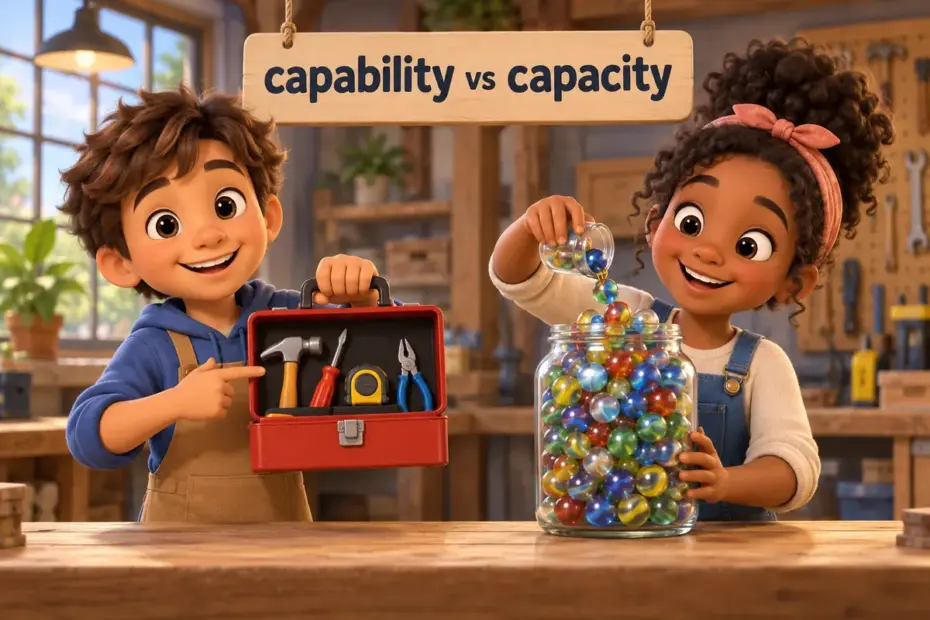
Capability vs capacity differ in one idea: capability is the power to do something, and capacity is how much something can hold. A phone with scanning capability has the feature; a battery with a large capacity stores more charge. “She has the capability to lead” praises skill; “the hall is at capacity” reports a full room.
Capability vs Capacity at a glance
- Capability is the power or skill to do something; capacity is the amount something holds.
- Capability answers can it be done; capacity answers how much fits.
- Capacity also means a mental or physical power, as in the capacity to concentrate.
- In law, capacity names the role in which a person acts, as in his official capacity.
- The commonest error is using capacity for a skill, as in the capacity to swim.
What do capability and capacity mean?
Capability is a noun meaning the power or skill to do something. Capacity is a noun meaning the maximum amount something can hold, or the power to receive and absorb. The Cambridge entry for capability and the Cambridge entry for capacity show the split: a workshop has the capability to make a part, while a tank has the capacity to hold a hundred litres.
| Sense | Word | Plain meaning | Example |
|---|---|---|---|
| Skill to perform | capability | Power or ability to do a task | The phone has scanning capability. |
| Potential to grow | capability | Room to develop into a role | The team has the capability to scale. |
| Amount contained | capacity | Maximum a container can hold | The bottle has a one-litre capacity. |
| Power to absorb | capacity | Ability to receive or process | She works at full capacity. |
| Role in which one acts | capacity | Legal or official position | He signed in his official capacity. |
What is the difference between capability and capacity?
The difference is quality against quantity. Capability asks whether something has the skill or feature to act, while capacity measures how much it can hold or handle, so a pair such as absence vs absents shows the same principle: two near-identical forms carry separate jobs.
| Test | Capability | Capacity |
|---|---|---|
| Core idea | can it be done | how much can it hold |
| Typical question | Are you able to? | How much does it take? |
| Focus | skill and potential | volume and limits |
| Common collocation | has the capability | at full capacity |
| What it implies | a feature or talent | a ceiling or a role |
| Usual partner | capability to do | capacity for or of |
Choose capability for a skill or feature and capacity for an amount, a load, or an official role.
How do you use capability and capacity in a sentence?
Both nouns follow fixed patterns, and the preposition is the fastest test; to watch the noun behave, read capability in a sentence.
| Pattern | Example | What it signals |
|---|---|---|
| capability to + verb | The lab has the capability to test water. | a feature or skill to act |
| capability of + noun | We questioned the capability of the engine. | the strength of a thing |
| the capability for + noun | She showed a real capability for design. | a talent to develop |
| capacity of + number | The stadium has a capacity of fifty thousand. | a maximum amount |
| capacity for + noun | He has a capacity for hard work. | the power to take on more |
| at + capacity | The hotel is at capacity this week. | a full state |
Capability and capacity in a sentence: examples across contexts
Reading the pair in different registers makes the choice automatic, and more everyday frames sit in capacity in everyday sentences.
| Context | Example sentence | Why this works |
|---|---|---|
| Classroom | The class practised the capability to explain ideas clearly. | capability names a skill under practice |
| Workplace email | We have the capability to deliver by Friday. | capability states a feature to act |
| News report | The plant is running at full capacity again. | capacity measures a full load |
| Engineering | The tank has a capacity of two thousand litres. | capacity gives a measured amount |
| Everyday speech | I do not have the capacity for another task today. | capacity names a personal limit |
| Academic writing | The study measured the capability of the sensor to detect heat. | capability states a technical feature |
| Legal writing | She signed the lease in her capacity as director. | capacity names an official role |
| Human resources | The team has spare capacity for new projects. | capacity means spare room or time |
| Transport | The new line will add capability for freight traffic. | capability adds a new feature |
| Management | He doubted the capacity of the plan to scale. | capacity questions how much it can take |
Which should you use?
Match the noun to the question: a skill or feature takes capability, and an amount or role takes capacity.
| Situation | Use | Example |
|---|---|---|
| Naming a skill or feature | capability | The tool has the capability to scan. |
| Naming a maximum amount | capacity | The lift has a capacity of eight people. |
| Spare room to take on work | capacity | We have capacity for one more client. |
| Official role | capacity | She spoke in her capacity as chair. |
Register is the second test. Capability appears in technical, business, and military writing about what a system can do, while capacity appears in engineering, law, and everyday talk about how much fits or how much one can take.
Word forms and grammar of capability and capacity
| Form | Part of speech | Example |
|---|---|---|
| capable | adjective | She is a capable editor. |
| capability | noun | The team has real capability. |
| capabilities | noun, plural | The system lists its capabilities. |
| incapable | adjective | He was incapable of lying. |
| capacity | noun | The hall reached capacity. |
| capacities | noun, plural | She worked in two capacities. |
| capacious | adjective | The bag is capacious and light. |
| incapacitated | adjective | The injury left him incapacitated. |
Common mistakes with capability and capacity
Mistake 1: capacity for a skill. Incorrect: She has the capacity to swim. Correct: She has the capability to swim. Rule: a skill takes capability, not capacity.
Mistake 2: capability for an amount. Incorrect: The tank has a capability of fifty litres. Correct: The tank has a capacity of fifty litres. Rule: a measured volume takes capacity.
Mistake 3: at capacity for a role. Incorrect: He spoke at his capacity as chair. Correct: He spoke in his capacity as chair. Rule: an official role takes in, not at.
Mistake 4: capable as a noun. Incorrect: The machine shows great capable. Correct: The machine shows great capability. Rule: capable is an adjective; the noun is capability.
Mistake 5: capacity of to + verb. Incorrect: The hall has the capacity to seat to hold five hundred. Correct: The hall has the capacity to hold five hundred. Rule: capacity takes one plain infinitive, with no duplicated to.
Practice using capability and capacity
- Fill in the blank: The new camera has the ___ to film in low light.
- Choose the better word: The bus has a seating (capability / capacity) of forty.
- Correct the error: The factory reached its capability by noon.
- Build a sentence: use in his capacity as to describe an official role.
- Spot the sense: in which sentence does capacity mean an official role, (a) The role is at capacity, or (b) She advised in her capacity as lawyer?
- Fill in the blank: The reservoir has a ___ of one million litres.
Answers
- capability, because filming is a feature or skill.
- capacity, because forty is a maximum number of seats.
- The factory reached its capacity by noon; a full load takes capacity.
- He spoke in his capacity as head of department.
- (b), because her capacity names the role she acted in.
- capacity, because litres measure how much the reservoir holds.

The bottom line
The capability vs capacity choice comes down to doing against holding: capability is the power or skill to act, and capacity is the amount something can take or the role someone holds. Use capability for features and talents, and capacity for volumes, limits, and official positions. One question, can it be done or how much fits, settles the pair.
Frequently asked questions about capability and capacity
Do we say capacity or capability to do something?
Capability takes to plus a verb for a skill or feature, as in the power to deliver. Capacity rarely takes that pattern for a skill; it names an amount or a limit, as in a capacity of fifty litres. If a person is learning a task, capability is the safer choice.
Can capacity mean ability?
Capacity can mean a power to receive or absorb, as in a capacity for hard work, so it shades into ability there. The distinction is that capacity stresses how much one can take on or hold, while capability stresses the skill itself. For a specific talent, capability is more exact.
What does at full capacity mean?
At full capacity means holding or working as much as possible, with no spare room. A stadium at full capacity has every seat taken, and a factory at full capacity is producing at its limit. It always describes a load or output, never a person’s skill.
Are capable and capability related to capacity?
They come from the same Latin root but split in meaning. Capable and capability describe a skill or fitness to do something, while capacity describes an amount that can be held or a role. So a capable worker has a skill, and a full container has reached its capacity. The shared letters do not make them interchangeable.