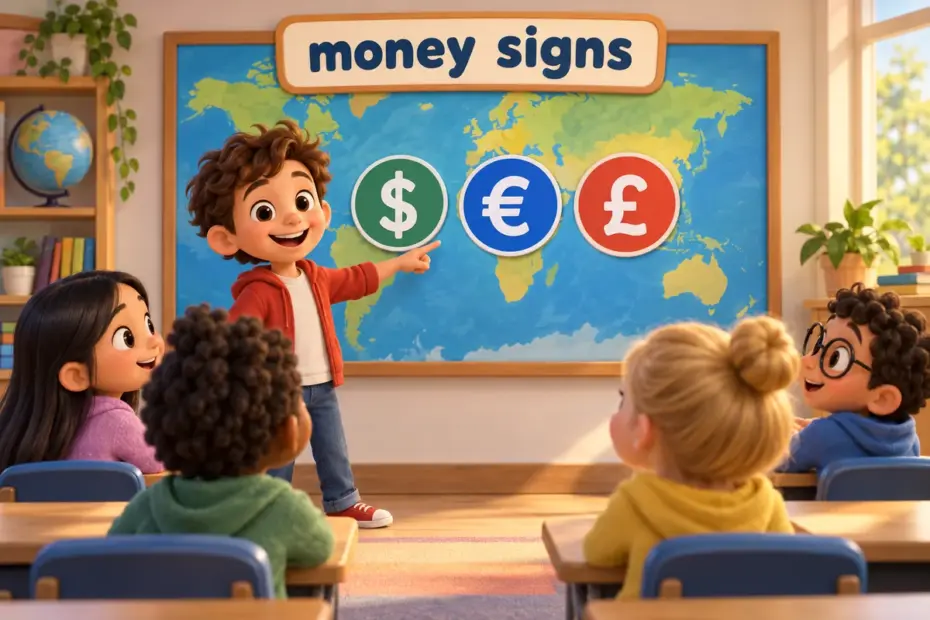
Currency symbols with names pair a small sign, such as $ or euro, with the money it stands for. This guide lists the common symbols, their names and the countries that use them, then shows the rules for writing amounts in a clear sentence.
Currency Symbols With Names at a glance
- A currency symbol is a short sign that stands for a unit of money.
- Common symbols include $ for the dollar, euro for the euro and the pound sign for sterling.
- One symbol can serve several countries, so the three-letter code removes the doubt.
- In English, the symbol usually comes before the number, as in $20.
- The commonest error is placing the symbol after the amount.
What are currency symbols?
Currency symbols are short signs that stand for a unit of money, just as letters stand for sounds. Each one is paired with a name, such as dollar or yen, and that name belongs to a country or a group of countries. A broader set of symbol sentence examples shows the same idea outside money.
| Where used | Symbols | Notes |
|---|---|---|
| United States and others | $ | The dollar sign serves many countries. |
| European Union | € | Shared by member states that use the euro. |
| United Kingdom | £ | The pound sterling. |
| East Asia | ¥ and ₩ | The yen, the yuan and the won. |
| South Asia | ₹ | The Indian rupee. |
A symbol saves space and reads at a glance, which is why prices on shelves, tickets and menus use signs rather than words. The exact mark also tells a traveller which money is expected. This page keeps to the symbols a reader meets in news and travel writing, so historical and regional coins with their own marks are left out.
The common currency symbols with names
The table below matches each sign to its familiar name and the money it names. The dollar sign is a good reminder that one symbol can carry several names.
| Symbol | Name | Money it stands for |
|---|---|---|
| $ | Dollar | The US dollar and several other dollars. |
| € | Euro | The shared currency of the eurozone. |
| £ | Pound | Pound sterling, the UK currency. |
| ¥ | Yen | The Japanese yen. |
| ¥ | Yuan | The Chinese yuan, written with the same sign. |
| ₹ | Rupee | The Indian rupee. |
| ₽ | Ruble | The Russian ruble. |
| ₩ | Won | The South Korean won. |
| ₺ | Lira | The Turkish lira. |
| ฿ | Baht | The Thai baht. |
| ₦ | Naira | The Nigerian naira. |
| ₪ | Shekel | The Israeli shekel. |
| ₫ | Dong | The Vietnamese dong. |
| R$ | Real | The Brazilian real. |
| ₡ | Colon | The Costa Rican and Salvadoran colon. |
| ₵ | Cedi | The Ghanaian cedi. |
Notice that the yen sign and the yuan sign look identical but name two different currencies. Without a country name or a code, a reader cannot tell which one a bare sign means.
How do you write currency symbols in a sentence?
English has a fixed habit: the symbol goes before the number, and the code appears when the symbol is unclear. The frames below cover the everyday uses.
| Pattern | Example | What it signals |
|---|---|---|
| symbol + number | The book costs $20. | An amount in dollars |
| code + number | The fee is USD 2,000. | The exact currency |
| number + unit word | I owe you twenty dollars. | The spoken or spelled form |
| symbol before a noun | a £10 note | A banknote of that value |
| code in a contract | Pay EUR 1,000 within a week. | An unambiguous figure |

Currency symbols in a sentence: examples across contexts
Money signs appear in prices, contracts and travel notes, and the conventions shift a little with each register.
| Context | Example sentence | Why this works |
|---|---|---|
| Shop sign | Coffee costs £3 a cup. | The symbol precedes the amount. |
| Bank statement | A transfer of ₹5,000 was received. | The symbol names the rupee. |
| Contract | The total is USD 12,500. | The code removes any doubt. |
| News report | The euro fell against the dollar overnight. | The names work as nouns. |
| Travel note | I changed a hundred dollars at the airport. | The unit word is spelled out. |
| Menu | Main dishes start at €12. | The sign marks the local currency. |
| Text message | You still owe me 20. | The context supplies the currency. |
| Academic writing | Output rose to ₩4 trillion. | The symbol suits a large figure. |
| Hotel bill | The rate includes a €15 service charge. | The sign marks a local fee. |
| Charity appeal | Donations over £50 qualify for the scheme. | The sign keeps the copy short. |
| Price comparison | The two plans cost ₹499 and ₹799. | The sign repeats cleanly in a table. |
Which currency symbol should you write?
Match the sign to the audience, and reach for the code when a symbol is shared.
| Situation | Write | Example |
|---|---|---|
| A US price for a US reader | $ | The jacket costs $80. |
| A price with several dollars possible | Code | Send USD 50 to the supplier. |
| A eurozone price | € | The room is €90 a night. |
| A UK price | £ | The fare is £5. |
| A spoken amount | Word | I will pay twenty euros. |
The rule of thumb is simple: use a symbol for a friendly local price and a code for anything that crosses a border. That way the sign stays readable and the figure stays exact.
Spelling and word forms of currency words
A currency symbol is not a cymbal, and the cymbal vs symbol page keeps those homophones apart. The wider idea of standing for something appears in symbolism sentence examples.
| Form | Part of speech | Example |
|---|---|---|
| symbol | noun | The symbol for the euro is clear. |
| symbols | plural noun | These symbols mark five currencies. |
| symbolise | verb | A crown may symbolise a nation. |
| symbolic | adjective | The payment was symbolic. |
| currency | noun | The local currency is the yen. |
| currencies | plural noun | Both currencies trade freely. |
Common mistakes with currency symbols
Mistake 1: the symbol goes after the number. Incorrect: The ticket costs 20$. Correct: The ticket costs $20. Rule: English places the currency symbol before the amount.
Mistake 2: the wrong symbol is matched to a country. Incorrect: The euro is used in Japan. Correct: The yen is used in Japan. Rule: pair the symbol with the country that uses it.
Mistake 3: a plural unit appears before a noun. Incorrect: a five dollars note. Correct: a five-dollar note. Rule: before a noun the amount becomes a hyphenated modifier and stays singular.
Mistake 4: the unit word loses its plural. Incorrect: I have five dollar. Correct: I have five dollars. Rule: a unit word takes the plural after a number.
Mistake 5: a shared symbol is left to guesswork. Incorrect: Send $ 50. Correct: Send USD 50. Rule: when several currencies share a sign, use the three-letter code.
Practice using currency symbols
- Fill in the blank: The pen costs ___2.
- Choose the better word: For a contract, write (₹ / INR) 5,000.
- Correct the error: The meal cost 40£.
- Build a sentence: use a code and a number to state a fee.
- Spot the register: which line suits a bank statement, (a) about 30 euros, or (b) EUR 30.00?
- Fill in the blank: The Japanese currency is the ___.
Answers
- £ or $, because the symbol comes before the number.
- INR, because a contract needs the exact code.
- The meal cost £40; the symbol belongs before the amount.
- The yearly fee is USD 500, payable in January.
- (b), because a bank statement needs an exact, coded figure.
- yen, because Japan uses the yen.

The bottom line
Currency symbols with names connect a small sign to the money behind it, from the dollar and the euro to the yen and the rupee. In English, place the symbol before the number and switch to the three-letter code when a sign is shared. Match the symbol to the country, and keep the unit word plural after a number.
Frequently asked questions about currency symbols
Why do so many countries use the dollar sign?
The dollar sign spread with trade and history, and several countries adopted it for their own currencies. That is why the United States, Canada, Australia and others all write $ before a price. When a reader might be unsure, the three-letter code such as USD or AUD removes the doubt.
What is the difference between a currency symbol and a code?
A symbol is the short sign, such as $ or the euro sign, used in prices and headlines. A code is the three-letter label set by an international standard, such as USD for the US dollar. Symbols are quick and familiar, while codes are exact, which is why contracts and banks prefer the code.
Where does the symbol go in an English price?
In English the symbol goes before the number, as in $20 or the pound sign followed by 20. Some languages put the sign after the amount instead, which explains the mix-ups learners make. After a number, the unit word is also plural, so we write twenty dollars, not twenty dollar.
Do all countries have their own currency symbol?
No. Many countries use a shared symbol, and some express their money mainly with a code or a word. The euro is shared across many nations, and the dollar sign serves several currencies at once. Where a unique symbol exists, such as the rupee sign, it names one currency clearly.