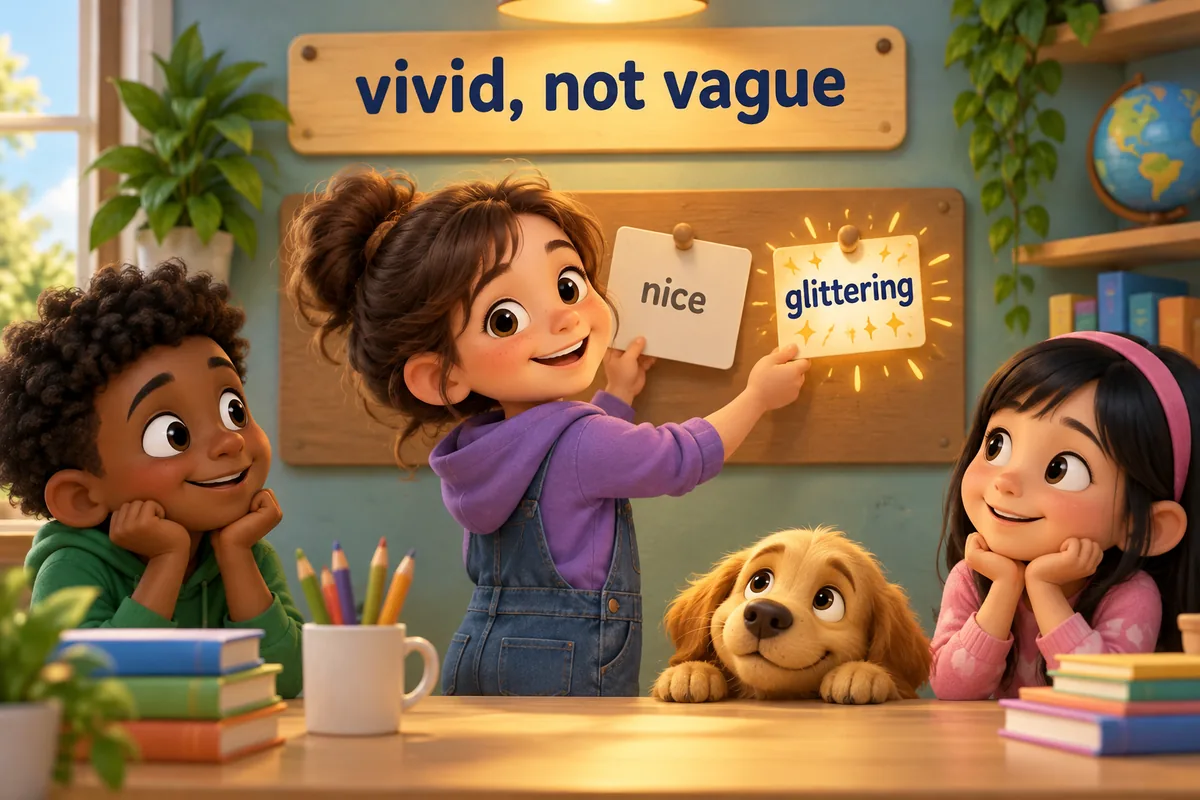
Creative or descriptive words for kids are the vivid words that help a child paint a picture in a reader’s mind. A sharp word such as glittering tells far more than a plain word such as nice. A simple swap is “the shimmering pond” instead of “the nice pond.”
Creative or descriptive words for kids at a glance
- Descriptive words are mostly adjectives and adverbs.
- They add detail about how something looks, sounds, feels, tastes or smells.
- Grouping the words by sense makes the right one easy to find.
- A vivid word beats a tired word such as nice or good.
- The commonest mistake is stacking three adjectives before one noun.
What are descriptive words for kids?
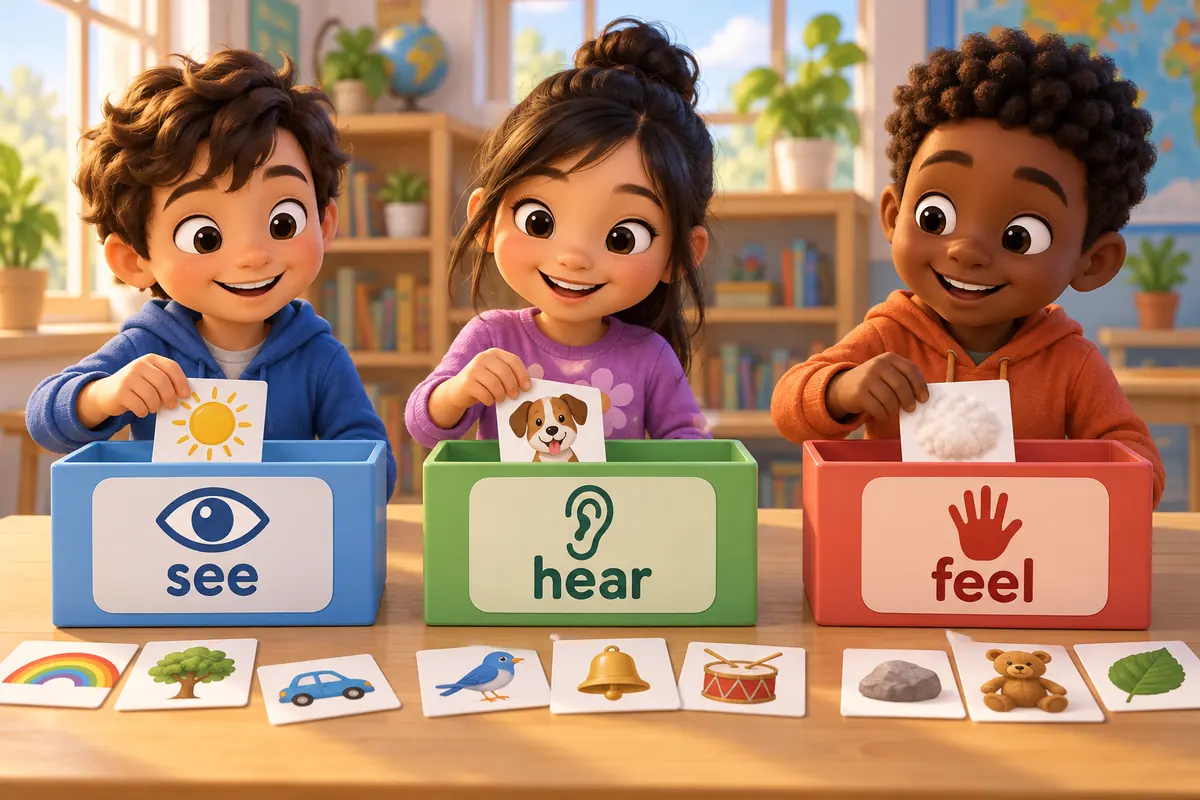
Descriptive words for kids are the adjectives and adverbs that tell a reader exactly how something looks, sounds or feels. They turn a plain sentence such as the dog ran into a clear picture such as the shaggy dog darted across the lawn. Learning them in small groups, one sense at a time, keeps the list easy to use.
| Sense | Descriptive words | Example |
|---|---|---|
| See | glossy, jagged, speckled | The glossy pebble glowed in the sun. |
| Hear | rumbling, tinkling, shrill | A tinkling bell announced the ice cream. |
| Feel | velvety, gritty, springy | The springy grass tickled her toes. |
| Taste | tangy, syrupy, bitter | The tangy drink made him blink. |
| Smell | fragrant, musty, acrid | A fragrant breeze filled the kitchen. |
Creative and descriptive words by group
The groups below gather vivid words under the sense or idea they describe, so a child can pick one that fits. Each row also shows the word inside a full sentence.
| Group | Vivid words | Example sentence |
|---|---|---|
| How things look | shimmering, jagged, glossy, dusty, speckled | The speckled eggs sat in the dusty nest. |
| How things sound | rumbling, tinkling, shrill, hushed, crackling | A shrill whistle cut through the hushed room. |
| How things feel | velvety, gritty, clammy, springy, silky | The springy moss felt soft underfoot. |
| How things taste | tangy, syrupy, bitter, smoky, buttery | The smoky soup tasted warm and rich. |
| How things smell | fragrant, musty, acrid, sweet, fresh | A fragrant breeze drifted from the garden. |
| Size and shape | enormous, tiny, narrow, lopsided, plump | A plump cat squeezed through the narrow gap. |
| Mood and feeling | cheerful, anxious, curious, gloomy, proud | A curious child peered into the gloomy cave. |
| Movement | darting, drifting, lumbering, tumbling, gliding | Silver fish were darting beneath the boat. |
How do you use a descriptive word?
Place the word just before the noun it describes, or pair it with a strong verb to describe an action. One well-chosen word usually does more than two or three stacked together. Read the sentence aloud to test whether the word earns its place. A strong verb often does the describing alone, so the river drifted already shows gentle movement without an adverb. Reading aloud is a reliable test, because an overloaded description is hard to say in a single breath.
| Pattern | Example | What it signals |
|---|---|---|
| adjective + noun | a ragged kite | The colour or shape of a thing. |
| adverb + verb | the river drifted slowly | The way an action happens. |
| verb + like + noun | it shone like a coin | A comparison to a familiar thing. |
| two-part contrast | smooth outside, rough within | Two qualities set side by side. |
| sensory verb | the bread smelled buttery | The sense a thing stirs. |
Children can widen their choices with the words collected under creative adjectives and the single words in adjectives for creative writing. A general list for younger learners sits in adjectives for kids, and two short words can combine into new descriptions, as the list of compound words for kids shows.
Overused words compared with vivid words
The quickest way to sharpen a sentence is to replace a tired word with a specific one. The table pairs the words children reach for first with stronger choices beside them.
| Overused word | Vivid choice | Why it is better |
|---|---|---|
| nice | fragrant | It names the smell directly. |
| good | clever | It says what kind of good. |
| big | enormous | It gives a clearer scale. |
| funny | giggly | It shows the effect on a person. |
| sad | gloomy | It sets a specific mood. |
Words that build description
A small set of grammar words holds the description together.
| Word | Part of speech | Example |
|---|---|---|
| shimmering | adjective | The shimmering lake caught the light. |
| drift | verb | Leaves drift slowly down the lane. |
| gently | adverb | She closed the box gently. |
| fragrant | adjective | A fragrant rose grew by the gate. |
| like | preposition | The stone shone like glass. |
Building a descriptive word bank at home
A word bank grows best when a child collects words from real things rather than copying a list. Keep a small notebook and add one vivid word each day beside the object that inspired it. Over a month a child gathers thirty or more words that are already tied to a memory.
| Place | Words to collect | Prompt to ask |
|---|---|---|
| Kitchen | smoky, tangy, buttery | How does this smell or taste? |
| Garden | fragrant, springy, speckled | How does this feel or look? |
| Street | rumbling, shrill, glossy | What can you hear or see? |
| Bedroom | velvety, hushed, cosy | How does this corner feel? |
| Weather | breezy, misty, glaring | How does the day look today? |
Ask the child to use one collected word in that day’s writing, and note which words keep returning. A word the child has used three times in a week is learned for good, while a word copied and never used fades away.
Common mistakes with descriptive words
Most weak description shares one of a few faults, and each fault has a quick fix.
- Incorrect:
The very big huge enormous giant dog barked.Correct: The enormous dog barked. Rule: keep one strong adjective, not a stack. - Incorrect:
The flowers is beautiful.Correct: The flowers are beautiful. Rule: the verb must agree with its subject. - Incorrect:
She ran quick to the gate.Correct: She ran quickly to the gate. Rule: use an adverb to describe a verb. - Incorrect:
It was a nice nice day.Correct: It was a bright, breezy day. Rule: replace the tired word instead of repeating it. - Incorrect:
The cold icy freezing wind blew.Correct: The icy wind blew. Rule: one vivid word is enough.
Practice with descriptive words
Try each task, then read the reason beside the answer to check your thinking.
- Fill in the blank: The ________ lake caught the light.
- Fill in the blank: She closed the box ________.
- Choose the vivid word: the soup tasted (nice / smoky).
- Correct the error: She ran quick to the gate.
- Build a sentence: describe a sound with one vivid word.
- Spot the sense: which sense does fragrant describe?
- Build a swap: replace big in a sentence with a stronger word.
Answers
- shimmering, because it describes how the lake looked in the light.
- gently, because an adverb describes how the action was done.
- Smoky, because it names the exact taste instead of the vague word nice.
- She ran quickly to the gate: an adverb describes the verb ran.
- Sample: A rumbling thunder shook the windows.
- Smell, because fragrant describes how something smells.
- Sample: The enormous oak blocked the path, replacing big with enormous.
The bottom line
Use creative or descriptive words for kids as a bank of vivid choices grouped by sense, so the right word is always within reach. Swap one tired word such as nice for a specific one such as fragrant, and keep each description to a single strong adjective. Read the sentence aloud, and the words that earn their place will stand out.
Frequently asked questions about descriptive words for kids
What is a descriptive word?
A descriptive word tells a reader more about a person, place, thing or action. Most descriptive words are adjectives, which describe nouns, such as a jagged rock, and adverbs, which describe verbs, such as she climbed carefully. Together they turn a plain sentence into a clear picture.
How many adjectives should one sentence have?
One strong adjective usually beats three weak ones. A sentence such as the enormous dog barked reads better than the big huge enormous dog barked, because the single word does the work. Add a second adjective only when it describes a different quality.
How can I help a child learn new describing words?
Teach the words in sense groups, such as words for sound or for touch, and use them in real sentences about things the child can see. Ask the child to pick the word that fits best, then to explain the choice. Using a new word three times in a day makes it stick.
Why should children avoid words like nice and good?
Words such as nice and good are so general that they tell the reader very little. A specific word such as fragrant or clever shows exactly what makes the thing stand out. Replacing one vague word with one vivid word sharpens a sentence instantly.