
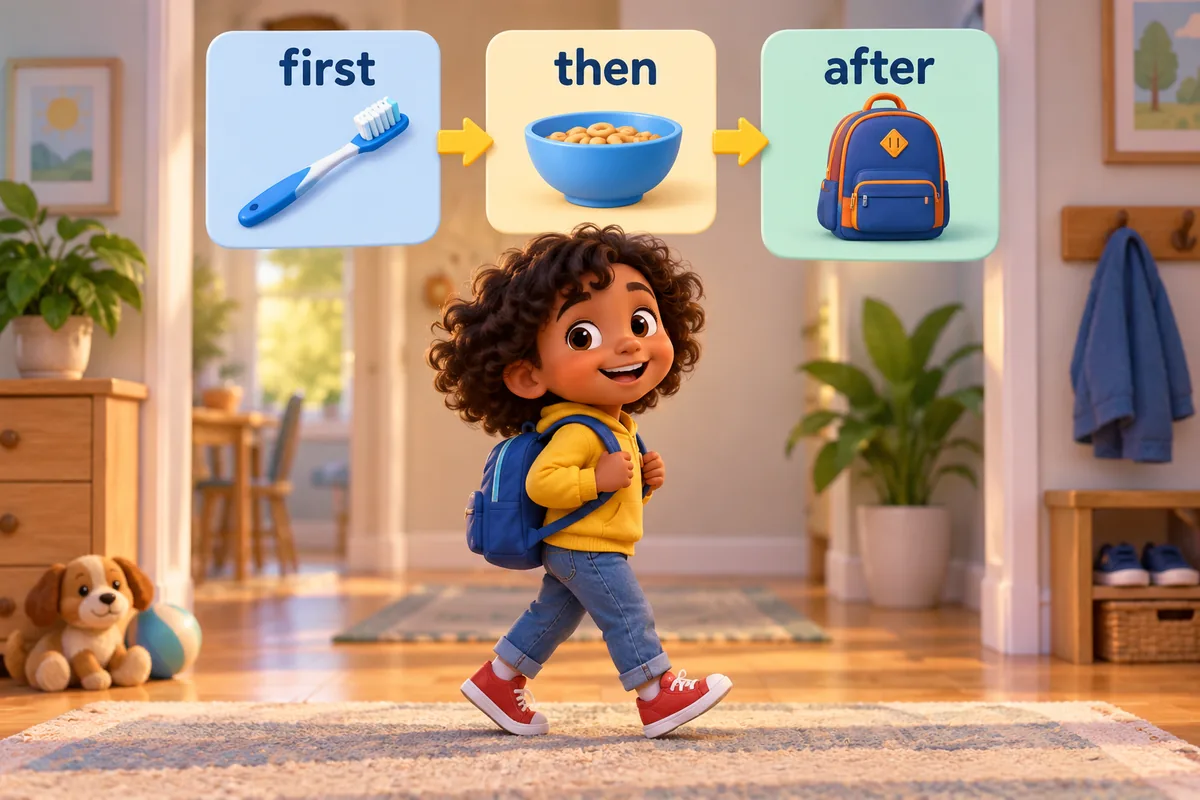
Daily routine sentences in English describe the actions you repeat each day, using the present simple tense and time words such as first, then and after that. A typical sentence is “I wake up at seven and have breakfast.” The order matters, because the reader follows the day from morning to night.
daily routine sentences in english at a glance
- Daily routine sentences use the present simple tense.
- Time connectors such as first, then and finally show the order.
- Third-person singular verbs take -s: she wakes, he goes.
- Adverbs of frequency sit before the main verb: I usually walk.
- The commonest error is dropping the -s in the third person.
What are daily routine sentences?
Daily routine sentences describe the actions you repeat each day, and they use the present simple because the pattern is regular rather than happening once. Time words such as first and then hold the day in order. More frames sit among routine sentence examples.
| Time | Activity | Sentence |
|---|---|---|
| Morning | wake up | I wake up at seven. |
| Breakfast | have breakfast | She has breakfast at eight. |
| Afternoon | go to work | He goes to work by bus. |
| Evening | have dinner | We have dinner at seven. |
| Night | go to bed | They go to bed at ten. |
The list runs from morning to night, and the reader follows the same order in every paragraph, which is what makes a routine readable.
How do you build a daily routine sentence?
Start with the subject, add the present simple verb and a time phrase, then link the sentences with time connectors. The building blocks match those in using adjectives in sentences and phrases.
| Pattern | Example | What it signals |
|---|---|---|
| Subject + verb + time | I brush my teeth at seven. | a simple routine action |
| Subject + adverb + verb | I always eat breakfast. | how often |
| Then + subject + verb | Then I catch the bus. | the next step |
| After that + clause | After that, I start work. | a later stage |
| Subject + verb + -s (third person) | She walks to school. | a singular third-person subject |
| Finally + subject + verb | Finally, I read before bed. | the last action |
Keep each sentence to one action, and the connectors will do the ordering work without extra words.
daily routine sentences in english examples across contexts
Routines appear in every register, from a child’s homework to an office schedule, and the grammar stays the same; the tone connects to sentences about the daily grind.
| Context | Example sentence | Why this works |
|---|---|---|
| Morning | I wake up at six and open the curtains. | two actions in time order |
| Breakfast | We eat toast and drink tea. | present simple for habit |
| Travel | She catches the train at eight. | third-person -s |
| Work | He checks his email first thing. | a fixed routine verb |
| Lunch | I usually walk to the park. | an adverb of frequency |
| Chores | Then I wash the dishes. | a connector signals the next step |
| Study | After that, I review my notes. | a later stage in the day |
| Exercise | They go running every evening. | a repeated activity |
| Dinner | We cook together before seven. | a time phrase at the end |
| Night | Finally, I read for twenty minutes. | a closing connector |
Which tense should you use?
Use the present simple for routines, and reserve the present continuous for something happening right now.
| Situation | Tense | Example |
|---|---|---|
| A daily habit | present simple | I drink coffee every morning. |
| Happening now | present continuous | I am drinking coffee now. |
| A repeated chore | present simple | She cleans the kitchen daily. |
| A one-off today | present continuous | She is cleaning the kitchen today. |
| A general truth | present simple | The sun rises in the east. |
| A temporary change | present continuous | This week I am waking early. |
The time phrase settles the choice: words such as every day, usually and always pull the sentence into the present simple.
Word forms and grammar of daily routine sentences
The present simple is regular for most verbs, and only the third-person singular adds -s; an everyday set sits among daily sentence examples.
| Form | Part of speech | Example |
|---|---|---|
| I / you / we / they + verb | verb | They walk to work. |
| He / she / it + verb-s | verb | She walks to work. |
| Negative: do not + verb | verb | I do not drive. |
| Negative third person: does not + verb | verb | He does not drive. |
| Adverb of frequency | adverb | I always walk. |
| Time connector | adverb | Then I rest. |
After does not the main verb loses its -s, so the ending appears once in the sentence, not twice.
Common mistakes with daily routine sentences
Mistake 1: missing third-person -s. Incorrect: She wake up at six. Correct: She wakes up at six. Rule: a singular third-person subject takes -s.
Mistake 2: double -s with does. Incorrect: He does not goes to work. Correct: He does not go to work. Rule: the -s moves to does.
Mistake 3: wrong tense for a routine. Incorrect: I am waking up at seven every day. Correct: I wake up at seven every day. Rule: a habit takes the present simple.
Mistake 4: adverb in the wrong place. Incorrect: I eat always breakfast. Correct: I always eat breakfast. Rule: an adverb of frequency sits before the main verb.
Mistake 5: -ing after do not. Incorrect: She does not walking to school. Correct: She does not walk to school. Rule: do not and does not take the base verb.
Practice using daily routine sentences in english
- Fill in the blank: She ___ (go) to bed at ten.
- Choose the better word: I (wake / am waking) up at six every day.
- Correct the error: He does not likes coffee.
- Build a sentence: describe three morning actions in order.
- Spot the register: which suits a school timetable, (a) I’m eating lunch at noon, or (b) I eat lunch at noon?
- Fill in the blank: They usually ___ (have) dinner at seven.
Answers
- goes, because a singular third-person subject takes -s.
- wake, because a daily habit uses the present simple.
- He does not like coffee; the -s moves to does, leaving the base verb.
- First I wake up, then I wash, and after that I have breakfast.
- Example (b), because a timetable states a habit in the present simple.
- have, because the third-person plural keeps the base verb.

The bottom line
Daily routine sentences in English use the present simple, follow the day in order and lean on time connectors such as first, then and finally. Add -s to the verb for he, she and it, and keep the adverb of frequency before the main verb. Practise the third-person -s, because it is the detail listeners notice straight away.
Frequently asked questions about daily routine sentences
Why do we use the present simple for routines?
The present simple suits routines because it describes repeated actions rather than one event happening now. A phrase such as every morning signals the repetition, so sentences like I walk to work stay in the present simple, while the present continuous would suggest a single moment.
Where does always go in a sentence?
An adverb of frequency such as always, usually or often goes before the main verb but after the verb to be. So you write I always eat breakfast and she is always late. Putting the adverb at the end, as in I eat breakfast always, sounds non-standard.
How many sentences should a routine have?
There is no fixed number, but five to eight sentences usually cover a day from waking to sleeping. One action per sentence keeps the routine clear, and time connectors such as first, then and finally tie the sentences into a single ordered paragraph.
Can I use the same verb twice in a routine?
You can, but varying the verbs keeps the routine readable. Verbs such as wake, wash, eat, travel, work, cook, study and rest each describe a different stage. A repeated verb is fine when it names a genuine habit, such as reading before bed every night.