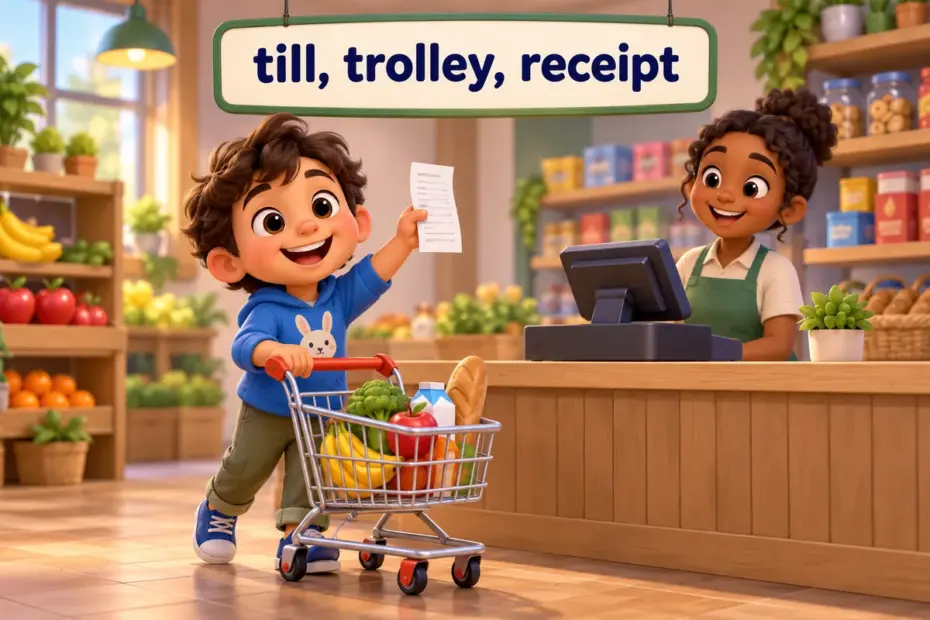
Daily life vocabulary for shopping covers the words you meet in a shop, from browsing the shelves to paying at the till. It includes nouns such as trolley, receipt and discount, and phrases such as try something on and ask for a refund. “Can I try this on?” works in any clothes shop.
daily life vocabulary for shopping at a glance
- Shopping words divide into places, items, prices and actions.
- Common nouns include trolley, basket, till, receipt and change.
- Useful verbs are browse, queue, try on, pay and return.
- Polite requests use could and would, as in Could I have a bag?
- The commonest error is saying pay with cash for pay in cash.
What words do you need for shopping in English?
Shopping vocabulary groups into the place, the items, the money and the actions, and knowing one or two words from each group carries a whole conversation. Everyday frames for these words sit in daily sentence examples.
| Category | Useful words | Example |
|---|---|---|
| Place | store, till, checkout | The till is by the door. |
| Items | trolley, basket, bag | Take a basket for two items. |
| Money | price, discount, change | The discount ends today. |
| Actions | browse, queue, pay, return | I queued for ten minutes. |
Learn the verbs with the noun they usually take, such as try on a jacket and pay at the till, because the pair travels better than the single word.
How do you use shopping phrases politely?
Shop English leans on modal verbs, because a request phrased with could or would sounds warmer than a bare command. The pattern is the same one covered in sentences about the daily grind of errands.
| Phrase | Use | Example |
|---|---|---|
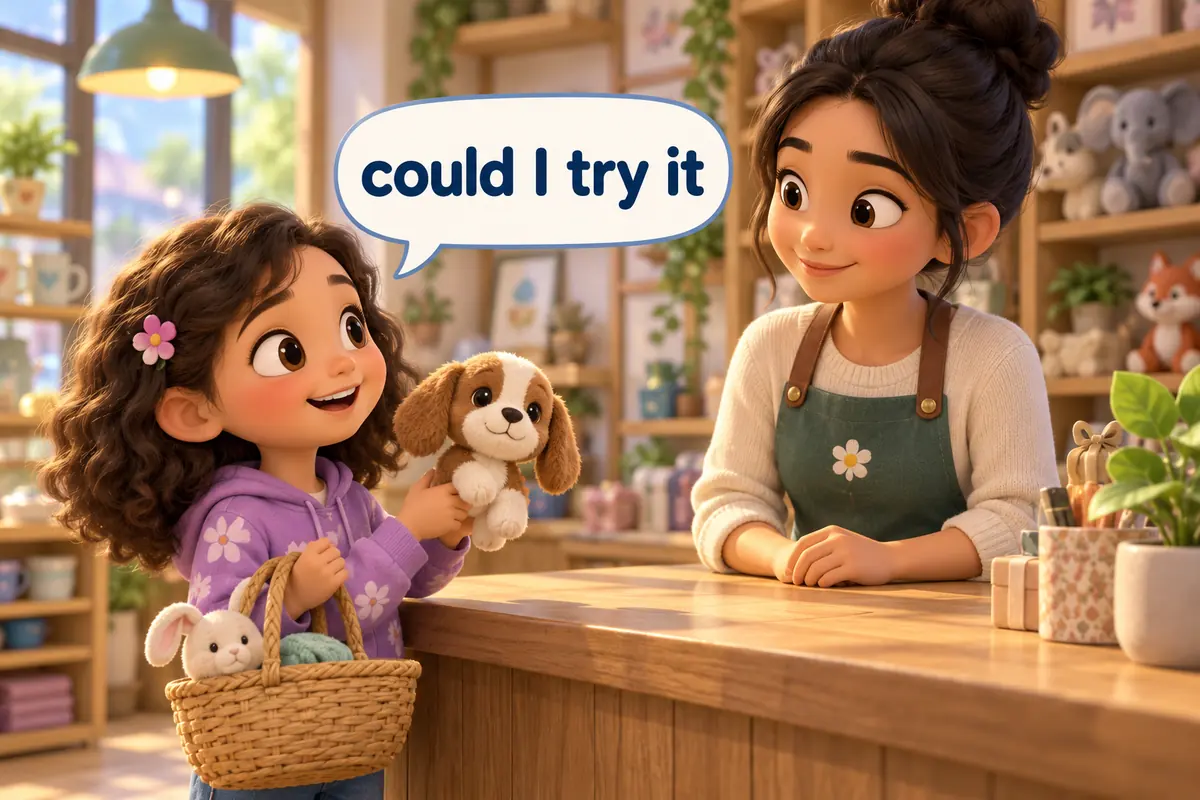
| Could I … | a polite request | Could I try this on? |
| I would like … | a firm but polite ask | I would like a refund. |
| Do you have … | checking stock | Do you have a smaller size? |
| How much is … | asking a price | How much is this shirt? |
| Can I pay by card | choosing a method | Can I pay by card? |
| Keep the receipt | a friendly reminder | Keep the receipt for a return. |
End a request with please and reply to an offer with no thank you rather than a flat no, and the exchange stays polite in any English-speaking shop.
daily life vocabulary for shopping examples across contexts
Shopping language shifts with the setting, from a corner shop to an online order, but the core words stay the same. The describing words that colour a review connect to adjectives for life.
| Context | Example sentence | Why this works |
|---|---|---|
| Clothes shop | Could I try these jeans on? | try on needs the item between the verb and on |
| Supermarket | The trolley is full, so let us find a till. | place words carry the scene |
| Market stall | How much are the peaches today? | a price question |
| Online order | I asked for a refund and kept the receipt. | return vocabulary online |
| Cafe | Can I pay by card, please? | a payment method request |
| Return desk | The item is faulty, so I would like a refund. | a firm polite complaint |
| Shoe shop | Do you have this in a size nine? | checking stock politely |
| Queue | We waited in line for twenty minutes. | queue as a verb or a noun |
| Bargain hunting | The jacket was half price in the sale. | discount vocabulary |
| Delivery | The parcel arrives on Thursday. | shopping beyond the shop |
Which phrase should you use?
Pick the phrase that matches what you want, then soften it with could or would.
| Situation | Phrase | Example |
|---|---|---|
| You want to test clothing | try on | Could I try this on? |
| You want money back | refund | I would like a refund. |
| You want a different size | Do you have | Do you have a larger size? |
| You want the price | How much | How much is this? |
| You want to pay | pay by card | Can I pay by card? |
| You need change | change | Could I have some change? |
Keep the request short and add please; a long explanation is not needed, and a single polite phrase usually gets the help you want.
Word forms and grammar of shopping vocabulary
Shopping words follow the same grammar as other nouns and verbs, so their forms and partners are worth fixing early.
| Form | Part of speech | Example |
|---|---|---|
| trolley / trolleys | noun | Two trolleys blocked the aisle. |
| queue / queued | verb | We queued at the till. |
| try on / tried on | phrasal verb | She tried the coat on. |
| cheap / cheaper / cheapest | adjective | This one is cheaper. |
| receipt / receipts | noun | Keep both receipts. |
| pay / paid / paying | verb | I paid in cash. |
The phrasal verb separates, so you say try the coat on as well as try on the coat, while a fixed phrase such as pay in cash keeps its preposition.
Common mistakes with shopping vocabulary
Mistake 1: pay with the wrong preposition. Incorrect: I paid with cash. Correct: I paid in cash. Rule: cash takes in, while card takes by.
Mistake 2: missing split of a phrasal verb. Incorrect: Could I try on it? Correct: Could I try it on? Rule: a pronoun goes between the verb and the particle.
Mistake 3: no article in a request. Incorrect: Could I have bag? Correct: Could I have a bag? Rule: a singular countable noun needs an article.
Mistake 4: refund for return. Incorrect: I would like a return of my money. Correct: I would like a refund. Rule: a refund is the money, a return is the action.
Mistake 5: much for price. Incorrect: How much are these apples cost? Correct: How much do these apples cost? Rule: use one verb, not a muddled pair.
Practice using daily life vocabulary for shopping
- Fill in the blank: Could I ___ this jacket ___? (try)
- Choose the better word: I paid (in / with) cash.
- Correct the error: I would like a return of my money.
- Build a sentence: ask a polite question about the price of a hat.
- Spot the register: which suits a shop assistant, (a) Gimme a bag, or (b) Would you like a bag?
- Fill in the blank: Do you have this in a smaller ___?
Answers
- try, on, because the phrasal verb try on wraps around the item.
- in, because cash pairs with in and card pairs with by.
- I would like a refund; the money returned is a refund.
- How much is this hat, please?
- Example (b), because would you like is a polite offer.
- size, because size names the dimension you are checking.
The bottom line
Daily life vocabulary for shopping breaks into places, items, money and actions, and a few words from each group carry a whole exchange. Learn the verbs with their partners, such as try on a jacket and pay in cash, because the fixed phrase matters more than the single word. Add could, would and please, and any shopping request sounds natural.
Frequently asked questions about shopping vocabulary
What is the difference between a refund and a return?
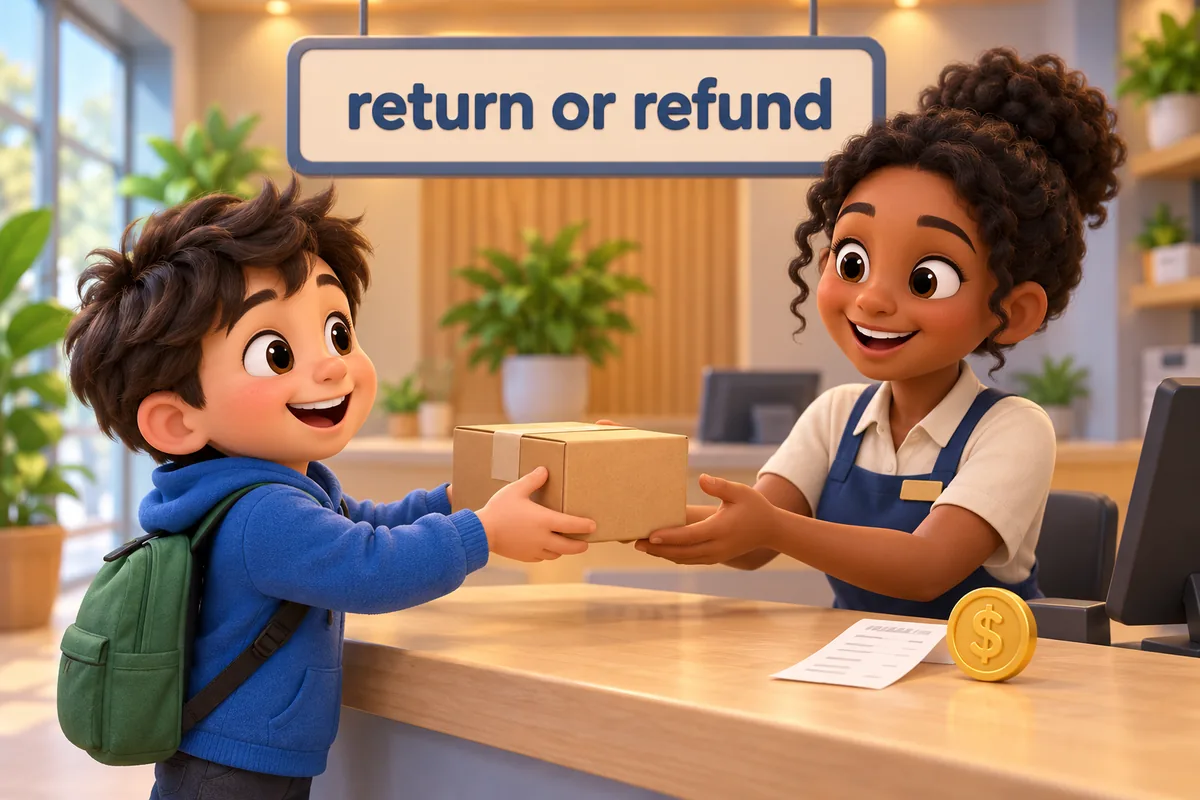
A return is the act of taking an item back to the shop, while a refund is the money you get back. You return an item and then receive a refund, so the two words describe different steps. A shop may offer an exchange instead of a refund.
Should I say till or checkout?
Both name the place where you pay. Till is common in British English, while checkout is used in both British and American English and also fits online shops. The meaning is the same, so choose the word that matches the variety you are learning.
Is it correct to say pay by cash?
No. Cash takes the preposition in, so you pay in cash, while a card takes by, so you pay by card. The two methods keep different prepositions, and mixing them is one of the most frequent small errors in shopping English.
How much or how many for prices and items?
Use how much for a price, which is uncountable, as in how much is this bag. Use how many for countable items, as in how many bags do you need. The choice follows the noun, not the topic of shopping.