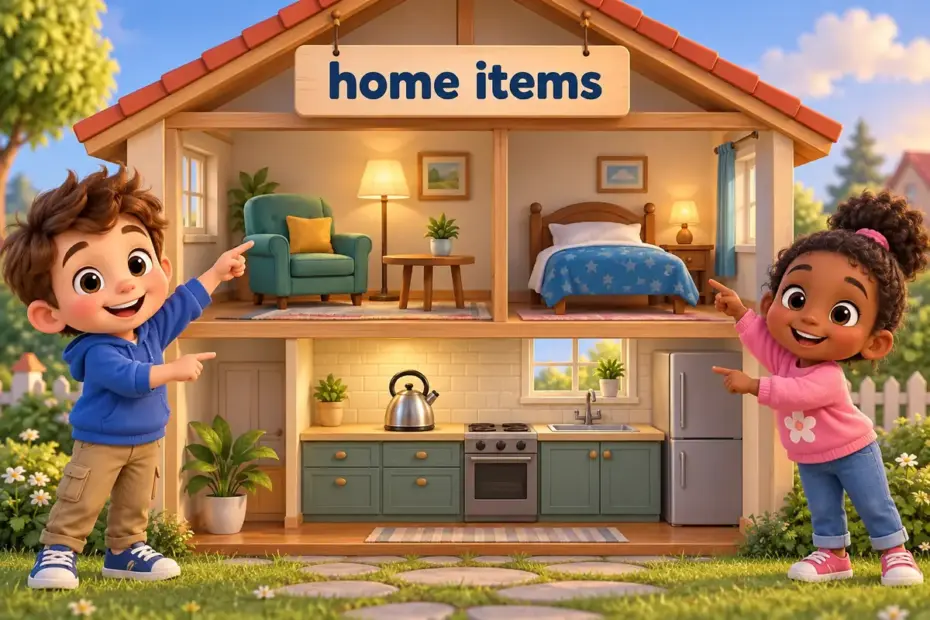
Daily used household item names are the words for the everyday objects found in and around a home, from chairs and lamps to buckets and brooms. This guide groups the names by room, lists the most common ones, and shows how to use them in clear sentences.
Daily Used Household Item Names at a glance
- A household item is any object used in the home for daily tasks.
- Common names include chair, table, lamp, plate, cup, kettle and broom.
- Most household item names are countable nouns, so they take a plural.
- Furniture is the main uncountable word in this group.
- The commonest error is writing furniture with a plural -s.
What are household items?
Household items are the objects people use at home every day, such as furniture, kitchen tools and cleaning equipment. English groups them by room and by job, which is why a learner can build the vocabulary room by room. A page of household items that start with a to z extends the list beyond this guide.
| Room or area | Typical items | What they are for |
|---|---|---|
| Living room | sofa, coffee table, rug, lamp | Sitting, relaxing and lighting. |
| Kitchen | kettle, pan, plate, cup, spoon | Preparing and eating food. |
| Bedroom | bed, pillow, blanket, wardrobe | Sleeping and storing clothes. |
| Bathroom | towel, soap, mirror, brush | Washing and grooming. |
| Utility area | broom, bucket, mop, dustpan | Cleaning the home. |
The objects fall into two rough families: furniture, which is usually uncountable, and tools and utensils, which are countable. Naming the room first gives a natural place to store each word. This list stays with the objects almost every home shares, so specialised tools and regional names are left out.
Common daily used household item names
The table below gives the most frequent names with a short note on what each one does. It is a useful starting point for labelling a room or writing a shopping list.
| Name | What it looks like | Everyday use |
|---|---|---|
| Chair | A seat with a back and four legs | Sitting at a table. |
| Table | A flat top on legs | Eating and working. |
| Bed | A soft frame for sleeping | Resting at night. |
| Sofa | A long padded seat | Relaxing in the living room. |
| Lamp | A stand with a light | Lighting a room. |
| Mirror | Glass that reflects | Checking your appearance. |
| Clock | A round face with hands | Telling the time. |
| Plate | A flat round dish | Serving food. |
| Cup | A small handle vessel | Drinking tea or coffee. |
| Kettle | A vessel with a spout | Boiling water. |
| Broom | A long handle and bristles | Sweeping the floor. |
| Bucket | A deep round container | Carrying water. |
| Towel | Soft absorbent cloth | Drying after washing. |
| Pillow | A soft cushion for the head | Supporting sleep. |
| Dustpan | A flat scoop with a handle | Collecting swept dust. |
| Toaster | A small box with two slots | Toasting bread. |
How do you use household item names in a sentence?
These names are mostly countable nouns. The frames below cover the patterns a learner needs, from the singular to the plural.
| Pattern | Example | What it signals |
|---|---|---|
| a + name | I bought a lamp. | One countable item |
| plural name | The chairs are new. | More than one item |
| name + of + noun | a cup of tea | A measured portion |
| name as adjective | a kitchen table | The name describes a type |
| there is or are | There are two towels here. | Stating what exists |
Household item names in a sentence: examples across contexts
The names appear in shopping lists, instructions and stories, and a household sentence collection shows the same words in wider use.
| Context | Example sentence | Why this works |
|---|---|---|
| Classroom | Our teacher asked us to name every object on the table. | The name follows a preposition. |
| Shopping list | Buy four plates, two cups and a kettle. | Plural forms state quantities. |
| Instruction | Wipe the mirror with a soft cloth. | The name is the object of a verb. |
| Conversation | The old sofa is too heavy to move. | The name takes an article. |
| Story | A lamp glowed in the corner of the room. | The name begins a scene. |
| News feature | Households replaced old bulbs with cheaper lamps. | The name takes a plural. |
| Recipe | Boil the water in the kettle. | The name names an object. |
| House move | We packed the pillows and blankets first. | The names work as a list. |
| Classroom game | I spy a chair, a clock and a lamp. | The names form a simple list. |
| Repair note | The tap drips, so bring a washer. | The name names a part. |
| Home tour | The kitchen has a kettle, a toaster and a sink. | The names describe a space. |
Which household item name should you choose?
Pick the word that names the object precisely, and the sentence stays clear.
| Situation | Name | Example |
|---|---|---|
| Carrying water | Bucket | Fill the bucket to the top. |
| Boiling water | Kettle | Put the kettle on. |
| Sweeping a floor | Broom | Grab the broom and sweep. |
| Supporting your head | Pillow | This pillow is too soft. |
| Checking your look | Mirror | She checked the mirror once. |
When two words are close, choose the one that names the exact object: a bucket and a plate both hold things, but only one carries water. The precise noun keeps the sentence clear.
Spelling and word forms of household item names
Most names add -s, but a few change their spelling or stay plural-only. A page of simple daily sentence examples shows how these words fit into routine talk.
| Form | Part of speech | Example |
|---|---|---|
| chair | noun | Pull up a chair. |
| chairs | plural noun | The chairs are stacked. |
| knife | noun | The knife is sharp. |
| knives | plural noun | Wash the knives carefully. |
| furniture | noun, uncountable | The furniture is old. |
| scissors | plural-only noun | The scissors are blunt. |
Watch the two-word names in particular. A washing machine, a coffee table and a toothbrush each keep their own spelling, and getting the spacing right is part of spelling the word correctly.
Common mistakes with household item names
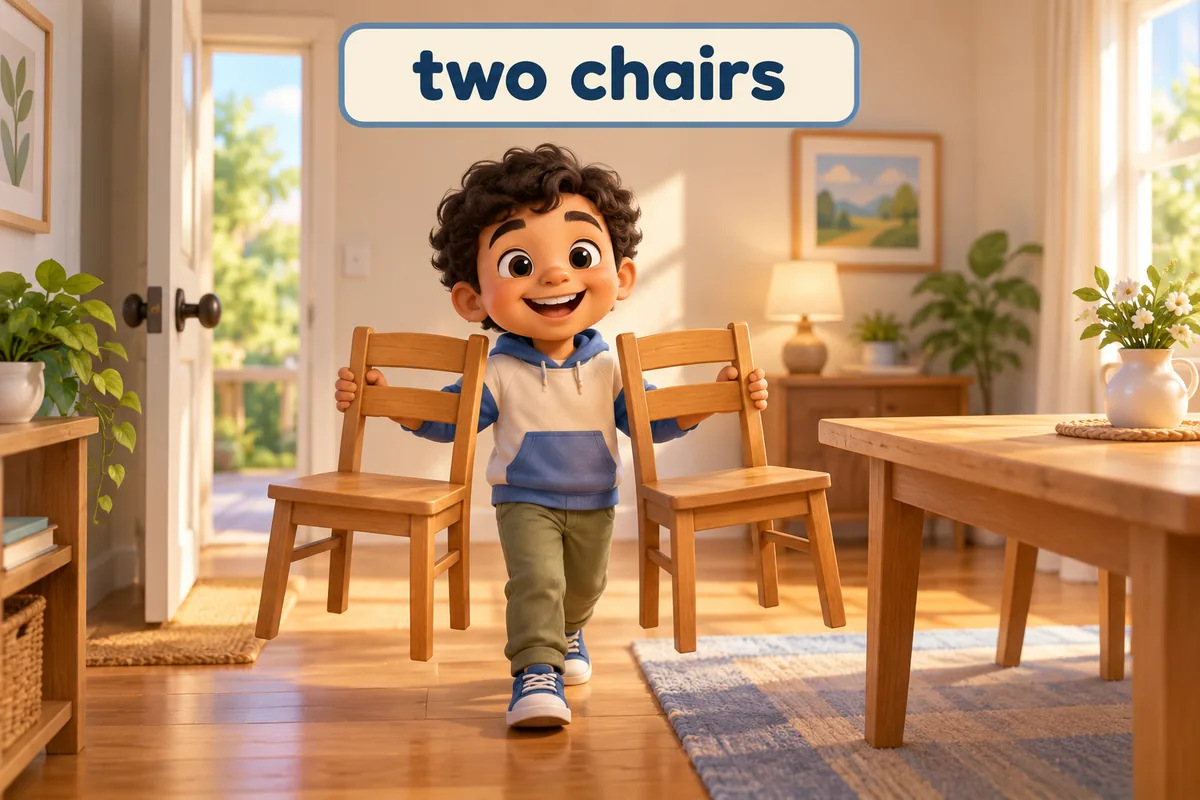
Mistake 1: a countable name loses its plural. Incorrect: I bought two chair. Correct: I bought two chairs. Rule: countable names add -s after a number.
Mistake 2: an irregular plural is regularised. Incorrect: Wash the knifes. Correct: Wash the knives. Rule: knife changes to knives, like life and wife.
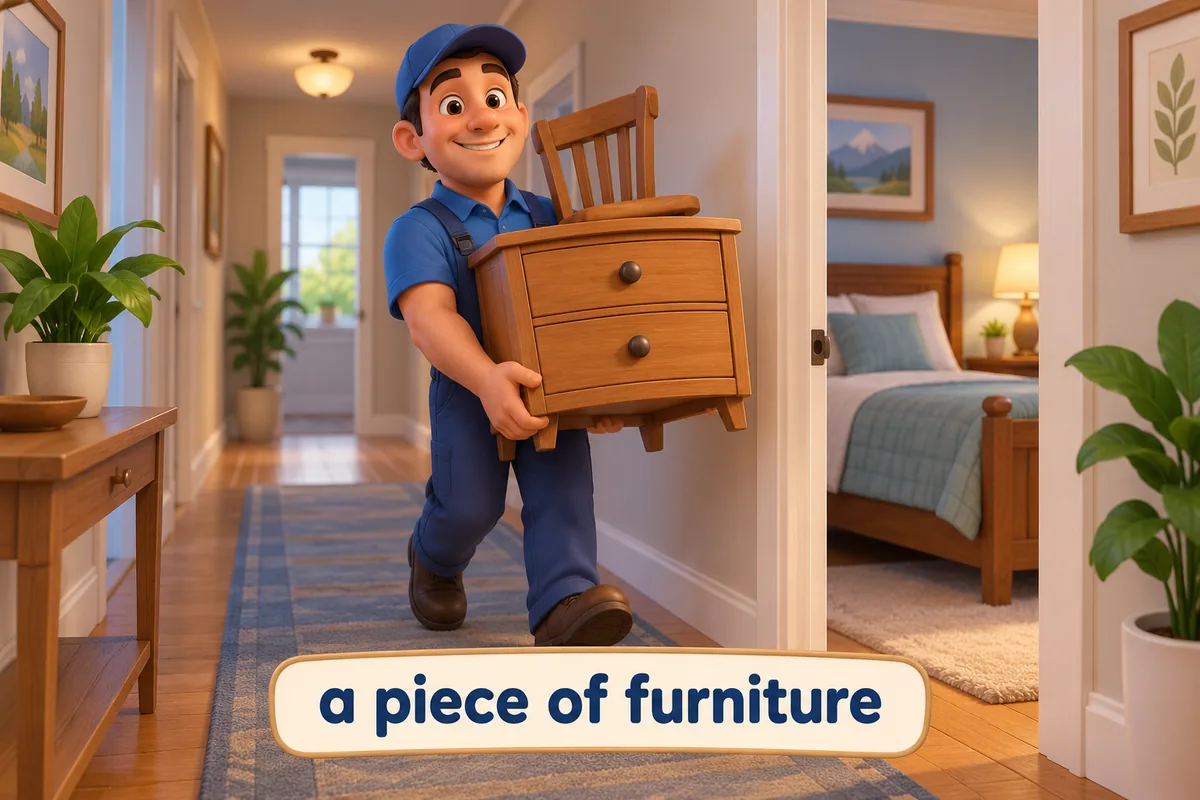
Mistake 3: furniture is given a plural. Incorrect: The room had many furnitures. Correct: The room had many pieces of furniture. Rule: furniture is uncountable.
Mistake 4: a compound name is written as one word. Incorrect: a washingmachine. Correct: a washing machine. Rule: many two-word household names keep a space.
Mistake 5: a plural-only noun is made singular. Incorrect: Pass me a scissor. Correct: Pass me a pair of scissors. Rule: scissors and similar tools are plural-only.
Practice using household item names
- Fill in the blank: Boil the water in the ___.
- Choose the better word: Fill the (bucket / plate) with water.
- Correct the error: We bought three new chair.
- Build a sentence: use there are with two household items.
- Spot the register: which line suits a moving checklist, (a) Bring the bed, or (b) Bed and bedding required?
- Fill in the blank: We have too much ___ in this room.
Answers
- kettle, because a kettle boils water.
- bucket, because a bucket carries water.
- We bought three new chairs; a number needs the plural.
- There are two lamps and a mirror in the hall.
- (b), because a moving checklist uses short, formal labels.
- furniture, because furniture is uncountable.
The bottom line
Daily used household item names cover the objects of everyday home life, from the chair and table to the kettle and broom. Treat them as countable nouns and add -s for the plural, but keep furniture uncountable and count pieces instead. Learn them room by room, and the vocabulary comes together quickly.
Frequently asked questions about household items
Is furniture countable or uncountable?
Furniture is uncountable in English, so it has no plural form. To count it, use a measure word such as a piece of furniture or three pieces of furniture. Saying furnitures is a common error, and it always sounds wrong to a native speaker, so learn the measure phrase early.
Why do we say a pair of scissors?
Scissors is a plural-only noun, like trousers and glasses for the eyes. The tool has two joined blades, so English treats it as a plural and asks for a pair. To count one, we say a pair of scissors, and the verb also stays plural, as in the scissors are sharp.
How many household items should a beginner learn?
A beginner can start with about twenty common names covering each room, such as chair, table, bed, lamp, plate, cup, kettle and broom. Those words cover most everyday sentences. Once they feel secure, the learner can add room by room, using pictures to attach each name to the object.
Are household item names different in British and American English?
A few names differ, though most are the same. American English favours faucet where British English says tap, and garbage can where British English says bin. The everyday core, such as chair, table, plate and kettle, is shared, so learners rarely meet a problem outside these small pairs.