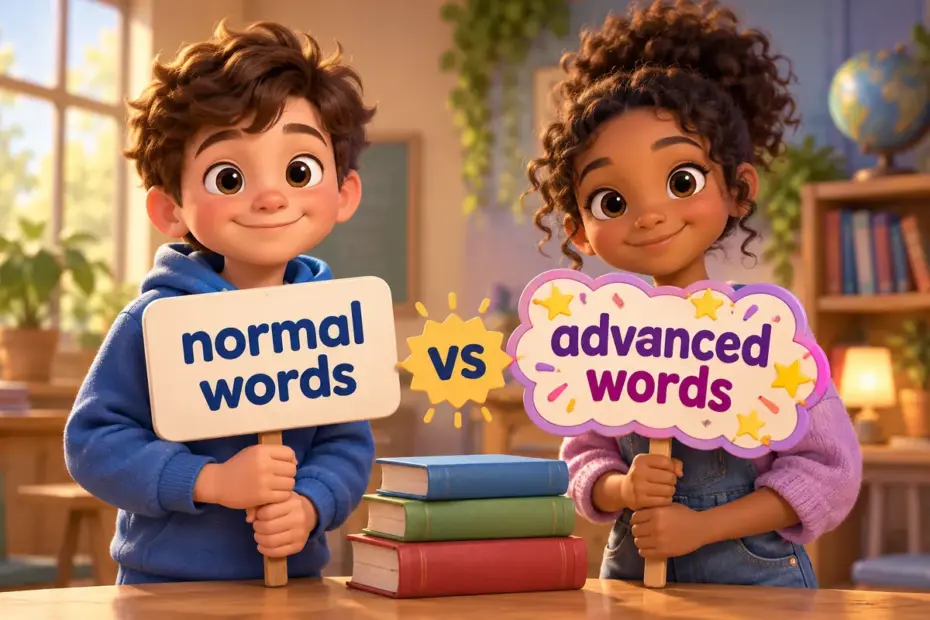
Daily used normal vs advanced english words describes the upgrade from plain everyday vocabulary to richer, more precise choices. A normal word such as big works anywhere, while an advanced word such as substantial adds weight and formality. “A big change” is clear; “a substantial change” sounds considered.
Daily Used Normal vs Advanced English Words at a glance
- Normal words are the common, plain words used in everyday speech.
- Advanced words are less common and carry more precision or formality.
- The upgrade keeps the meaning and changes the register and weight.
- Advanced words suit essays, reports, and professional writing.
- The commonest error is forcing an advanced word into casual writing.
What do normal and advanced English words mean?
A normal English word is a common, plain word used in daily speech, such as big or happy. An advanced English word is a less common synonym that adds precision or formality, such as substantial or elated. The Cambridge entry for daily and the Cambridge entry for advanced anchor the idea, and one line shows it: the meal was good is plain, while the meal was superb is elevated.
| Sense | Type | Plain meaning | Example |
|---|---|---|---|
| Everyday basic word | normal | Common, neutral vocabulary | a big problem |
| Upgraded synonym | advanced | A precise or formal choice | a substantial problem |
| Neutral register | normal | Fits any conversation | She was happy. |
| Elevated register | advanced | Suits essays and reports | She was elated. |
What is the difference between normal and advanced English words?
The difference is register and weight, not meaning. A normal word is common and neutral, while an advanced word is rarer and carries a stronger tone, so a pair such as addition vs edition shows the same principle: a small change in form shifts how the reader hears the line.
| Test | Normal word | Advanced word |
|---|---|---|
| Frequency | very common | less common |
| Register | neutral and spoken | formal and written |
| Length | often short | often longer |
| Effect | clear and simple | precise or vivid |
| Typical reader | any reader | professional or academic |
| Risk | rarely misused | easily misused if forced |
Choose the normal word for clarity and the advanced word when precision or formality earns its place.
How do you use normal and advanced English words in a sentence?
Both follow the same sentence frame, so the swap is safe once the register matches; a further letter-level pair sits in abel vs able, where form decides the word.
| Pattern | Example | What it signals |
|---|---|---|
| swap an adjective | good becomes excellent | a stronger judgement |
| swap a verb | get becomes obtain | a formal action |
| swap a noun | job becomes position | a professional tone |
| keep the frame | The plan is solid becomes The plan is sound. | same grammar, new weight |
| match the register | Use obtain in a report, not in a text to a friend. | audience fit |
Normal and advanced English words: examples across contexts
Reading both levels in different registers makes the swap automatic, and a further common pair sits in absence vs absents, where one letter decides the word.
| Context | Example sentence | Why this works |
|---|---|---|
| Classroom | The pupil gave a clear answer. | a plain word keeps the lesson simple |
| Workplace email | We obtained the figures from the finance team. | obtained suits a professional note |
| News report | Officials cited a substantial rise in costs. | substantial adds weight to a report |
| Academic writing | The study found a significant link. | significant is precise and formal |
| Everyday speech | The film was really good. | good fits casual talk |
| Customer service | Your request has been approved. | approved sounds official and clear |
| Recruitment | The role demands a resilient candidate. | resilient is precise for a job ad |
| Social media | This coffee is amazing. | amazing stays light and warm |
| Legal writing | The parties agreed to amend the clause. | amend is the precise legal verb |
| Narration | He was utterly exhausted after the climb. | exhausted is vivid but still plain |
Which should you use?
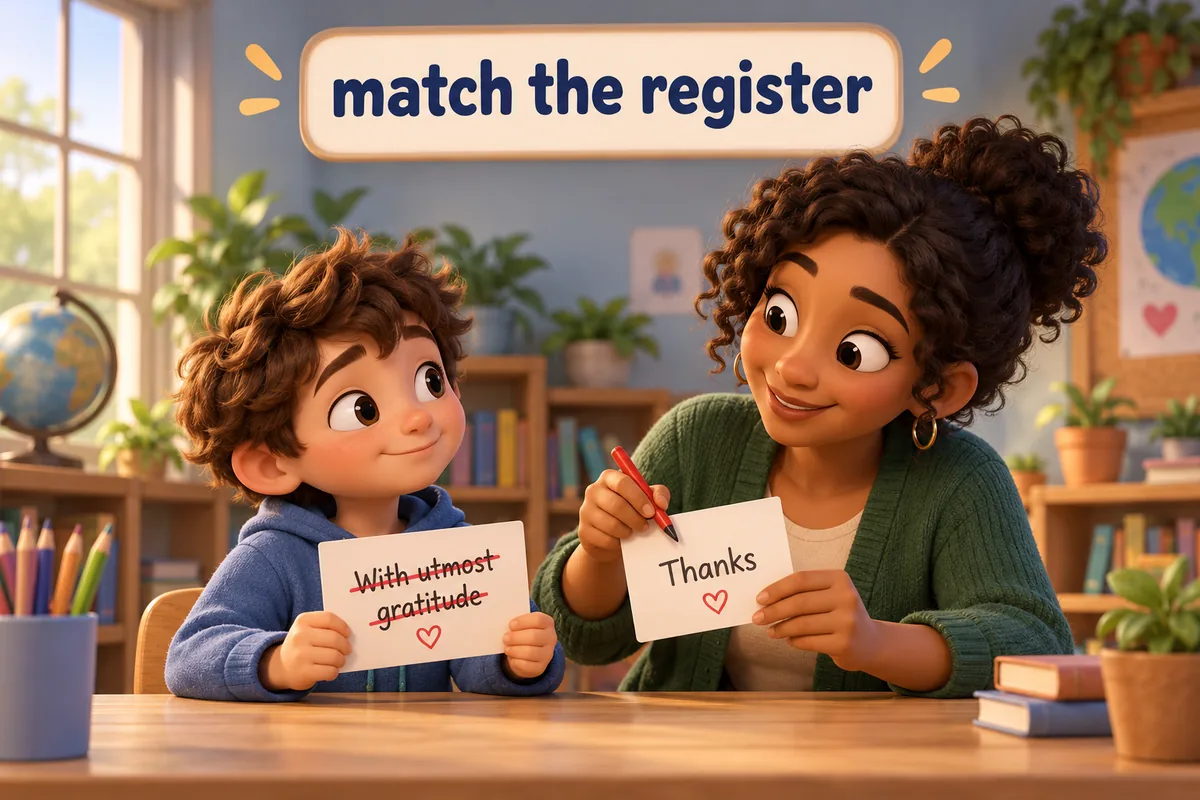
Match the word to the reader and the purpose: plain words for clarity, advanced words for precision or formality.
| Situation | Use | Example |
|---|---|---|
| A text to a friend | normal word | The bus was slow. |
| A formal report | advanced word | The service was delayed. |
| Teaching a child | normal word | That is a big dog. |
| An academic essay | advanced word | The evidence was compelling. |
Register is the whole test. An advanced word placed in a friendly message reads as pompous, while a plain word in a formal report reads as thin; the goal is a match, not a bigger word.
Word forms and grammar of normal and advanced English words
| Normal word | Advanced swap | Register shift |
|---|---|---|
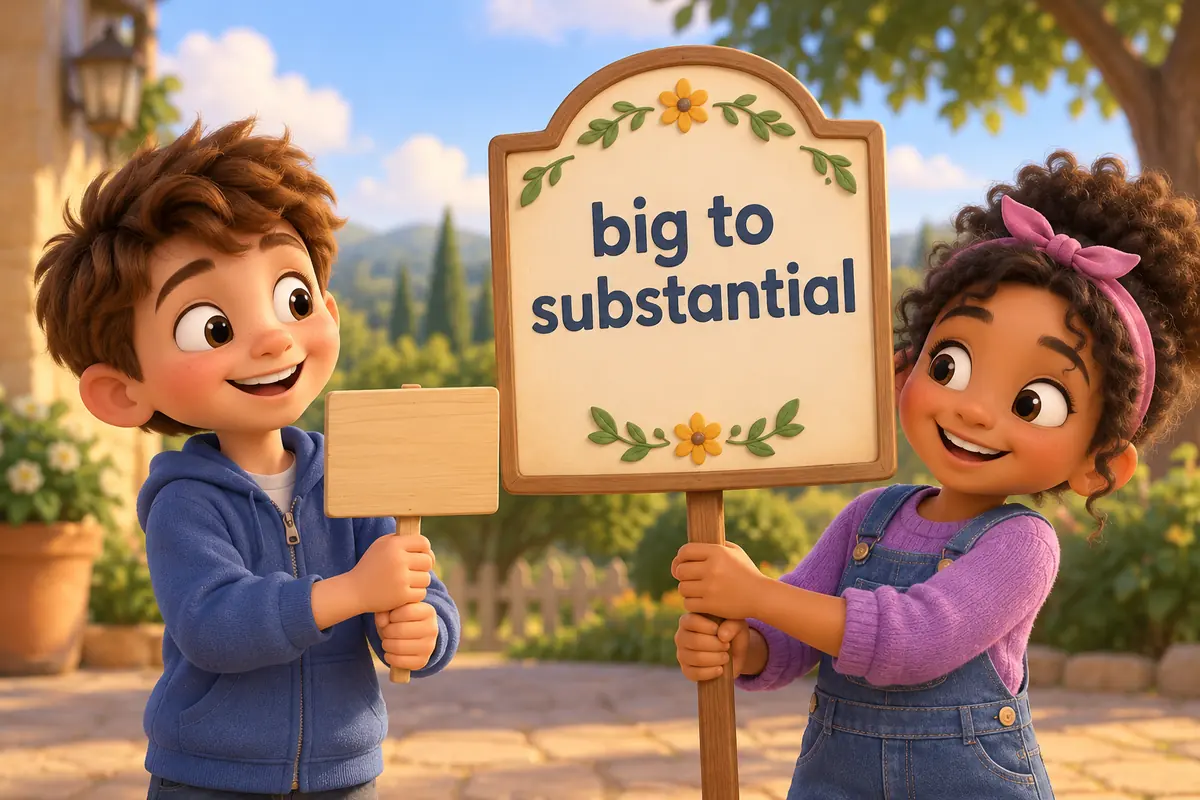
| big | substantial | neutral to formal |
| good | excellent | neutral to formal |
| happy | elated | neutral to literary |
| get | obtain | spoken to written |
| tell | inform | spoken to professional |
| tired | exhausted | neutral to vivid |
| hard | demanding | neutral to professional |
| help | assist | spoken to formal |
Common mistakes with normal and advanced English words
Mistake 1: an advanced word in a casual text. Incorrect: I shall obtain a coffee in a message to a friend. Correct: I will grab a coffee. Rule: match the register to the reader and the setting.
Mistake 2: a forced synonym with the wrong sense. Incorrect: He was elated by the traffic jam, meaning annoyed. Correct: He was frustrated by the traffic jam. Rule: an advanced word must still fit the meaning.
Mistake 3: a long word for a plain idea. Incorrect: We must utilise a pen. Correct: We must use a pen. Rule: a plain word is right when no extra precision is gained.
Mistake 4: an advanced word with the wrong collocation. Incorrect: She did a substantial mistake. Correct: She made a serious mistake. Rule: advanced words keep their own partners, so check the pair.
Mistake 5: a plain word where precision is needed. Incorrect: The dose was big in a medical note. Correct: The dose was high. Rule: a technical context rewards the precise word.
Practice using normal and advanced English words
- Upgrade the adjective: The soup was good. Replace good with an advanced word.
- Choose the better word for a report: We (got / obtained) the data from head office.
- Correct the error: I shall commence my snack now, said to a friend.
- Build a sentence: use a formal verb for telling someone about a delay.
- Spot the register: which suits a job advert, (a) We need a tough worker, or (b) We seek a resilient candidate?
- Upgrade the verb: We told the manager about the fault.
Answers
- The soup was excellent, or superb, for a stronger judgement.
- obtained, because it suits a formal report.
- I will grab my snack now; commence is too formal for a friend.
- We must inform the client of the delay.
- (b), because resilient is the precise professional word.
- We informed the manager about the fault.
The bottom line
The daily used normal vs advanced english words upgrade is about match, not size: a plain word wins when clarity matters, and an advanced word wins when precision or formality earns its place. Swap the word but keep the meaning and the register aligned to the reader. Used well, the richer word sharpens the line rather than decorating it.
Frequently asked questions about normal and advanced English words
Do advanced words make writing better?
Advanced words help only when they add precision or suit the register. In a report, a precise word such as significant beats a vague big, but in a friendly message the same word can sound stiff. Better writing comes from the right word for the reader, not the longest one.
What are some normal and advanced word pairs?
Common swaps include good to excellent, big to substantial, get to obtain, tell to inform, tired to exhausted, and help to assist. Each pair keeps the meaning and raises the formality or vividness. The pair is a starting point, not a rule, since the reader still decides the fit.
When should I avoid advanced words?
Avoid them in casual talk, in instructions for beginners, and wherever a plain word is clearer. An advanced word also fails when it carries the wrong sense, as when elated replaces annoyed. If the simpler word says exactly what you mean, keep it.
Are advanced English words the same as formal words?
Not exactly. Many advanced words are formal, such as obtain or inform, but some are vivid rather than formal, such as exhausted or superb, and fit storytelling. So advanced covers both a formal register and a richer descriptive one, while formal is only one direction of the upgrade.