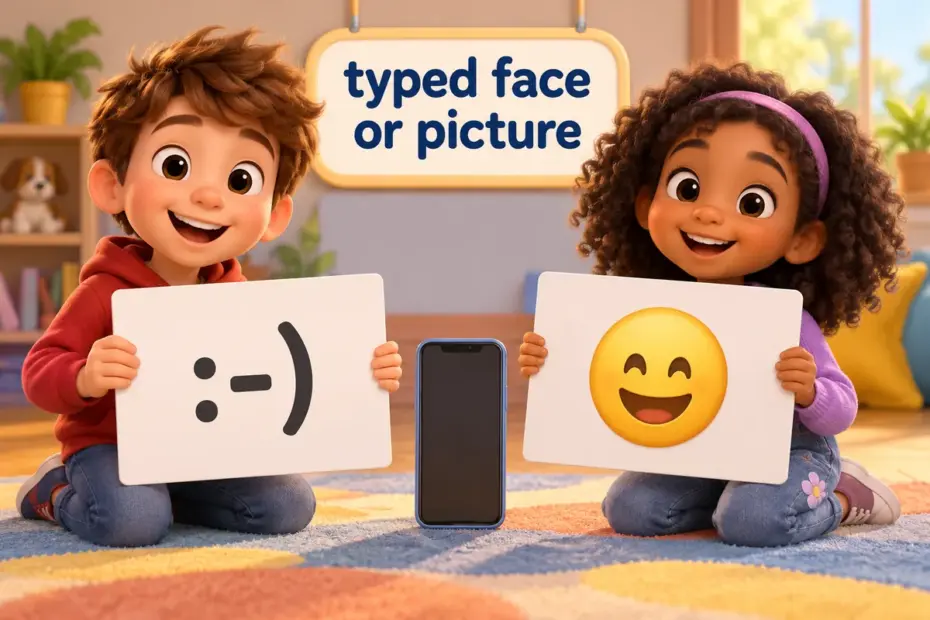
Emoticon emojis are two ways of showing a face in a message: one is typed from keyboard characters, and the other is a small coloured picture. An emoticon might be 🙂 and an emoji might be the smiling face. A simple example is the typed heart <3 beside the picture heart, which send the same warm feeling.
Emoticon emojis at a glance
- An emoticon is a face typed from characters such as 🙂 .
- An emoji is a small coloured picture built into the phone or app.
- Emoticons came first, and emojis grew from the same idea.
- Emoticons suit plain text, while emojis suit richer screens.
- The commonest mistake is mixing many emoticons and emojis in one short line.
What is an emoticon and what is an emoji?
An emoticon is a face typed from ordinary keyboard characters, while an emoji is a small picture that the software draws for you. Both show feeling, but one is text and the other is an image. The shape of the mouth and the choice of eye show the feeling, so a reader learns the pattern once and reads every emoticon the same way. The table below shows four pairs sharing the same sense.
| Feeling | Emoticon | Emoji |
|---|---|---|
| happy | 🙂 | 😀 |
| wink | 😉 | 😉 |
| sad | 🙁 | 😢 |
| love | <3 | ❤️ |
How do you type an emoticon?
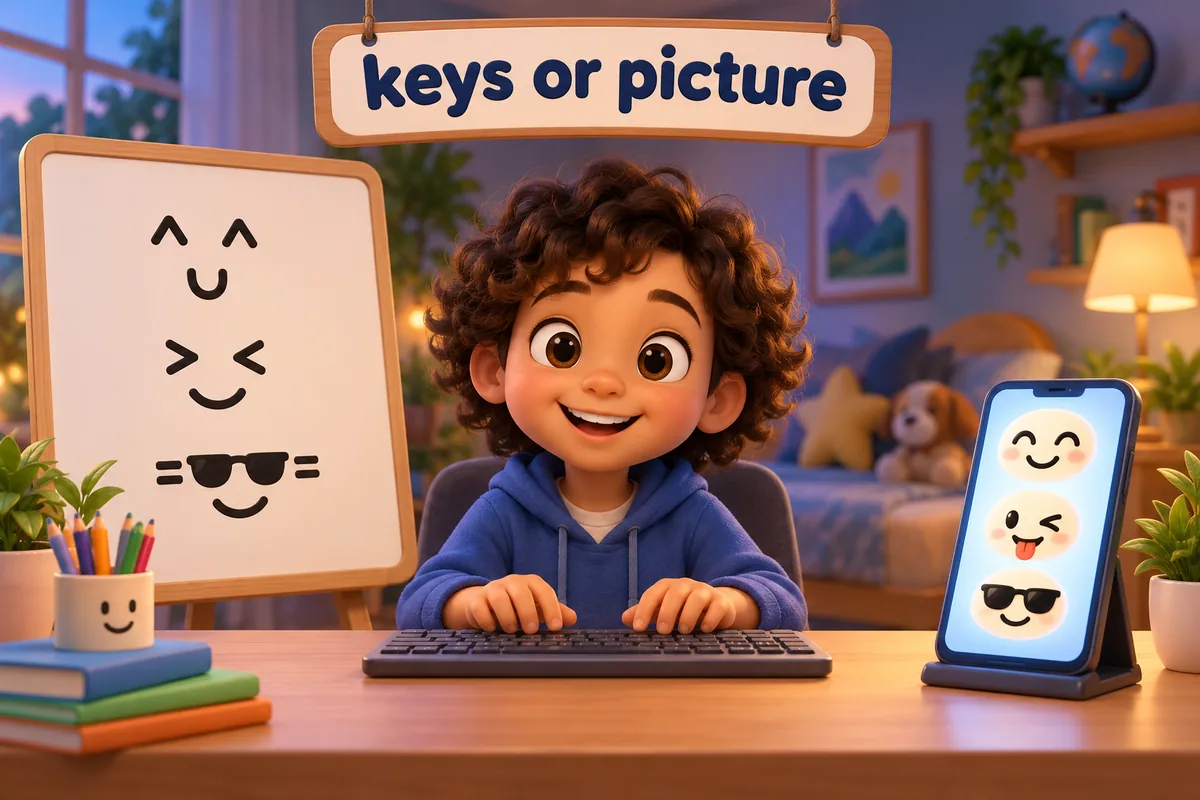
An emoticon is built from a few keys, and you read it by tilting your head to the left. The parts below show how each piece adds a feature to the face.
| Parts | Example | What it signals |
|---|---|---|
| eyes | : | the two eyes of the face |
| nose | – | an optional nose between the eyes and mouth |
| mouth | ) | a smile; the bracket points up |
| mouth down | ( | a frown; the bracket points down |
| extra mark | D | an open grin with a wide mouth |
| side mark | ; | a wink when used for an eye |
| angled face | ^_^ | a happy face read without tilting |
| flat eyes | -_- | a calm or unimpressed look |
A typed face is read by tilting the head to the left, so the colon sits on the left and the mouth bracket on the right. A few styles, such as ^_^ and T_T, are read straight on and use two eyes, a mouth and a symbol above them.
Common emoticons and their meanings
The set of everyday emoticons is small, and each one carries a clear feeling once you know the shape.
| Emoticon | Meaning | Example message |
|---|---|---|
| 🙂 | a basic smile | Thanks, that helped 🙂 |
| 🙂 | a quick smile | See you soon 🙂 |
| 😉 | a wink | I told you so 😉 |
| 😀 | a big grin | We won 😀 |
| 🙁 | a frown | My pen broke 🙁 |
| :'( | crying | The film ended :'( |
| 😛 | a tongue-out joke | Not me 😛 |
| :O | surprise | You did it :O |
| :/ | unsure or mild doubt | Maybe tomorrow :/ |
| <3 | a heart | Goodnight <3 |
| ^_^ | a happy face, angled style | Well done ^_^ |
| T_T | crying, angled style | So tired T_T |
Common emojis and their meanings
The picture set is far larger, and each emoji stands for a feeling or an idea at a glance.
| Emoji | Common meaning |
|---|---|
| 😀 | a wide smile |
| 😂 | laughing hard |
| 😉 | a friendly wink |
| 😢 | a sad tear |
| 😍 | a loving look |
| 🤔 | thought or doubt |
| 👍 | approval |
| ❤️ | love |
| 🔥 | excellent |
| 🎉 | celebration |
Emoticon emojis across contexts
One style fits a plain text screen and the other fits a modern phone, so the setting decides the choice. Each example below shows a typed face or a picture face used well in one place.
| Context | Example message | Why this works |
|---|---|---|
| Plain-text forum | Good to see you 🙂 | A typed face survives plain text. |
| Phone text | Good to see you 😀 | A picture face renders on a phone. |
| Code comment | Fixed the bug 🙂 | A typed face fits a code editor. |
| Party chat | Happy birthday 🎉 | A bright picture suits a happy event. |
| Plain email client | Thanks 🙂 | A typed face needs no picture support. |
| Group chat | Well done 👍 | One picture face reads at a glance. |
| Group project | Done ✅ | A plain tick confirms the task. |
| Formal letter | Thank you for your help. | Formal writing shows no face at all. |
Emoticon and emoji compared
The two styles share an aim but differ in how they are made and where they fit.
| Point | emoticon | emoji |
|---|---|---|
| Made from | keyboard characters | a picture drawn by software |
| Example | 🙂 | 😀 |
| Look | plain black text | bright coloured art |
| Best screen | plain text and code | phones and modern apps |
| Speed | slow to type a set | one tap to add |
| Range | a few dozen faces | thousands of pictures |
Use an emoticon where only plain text will survive, and use an emoji where the screen shows pictures, because each style suits one setting. An emoticon also travels well through plain logs and screenshots, while an emoji can appear as a blank box when the software does not recognise it, and that reliability is why the older style never fully disappeared.
Word forms and grammar of emoticon emojis
Both words follow ordinary English grammar, and each keeps its meaning as it changes form.
| Form | Part of speech | Example |
|---|---|---|
| emoticon | noun | She typed an emoticon. |
| emoticons | plural noun | Old emoticons still work. |
| emoji | noun | He added an emoji. |
| emoji | plural noun | The same form can stand for many. |
| emojis | plural noun | She sent three emojis. |
| emotive | adjective | An emotive message stirs feeling. |
The plain side of each term sits beside it, so a learner can check an emotion sentence for a feeling word. A stirring line is often called emotive in a sentence, a warm note is emotional in a sentence, and a heartfelt reply is written emotionally in a sentence.
Common mistakes with emoticon emojis
Most errors come from spacing and from overuse, because a row of faces blurs the meaning.
- Incorrect:
🙂 🙂 😉 😀 🙁 😛Correct: 🙂 or 👍, one mark only. Rule: one face per line reads best. - Incorrect:
Dear Sir, the report is done :-).Correct: Dear Sir, the report is complete. Rule: formal writing uses no emoticon. - Incorrect:
thanks so much smiley face heart.Correct: Thanks so much ❤️. Rule: name one feeling and let one symbol carry it. - Incorrect:
: I am fineCorrect: 🙂 I am fine. Rule: type the whole emoticon or leave it out. - Incorrect:
I am so sorry for your loss 😀Correct: I am so sorry for your loss. Rule: match the face to the feeling.
Practice with emoticon emojis
Try each item, then read the reason beside the answer to check your thinking.
- Fill in the blank: a smile typed from keys is ________. (an emoticon / an emoji)
- Fill in the blank: a small coloured picture is ________. (an emoji / an emoticon)
- Choose the better mark: a plain text email that strips pictures needs 🙂 / 😀. (:-) / 😀)
- Correct the error: I am so sorry for your loss :D.
- Build a message: use one emoticon and one word to say thank you.
- Spot the setting: which fits an old plain-text forum, “Good to see you :)” or “Good to see you 😀”?
Answers
- an emoticon, because it is typed from keyboard characters.
- an emoji, because it is a picture the software draws.
- 🙂 , because plain text keeps the typed face while pictures may vanish.
- I am so sorry for your loss: the face must match the sad feeling.
- Sample: Thanks so much :-). It pairs one emoticon with clear words.
- Good to see you :), because a plain-text forum keeps typed characters.
The bottom line
Emoticon emojis name two ways to show a face in a message: the typed emoticon and the picture emoji. Each carries feeling at a glance, and each suits a different screen. Use one mark per line, match the face to the feeling, and keep both out of formal writing, where plain words work best.
Frequently asked questions about emoticon emojis
Are emoticons and emojis the same thing?
They are close cousins but not the same. An emoticon is a face typed from keyboard characters, such as :-), while an emoji is a small picture that the software draws. Both show feeling, and the emoji grew from the same idea that the typed face started.
Why do people still use emoticons?
Emoticons still work wherever only plain text survives, such as code, logs and simple messages. They also feel quick and light to some writers. A typed face needs no picture support, so it never breaks, and that reliability keeps it useful beside the newer picture set.
Which one should I use in a text message?
A modern phone shows emojis well, so a single emoji is usually the easier choice for a quick text. An emoticon suits a plain-text app or an older device. Either way, one mark on a line reads better than a row of faces, so keep the message clear.
Can emoticons be used in school writing?
No. School reports, essays and formal letters use plain words with no face of any kind. A typed face may appear in a story quote or a text between characters to show tone, but the surrounding writing stays standard. Keep emoticons for casual messages.