Short and Long O Words: Sounds, Patterns, and Examples
Short O and long O name two common sounds represented by the letter o: the vowel in sock and the letter-name sound in home. Many short-O words use a consonant after a single o; long O often appears in o-consonant-e, oa, ow, or open-syllable patterns. English spelling has exceptions and accents vary.
Key facts at a glance
- In phonics, short O is the vowel sound in words such as sock; long O is the letter-name sound in home.
- A closed syllable often has a short vowel, as in hot and stop.
- Long O commonly appears in o-consonant-e, oa, ow, and open-syllable patterns.
- Spelling patterns are clues, not guarantees; English has exceptions and pronunciation varies by accent.
- Listen to the vowel in the spoken word before sorting it by spelling.
What are short O and long O sounds?
In many English phonics programs, short O is the vowel sound in sock or pot, while long O is the letter-name sound in home or go. “Long” and “short” are traditional sound labels, not instructions to hold a sound for more or less time. Pronunciation can differ across English accents.
The letter o can represent other sounds too, as in love, move, or one. Teach common patterns as decoding clues, then check the word’s pronunciation and meaning.
Which words have the short O sound?
Short O commonly appears in a closed syllable: one vowel letter followed by one or more consonants that close the syllable. Examples include hot, dog, and stop. The following list focuses on a common short-O pronunciation; some words vary by accent.
| Short O word | Example sentence |
|---|---|
| hot | The soup was hot. |
| pot | She put the pot on the stove. |
| dog | The dog slept beside the door. |
| box | We packed the books in a box. |
| sock | A red sock fell behind the chair. |
| stop | The bus came to a stop. |
| frog | A frog sat on the log. |
| clock | The clock ticked softly. |
Which spelling patterns make the long O sound?
Long O often appears in several recurring patterns. The examples below use common pronunciations; a pattern can have exceptions, so learners should read the whole word rather than apply a rule mechanically.
| Pattern | Examples | Example sentence |
|---|---|---|
| o-consonant-e | home, note, rope, those | We left a note at home. |
| oa | boat, road, toast, float | The boat moved slowly across the lake. |
| ow | snow, grow, window, own | Fresh snow covered the window ledge. |
| Open syllable | go, open, robot | We can go when the shop opens. |
| oe | toe, goes, oboe | Her toe touched the tip of the shoe. |
Reading Rockets’ phonics guidance introduces common long-vowel patterns such as oa and notes that other vowel spellings and sounds add complexity. In ow, the same letters can also say a different sound, as in cow, so the word must be checked.

How can learners practice short and long O?
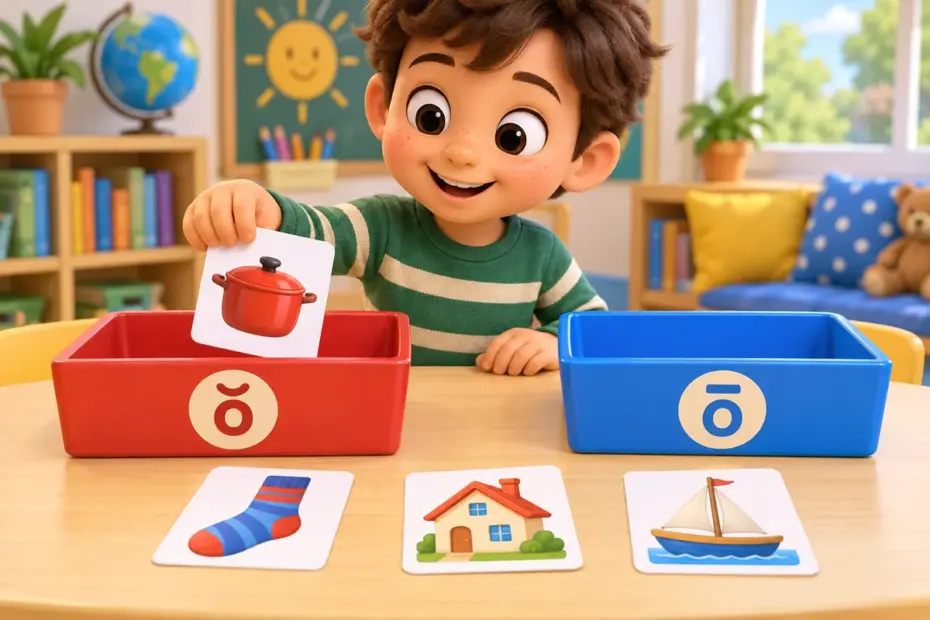
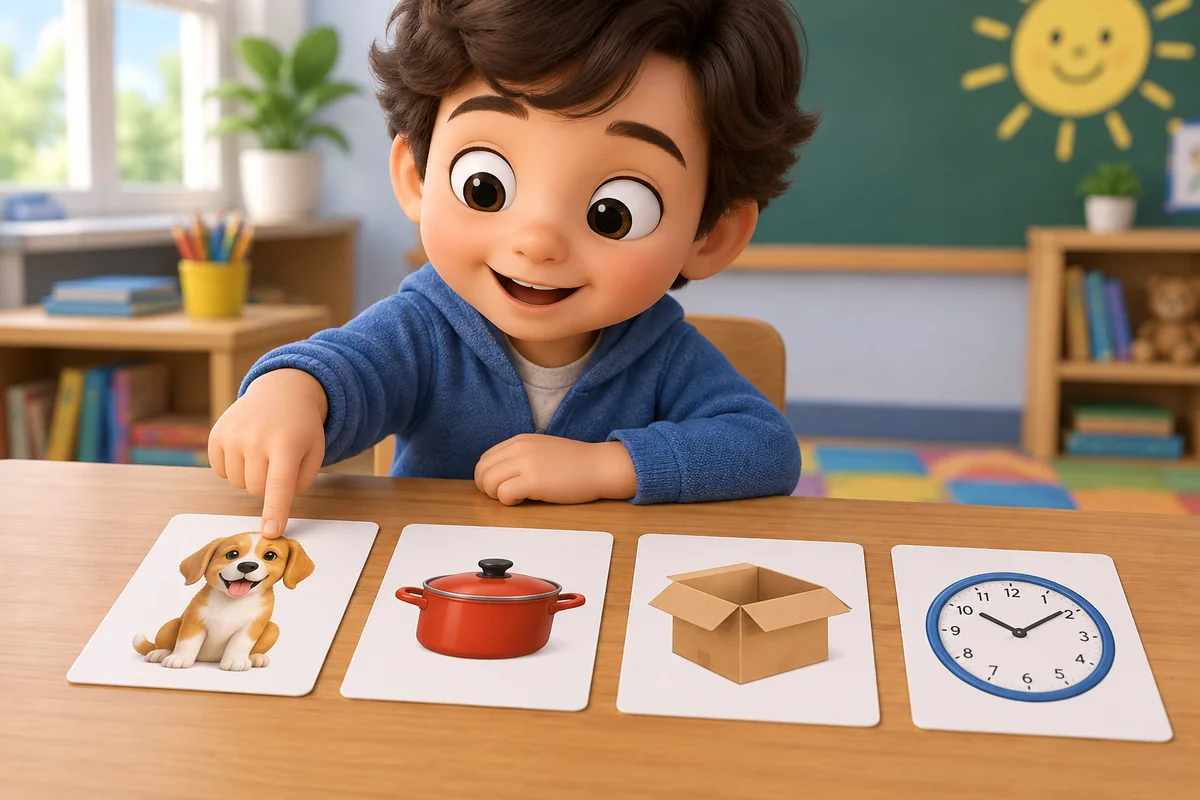
Sort picture or word cards into sound groups, say each word aloud, and point to the letter pattern that supports the sound. Begin with one-syllable examples such as hot, home, boat, and snow before adding longer words such as robot or window.
- Read the word aloud and listen for the vowel sound.
- Look for a closed syllable, silent-e pattern, vowel team, or open syllable.
- Sort by sound rather than by first or last letter alone.
- Use the word in a sentence to confirm its meaning.
Compare hop and hope to hear how final silent e changes a common pattern; compare cot and coat to hear the vowel team. Do not treat “two vowels go walking” or another shortcut as a rule without exceptions.
Frequently asked questions
What is a short O word?
A short O word has the vowel sound commonly heard in “sock” or “pot.” Examples include hot, dog, box, stop, and frog. The exact vowel quality can vary among English accents, so use the word’s spoken sound and your classroom pronunciation model when sorting examples.
What is a long O word?
A long O word has the letter-name sound, as in “home” or “go.” Common examples include note, rope, boat, road, snow, and toe. These words use several spelling patterns, and the sound can vary in some words or accents. Start with familiar words.
What spelling patterns often make long O?
Common long-O spellings include o-consonant-e, as in home; oa, as in boat; ow, as in snow; and an open syllable, as in go. These are helpful reading patterns rather than exceptionless rules. For example, ow has a different sound in cow.
How can I teach the difference between short and long O?
Say a short list of words aloud, then ask learners to listen for the vowel before looking at spelling. Sort pairs such as hop/hope and cot/coat, point to the spelling pattern, and use each word in a sentence. Include accent variation and explain that patterns have exceptions.
Conclusion
Use “short and long o vowel sound words” with a clear example, accurate context, and the right meaning so readers can see how the phrase works.
Have you ever wondered why the same letter can make different sounds? Well, in the world of phonics, it’s all about understanding the different vowel sounds. Today, I want to dive into the fascinating world of short and long o vowel sound words.
In this article, we’ll explore the extensive list of words that showcase the short and long o vowel sounds. From “pot” to “coat,” we’ll cover it all. You’ll be amazed at how a simple change in pronunciation can completely alter the meaning of a word.
What is the Short Vowel O?
The short vowel “o” is one of the sounds that the letter “o” can make in the English language. It is characterized by the sound “awe” as in words like “cop” and “bot.” Understanding the short vowel “o” is essential in the world of phonics as it helps children develop their reading and pronunciation skills.
The short vowel “o” sound is typically taught before introducing the long vowel “o” sound, as it lays a foundation for phonetic comprehension. By first familiarizing students with the short vowel sounds, teachers can help them distinguish between words with different vowel sounds and avoid confusion.
In words like “cop” and “bot,” the short vowel “o” is pronounced as “awe.” This pronunciation is made clear by the absence of the silent “e” at the end of the word, which would indicate a long vowel sound. By focusing on short vowel “o” words, students can learn to recognize and produce the correct sound.
Teaching short vowel “o” words can be an interactive and engaging activity for young learners. Activities where students raise their thumbs up or down to indicate whether they hear the short vowel “o” sound in a word can make learning more fun and memorable. Incorporating movements, such as reaching up tall for long vowel “o” words and touching their toes for short vowel “o” words, can also add a kinesthetic element to the lesson and further enhance understanding.
To reinforce the learning of short vowel “o” words, providing students with additional practice through worksheets or printable lists can be beneficial. These resources allow students to practice identifying and reading words with the short vowel “o” sound independently.
Understanding the short vowel “o” sound is a crucial step in phonics instruction. By focusing on short vowel “o” words, students can develop their ability to distinguish between different vowel sounds, paving the way for more advanced reading skills.
What is the Long Vowel O?
As an experienced blogger in phonics education, I understand the importance of teaching the different vowel sounds to help children develop their reading and pronunciation skills. In this section, we will explore the long vowel “o” and its significance in phonics instruction.
The long vowel “o” sound is typically represented by the letter “o” itself, as in words like “goat” and “low.” It is important to note that the long “o” sound can have different spelling patterns, which can be taught to students to help them recognize and remember words more effectively.
Here are some common spelling patterns for the long “o” sound:
- “O” consonant-e: In words like “nose” and “note,” the long “o” sound is created by combining the “o” with a silent “e” at the end. This pattern is known as the “o consonant-e” pattern and is an important concept for students to grasp.
- “Oa” vowel team: Another spelling pattern for the long “o” sound is the “oa” vowel team. Examples include words like “boat” and “coal.” Teaching students about vowel teams and their corresponding sounds is crucial for their phonetic understanding.
It is worth mentioning that in some cases, the long “o” sound can be made when the letter “o” appears before two consonants, as in words like “cold” and “gold.” This is an exception to the general rule and should be introduced when students are ready.
By teaching students the specific spelling patterns associated with the long “o” sound, we can help them recognize and decode words more accurately. Incorporating interactive activities and resources like worksheets can further reinforce their understanding and application of long “o” sound words.
The long vowel “o” sound plays a significant role in phonics instruction. By familiarizing students with the different spelling patterns and providing them with engaging learning materials, we can empower them to become confident readers and effective communicators.
List of Short and Long “o” Vowel Sound Words
| Bog | Bone | Bop | Bottom |
| Box | Broken | Cod | Cog |
| Con | Cop | Cot | Doctor |
| Dog | Don | Dot | Emotion |
| Focus | Fog | Global | God |
| Got | Hog | Home | Hot |
| Job | Jog | Jot | Lob |
| Lock | Log | Lop | Lot |
| Mob | Modern | Mom | Mop |
| Nod | Not | Note | Octopus |
| Odd | Open | Option | Pod |
| Pop | Pot | Problem | Remote |
| Rod | Rope | Rot | Sod |
| Solid | Tom | Top | Tot |
| Total | Woke |
Short and Long O Vowel Sounds
What are Short and Long Vowel Sounds?
In phonics education, understanding the different vowel sounds is crucial for students to become confident readers and effective communicators. The letter O, as the 4th vowel of the English alphabet, has both a short and long sound.
The short O sound is pronounced like “awe,” as in words like COP and BOT. It is the most common sound for the letter O and is introduced to students before teaching the long O sound.
On the other hand, the long O sound is pronounced like “oh,” as in words like MODE. It is usually created by a silent E at the end of a word, where the E makes the preceding vowel a long sound. For example, “MODE” has a long O sound because of the silent E at the end.
Rules for Short O Sound
To help students grasp the short O sound, it’s essential to focus on words that have a short vowel O. These words do not allow the vowel to generate its long vowel sound.
Typically, short vowel O words have three letters, which makes them an excellent starting point. However, it’s important to note that not all three-lettered words have a short vowel sound, as some might have a second vowel that forces the long vowel sound. Exceptions, such as “bee” or “tea,” utilize a second vowel to generate the long vowel sound.
Here are some examples of short O words with three letters:
- BUG
- POT
- JOB
Rules for Long O Sound
The long O sound is created by different spelling patterns and conventions, such as the silent E. While these patterns and rules are introduced later on in phonics instruction, it’s important to provide students with exposure to the long O sound.
One common spelling pattern for the long O sound is the “O consonant-E” pattern. Words like MODE and NOTE follow this pattern, where the silent E at the end makes the O sound long.
Another pattern is the “OA” vowel team, found in words like COAT and BOAT. In this pattern, the two vowels work together to create the long O sound.
By teaching students these spelling patterns and rules for the long O sound, we can help them recognize and decode words accurately.
Remember, the short and long O vowel sounds are important components of phonics education. Through interactive activities and resources like worksheets, we can reinforce learning and support students in becoming confident readers.
Now that we’ve covered the short and long O vowel sounds, let’s explore some word lists to further enhance students’ understanding and practice.
Short O Word List
Short O Words with -ob and -op
When teaching the short “O” vowel sound, it’s important to introduce words that demonstrate this sound. One way to do this is by focusing on word families or rimes that contain the short “O” sound. Let’s take a look at some words with the -ob and -op endings that have the short “O” sound:
- cob
- job
- mob
- pop
- top
- chop
- shop
- stop
By exploring these word families, students can develop an understanding of the short “O” sound and begin to recognize and decode words accurately.
Short O Words with -ot and -og
Another set of word families that help reinforce the short “O” sound include those with the -ot and -og endings. Here are some examples of words with the short “O” sound in these word families:
- dot
- hot
- pot
- got
- jog
- log
- dog
- fog
Teaching students these word families can enable them to identify and read words that contain the short “O” sound, thereby enhancing their reading fluency and confidence.
Short O Words with -ock and -op
Expanding their knowledge of short “O” words, students can delve into word families with the -ock and -op endings. Here are some examples to include in your teaching materials:
- sock
- lock
- rock
- knock
- crop
- drop
- flop
- stop
By adding these words to their vocabulary, students can enhance their reading and phonics skills, improving their ability to decode and recognize words with the short “O” sound.
Short O Words with -os and -on
To further strengthen students’ understanding of the short “O” sound, it’s essential to introduce words from word families with the -os and -on endings. Here are some examples:
- boss
- loss
- moss
- toss
- con
- don
- gone
- ton
Including these word families in instruction can help students recognize and decode words with the short “O” sound more efficiently, contributing to their overall reading achievement.
Remember, teaching students about word families and their associated short “O” sounds is an effective way to reinforce the phonics skills necessary for accurate reading and decoding.
Long O Word List
When teaching the long O vowel sound, it’s important to provide students with a comprehensive list of words that exemplify this sound. This word list will help students practice and reinforce their understanding of the different spelling patterns associated with the long O sound.
Long O Words with -ow and -oa
Words with the spelling pattern -ow and -oa make the long O sound. Here are some examples:
- ow: bow, cow, how, now, row, sow
- oa: boat, coat, float, goat, moat, soap
These words not only provide practice with the long O sound but also expose students to different vocabulary and contexts where the long O sound is used.
Long O Words with -old and -ote
Another set of spelling patterns that produce the long O sound are -old and -ote. Here are some examples:
- -old: bold, cold, fold, gold, hold, mold
- -ote: note, vote, tote, quote, remote, wrote
Exploring words with these spelling patterns allows students to recognize and differentiate between different ways of spelling the long O sound.
Long O Words with -ose and -one
The spelling patterns -ose and -one also produce the long O sound. Here are some examples:
- -ose: close, dose, hose, nose, pose, rose
- -one: cone, gone, lone, phone, stone, tone
By including words with -ose and -one in the long O word list, students can further solidify their understanding of the different ways the long O sound is represented.
Remember, practicing with these word lists will enhance students’ phonics skills and help them become more confident and independent readers.
Teaching the Long O Sound
Now that we’ve covered the short “O” sound, it’s time to move on to the long “O” sound. Teaching the long “O” sound introduces students to different spelling patterns and helps them understand how the sound can be represented in different ways. This section will provide you with word lists and strategies to effectively teach the long “O” sound to your students.
Word Lists for Teaching the Long O Sound
- -ow: bow, cow, how, now, row
- -oa: boat, coat, goat, road, toad
- -old: bold, cold, hold, mold, sold
- -ote: note, vote, wrote, smote, tote
- -ose: close, hose, nose, pose, rose
- -one: cone, gone, lone, phone, stone
Strategies for Teaching the Long O Sound
- Phonics Games: Engage your students in fun and interactive phonics games to practice and reinforce the long “O” sound. For example, you can play “Long O Bingo” where students identify and mark words with the long “O” sound on their bingo cards.
- Word Sorts: Provide students with word cards representing different spelling patterns for the long “O” sound. Ask students to sort these words into categories based on the spelling patterns they observe. This activity enhances their phonetic awareness and helps them identify patterns in words.
- Word Hunts: Have students go on a “word hunt” around the classroom or in books to find words with the long “O” sound. Encourage them to record these words in their notebooks or on a worksheet. This activity promotes independent learning and reinforces their understanding of the long “O” sound.
- Interactive Whiteboard Activities: Utilize interactive whiteboard activities that allow students to manipulate and interact with words. This can include matching, sorting, and filling in missing letter activities. Visual and hands-on experiences enhance learning and engagement.
Remember, teaching the long “O” sound is an important step in developing your students’ phonics skills. By providing them with word lists and engaging activities, you can help them practice, reinforce, and master the different spelling patterns associated with the long “O” sound.
And there you have it – a comprehensive guide to teaching the long “O” sound.
Teaching the Short O Sound
When it comes to phonics education, teaching vowel sounds is crucial. One important vowel sound to focus on is the short “O” sound. In this section, I’ll share some strategies and resources for helping students learn and master the short “O” sound.
First and foremost, it’s essential for students to understand the difference between the short and long “O” sounds. Before introducing the long “O” sound, make sure your students are familiar with the short “O” sound. You can do this by providing examples and having them practice saying words with the short “O” sound.
To engage your students and make learning fun, consider using interactive activities and games to teach the short “O” sound. Here are a few ideas:
- Phonics Games: Play games like “I Spy” or “Word Bingo” where students have to find and identify words that contain the short “O” sound. This not only reinforces their understanding of the sound but also improves their vocabulary.
- Word Sorts: Provide word cards with different short “O” sound words and have students sort them into categories based on their spelling patterns. This helps them recognize and internalize the different ways the short “O” sound can be represented.
- Word Hunts: Give students worksheets or passages and have them search for words that have the short “O” sound. This activity encourages them to listen for the sound and reinforce their understanding through reading and writing.
- Interactive Whiteboard Activities: Use online resources or interactive whiteboard activities to present short “O” sound words in an engaging way. Students can drag and match word cards, complete fill-in-the-blank exercises, or listen to audio recordings of words containing the short “O” sound.
By incorporating these strategies into your phonics instruction, you can effectively teach the short “O” sound and help your students become more confident readers. Remember, it’s important to keep the lessons engaging and interactive to ensure maximum learning retention.
Now that we have covered strategies for teaching the short “O” sound, in the next section, we will explore word lists and resources for teaching the long “O” sound. Stay tuned!
Word lists and resources for teaching the short “O” sound help students practice and reinforce their understanding of this vowel sound. Engaging activities like phonics games, word sorts, word hunts, and interactive whiteboard activities make learning fun and effective.
Conclusion
Teaching vowel sounds is a crucial aspect of phonics education, and in this article, I have discussed the significance of focusing on the short “O” sound. By implementing various strategies and resources such as phonics games, word sorts, word hunts, and interactive whiteboard activities, educators can create engaging and interactive lessons that help students practice and reinforce their understanding of the short “O” sound.
It is important to remember that these activities not only provide opportunities for students to develop their phonics skills but also enable them to retain what they have learned. By incorporating interactive elements into lessons, educators can ensure maximum learning retention.
In the next section, we will delve into word lists and additional resources that can be used to teach the long “O” sound. These resources will further enhance students’ phonics knowledge and help them become proficient in recognizing and producing words with the long “O” sound.
By employing a variety of teaching strategies and resources, educators can effectively support their students in mastering vowel sounds, including the short and long “O” sounds.