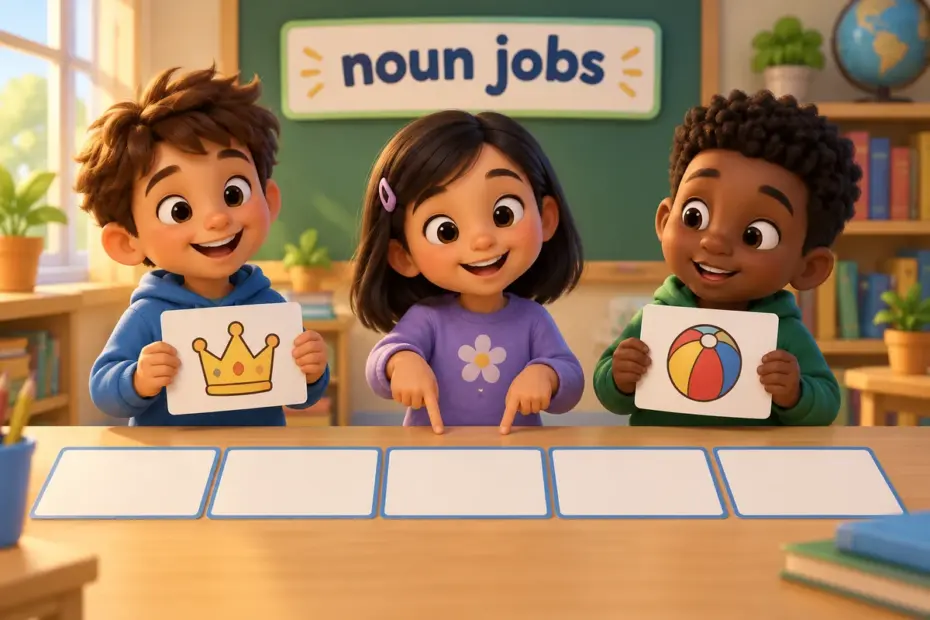
The functions of nouns in English sentences are the jobs a noun performs: subject, object, complement, appositive and more. A noun is a naming word, and which function it fills depends on its position and on what the verb needs. Maya threw the ball shows a subject noun and an object noun side by side.
Functions of Nouns in English Sentences at a glance
- A noun names a person, place, thing or idea.
- The same noun can do different jobs in different sentences.
- Function is decided by position and by the verb, not by the word alone.
- The eight core functions are subject, direct object, indirect object, subject complement, object complement, appositive, object of a preposition and noun adjunct.
- The commonest error is confusing a subject complement with a direct object.
What are the functions of nouns in English sentences?
A noun function is the grammatical slot a noun fills in a clause. English marks most functions by word order rather than by endings, so the same noun changes job when it moves. In The dog chased the cat, dog is the subject because it acts, and cat is the object because it receives the action. The table lists the eight functions with a test question for each.
| Function | Question it answers | Example |
|---|---|---|
| Subject | Who or what does the action? | The dog barked. |
| Direct object | Who or what receives the action? | She kicked the ball. |
| Indirect object | To whom or for whom? | He gave me a gift. |
| Subject complement | What is the subject? | Amina is a doctor. |
| Object complement | What does the object become? | They elected her president. |
| Appositive | What else is it called? | My brother, a chef, cooks well. |
| Object of a preposition | After which preposition? | We met at the station. |
| Noun adjunct | What kind or purpose? | The school bus arrived. |
How do you find the function of a noun in a sentence?
Finding the function is a sequence of questions, not a guess. Start with the verb, then ask who or what performs it; that noun is the subject. Ask who or what receives the action for the object, and check the words before a noun for a preposition. For extra work on descriptive words that cluster around nouns, see how to use adjectives in sentences and phrases.
| Step | What to look for | Example |
|---|---|---|
| Find the main verb | Every clause has one main verb | Rain fell. |
| Ask who or what before the verb | That noun is the subject | The teacher smiled. |
| Ask who or what after an action verb | That noun is the direct object | She read the letter. |
| Ask to whom or for whom | That noun is the indirect object | He sent us a card. |
| Look after a linking verb | A noun there is a subject complement | He became a pilot. |
| Look beside another noun | An appositive renames it | Paris, the capital, glows. |
| Look after a preposition | That noun is the object of the preposition | She waited in the hall. |

Functions of nouns in English sentences: examples across contexts
The same eight jobs appear in every register, from a text message to a science report. Reading the function in different contexts makes the labels stick, and the sentence patterns overlap with adjective clauses in complex sentences that also attach nouns to other nouns.
| Context | Sentence | Function in focus |
|---|---|---|
| Classroom | The teacher praised the pupil. | pupil is the direct object |
| Home | Dad cooked the family a meal. | family is the indirect object |
| News report | The mayor resigned on Tuesday. | mayor is the subject |
| Workplace email | Please send me the report. | the report is the direct object |
| Science writing | Water becomes steam when heated. | steam is a subject complement |
| Academia | The committee elected Dr Ray chair. | chair is an object complement |
| Travel writing | Cairo, a busy city, never sleeps. | a busy city is an appositive |
| Conversation | We waited at the corner. | the corner is the object of a preposition |
| Marketing | Our summer sale starts today. | summer is a noun adjunct |
| Storytelling | The king wore a golden crown. | crown is the direct object |
How do you tell a direct object from a subject complement?
Both sit after the verb, so learners mix them up, but the verb type decides. An action verb takes a direct object that is a different thing from the subject, while a linking verb takes a complement that describes or names the same subject. The test below separates them in one line.
| Test | Direct object | Subject complement |
|---|---|---|
| Verb type | action verb | linking verb |
| Relation to subject | a different thing | the same thing |
| Can it be replaced by an adjective? | no | often yes |
| Example | She fixed the engine. | She became an engineer. |
| Swap test | subject and object do not swap | subject and complement can swap |
Read the noun back onto the subject: a doctor after is means the same person, but an engine after fixed does not.
Word forms and grammar of nouns
Nouns carry number and possession, and those endings change how a function reads. A plural subject takes a plural verb, and an apostrophe marks possession. The table shows the forms a learner meets most, including the words that only look like verbs.
| Form | What it is | Example |
|---|---|---|
| common noun | a general name, no capital | city, river, idea |
| proper noun | a specific name, capitalised | Lagos, Nile, Friday |
| countable noun | takes a plural form | one chair, two chairs |
| uncountable noun | no plural, singular verb | water, advice, furniture |
| collective noun | names a group | team, family, crowd |
| possessive noun | shows ownership with an apostrophe | the boy’s cap, the teachers’ room |
| noun adjunct | a noun used like an adjective | school bus, tennis racket |
| gerund | an -ing verb form acting as a noun | Swimming is good exercise. |
For a wider set of example nouns grouped by first letter, browse nouns that start with c and test each one in the functions above.
Common mistakes with noun functions
Mistake 1: an object where a subject belongs. Incorrect: The letter and the parcel was sent. Correct: The letter and the parcel were sent. Rule: two subjects joined by and make a plural subject that needs a plural verb.
Mistake 2: confusing a complement with an object. Incorrect: She became a doctor means she received one. Correct: The noun after became names the same person, so it is a subject complement. Rule: linking verbs take complements, not objects.
Mistake 3: a double object with no order. Incorrect: I gave the gift my sister. Correct: I gave my sister the gift. Rule: with two objects, put the person before the thing.
Mistake 4: an adjective used as an appositive. Incorrect: My aunt, very kind, arrived. Correct: My aunt, a kind woman, arrived. Rule: an appositive must be a noun phrase that renames the other noun.
Mistake 5: a missing preposition object. Incorrect: She is the person I spoke. Correct: She is the person I spoke to. Rule: a preposition such as to needs its noun object.
Practice using the functions of nouns in English sentences
- Find the subject: The old bridge collapsed in the storm.
- Find the direct object: Ravi repaired the bicycle.
- Find the indirect object: The nurse brought the patient water.
- Label the complement: She grew tired, and he became a captain.
- Spot the appositive: My cousin, a pilot, flies weekly.
- Correct the error: The team play well together.
Answers
- The old bridge is the subject; it performs collapsed.
- The bicycle is the direct object; it receives the action.
- The patient is the indirect object; it answers to whom water was brought.
- A captain is the subject complement; it names the same person as he.
- A pilot renames my cousin, so it is an appositive.
- The team plays well together; a collective noun acting as one unit takes a singular verb.

The bottom line
The functions of nouns in English sentences come down to position and the verb, not to memorising eight labels. Ask who acts to find the subject, ask who or what receives the action to find the object, and check the verb type to separate an object from a complement. Once the questions become automatic, every sentence can be mapped in seconds.
Frequently asked questions about noun functions
Can one noun have two functions in the same sentence?
Yes, when a sentence contains two clauses. In The man who called left a note, the man is the subject of left and who is the subject of called. Each noun phrase belongs to one clause and keeps one function there, so count clauses first.
Is a noun always the subject of a sentence?
No. A noun can be the subject, a direct or indirect object, a complement, an appositive, the object of a preposition or a noun adjunct. Only the subject performs the main action, and many sentences place their nouns in several other roles.
How do I know if a word is a noun or a verb?
Try placing a word such as the or a before it. If the sentence still works, the word is a noun, as in the report. If it takes an object and shows action, as in they report the news, that use is a verb, so the same word can switch roles.
What is the difference between a direct object and an indirect object?
The direct object receives the action and answers who or what, while the indirect object answers to whom or for whom. In She gave the child a book, the book is the direct object and the child is the indirect object, named before the thing.