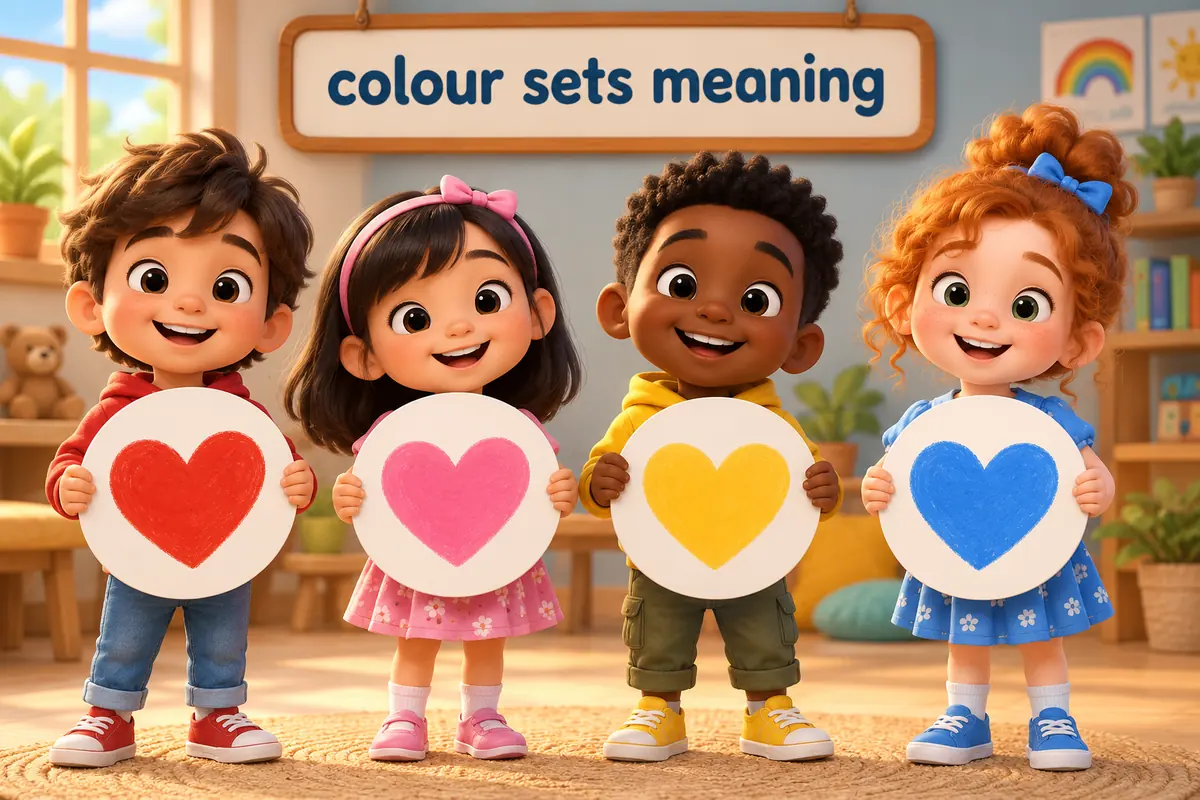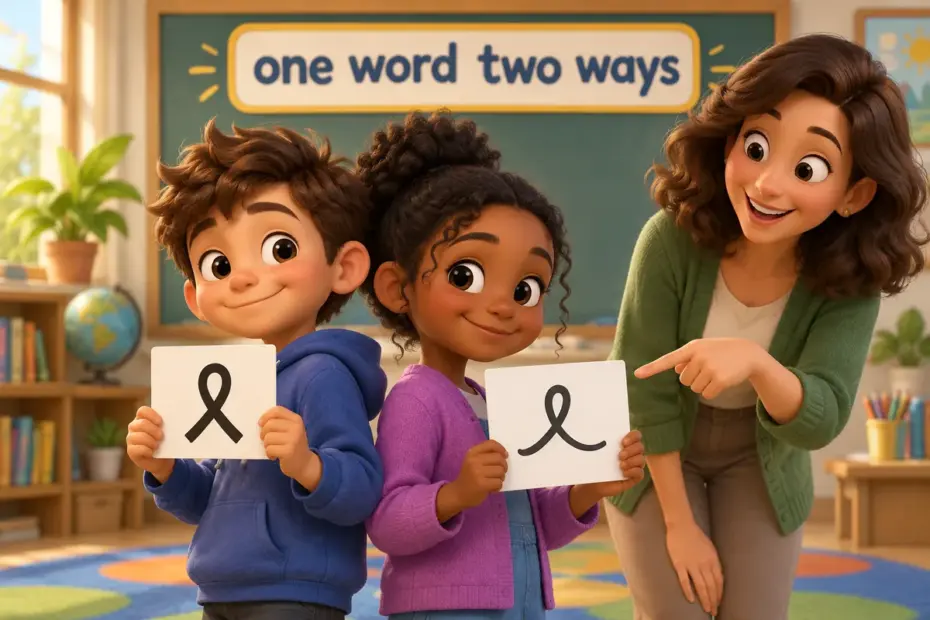
Homographs in English with meanings are words that share one spelling but carry two or more senses, such as bow for a ribbon and bow for a weapon. Some homographs change their sound, which is why lead the metal and lead the verb are said differently. This guide lists the pairs and shows how to choose the right meaning.
Homographs in English with meanings at a glance
- A homograph is one spelling with two or more meanings.
- Some homographs sound the same and some sound different.
- Stress can move between senses, as in PREsent and preSENT.
- Context, not the spelling, decides which meaning is intended.
- The commonest error is reading the wrong sense from a familiar word.
What is a homograph?
A homograph is a word that is written exactly like another word but has a different meaning and often a different origin. The two senses may share a part of speech, as in the two nouns of bat, or differ, as in the noun and verb of object. The table lists common homographs with both meanings and a sentence for each; further word-structure notes sit in word structure in a sentence.
| Word | Meaning one | Meaning two |
|---|---|---|
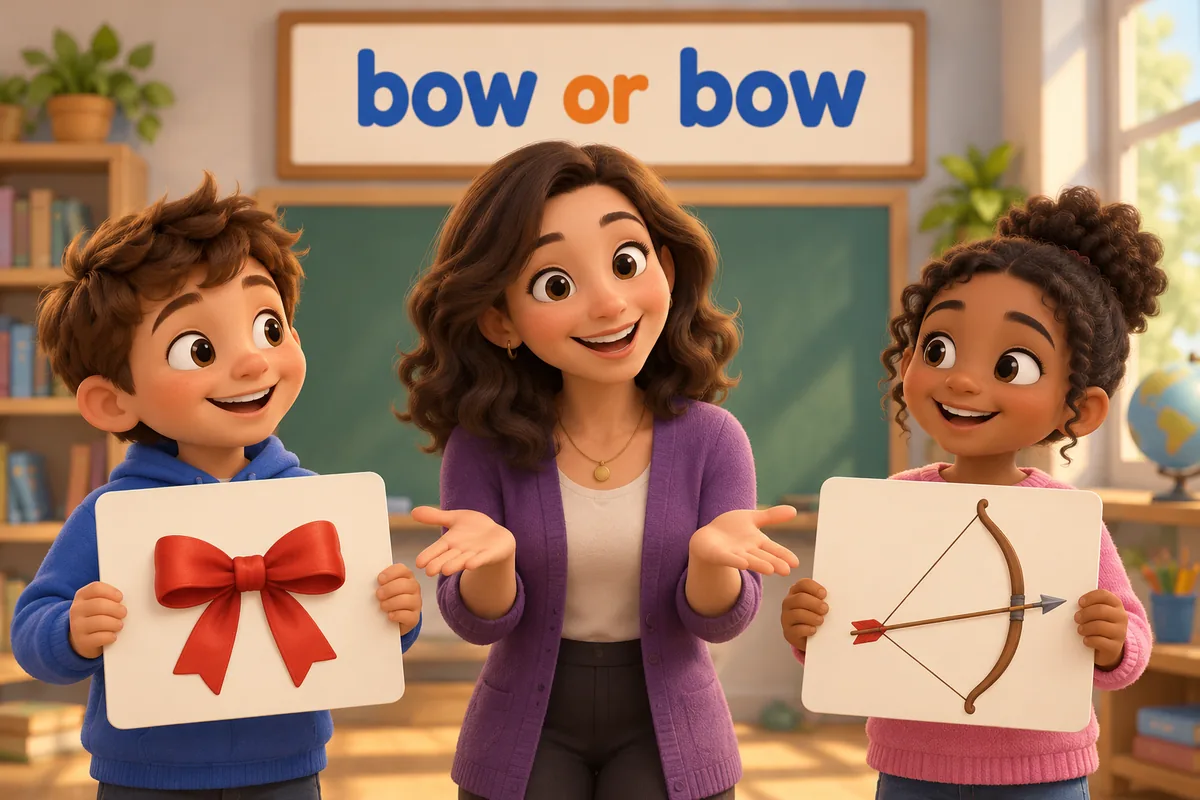
| bow | a tied ribbon | a weapon for arrows |
| lead | a heavy metal | to guide a group |
| tear | a drop from the eye | to rip paper |
| wind | moving air | to turn a handle |
| bass | a low voice or instrument | a kind of fish |
| close | near in space | to shut a door |
| desert | dry sandy land | to abandon someone |
| minute | sixty seconds | very small |
| refuse | household waste | to say no |
| object | a thing you can touch | to disagree with a plan |
Homographs vs homophones vs homonyms
The three terms overlap, so learners mix them up. A homograph shares spelling, a homophone shares sound, and a homonym is the umbrella word for both. A pair can belong to more than one group, which is why bear the animal and bear the verb count as both a homograph and a homonym. Strictly speaking, a homograph does not have to sound alike, and a homophone does not have to look alike, so the two sets overlap only partly. The table separates the three.
| Term | What it shares | Example pair |
|---|---|---|
| Homograph | spelling | lead (metal) and lead (guide) |
| Homophone | sound | to, too and two |
| Homonym | spelling or sound | bear (animal) and bear (carry) |
| Heteronym | spelling, but a different sound | wind (air) and wind (turn) |
Homographs in English with meanings: examples across contexts
The right meaning always comes from the sentence around the word, so context does more work than any list. Each line below uses a homograph in a setting that points to one sense, and more example frames sit in vocabulary in a sentence.
| Context | Sentence | Sense in use |
|---|---|---|
| Craft class | She tied a bow on the parcel. | ribbon bow |
| Archery lesson | He drew the bow and aimed. | weapon bow |
| Science lab | The pipe is made of lead. | the metal |
| Team meeting | She will lead the project. | to guide |
| Wedding | A tear ran down her cheek. | eye drop |
| Wrapping gifts | Do not tear the paper. | to rip |
| Weather news | The wind picked up at noon. | moving air |
| Toy repair | Turn the handle to wind the clock. | to twist |
| Geography | Few plants grow in the desert. | dry land |
| Storytelling | He would never desert a friend. | to abandon |
Which homographs change their sound?
Some homographs are also heteronyms, which means the spelling stays the same while the sound shifts. The change is often a vowel sound or a move in stress, and the sound usually marks the difference between a noun and a verb. The table shows the pairs a learner meets most, and further notes sit in pronounce in a sentence.
| Word | Sound one | Sound two |
|---|---|---|
| lead | rhymes with red | rhymes with feed |
| wind | rhymes with sinned | rhymes with find |
| tear | rhymes with ear | rhymes with air |
| close | rhymes with dose | rhymes with gross |
| object | stress on the first syllable | stress on the second syllable |
| present | stress on the first syllable | stress on the second syllable |
The stress pattern is a reliable clue once it is learned. In these pairs the noun usually takes stress on the first syllable and the verb on the second, so the ear can tell the two apart even before the meaning is clear. A learner who masters this shift can read object and present confidently in speech and in writing.
Word forms and parts of speech of homographs
Many homograph pairs split along the noun and verb line, so the part of speech often hints at the sense. Learning the pair with its grammar keeps the two meanings apart far better than a bare list of definitions.
| Word | Form one | Form two |
|---|---|---|
| object | noun: a thing | verb: to oppose |
| present | noun: a gift | verb: to show |
| record | noun: a document | verb: to capture sound |
| refuse | noun: waste | verb: to decline |
| desert | noun: dry land | verb: to abandon |
| contest | noun: a competition | verb: to challenge |
Common mistakes with homographs
Mistake 1: choosing the wrong sense. Incorrect: He bought a bow of ribbon and shot an arrow. Correct: He tied a bow of ribbon and shot an arrow from a different bow. Rule: one spelling covers both senses, so the sentence must make the choice clear.
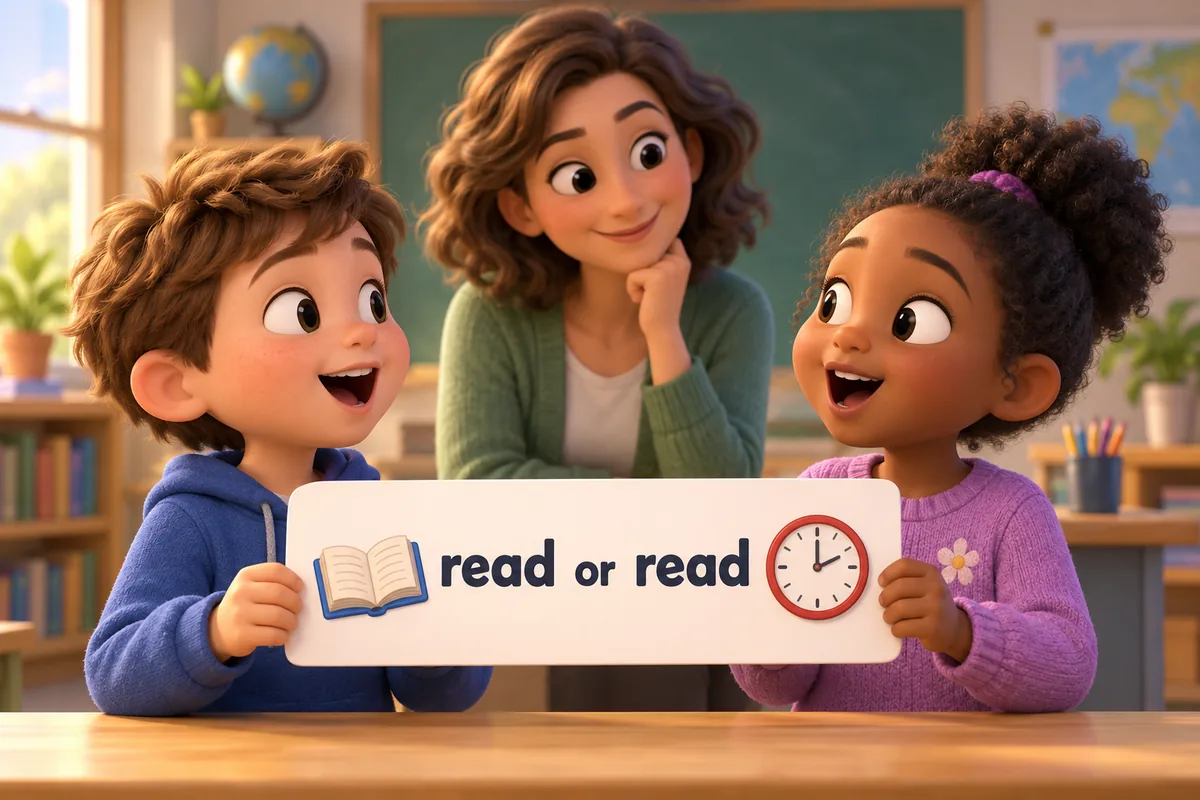
Mistake 2: reading a familiar word only one way. Incorrect: The report will lead to trouble, said as the metal. Correct: The report will lead to trouble, said to rhyme with feed. Rule: lead is a heteronym, so sound and sense go together.
Mistake 3: a stressed-syllable slip. Incorrect: I want to PREsent my idea, stressing the first syllable in the verb. Correct: I want to preSENT my idea. Rule: the verb takes stress on the second syllable.
Mistake 4: confusing a homograph with a homophone. Incorrect: to and too are homographs. Correct: to and too are homophones, because they sound alike but are spelled differently. Rule: homographs share spelling, homophones share sound.
Mistake 5: ignoring the plural change. Incorrect: The team records three wins, said as the noun. Correct: The team records three wins, said as a verb. Rule: the same letters shift part of speech, and the sound or stress shifts with them.
Practice using homographs
- Choose the sense: The dove flew away, or He dove into the pool?
- Pick the sound of live: a live concert, or the place where I live.
- Correct the error: She wound the clock and then felt the wound.
- Build a sentence: use object once as a noun and once as a verb.
- Name the term: lead and lead share spelling, so they are ______.
- Spot the stress: is the noun a REC-ord or a reCORD?
Answers
- The dove flew away uses the bird, a noun; He dove into the pool uses the verb form of dive.
- A live concert uses the long i sound, and where I live uses the short i sound.
- She wound the clock and then felt the wound; the verb is said one way and the noun another.
- Sample: I placed the object on the shelf, but I object to that plan; the noun and verb differ in stress.
- homographs, because the spelling is shared.
- A REC-ord, with stress on the first syllable.
The bottom line
Homographs in English with meanings are simply one spelling for two ideas, and the sentence decides which idea is in play. Learn each pair with its part of speech and, where it applies, its sound, because the grammar and the pronunciation point to the sense. Read the whole line before you decide, and the right meaning appears on its own.
Frequently asked questions about homographs
What is a homograph?
A homograph is a word that is spelled exactly like another word but has a different meaning. The two words may sound the same, as with bear the animal and bear the verb, or sound different, as with lead the metal and lead the verb. Context decides the sense.
What is the difference between a homograph, a homophone and a homonym?
A homograph shares spelling, a homophone shares sound, and a homonym is the umbrella term for both. To, too and two are homophones because they sound alike. Lead and lead are homographs because they look alike. Many pairs fit more than one label.
Do homographs always sound the same?
No. When a homograph is also a heteronym, the sound changes with the meaning, as in wind for moving air and wind for turning a handle. Many other homographs keep the same sound, as with the two senses of bat, a flying animal and a sports club.
How can I tell which meaning of a homograph is intended?
Read the words around the homograph, because the sentence supplies the clues. A word like pipe points to lead the metal, while a word like team points to lead the verb. Part of speech and pronunciation add a second clue when the sound changes.