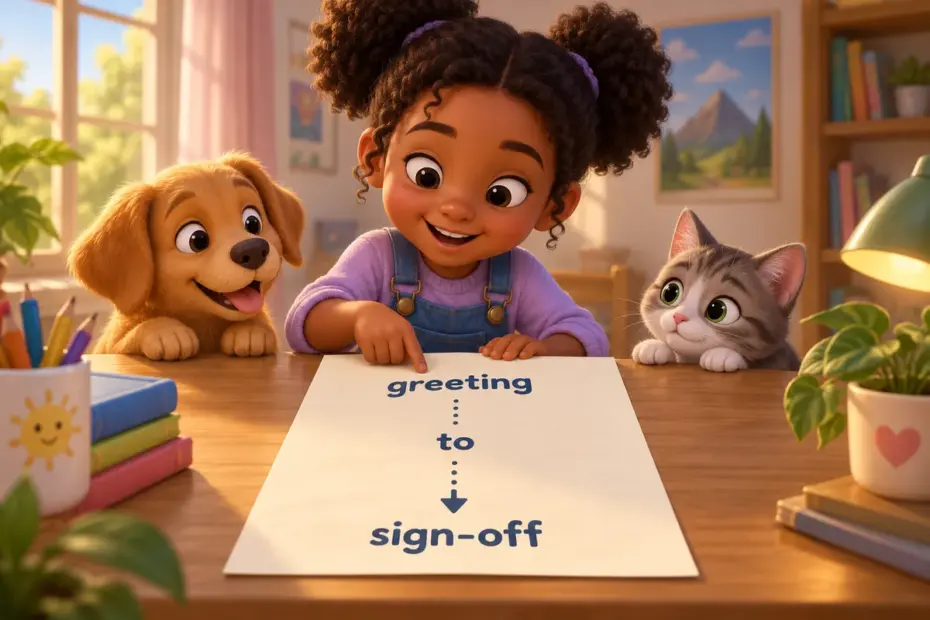
Knowing how to write a letter means knowing who will read it, because the reader sets the tone. A letter carries a heading, a greeting, a short body and a sign-off, as in “Dear Mr Cole, thank you for your help with the forms.”
Letter writing at a glance
- A letter has a heading, a greeting, a body and a sign-off.
- The reader chooses the tone, formal or informal.
- A formal letter states its purpose in the first line.
- An informal letter can be warm, short and personal.
- Block layout is the usual choice for formal letters today.
- The commonest error is skipping the clear purpose at the start.
What are the parts of a letter?
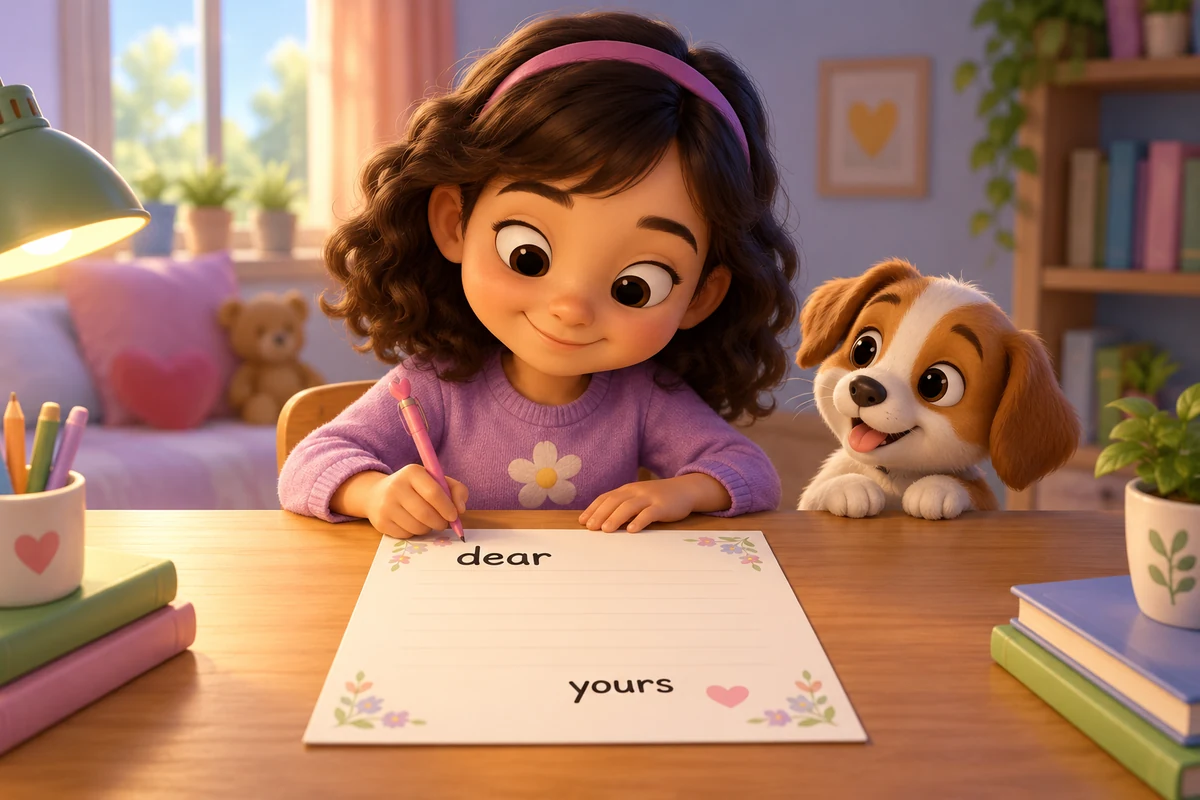
A letter has a heading, a greeting, a body and a sign-off, and each part has a job. The first capital of a name, the initial letter, begins the greeting and the sign-off.
| Part | Purpose | Example |
|---|---|---|
| Heading | Gives your address or the date | 12 Oak Lane, 4 May 2026 |
| Greeting | Names the reader | Dear Mr Cole, |
| Opening line | States why you are writing | I am writing to ask about the course. |
| Body | Gives the details | Could you send the term dates? |
| Sign-off | Closes politely | Yours sincerely, |
| Signature | Names the writer | Priya Raman |
The heading, greeting, body and sign-off also carry the letter’s tone, so the reader forms an impression before reaching the message itself. A neat heading and a correctly spelled name signal care, while a missing greeting or a casual sign-off suggests haste. Even a short letter reads as thoughtful when these four parts are present and in order, which is why teachers check the frame before they check the content.
How do you write a letter in five steps?
Write a letter in five moves so the reader never has to guess your purpose. Decide the reader, set the tone, state the reason first, add only the details that support it, and close politely. For practice with one fixed phrase, see how a letter a appears in context.
| Step | Action | Example |
|---|---|---|
| 1. Reader | Decide who will read it | A landlord, a friend, a school |
| 2. Tone | Choose formal or informal | Formal for a landlord |
| 3. Purpose | State it in the first line | I am writing to report a broken tap. |
| 4. Details | Add only what supports it | The kitchen tap has dripped since Monday. |
| 5. Close | Sign off politely | Yours sincerely, Priya Raman |
Letter lines across contexts
The same frame holds across many readers, and only the tone shifts. Each line below opens a letter and names its purpose at once.
| Context | Line | Why it works |
|---|---|---|
| Complaint | “I am writing to report a fault with the tap.” | It states the purpose first. |
| Application | “I am writing to apply for the summer post.” | It names the role at once. |
| Invitation | “We would be glad if you could join us.” | It is warm but clear. |
| Request | “Could you send the form by Friday?” | It asks for one action. |
| Thank-you | “Thank you for your help last week.” | It names the reason for thanks. |
| Apology | “I am sorry that I missed the meeting.” | It admits the fault plainly. |
| School note | “Please excuse Alia from games today.” | It states the request clearly. |
| Reference | “I am pleased to recommend Mr Aden.” | It gives the letter’s purpose at once. |
How is a formal letter different from an informal one?
Formal and informal letters share a frame but differ in tone, greeting and level of detail. A formal letter is brief, polite and direct, while an informal letter may share news and feelings. A formal letter is often set in block letter form so every line starts at the left margin.
| Feature | Formal letter | Informal letter |
|---|---|---|
| Reader | A stranger or an official | A friend or a relative |
| Greeting | Dear Ms Cole | Hi Aunt Meera |
| Tone | Polite and impersonal | Warm and personal |
| Sentences | Short and direct | Longer and relaxed |
| Sign-off | Yours sincerely | Love or Best wishes |
Word forms and grammar of letter writing
Letter writing uses a small set of fixed phrases, and using the right one signals that you know the form. The same formal tone carries into a cover letter for a job, which follows the same frame.
| Phrase | Use | Example |
|---|---|---|
| Dear Sir or Madam | No name known | Dear Sir or Madam, |
| I am writing to | Opening purpose | I am writing to enquire about the course. |
| I would be grateful if | A polite request | I would be grateful if you could reply. |
| Yours sincerely | Signed to a named reader | Yours sincerely, Priya Raman |
| Yours faithfully | Signed to Dear Sir or Madam | Yours faithfully, Priya Raman |
Letter writing rewards a habit of reading the draft from the reader’s side. Ask what the reader needs to know and where they will look for it, because a formal letter is often skimmed for the purpose and the request before it is read in full. Place the purpose in the opening line and the request near the close, then check that the greeting and the sign-off agree with each other. A reader who sees Dear Sir or Madam above Yours sincerely will trust the letter less, since the mismatch suggests the writer did not check. This small review turns a merely correct letter into a considerate one.
Common mistakes when writing a letter
Each pair shows a weak line, a repair, and the rule behind the fix.
- Incorrect:
Hi Sir, I want to complain. - Incorrect:
Yours sincerely,after Dear Sir or Madam, - Incorrect:
I am writing this letter to you today about a thing. - Incorrect:
Bye for now,to a landlord - Incorrect:
Dear Mr Cole, I hope you are fine and the family is well and the weather is nice. I want a form.
Practice writing a letter
Six tasks cover the frame, the tone and the sign-off.
- Fill the gap: “I am writing to ______ about the course.” (ask / say)
- Choose the better greeting for a named reader: “Dear Ms Cole” or “Hi Sir”.
- Correct the error: “Yours sincerely” after “Dear Sir or Madam”.
- Build a sentence that states a complaint’s purpose in one line.
- Spot the register: which closes an informal letter, (a) Love, or (b) Yours faithfully?
- Write one polite request asking for a reply by Friday.
Answers
- ask, because “ask about” is the natural phrase here.
- Dear Ms Cole, because a named reader takes a named greeting.
- Yours faithfully, because an unnamed reader takes faithfully.
- I am writing to report a fault with the kitchen tap, because it states the purpose at once.
- (a) Love, because it suits a friend rather than an official.
- I would be grateful if you could reply by Friday, because it politely asks for one action.
The bottom line
How to write a letter comes down to matching the reader and stating your purpose in the first line. Use the heading, greeting, body and sign-off as a frame, and choose a formal or informal tone to suit the reader. Keep the closing phrase correct and the letter brief.
Frequently asked questions about writing letters
What is the correct order of a letter?
A letter runs from the heading and greeting, through the body, to the sign-off and signature. The heading gives the date or address, the greeting names the reader, the body carries the message, and the sign-off closes politely before your name is written below it.
How do I start a formal letter?
Start a formal letter with the correct greeting, then state your purpose in the very first sentence. Dear Sir or Madam suits an unnamed reader, while Dear Ms Cole suits a named one. Follow with a line such as I am writing to enquire about the course.
Is it Yours sincerely or Yours faithfully?
Use Yours sincerely when you have named the reader, as in Dear Ms Cole, and Yours faithfully when you have not, as in Dear Sir or Madam. The choice depends on the greeting above it, so match the pair every time.
Can a letter be short?
A letter can be short, and a brief one often reads as more confident. State the purpose in the opening line, add only the details the reader needs, and close politely. For a formal request, three or four sentences are usually enough.