Illusion vs allusion is a pair that looks and sounds almost identical, yet the two nouns do completely different jobs. An illusion is a false perception or mistaken belief, like a mirage on a hot road; an allusion is an indirect reference to a text, person or event. One fools the senses, the other points outside the sentence.
Illusion vs Allusion at a glance
- Illusion and allusion are both nouns, and both are near-homophones.
- An illusion is a false perception, or a belief that is not true.
- An allusion is an indirect reference to another text, person or event.
- The first letters are the clue: il- belongs to illusion, al- belongs to allusion.
- The commonest error is writing allusion for a false impression, or illusion for a reference.
What does illusion mean and what does allusion mean?
Illusion is a noun meaning a false perception of reality or a mistaken belief. Allusion is a noun meaning an indirect reference, usually to a well-known text, person or event. The Cambridge entry for illusion and the Cambridge entry for allusion confirm the split, and one line shows it: a magician creates an illusion, while a poem makes an allusion to the Bible.
| Sense | Word | Plain meaning | Example |
|---|---|---|---|
| False perception | illusion | Something that looks real but is not | The mirror creates the illusion of a wider room. |
| Mistaken belief | illusion | A comforting idea that is untrue | He is under the illusion that fame brings peace. |
| Optical trick | illusion | A vision the eye misreads | Heat haze is a common optical illusion. |
| Indirect reference | allusion | A brief nod to another text | The title is an allusion to a Greek myth. |
| Implied hint | allusion | A passing mention that implies more | Her speech made an allusion to the scandal. |
Only one sense of each word is common in everyday writing, so a reader rarely has to weigh alternatives. Illusion almost always marks something untrue, whether an optical trick or a false hope. Allusion almost always marks a reference that the writer expects someone else to recognise.
What is the difference between illusion and allusion?
Both words are nouns, so part of speech never separates them; meaning and origin do. An illusion is something false that the mind or the eye accepts, while an allusion is a deliberate reference that a reader is expected to catch. The same one-letter trap appears in abel vs able, and a familiar mix-up such as addition vs edition fails in exactly the same way.
| Test | Illusion | Allusion |
|---|---|---|
| Core meaning | a false perception or belief | an indirect reference |
| What it points to | something that only seems real | something already known |
| Typical subject | the senses or the mind | a text, person or event |
| Common verb | create, suffer, be under | make, drop, contain |
| Register | neutral, used everywhere | literary and academic |
| Memory hook | il- as in a lie to the eye | al- as in an echo of another |
Choose illusion when something false is being perceived, and allusion when a reference is being made.
How do you use illusion and allusion in a sentence?
Both nouns follow fixed patterns, and the preposition after each one is a faster test than the definition. To watch the first noun behave, read illusion in a sentence.
| Pattern | Example | What it signals |
|---|---|---|
| an illusion of + noun | The paint gives an illusion of depth. | something appears real |
| be under the illusion that | She is under the illusion that it is easy. | a false belief held |
| an optical illusion | Optical illusions fool the eye. | a named type of trick |
| an allusion to + noun | The song is an allusion to his childhood. | a pointed reference |
| make an allusion to | The essay makes an allusion to Darwin. | a deliberate nod |
| a literary allusion | The novel is full of literary allusions. | a reference to books |
| the illusion that + clause | They live under the illusion that money lasts. | a shared false belief |
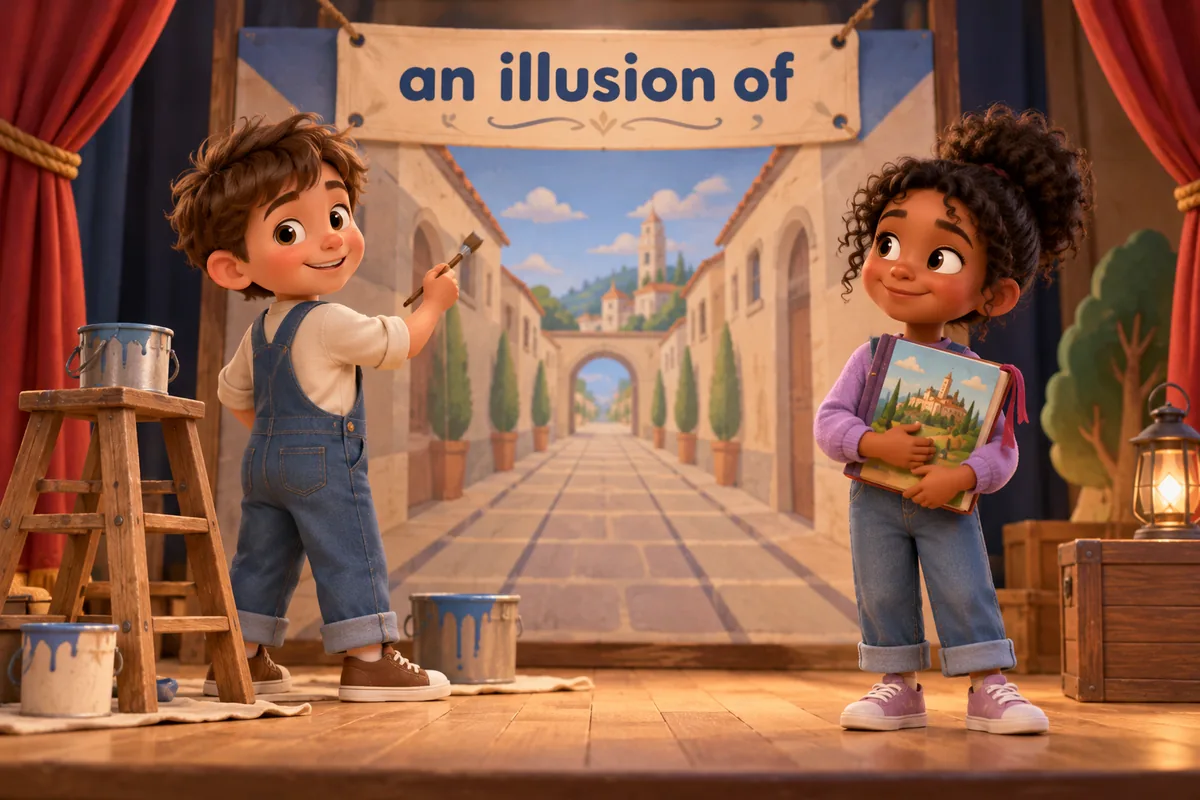
Illusion and allusion in a sentence: examples across contexts
Reading the pair in different registers makes the choice automatic, and more literary frames sit in allusion in everyday sentences.
| Context | Example sentence | Why this works |
|---|---|---|
| Classroom | The teacher explained the optical illusion with a bent pencil in water. | illusion names a false perception |
| English essay | The poem opens with an allusion to Paradise Lost. | allusion names a literary reference |
| Workplace email | The new layout creates an illusion of extra space. | illusion of + noun |
| News report | Investors were under the illusion that prices would keep rising. | a false shared belief |
| Conversation | That advert is really an allusion to an old film. | a knowing reference |
| Academic writing | The author makes an allusion to Freud in the second chapter. | a formal reference |
| Stage review | The lighting builds an illusion of depth on a flat set. | a sensory trick |
| Public speech | Her closing line is an allusion to a famous address. | a pointed nod |
| Marketing copy | The filter creates the illusion of flawless skin. | a misleading appearance |
| Literary criticism | The title carries a biblical allusion. | a technical term |
| Everyday talk | It was an illusion; the vase was never on the table. | a false perception |
| History writing | The treaty was an allusion to an earlier peace. | a reference across time |
Which should you use?
Match the word to what the sentence is doing: perceiving something false takes illusion, and referring to something known takes allusion.
| Situation | Use | Example |
|---|---|---|
| Something false seems real | illusion | The stage creates the illusion of rain. |
| You hint at another text | allusion | The title is an allusion to a myth. |
| A person holds a false belief | illusion | He is under the illusion that it is free. |
| You want a subtle reference | allusion | The speech makes an allusion to Churchill. |
Register is the second test. Illusion belongs to every style, from a text message to a physics lesson, because false perceptions and false hopes appear everywhere. Allusion leans literary: it rewards a reader who knows the source, so it appears most often in essays, reviews and speeches. That slant explains why learners meet allusion only in reading, while they use illusion in speech.
Word forms and grammar of illusion and allusion
| Form | Part of speech | Example |
|---|---|---|
| illusion | noun | The illusion was convincing. |
| illusions | noun, plural | Optical illusions are fun to test. |
| illusory | adjective | The early gains were illusory. |
| allude | verb | He alluded to the argument. |
| allusion | noun | The poem contains an allusion. |
| allusions | noun, plural | The novel is rich in allusions. |
| allusive | adjective | Her allusive style rewards close reading. |
Common mistakes with illusion and allusion
Mistake 1: allusion for a false perception. Incorrect: The mirror gives the allusion of a bigger room. Correct: The mirror gives the illusion of a bigger room. Rule: a false appearance is an illusion; an allusion is a reference.
Mistake 2: illusion for a reference. Incorrect: The title is an illusion to a Greek myth. Correct: The title is an allusion to a Greek myth. Rule: a nod to another text is an allusion.
Mistake 3: the wrong preposition. Incorrect: The song is an allusion of his childhood. Correct: The song is an allusion to his childhood. Rule: the noun allusion takes to before the thing referenced.
Mistake 4: allude without its preposition. Incorrect: She alluded the scandal. Correct: She alluded to the scandal. Rule: the verb allude needs to before its object.
Mistake 5: swapping the adjectives. Incorrect: The gains were allusive. Correct: The gains were illusory. Rule: illusory means deceptive, while allusive means full of references.
Practice using illusion and allusion
- Fill in the blank: The heat created the ___ of water on the road.
- Choose the better word: The film title is an (illusion / allusion) to an old myth.
- Correct the error: He is under the allusion that the fee is refundable.
- Build a sentence: use an allusion to about a well-known novel.
- Spot the register: which line suits a literary essay, (a) It is like an inside joke to a book, or (b) The title is an allusion to Conrad?
- Fill in the blank: The magic trick relies on a simple optical ___.
Answers
- illusion, because the water is not really there.
- allusion, because the title refers to the myth.
- He is under the illusion that the fee is refundable; a false belief is an illusion.
- The mural makes an allusion to Jules Verne.
- (b), because allusion and its formal phrasing suit an essay.
- illusion, because the eye is being fooled.
The bottom line
The illusion vs allusion choice is settled by meaning, not by sound. An illusion is something false that the senses or the mind accept, and an allusion is a reference to a text, person or event. Remember the first letters, il- for the lie to the eye and al- for the echo of another writer, and the pair stays apart even though it sounds the same.
Frequently asked questions about illusion and allusion
Are illusion and allusion homophones?
In most accents the two nouns sound almost the same, which is why they are confused both on the page and in speech. They are not the same word, though: illusion names a false perception or belief, and allusion names an indirect reference. Meaning, not sound, tells them apart.
Can allusion be used outside literature?
Yes. An allusion can point to any shared reference, including a film, a song, a news event or a well-known saying, and not only to books. The word simply means an indirect reference, so a headline can make an allusion to a speech or a slogan just as easily as a poem can.
What is the adjective for each word?
The adjective from illusion is illusory, meaning deceptive or not real, as in illusory gains. The adjective from allusion is allusive, meaning full of references, as in an allusive style. The two adjectives are also close in sound, so link each one to its noun before you choose.
Do I write an allusion to or an allusion of?
Write an allusion to. The noun takes the preposition to before the thing that is referenced, so a novel makes an allusion to a myth. The verb allude follows the same pattern and also needs to, as in he alluded to the quarrel. The phrasing an allusion of is not standard.