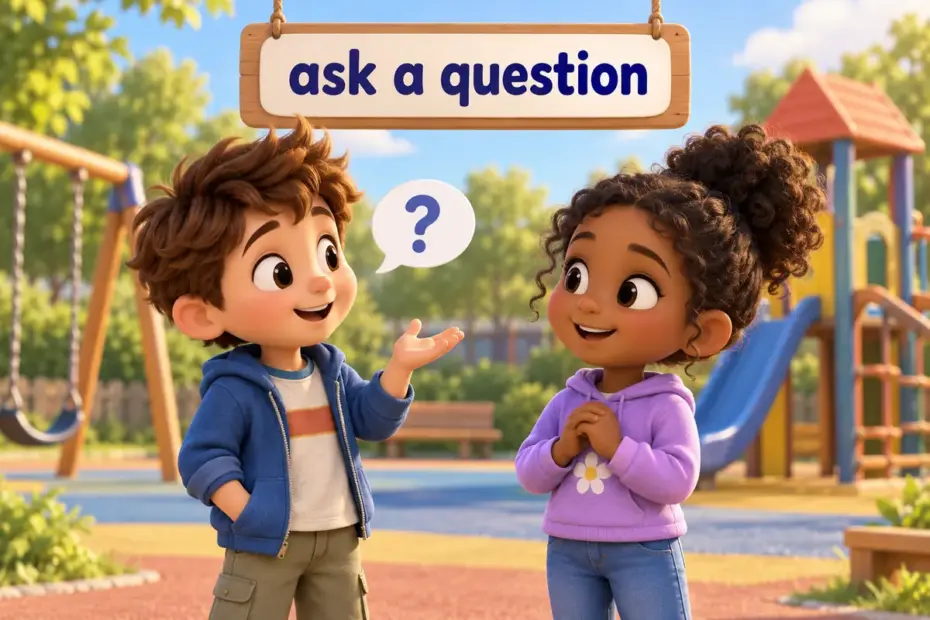
Icebreaker questions for kids are simple, friendly questions that help children start talking when they meet someone new. They work best when they are short, easy to answer and about something a child already knows, such as favourite colours, pets or games. “What is your favourite animal?” opens a conversation without any pressure.
Icebreaker questions for kids at a glance
- An icebreaker question is a friendly opening question that helps a child begin to talk.
- The usual pattern is a question word plus a short, easy topic.
- Favourite, would you rather and this or that are the easiest types to answer.
- One word answers are common at first, so a follow-up question keeps the talk moving.
- The commonest mistake is asking a question that can be answered with only yes or no.
What are icebreaker questions for kids?
An icebreaker question for kids is a gentle question that gives a child an easy way into a conversation, usually when meeting a new group. The questions fall into a few friendly types, and each type does a slightly different job. The best ones ask about things a child can picture, so no long thinking is needed before an answer.
| Type | Example question | When it helps |
|---|---|---|
| Favourites | What is your favourite colour? | an easy first question |
| This or that | Cats or dogs? | a quick either-or choice |
| Would you rather | Would you rather fly or swim? | a playful, imaginative pick |
| About me | What do you like doing at home? | invites a personal answer |
| Imagination | If you could have any pet, what would it be? | sparks a small story |
| Weekend | What did you enjoy at the weekend? | links to a recent event |
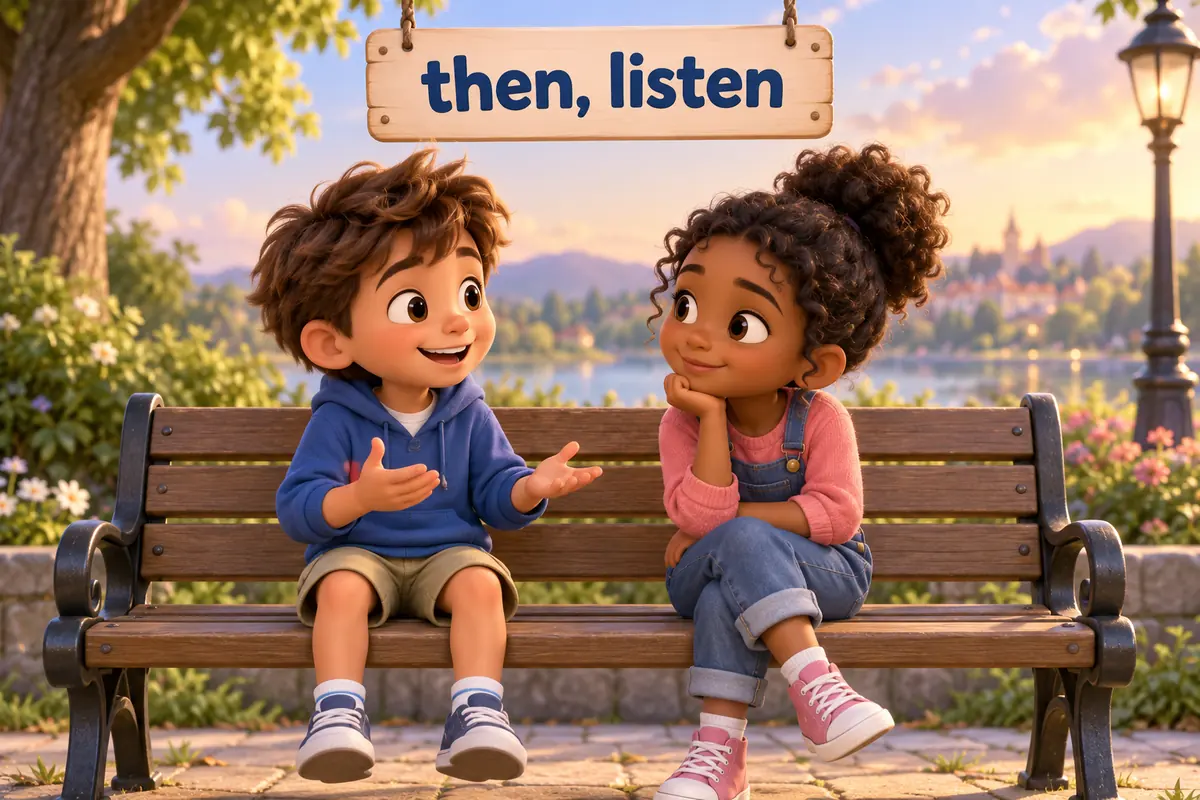
One honest caution is worth stating plainly: an icebreaker question starts a conversation, and then it stops working. A question that is repeated after every answer turns a chat into an interview. The skill is to ask one, listen properly, and then follow the answer with a related question or a short comment of your own.
How do you ask an icebreaker question?
An icebreaker question follows a short, open pattern that invites more than one word. The pattern matters more than the exact words, because the shape decides whether an answer can grow.
| Pattern | Example | What it signals |
|---|---|---|
| What is your favourite + noun? | What is your favourite game? | invites a personal choice |
| Which do you prefer, A or B? | Which do you prefer, rain or snow? | a gentle either-or |
| Would you rather + verb + or + verb? | Would you rather read or draw? | a playful dilemma |
| If you could + verb, what would you do? | If you could travel anywhere, where would you go? | invites imagination |
| What do you like about + noun? | What do you like about your school? | asks for a reason |

Icebreaker questions across contexts
The same friendly question suits many settings, from a new classroom to a family gathering. Children pick up question words faster when they meet them in real situations, and pages such as a words for kids and b words for kids add the vocabulary a child needs for the answers.
| Context | Example question | Why this works |
|---|---|---|
| First day of school | What is your name and your favourite game? | two easy facts in one line |
| Summer camp | Which do you prefer, swimming or climbing? | an either-or about camp fun |
| Birthday party | What is your favourite party food? | a topic everyone enjoys |
| After-school club | What do you like making best? | fits the club activity |
| Video call | What did you do today? | works without shared space |
| Family gathering | What is your favourite thing about school? | gives a relative an opener |
| Sports team | Which position do you like playing? | a shared interest |
| Playdate | What game shall we play first? | moves straight into play |
| Library group | What kind of story do you enjoy? | fits the setting |
| Bus stop | Do you walk to school or ride? | a light everyday question |
| Classroom circle | What is something you are good at? | builds a positive answer |
Which icebreaker question should you choose?
The right question depends on the setting, how well the children know each other and how comfortable the child feels. A short comparison makes the choice clearer.
| Situation | Better question | Weaker question | Reason |
|---|---|---|---|
| A shy child | Favourites | Tell me about yourself | a favourite has a ready answer |
| A large new group | This or that | An open personal question | a quick choice suits many voices |
| A quiet playdate | What game shall we play? | What is your favourite book? | play moves the moment forward |
| A mixed-age group | Would you rather | What job do you want? | a playful question suits all ages |
| A language learner | This or that | Why do you like school? | short answers build confidence |
A follow-up question is what turns an icebreaker into a conversation. When a child says dogs, the next line can be a comment such as I have a dog too, followed by what is your dog called. Mirroring the answer and adding one detail of your own keeps the exchange equal, so neither child feels questioned.
Words and phrases linked to questions
The word question sits inside a small family that helps a child talk about asking and answering. Young readers can pair question and answer with compound words for kids, then describe a kind tone with adjectives for kids such as friendly, gentle and curious.
| Word | Type | Example |
|---|---|---|
| ask | verb | I will ask a friendly question. |
| question | noun | Her question was easy to answer. |
| answer | noun and verb | He answered with a smile. |
| icebreaker | noun | The game was a good icebreaker. |
| conversation | noun | They had a short conversation. |
Common mistakes with icebreaker questions
Mistake 1: asking a yes-or-no question. Incorrect: Do you like school? Correct: What do you like about school? Rule: open questions invite a full answer.
Mistake 2: firing question after question. Incorrect: What is your name? Where do you live? How old are you? Correct: What is your name, and what game do you like? Rule: one question plus a comment keeps the talk natural.
Mistake 3: choosing a topic a child cannot answer. Incorrect: What is your favourite city abroad? Correct: What is your favourite place nearby? Rule: match the question to the child’s experience.
Mistake 4: forgetting to listen. Incorrect: What is your favourite colour? Anyway, my favourite is blue. Correct: Blue is a good one, why do you like it? Rule: a follow-up shows the answer was heard.
Mistake 5: writing questions without a question mark. Incorrect: What is your favourite game. Correct: What is your favourite game? Rule: a direct question ends with a question mark.
Mistake 6: using an unfriendly tone. Incorrect: Who are you? Correct: Hello, I am Sam, what is your name? Rule: an icebreaker begins with a greeting.
Practice using icebreaker questions
- Fill in the blank: What is your ___ animal?
- Choose the better question: (Do you have a pet? / What is your pet like?) for a full answer.
- Correct the error: What is your favourite colour.
- Build a question: ask a new classmate what game they like best.
- Spot the register: which question suits a first meeting, (a) What do you enjoy doing? or (b) What is your address?
- Fill in the blank: Would you ___ fly or swim?
Answers
- favourite, because it asks for a personal choice.
- What is your pet like, because it invites a description rather than a yes or no.
- What is your favourite colour? because a direct question needs a question mark.
- Hi, I am new here, what game do you like best?
- (a), because a first meeting calls for a friendly, open question.
- rather, because would you rather introduces a playful either-or.
The bottom line
Icebreaker questions for kids work because they are short, friendly and about things a child already knows. Favourites, this or that and would you rather suit almost any setting, and a follow-up question is what keeps the talk going. Ask one, listen closely, then comment before asking the next, and a new friendship has room to begin.
Frequently asked questions about icebreaker questions for kids
What are good icebreaker questions for shy kids?
Favourite questions work best because the answer is already in the child’s mind. Ask what is your favourite colour, animal or game, then accept a one-word answer without pushing for more. A gentle comment such as that is a good choice lets the child add more when ready.
How many icebreaker questions should I prepare?
Two or three are plenty for a first meeting, because the aim is a conversation rather than a list. Prepare one favourites question, one either-or and one imaginative question. Once children begin answering each other, the adult can step back and listen.
What if a child gives a one-word answer?
A one-word answer is a normal start, not a failure, so respond with a related follow-up rather than a new subject. If the child says blue, ask why blue is a favourite, or share your own choice. Adding your own answer turns the exchange into a chat between equals.
Are icebreaker questions different for different ages?
Younger children do best with concrete favourites and quick either-or choices, because those need no long thought. Older children enjoy would you rather questions and imaginative prompts that invite a reason. The setting matters too, since a club or a camp gives its own natural topics.