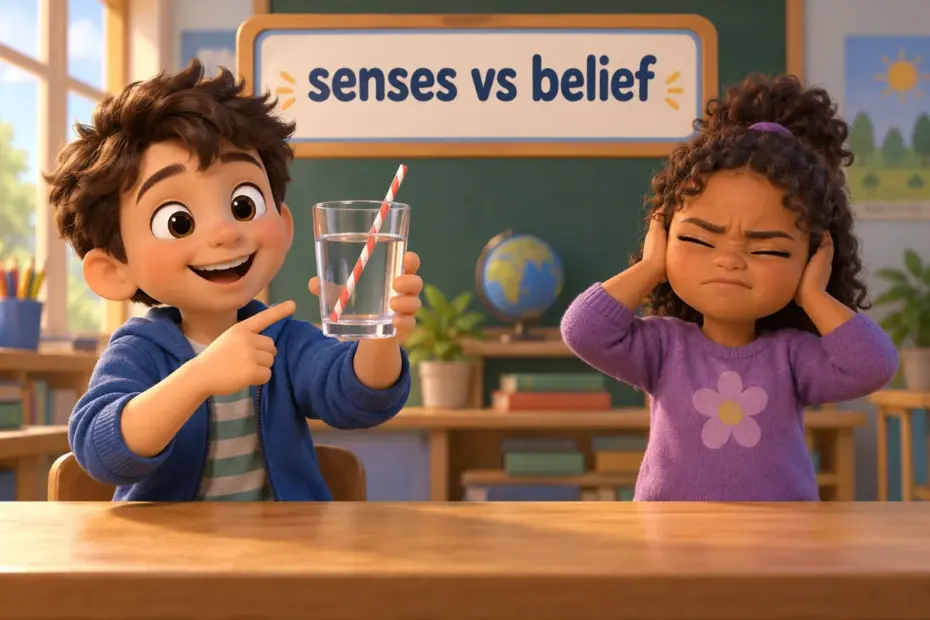
Illusion vs delusion is a pair that both describe something false, yet the two nouns differ in where the error lies. An illusion misreads a real sight or sound, while a delusion is a fixed false belief held against the evidence. One fools the senses, the other grips the mind.
Illusion vs Delusion at a glance
- Illusion and delusion are both nouns that describe something untrue.
- An illusion is a misreading of a real stimulus, as when a stick looks bent in water.
- A delusion is a firm false belief that evidence does not shake.
- Illusion begins in the senses; delusion lives in belief.
- The commonest error is using delusion for a harmless optical trick.
What does illusion mean and what does delusion mean?
Illusion is a noun meaning a false perception of something real, while delusion is a noun meaning a false belief that is held firmly despite the facts. The Cambridge entry for illusion and the Cambridge entry for delusion confirm the split, and one line shows it: a curved mirror creates an illusion, while a man who believes he is a king lives under a delusion.
| Sense | Word | Plain meaning | Example |
|---|---|---|---|
| Optical misreading | illusion | The eye misreads a real thing | The lake shows an illusion of a ship floating in the air. |
| False appearance | illusion | Something seems other than it is | Stage fog builds an illusion of great distance. |
| False belief | delusion | A fixed belief against the evidence | He clings to the delusion that the money is his. |
| Self-deception | delusion | A comforting untruth a person keeps | She is under the delusion that nothing can go wrong. |
| Clinical sense | delusion | A symptom named in medicine | The patient described a lasting delusion of being watched. |
Only one sense of each word is common in ordinary writing. Illusion almost always marks a trick of the eye, the ear or the memory. Delusion almost always marks a belief that a person will not surrender, which is why it carries a heavier charge than illusion.
What is the difference between illusion and delusion?
The difference lies in what is wrong. An illusion is a genuine signal that the senses misread, so the same object looked at again may end the illusion. A delusion is a belief, not a perception, and it survives the very evidence that should end it. The same one-letter trap appears in addition vs edition, and even shorter in ad vs add.
| Test | Illusion | Delusion |
|---|---|---|
| Nature of the error | a misreading of the senses | a false belief held |
| Source | a real stimulus, misread | the mind, unshaken by facts |
| Duration | momentary | lasting |
| Can it be corrected | often, by looking again | rarely, by evidence alone |
| Typical collocation | an optical illusion | a paranoid delusion |
| Register | neutral, used everywhere | medical and psychological |
Choose illusion when the senses are deceived by something that is really there, and delusion when a belief holds firm even when the facts deny it.
How do you use illusion and delusion in a sentence?
Both nouns follow fixed patterns, and the phrase after each one separates a sensory trick from a stubborn belief. To watch the first noun behave, read illusion in a sentence.
| Pattern | Example | What it signals |
|---|---|---|
| an illusion of + noun | Bare branches give an illusion of lace. | something appears real |
| create / build an illusion | The set designers create an illusion of wealth. | a deliberate trick |
| an optical illusion | Optical illusions test how the eye works. | a named sensory trick |
| a delusion that + clause | He has the delusion that he is watched. | a fixed false belief |
| labour under a delusion | The firm labours under a delusion about demand. | a belief that misleads |
| delusions of grandeur | His talk of ruling the world is delusions of grandeur. | an inflated fixed belief |
| under the delusion that | They are under the delusion that costs will fall. | a shared false belief |

Illusion and delusion in a sentence: examples across contexts
Reading the pair in different registers makes the choice automatic, and more serious frames sit in delusion in everyday sentences.
| Context | Example sentence | Why this works |
|---|---|---|
| Classroom | The class drew an optical illusion with two equal lines that look different. | illusion names a sensory trick |
| Science lesson | A mirage is an illusion caused by heated air. | a real signal, misread |
| News report | The scheme was built on a delusion that demand would never fall. | a belief, not a perception |
| Film review | The camera work creates an illusion of endless corridors. | a designed false appearance |
| Psychology article | A delusion persists even when the person meets clear counter-evidence. | a technical, clinical use |
| Everyday talk | It was just an illusion; the ring was never in the box. | a false perception |
| Workplace email | Let us not labour under the delusion that the client will wait. | a shared false belief |
| Self-help writing | Fame offered an illusion of lasting happiness. | a misleading appearance |
| History writing | Leaders held the delusion that the border could not be crossed. | a strategic false belief |
| Medical writing | The report describes a delusion of persecution in clear terms. | the clinical noun |
| Stage review | Clever lighting builds an illusion of a moonlit garden. | a deliberate stage trick |
| Conversation | Calling that a plan is a delusion, not optimism. | a belief against the facts |
Which should you use?
Match the word to what is wrong in the sentence: a misread sense takes illusion, and a belief that ignores the facts takes delusion.
| Situation | Use | Example |
|---|---|---|
| The eye is deceived by a real thing | illusion | Heat haze is an illusion of water. |
| A person believes something untrue | delusion | He has a delusion that he is owed millions. |
| A designer fakes depth or space | illusion | The mural creates an illusion of a doorway. |
| A group ignores clear warnings | delusion | The company acted on a delusion of safety. |
Register is the second test. Illusion fits every style, from a chat to a physics paper, since everyone can be fooled by the eye. Delusion carries weight and often signals medicine or psychology, so it sounds odd in a light sentence about a card trick. When the tone is playful, illusion is almost always the safer noun.
Word forms and grammar of illusion and delusion
| Form | Part of speech | Example |
|---|---|---|
| illusion | noun | The illusion lasted only a moment. |
| illusions | noun, plural | Optical illusions are fun to test. |
| illusory | adjective | The promise of easy money was illusory. |
| delude | verb | Do not delude yourself about the cost. |
| delusion | noun | The delusion was hard to treat. |
| delusional | adjective | The claim sounded delusional to the panel. |
| deluded | adjective | He felt deluded by the advertisement. |
Common mistakes with illusion and delusion
Mistake 1: delusion for a sensory trick. Incorrect: The mirror gives the delusion of a wider room. Correct: The mirror gives the illusion of a wider room. Rule: a false appearance is an illusion; a false belief is a delusion.
Mistake 2: illusion for a fixed belief. Incorrect: He lives under the illusion that he is never wrong and nothing can change his mind. Correct: He lives under the delusion that he is never wrong. Rule: a belief that resists evidence is a delusion.
Mistake 3: swapping the adjectives. Incorrect: The bent stick was a delusional effect. Correct: The bent stick was an illusory effect. Rule: illusory describes a false perception, while delusional describes a false belief.
Mistake 4: the wrong verb for a belief. Incorrect: The firm created a delusion about demand. Correct: The firm laboured under a delusion about demand. Rule: a delusion is held or suffered, while an illusion can be created.
Mistake 5: under the illusion where the sense is wrong. Incorrect: She is under the illusion that the bank owes her a fortune in law. Correct: She is under the delusion that the bank owes her a fortune. Rule: an unshakable belief takes delusion.
Practice using illusion and delusion
- Fill in the blank: The hot road produced the ___ of a puddle.
- Choose the better word: He has a (illusion / delusion) that the manager is watching him.
- Correct the error: The polished floor gave a delusion of water.
- Build a sentence: use delusions of grandeur about a boastful character.
- Spot the register: which line suits a psychology report, (a) He has some weird ideas, or (b) The patient presented a persistent delusion?
- Fill in the blank: The curtain trick relies on a simple visual ___.
Answers
- illusion, because the puddle is not really there.
- delusion, because it is a fixed belief rather than a sight.
- The polished floor gave an illusion of water; a false appearance is an illusion.
- The villain is full of delusions of grandeur and talks of ruling the town.
- (b), because delusion and its clinical phrasing suit a report.
- illusion, because the eye is being deceived.

The bottom line
The illusion vs delusion choice turns on where the error sits. An illusion is a real signal that the senses misread, so a second look may end it, and a delusion is a belief that holds firm against evidence. Keep the senses for illusion and the mind for delusion, and the two nouns stop overlapping.
Frequently asked questions about illusion and delusion
Is delusion always a medical term?
No. Delusion is used in medicine for a fixed false belief that is a symptom, but everyday writing also uses it more loosely for any belief that ignores the evidence. The word always carries weight, though, so it suits a serious claim rather than a light remark about a card trick.
Can an illusion ever be a belief?
Illusion mostly describes a false perception of something real, but it can stretch to a false hope, as in an illusion of safety. Even then it keeps a sense of something seen or felt, and it can usually be broken. Delusion, by contrast, names a belief that resists correction.
What is the verb related to delusion?
The verb is delude, meaning to mislead or to make someone believe something untrue, as in do not delude yourself. The adjective is delusional, describing a person or claim marked by false belief. Illusion has no verb of its own; its adjective is illusory.
Are delusions of grandeur a recognised phrase?
Yes. Delusions of grandeur is a fixed phrase for an inflated belief in one’s own importance, wealth or power, and it appears in both clinical writing and ordinary comment. It treats the belief as a set, so the plural delusions stays even when one person holds it.