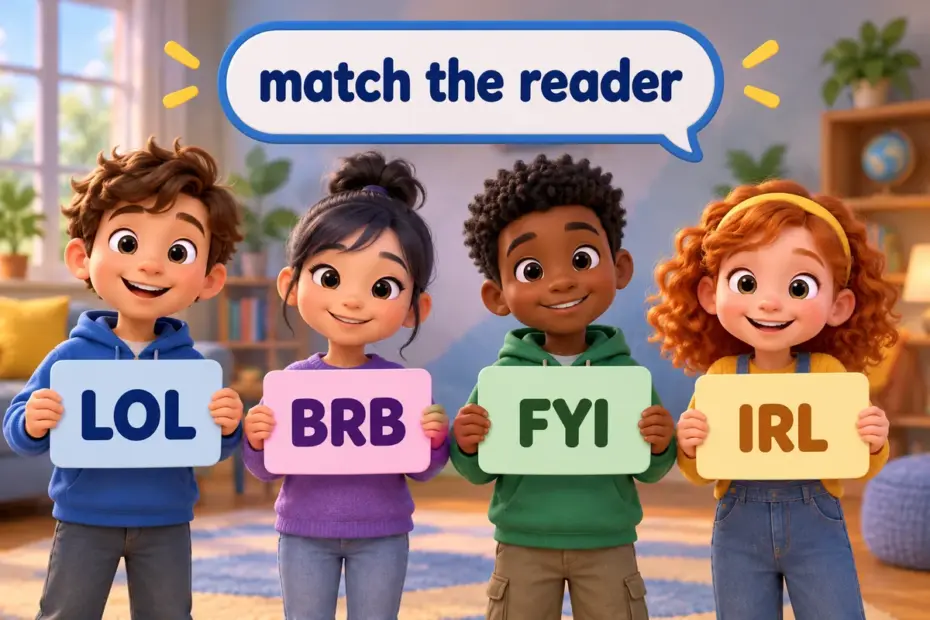
Internet slang abbreviations and acronyms are the short typed forms, from LOL and BRB to IRL and NGL, that keep fast conversation moving. They save keystrokes and signal who belongs in a group. The same letters can read as casual in a chat and careless in an email.
Internet slang abbreviations and acronyms at a glance
- An abbreviation shortens a phrase, while an acronym is spoken as a word.
- Forms such as LOL and BTW began in chat and spread into everyday typing.
- Many are true acronyms, but some are said letter by letter instead.
- Register matters, because the same letters suit a group chat and fail in a report.
- The commonest mistake is using chat forms in a formal or professional message.
What do internet slang abbreviations mean?
Each form shortens a phrase, so LOL was laughing out loud, BRB was be right back and FYI was for your information. Everyday web typing is its own dialect, and slang in a sentence shows where slang ends and jargon begins. Strictly, an acronym is spoken as a word, so acronym in a sentence keeps the term honest.
| Form | Stands for | Register | Example |
|---|---|---|---|
| LOL | laughing out loud | casual | That meme, LOL |
| BRB | be right back | casual | BRB, food is here |
| IDK | I do not know | casual | IDK, ask Sam |
| FYI | for your information | neutral | FYI, the meeting moved |
| BTW | by the way | neutral | BTW, thanks for yesterday |
| TBH | to be honest | casual | TBH, I liked the first one |
| IRL | in real life | casual | We finally met IRL |
| NGL | not going to lie | casual | NGL, that was close |
Chat forms are a poor fit for a formal report, a job application or a legal notice, where a reader expects full words. Even in a friendly work thread, a form such as LOL can look careless when the message carries a decision or a deadline. In a personal text the forms are harmless, so the setting rather than the letters decides whether they fit.
How do you use internet slang in a sentence?
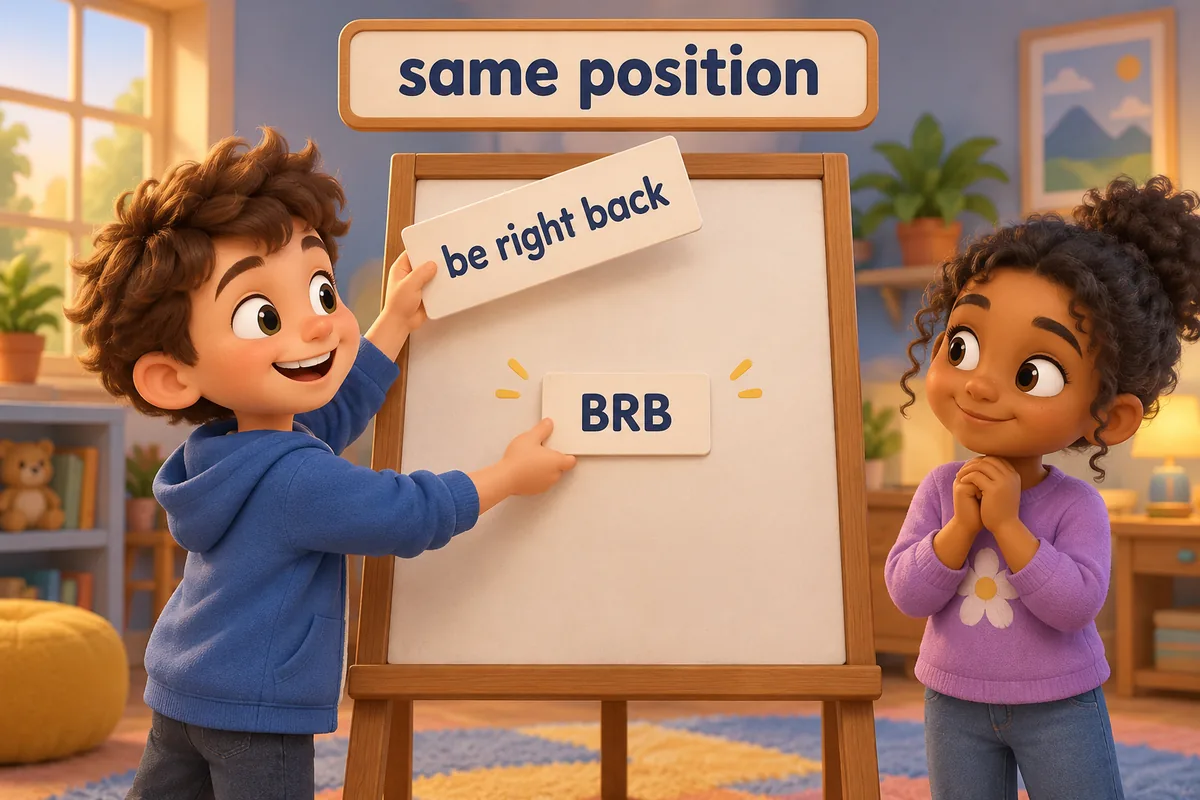
A shortened form usually stands where the full phrase would go, so it takes the same position in the sentence. Early browsers spread these forms quickly, and internet explorer in a sentence recalls that era.
| Pattern | Example | What it signals |
|---|---|---|
| Form replaces a phrase | BRB, someone is at the door | A quick pause in the chat |
| Form opens a message | FYI, the room changed | Flags a useful notice |
| Form softens an opinion | TBH, I preferred the draft | Signals a frank remark |
| Form as a whole reply | IDK | A short, casual answer |
| Form in a lower case run | idk maybe lol | A relaxed, jokey tone |
Internet slang across contexts
The same letters shift register with the setting, so read the room before you type. A form that charms a group chat can stall a serious note.
| Context | Sentence | Why it works |
|---|---|---|
| Text to a friend | On my way, ETA ten | Short and clear between friends |
| Group chat | BRB, back in five | A quick pause everyone understands |
| Work chat | FYI, the file is shared | Neutral and useful at work |
| Email to a client | For your information, the file is shared | Expands the form for a formal reader |
| Social post | NGL, this recipe is a keeper | Casual praise for a wide audience |
| Classroom note | HW due Friday, BTW | Friendly reminder between students |
| News headline | Nasa launches mission, IRL | Brand style that suits a light story |
| Message to a teacher | Please find the essay attached | No chat forms, to keep it formal |
| Support ticket | The error is fixed, FYI | Brief update for a colleague |
| Study group | LMK when you are free to revise | Short and clear between classmates |
| Gaming chat | AFK for a bit, back soon | A quick pause everyone understands |
Which abbreviation should you use?
Match the form to the setting, then to the reader’s likely familiarity.
| Setting | Best form | Why |
|---|---|---|
| Group chat with friends | LOL or TBH | Casual forms that friends know |
| Friendly work thread | FYI or BTW | Neutral forms that stay tidy |
| Email to a new client | Full words | A formal reader may not know the forms |
| Written report | Full words | Precision matters more than speed |
| Social caption | NGL or IRL | Light and widely understood |
| Message to a teacher | Full words | Keeps the tone respectful |
Use a form only where the reader will know it, and write the full words whenever the message has to be clear or formal.
How these forms are built and written
The forms fall into a few families, and each behaves differently in a sentence. Some are spoken as a word, others letter by letter, and the two are often grouped together even when the label is not exact.
| Family | What it is | Example |
|---|---|---|
| Acronym | Letters spoken as a single word | Nasa |
| Initialism | Letters spoken one by one | FYI |
| Clipping | A word with the end trimmed | app for application |
| Blend | Two words joined and shortened | bromance |
| Number form | Letters and a numeral together | B2B meaning business to business |
Common mistakes with internet abbreviations
Most errors come from the wrong register or from a form the reader will not recognise.
Incorrect: FYI, the contract is void, in a legal notice Correct: For your information, the contract is void, in a legal notice Rule: a chat form undercuts a formal document
Incorrect: LOL, sent to a new client Correct: Thank you, sent to a new client Rule: casual forms can read as careless to an unfamiliar reader
Incorrect: IRL used for an online event Correct: IRL used for an offline, in-person event Rule: use the form for the meaning it actually carries
Incorrect: IDK as the whole answer to a customer Correct: I will check and reply shortly, to a customer Rule: a short form gives the reader nothing to act on
Incorrect: A report full of chat forms and no full words Correct: a report written in full words Rule: a formal reader expects complete words throughout
Practice using internet abbreviations
Six short tasks check whether you can match a form to a setting and expand it when the register rises.
- Fill in the blank: to tell a friend you are stepping away briefly, type blank.
- Choose the better form: in a client email, FYI or for your information?
- Correct the error: LOL, the invoice is overdue.
- Build a sentence: write a group-chat line that shares a useful update with one neutral form.
- Spot the register: which suits a group chat, BRB in five, or be right back in five?
- Fill in the blank: in a social caption that admits a frank opinion, the form blank fits.
Answers
- BRB, because the form shortens a brief pause that friends already understand.
- for your information, because a client email uses full words rather than a chat form.
- Please note, the invoice is overdue, because a serious notice needs full words and a calm tone.
- FYI, the notes are in the shared folder, because FYI is neutral and fits a work thread.
- BRB in five, because the short form suits a fast chat where everyone knows it.
- NGL, because it flags a frank remark that matches a casual caption.
The bottom line
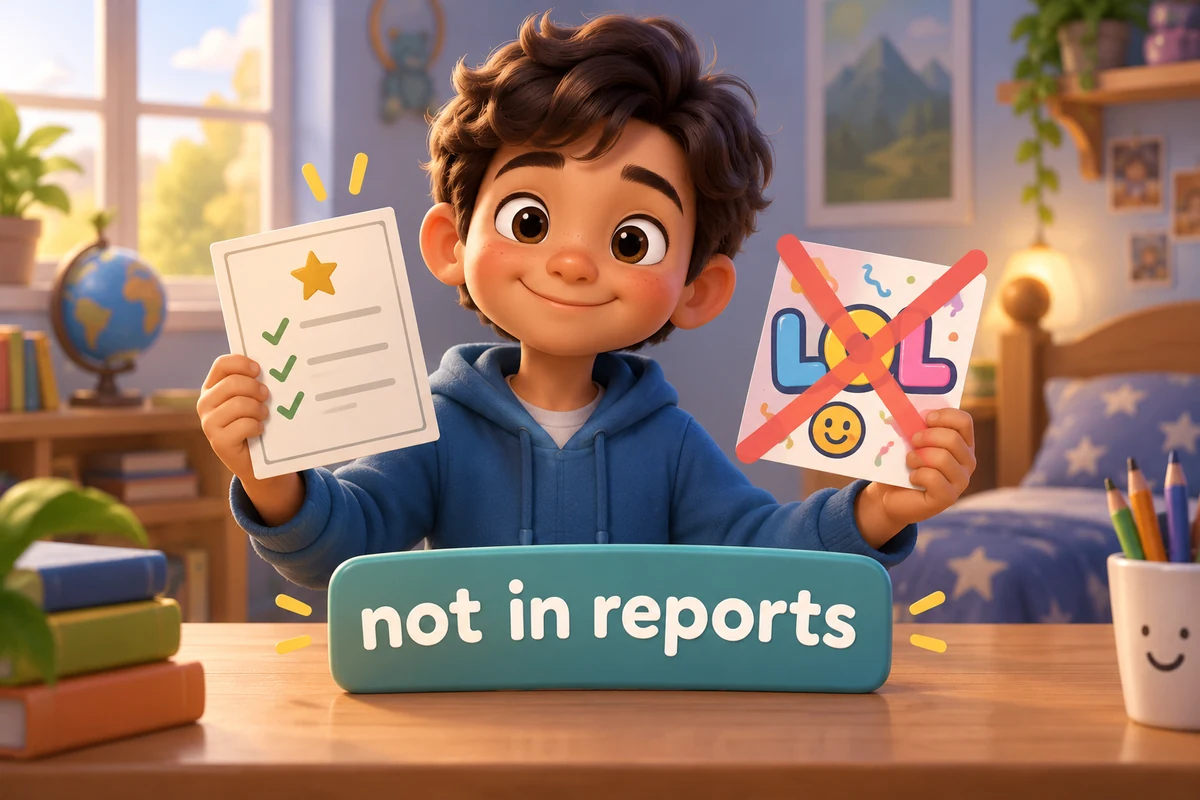
Internet slang abbreviations and acronyms speed up typing, but they carry a register that travels with them. A form such as LOL or BRB fits a group chat and fails in a report, while FYI and BTW survive both friendly and neutral settings. The safe rule is to match the form to the reader, and to write the full words whenever the message has to be clear. A short form is a tool rather than a habit, and the reader always decides whether it reads as friendly or careless.
Frequently asked questions about internet abbreviations
Is LOL an acronym or an abbreviation?
LOL began as an abbreviation of laughing out loud, and it fits the strict definition of an initialism because people say the letters one by one. In everyday use most writers simply call it an acronym. The label matters less than the register, which stays casual.
When should I avoid chat abbreviations?
Avoid them in a report, a job application, a legal notice or any first message to a formal reader. Even in a friendly work thread, expand the form when the message carries a decision, a deadline or a price. Full words keep the meaning safe.
What does IRL mean and where did it come from?
IRL stands for in real life, and it separates offline, in-person events from online ones. People use it to mark the difference between a screen profile and an actual person, so a first meeting becomes the moment two people finally met IRL.
Are internet abbreviations bad English?
No. They are a register rather than an error, so they follow their own rules inside a chat. A form becomes a mistake only when it appears where the reader expects full words, such as a formal document or a message to an unfamiliar client.