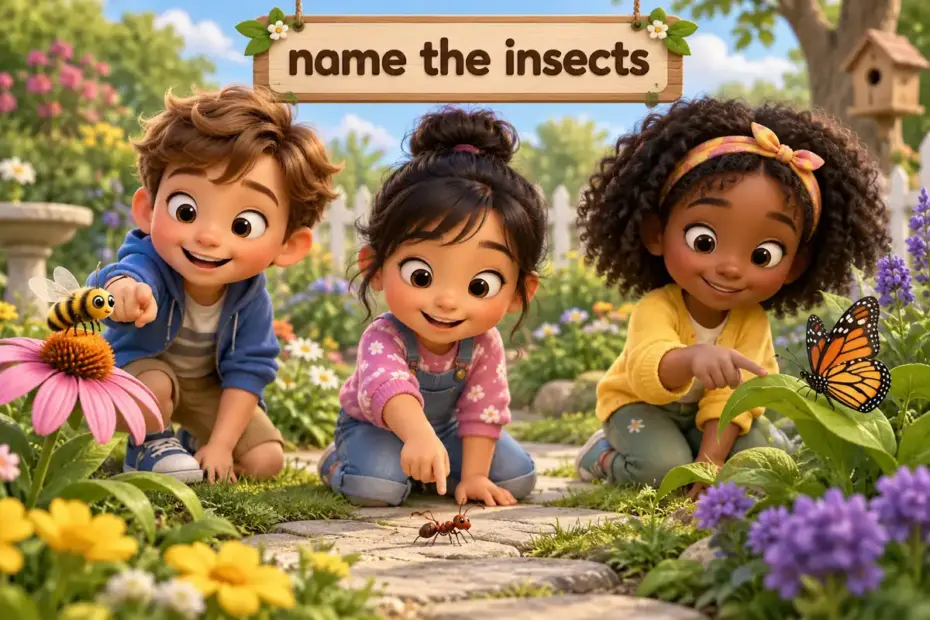
Insects names in english cover the small six-legged creatures a learner meets first, from the busy bee and the ant to the butterfly, the beetle and the dragonfly. Every insect has six legs and three body parts, which is what separates it from a spider. A butterfly has four wings.
Insects names at a glance
- An insect is a small creature with six legs and three body parts.
- Common insect names include bee, ant, butterfly, beetle, moth and fly.
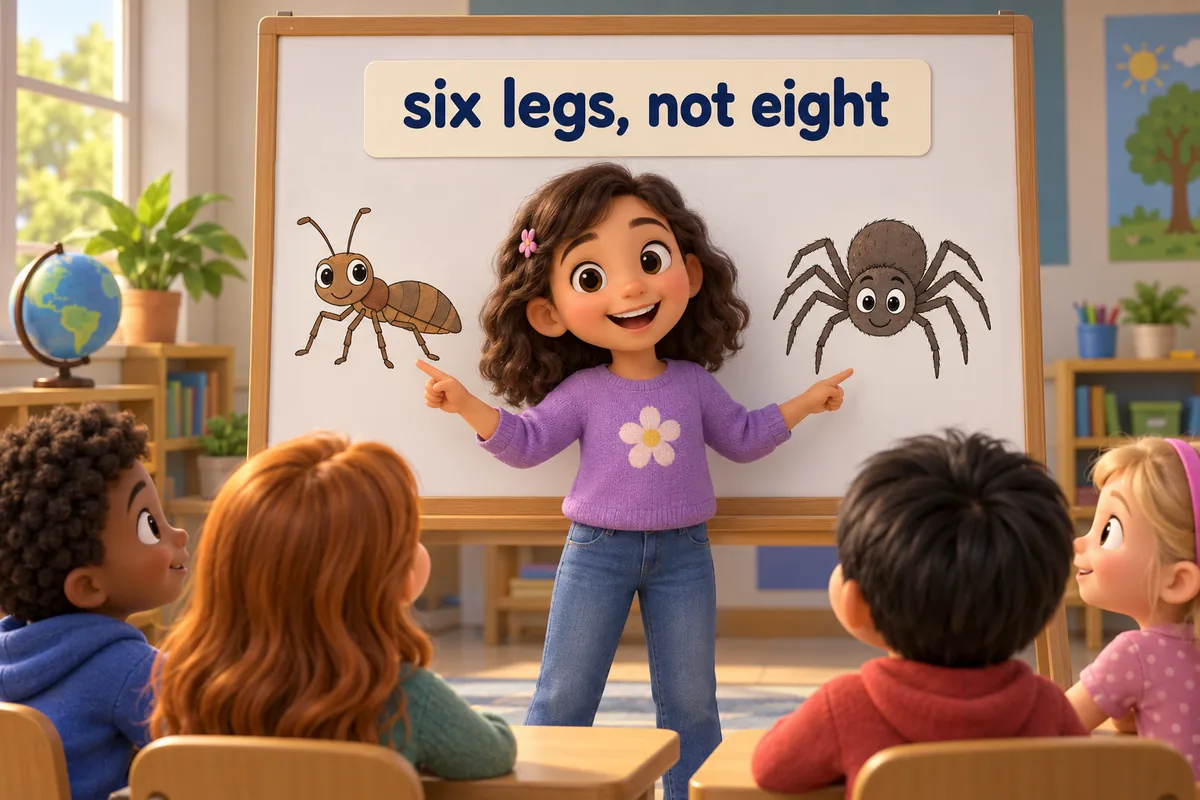
- A spider is not an insect, because it has eight legs and two body parts.
- The word insect is countable, so it takes a plural.
- The commonest error is calling a spider an insect.
What are insects names in English?
Insects names in English are the words for the six-legged creatures that make up the largest group of animals, from the bee and the ant to the butterfly and the beetle. Every true insect shares the same body plan of head, thorax and abdomen with six legs, while spiders look similar but belong to a different group. More describing words sit in adjectives for insects.
| Insect | Look and habit | Example |
|---|---|---|
| Bee | buzzing, makes honey | A bee visited the flowers. |
| Ant | small, lives in a colony | An ant carried a crumb away. |
| Butterfly | large, colourful wings | A butterfly rested on the leaf. |
| Beetle | hard wing cases | A beetle crawled under the stone. |
| Ladybug | round, red with black spots | A ladybug landed on her hand. |
| Grasshopper | long legs, jumps well | A grasshopper leapt through the grass. |
| Cricket | chirps at night | A cricket sang in the garden. |
| Dragonfly | long body, fast flight | A dragonfly skimmed the pond. |
| Fly | two wings, fast and buzzing | A fly buzzed near the plate. |
| Mosquito | bites and draws blood | A mosquito bit his arm. |
| Moth | dull wings, night flyer | A moth circled the lamp. |
| Cockroach | flat body, fast runner | A cockroach hid in the corner. |
| Wasp | narrow waist, stings | A wasp hovered by the bin. |
| Firefly | glows at night | A firefly lit the dusk. |
| Cicada | loud summer song | A cicada shrilled in the tree. |
One honest limit belongs here: the everyday word bug is wider than insect. In science, a bug is one particular group of insects with a beak and half-hardened wings, yet in speech people call every small crawling creature a bug. The word insect stays the safer choice when the six-legged body plan matters, and a spider is never an insect at all.
How do you use insect names in a sentence?
Insect names are countable nouns, and the words around them follow simple patterns.
| Pattern | Example | What it signals |
|---|---|---|
| a / an + insect | An ant carried a crumb away. | one insect |
| insect + plural verb | Bees live in colonies. | a group of insects |
| insect + bites / stings + noun | A mosquito bit his arm. | an action on a person |
| the + insect + did something | The butterfly rested on the leaf. | a specific insect |
| insect + lives / glows + place | Fireflies glow in warm fields. | a habitat or habit |
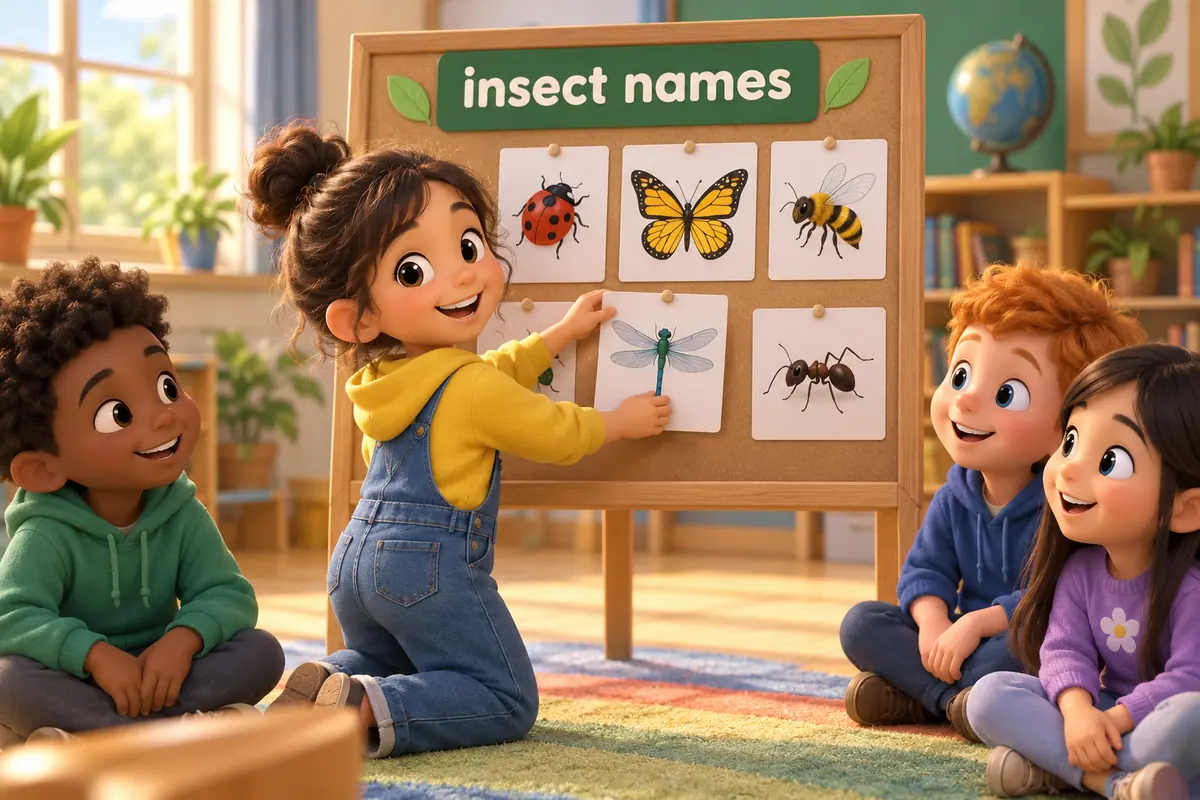
Insects names in english: examples across contexts
The insect names move from a garden to a science lesson, and each setting uses a different word. The plain word appears in insect in a sentence, and a related complaint appears in insect bite in a sentence.
| Context | Example sentence | Why this works |
|---|---|---|
| Classroom | Label each insect on the chart. | a matching task |
| Garden | A bee visited the flowers. | a scene detail |
| Science note | An insect has six legs and three body parts. | a defining fact |
| Picnic | A wasp hovered by the bin. | an everyday nuisance |
| Story | A dragonfly skimmed the pond at dusk. | narration |
| Health | A mosquito can spread disease. | a factual note |
| Night walk | A firefly lit the dark hedge. | a vivid detail |
| Kitchen | Keep food covered to stop flies. | a practical tip |
| Farm | Ladybugs eat garden pests. | a helpful habit |
| Conversation | Is that a moth or a butterfly? | an everyday question |
Which insect name should you use?
Match the name to the creature, because a moth and a butterfly look alike but are not the same word. A word with a similar opening appears in insertion point in a sentence.
| Situation | Pick | Example |
|---|---|---|
| A honey-maker | bee | A bee visited the flowers. |
| A colourful day flyer | butterfly | A butterfly rested on the leaf. |
| A night flyer at a lamp | moth | A moth circled the lamp. |
| An itchy bite | mosquito | A mosquito bit his arm. |
| A glowing summer bug | firefly | A firefly lit the dusk. |
The insect name should match the creature a reader would see, so a bee and a wasp are not interchangeable even though both sting. For the moth and the butterfly, the resting wings give the clue: a butterfly folds them upright while a moth spreads them flat. Naming the insect rather than saying a bug keeps a description exact.
Word forms and grammar of insect names
The insect words change shape in a few set ways, and one plural catches most learners.
| Form | Part of speech | Example |
|---|---|---|
| insect | noun | An insect has six legs. |
| insects | plural noun | Insects live almost everywhere. |
| ant / ants | noun singular / plural | One ant; a line of ants. |
| fly / flies | noun singular / plural | One fly; two flies. |
| mosquito / mosquitoes | noun singular / plural | One mosquito; many mosquitoes. |
| insectivorous | adjective | An insectivorous bird eats insects. |
| insecticide | noun | Insecticide kills pests. |
Common mistakes with insect names
Mistake 1: calling a spider an insect. Incorrect: A spider is an insect. Correct: A spider is an arachnid. Rule: an insect has six legs and three body parts, while a spider has eight legs and two.
Mistake 2: a plural after the article a. Incorrect: a bees. Correct: a bee. Rule: a comes before a singular countable noun.
Mistake 3: the wrong plural for fly. Incorrect: two flys. Correct: two flies. Rule: a consonant plus y noun changes y to ies.
Mistake 4: using bug as if it were the scientific word. Incorrect: Every small crawling bug is an insect. Correct: Not every small crawling creature is an insect. Rule: in science a bug is a narrower group, so bug is too loose for precise writing.
Mistake 5: the British word used in American writing. Incorrect: a ladybird in an American text. Correct: a ladybug in American writing, or a ladybird in British writing. Rule: ladybird is British and ladybug is American for the same beetle.
Practice using insect names
- Fill in the blank: An ___ has six legs and three body parts.
- Choose the better word: A spider is an (arachnid / insect).
- Correct the error: I saw two flys on the wall.
- Build a sentence: use “insect + bites + noun” with mosquito.
- Spot the register: which suits a science note, (a) Loads of creepy bugs, or (b) An insect has three body parts?
- Fill in the blank: A ___ glows in warm fields at dusk.
Answers
- insect, because an insect has six legs and three body parts.
- arachnid, because a spider has eight legs and two body parts.
- I saw two flies on the wall; a consonant plus y becomes ies.
- A mosquito bit his arm.
- (b), because a science note gives a precise, defining fact.
- firefly, because a firefly glows at dusk.
The bottom line
Insects names in english give a learner the words for the six-legged creatures, from the bee and the ant to the butterfly, the beetle and the dragonfly. Use the exact insect name in a sentence, remember the six legs and three body parts that define the group, and keep spiders apart as arachnids with eight legs. A related set of describing words sits in adjectives for insects, and a related complaint appears in insecurity in a sentence.
Frequently asked questions about insects
What are common insects in English?
Common insects in English include bee, ant, butterfly, beetle, ladybug, grasshopper, cricket, dragonfly, fly, mosquito, moth, cockroach, wasp, firefly and cicada. They share a body plan of head, thorax and abdomen with six legs, which keeps them apart from spiders.
Is a spider an insect?
No, a spider is an arachnid rather than an insect. A spider has eight legs and two main body parts, while an insect has six legs and three body parts. The two groups sit close together among invertebrates, but the leg count separates them clearly.
What is the difference between a bug and an insect?
In everyday speech bug means any small crawling creature, so it is wider than insect. In science a bug is a narrower group of insects with a beak and half-hardened wings. For careful writing, insect is the safer general word.
Why do some insects have different names in Britain and America?
A few insects carry two everyday names, so the same beetle is a ladybird in British writing and a ladybug in American writing. Both names are correct, and the choice usually follows the variety of English that the writer is using.