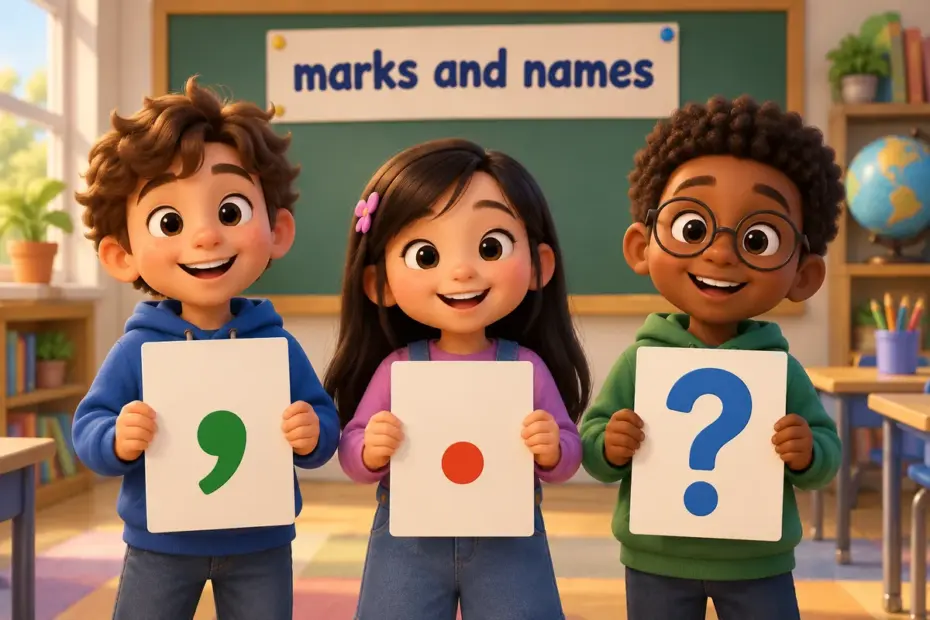
The names of punctuation symbols are the labels English gives to the marks that organise writing, from the quiet comma to the wide em dash. Each mark has a standard name and a clear job, so a writer can say precisely which one is missing. The comma, for instance, separates items in a list.
Names of punctuation symbols at a glance
- A period, also called a full stop, closes a declarative sentence.
- A comma separates items in a series and marks short pauses.
- A question mark and an exclamation mark close questions and exclamations.
- A colon introduces, while a semicolon links two balanced clauses.
- Parentheses, brackets and braces each enclose a different kind of aside.
What are the names of punctuation symbols?
The names of punctuation symbols are the fixed words we use for each written mark. The standard list runs from the period and comma to the less familiar backslash and tilde, and British and American writers share most of it. The rules for the comma make a good starting point because that mark appears in nearly every sentence.
| Mark | Common name | Main job |
|---|---|---|
| . | period (full stop) | Ends a statement. |
| , | comma | Separates items in a series. |
| ? | question mark | Closes a direct question. |
| ! | exclamation mark | Marks strong feeling. |
| : | colon | Introduces a list or a definition. |
| ; | semicolon | Joins two related clauses. |
| ‘ | apostrophe | Marks possession or a contraction. |
| “ | quotation mark | Encloses quoted or spoken words. |
| – | hyphen | Joins the parts of a compound word. |
| ( | parenthesis (round bracket) | Adds an extra remark. |
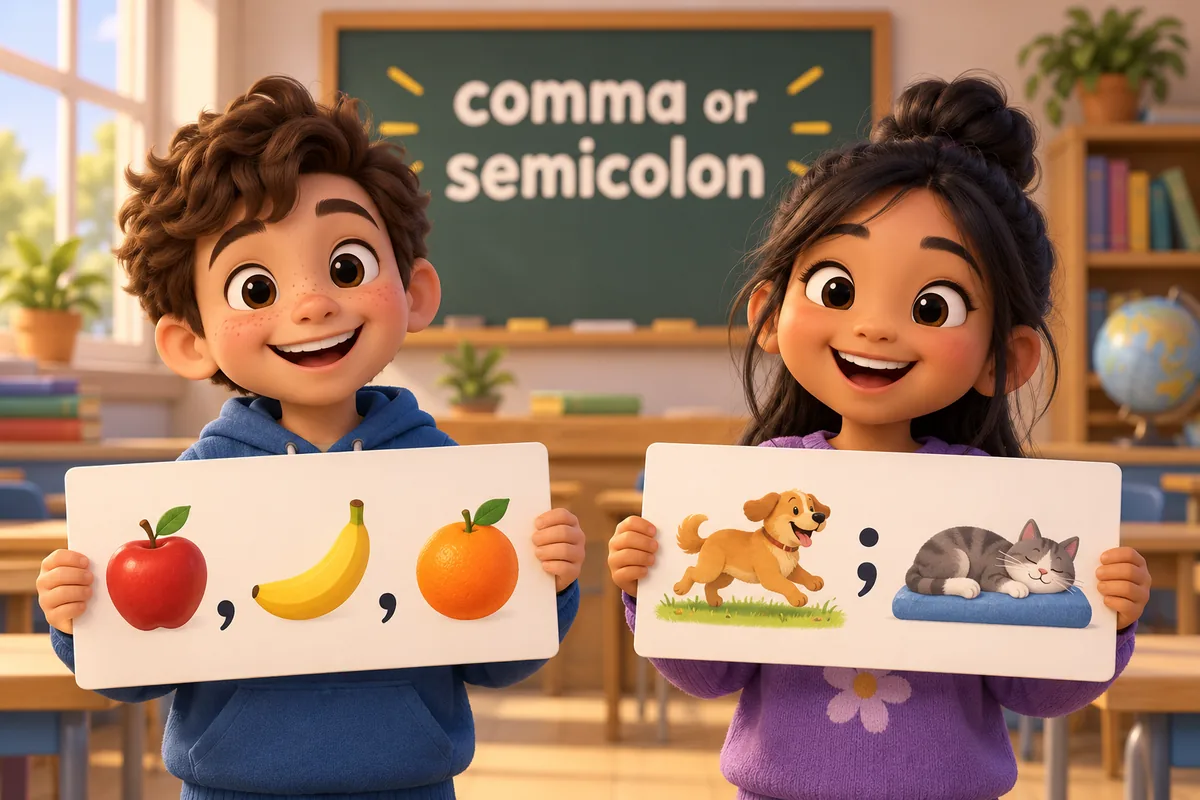
The punctuation marks people confuse most often are the colon and the semicolon, and the difference between a colon and a semicolon comes down to what follows each mark: a list or a pair of joined clauses.
Beyond that core list sit the symbols that organise data as well as prose. The ampersand stands for and, the at sign marks an address, the hash opens a tag and the asterisk points to a footnote. The underscore joins words in a file name, the tilde shows an approximate value and the slash separates alternatives. Each one carries a fixed name, which matters when someone has to type it from an instruction.
How do you use punctuation names in a sentence?
A punctuation name works as an ordinary noun, so it takes an article and a plural and can be the subject of a sentence. Writers name a mark when they give an instruction, describe a style or point to an error, and the pattern table shows the frame each name appears in.
| Name | Pattern | What it signals |
|---|---|---|
| comma | item, item and item | A list of three or more. |
| colon | clause: list | What follows explains the first part. |
| semicolon | clause; clause | Two balanced, related clauses. |
| quotation mark | He said, “wait” | The exact words someone used. |
| apostrophe | the girl’s book | Possession by a single owner. |
| hyphen | a well-known author | Two words acting as one modifier. |
A named mark also behaves like any countable noun, so it takes the and a, forms a plural and can lead a sentence. A phrase such as the comma after the date is a complete subject, and a line such as the semicolons need checking uses the plural name as plainly as any other noun. That is why an editor can write the sentence and the mark into a single clear instruction.
Punctuation names across contexts
The same names appear in classrooms, newsrooms and code, and each setting needs the mark to be named exactly. The table gives one real use of a symbol name in each context, with the reason the name matters there.
| Context | Sentence | Why this works |
|---|---|---|
| Classroom | The teacher circled the missing full stop. | Names the exact mark a pupil left out. |
| Editing note | Add a comma after the opening phrase. | A name turns a comment into a short instruction. |
| Technical writing | Escape the backslash before the quote. | Code guides reuse the same symbol names. |
| Business email | Replace the hyphen with an en dash. | Precise names keep format requests unambiguous. |
| Newsroom | The copy desk shortened the em dash sentence. | Each dash has its own name and width. |
| Academic writing | The citation sits inside square brackets. | The name separates bracket types clearly. |
| Conversation | Put that phrase in inverted commas. | British speakers name quotation marks differently. |
| Dictionary work | The entry lists the plural ellipses. | Reference books depend on consistent names. |
| Exam paper | Identify the apostrophe in line two. | A named mark is easy to point at. |
| Proofreading | A stray semicolon broke the list. | Naming the mark locates the fault quickly. |
Learners who want the habits behind the symbol can read how a question mark works, since that mark changes the shape of a whole sentence.
Register shapes which names an editor reaches for. A proofreading note names the mark and its place, as in add a comma after the opener, while a style guide names the rule, as in use the serial comma. In everyday speech people often shorten the labels, saying quote for quotation mark or dot for period, and those short forms belong in conversation rather than in formal instructions.
Which name should you use?
Two writers can mean the same mark and still use different names, because American and British English label a few of them differently. Choose the set that matches your audience, and stay consistent within one document.
| Mark | American name | British name |
|---|---|---|
| . | period | full stop |
| ( ) | parentheses | round brackets |
| [ ] | brackets | square brackets |
| { } | braces | curly brackets |
| ” “ | quotation marks | inverted commas |
Either set is correct, but a mismatch inside one page reads as carelessness, so pick one and hold it. The guide to quotation marks shows how the two traditions punctuate the same quoted line.
Word forms and plurals of punctuation names
Most punctuation names are countable, so they take a plural and an article. A few come from Greek, and those keep the original plural, which is why ellipsis becomes ellipses rather than ellipsises.
| Singular | Plural | Example |
|---|---|---|
| comma | commas | Two commas frame the phrase. |
| parenthesis | parentheses | The aside sits in parentheses. |
| ellipsis | ellipses | She trailed off with an ellipsis. |
| dash | dashes | The sentence holds two dashes. |
| bracket | brackets | Close the brackets after the date. |
| hyphen | hyphens | Aged care takes a hyphen. |
Countability follows the ordinary noun rules, so a name such as comma freely takes a and an s. The exception is a name that already ends in s or comes from Greek, because parenthesises and ellipsises are not English words at all. When a plural looks unlikely, the safest test is to check the pattern against a familiar pair such as dash and dashes before writing it.
Common mistakes with punctuation names
- Incorrect:
That is a quote mark.Correct: That is a quotation mark. Rule: the standard name is quotation mark, and quote is only the informal short form. - Incorrect:
Write a parenthesis around the year.Correct: Write parentheses around the year. Rule: a matching pair is parentheses; a single one is a parenthesis. - Incorrect:
The mark in well-known is a dash.Correct: The mark in well-known is a hyphen. Rule: a hyphen joins word parts, while a dash separates clauses. - Incorrect:
Use inverted commas in American academic writing.Correct: Use quotation marks in American academic writing. Rule: inverted commas is the British name. - Incorrect:
The plural of ellipsis is ellipsis.Correct: The plural of ellipsis is ellipses. Rule: a Greek-derived name ending in -is takes the plural -es.
Practice using punctuation names
- Name the mark that closes a declarative sentence, giving its American and British names.
- Which mark joins two related clauses: a comma or a semicolon?
- Correct the error: He wrote a dash between the two halves of the compound word.
- Fill the gap: A direct question ends with a ______ mark.
- Build a sentence that names two punctuation marks and states the job of each.
- Spot the register: which sentence fits an editing note, (a) Add a comma after the opener, or (b) That little squiggle goes there?
Answers
- A period in American English and a full stop in British English, because both close a statement.
- A semicolon, because it joins two clauses, while a comma only lists or pauses.
- He wrote a hyphen, because a hyphen joins the parts of one compound word.
- question, because a question mark signals a direct question rather than a statement.
- The colon introduces a list and the comma separates its items, because each mark has a distinct job.
- (a) Add a comma after the opener, because it names the mark and the place in one instruction.
The bottom line
The names of punctuation symbols give every mark a fixed label, so a writer can name the exact point that needs changing. Most names are shared, but a handful split between American and British usage, such as period and full stop. Learn the standard name, the plural and the job, and talking about writing becomes precise.
Frequently asked questions about names of punctuation symbols
Is a period the same as a full stop?
Yes. A period and a full stop are the same mark, and the difference is regional. American writers say period, British writers say full stop, and both close a declarative sentence. The name you choose matters less than using it consistently within one piece of writing.
What do you call the dots in an ellipsis?
The dots are simply the three periods that make up an ellipsis, and there is no separate name for each one. The whole mark is an ellipsis, its plural is ellipses, and writers use it to show an omitted word or a trailing thought in a sentence.
Why are quotation marks called inverted commas?
British writers call them inverted commas because the opening mark looks like a pair of raised, or inverted, commas. The name describes the shape rather than the job. American writers simply say quotation marks, and both names refer to the same pair of marks around quoted words.
What is the difference between a hyphen and a dash?
A hyphen is short and joins the parts of one word, as in well-known. A dash is longer and separates a phrase or a clause from the rest of the sentence. The hyphen builds a single unit, while the dash interrupts the flow of a sentence.