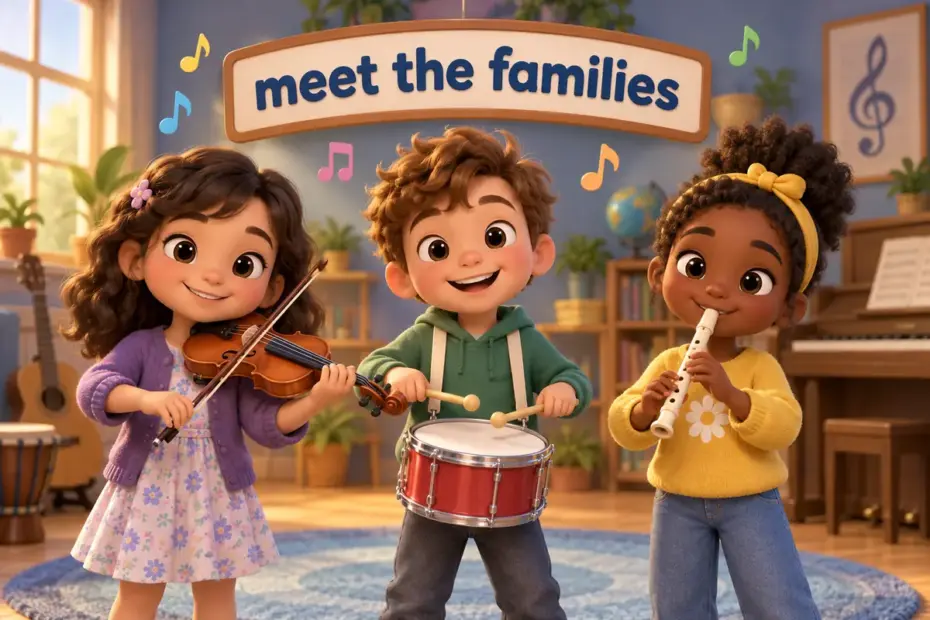
Musical instruments for kids are the objects children use to make rhythm and melody, grouped into families such as strings, woodwind, brass, percussion and keyboard. Each family makes sound in a different way. “I play the recorder at school,” a child might say, naming an instrument in a simple sentence.
Musical instruments for kids at a glance
- A musical instrument is an object a child plays to make music.
- Instruments are grouped into strings, woodwind, brass, percussion and keyboard.
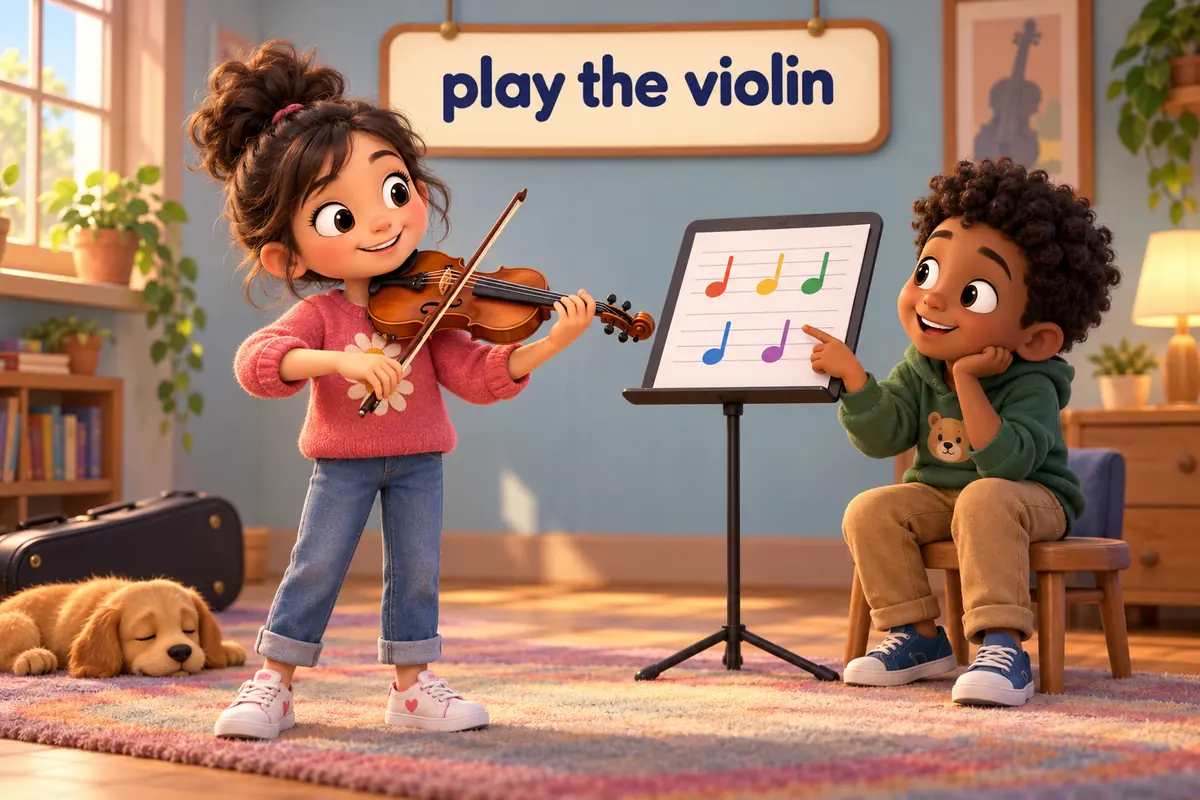
- The usual play pattern puts the before the instrument, as in play the violin.
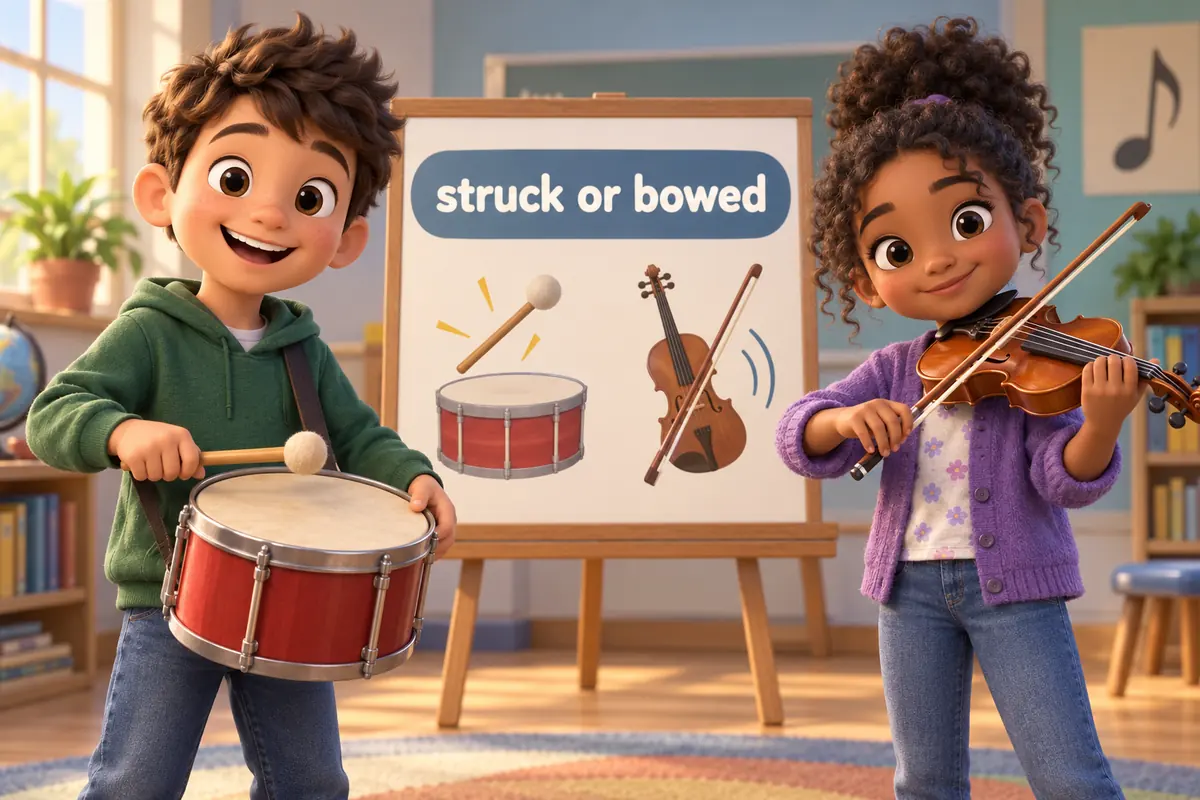
- Percussion instruments are struck; strings are bowed or plucked; winds need breath.
- The commonest mistake is dropping the word the before the instrument name.
What are musical instruments for kids?
Musical instruments for kids are the things a child plays to make sound, and they are grouped into families by how that sound is made. Naming the family is the fastest way to describe an instrument, because a child can then say what it does rather than only what it looks like. Each family below uses a different action.
| Family | Instruments | How sound is made |
|---|---|---|
| Strings | violin, cello, guitar, harp | strings vibrate when bowed or plucked |
| Woodwind | flute, recorder, clarinet, saxophone | breath passes over an edge or reed |
| Brass | trumpet, trombone, tuba, French horn | buzzing lips push air through a tube |
| Percussion | drum, xylophone, tambourine, cymbals | the instrument is struck or shaken |
| Keyboard | piano, keyboard, organ | keys set strings or notes in motion |
One honest caution is worth stating: an instrument is a tool, and the family it belongs to says more about the sound than its size. A small flute can carry a clear tune across a hall, while a large drum mostly keeps time. A child who learns the family first can describe any new instrument met later, which is more useful than memorising a long list of names.
How do you talk about playing an instrument?
Talking about instruments follows a short pattern that names the player and the instrument. The small word the matters, because it appears before the instrument name in most sentences.
| Pattern | Example | What it signals |
|---|---|---|
| I play the + instrument | I play the recorder. | states a skill |
| can play the + instrument | She can play the violin. | states an ability |
| learn to play the + instrument | He is learning to play the drums. | shows progress |
| practise the + instrument | I practise the piano each day. | names the routine |
| the + instrument + sounds + adjective | The flute sounds soft and clear. | describes the tone |
Musical instruments across contexts
Instrument words appear in a music lesson, a school concert and a family living room, and each setting adds a new phrase. Children build vocabulary quickly when they name what they hear, and pages such as a words for kids and b words for kids add useful letters and words for talking about music.
| Context | Example sentence | Why this works |
|---|---|---|
| Music lesson | I play the recorder in class. | names an instrument and a skill |
| School concert | The band played three songs. | names a group of players |
| Home practice | I practise the piano after school. | links the instrument to routine |
| Shop visit | May I try the small guitar? | a polite request to test |
| Family evening | Grandpa taught me a song on the flute. | connects music to family |
| Assembly | The drum kept a steady beat. | describes the role of a percussionist |
| Listening game | Which instrument sounds high? | links sound to pitch |
| Orchestra trip | The strings played softly first. | names a whole family |
| Birthday wish | I would like a keyboard for my birthday. | names a wanted instrument |
| Practice diary | I practised the violin for ten minutes. | records a small goal |
| Friend’s news | She is learning the trumpet. | reports a new skill |
Which instrument suits which child?
The best first instrument depends on the child’s size, patience and interest, not on what looks impressive. A short comparison makes the choice easier for a family.
| Child | Good first choice | Harder start | Reason |
|---|---|---|---|
| A very young child | a drum or a xylophone | a violin | percussion needs only a steady hand |
| A quiet, patient child | the recorder or the piano | the trombone | slow, careful practice pays off |
| A child who loves breath control | the flute | the tuba | the flute is light and easy to hold |
| A child who loves rhythm | the drums | the harp | drums build on a natural sense of beat |
| A child who loves melody | the violin or the piano | cymbals | these instruments carry a whole tune |
Renting before buying is a sensible first step, because a child’s interest can change within months. A short trial also shows whether the child enjoys the practice, which matters more than the instrument name. Above all, keep the first sessions short and playful, since a happy ten minutes builds a habit better than a tired hour.
Words and phrases linked to instruments
Instrument words sit inside a musical family that lets a child describe a whole lesson. Young readers can pair musician and drumbeat with compound words for kids, then describe the tune with adjectives for kids such as loud, soft and merry.
| Word | Type | Example |
|---|---|---|
| instrument | noun | She chose a small instrument. |
| musician | noun | The musician played all evening. |
| practise | verb | I practise the flute every day. |
| melody | noun | The melody was easy to hum. |
| rhythm | noun | The drum kept a strong rhythm. |
Common mistakes with instrument words
Mistake 1: dropping the word the. Incorrect: I play violin. Correct: I play the violin. Rule: the pattern is play the plus the instrument name.
Mistake 2: leaving out musical. Incorrect: A music instrument. Correct: A musical instrument. Rule: the adjective musical describes the instrument.
Mistake 3: using good instead of well. Incorrect: She plays the flute good. Correct: She plays the flute well. Rule: an adverb describes how the playing is done.
Mistake 4: mixing up practise and practice in British spelling. Incorrect: I practice the piano each day. Correct: I practise the piano each day. Rule: in British English the verb ends in se and the noun in ce.
Mistake 5: pluralising a single instrument. Incorrect: I play the flutes. Correct: I play the flute. Rule: one player plays one instrument, so the noun stays singular.
Mistake 6: writing piano as two words. Incorrect: piano forte for the modern piano. Correct: piano. Rule: the modern keyboard instrument is spelled as one word.
Practice using instrument words
- Fill in the blank: I play the ___ in the school band.
- Choose the better word: (struck / bowed) for how a drum makes sound.
- Correct the error: He can play violin very good.
- Build a sentence: name an instrument you would like to learn and say why.
- Spot the register: which sentence suits a music teacher, (a) I practise the flute daily, or (b) Me play flute?
- Fill in the blank: The ___ sounds soft and clear.
Answers
- recorder, because the pattern needs an instrument after the.
- struck, because a drum is hit rather than bowed.
- He can play the violin very well; the takes the instrument and well describes the playing.
- I would like to learn the piano, because it can play both melody and chords.
- (a), because a teacher expects a complete, polite sentence.
- flute, because the pattern is the plus instrument plus sounds.
The bottom line
Musical instruments for kids are easier to learn when they are grouped by family: strings are bowed or plucked, woodwind uses breath, brass uses buzzing lips, percussion is struck and keyboards move keys. The play pattern keeps the before the instrument, as in I play the violin. Let a child try a few short, happy sessions before choosing, and the right instrument will show itself.
Frequently asked questions about musical instruments for kids
What is the easiest instrument for a young child?
Percussion is often easiest to start, because a drum or xylophone needs only a steady hand. The recorder is the next gentle step, since it is light, cheap and taught in many schools. A young child enjoys these because the first sound comes easily and quickly.
Why do we say play the piano and not play piano?
English places the before an instrument name in the phrase play the plus instrument, as in play the violin. Dropping the is a common slip that marks a learner. Both British and American speakers usually keep the word the in this pattern.
How long should a child practise an instrument?
Short and regular beats long and rare, so ten focused minutes a day suits a beginner well. Practising the same small part slowly improves it faster than rushing through a whole tune. A child who enjoys the routine will naturally ask for more time.
Which instruments can a child learn at school?
Many schools teach the recorder, the violin and classroom percussion such as drums and xylophones. Some offer brass and woodwind lessons in small groups. A school band gives a child a reason to practise, because the playing is shared with others.