
Mountain animal names describe the creatures that live at high altitude and cope with cold, thin air and steep ground, such as the snow leopard, the ibex and the mountain goat. Grouping them by the zone they live in makes the long list easier to learn.
Mountain animal names at a glance
- A mountain animal is one that lives on high ground and tolerates cold and thin air.
- Common names are short: ibex, chamois, pika, marmot, yak.
- Some names carry two words, as in snow leopard or mountain goat.
- The plural is regular for most names: ibexes, yaks, marmots.
- The commonest error is calling the puma a mountain lion in one clause and a cougar in the next.
What are mountain animal names?
Mountain animal names are the common words for wildlife that lives on peaks, cliffs and alpine meadows. The animals sort into three loose zones, and the zone tells you how each one survives. More animal words appear in animal in a sentence.
| Animal | Where it lives | One fact |
|---|---|---|
| Snow leopard | high ranges of Central Asia | A thick tail and wide paws for cold rock. |
| Ibex | rocky cliffs of Europe and Asia | Long ridged horns that curve back. |
| Mountain goat | peaks of North America | A white coat and sure footing on ledges. |
| Bighorn sheep | Rocky Mountains | The male has heavy curled horns. |
| Chamois | the Alps and other European ranges | A small, agile climber of steep ground. |
| Yak | the Himalayan plateau | A long shaggy coat and a pack animal role. |
| Puma | ranges across the Americas | Also called cougar or mountain lion. |
| Vicuña | the Andes | Grows very fine wool. |
| Marmot | alpine meadows | Burrows underground and whistles a warning. |
| Pika | rocky slopes | A small relative of the rabbit. |
| Golden eagle | mountain skies | Hunts over open ridges. |
| Andean condor | the Andes | A very wide wingspan that glides on updraughts. |
| Mountain hare | moorland and high ground | Turns white in winter in many regions. |
| Takin | Himalayan forests and slopes | A stocky animal related to goats and sheep. |
| Grizzly bear | mountain ranges of North America | Digs for roots and forages widely. |
| Alpine chough | high peaks | A black bird with a yellow bill. |
One honest limit belongs here. A mountain is not a single habitat, so a name on this list may live in forest lower down as well as on open rock above, and the exact range of each animal shifts with the region and the season.
How do you use mountain animal names in a sentence?
Each name is a countable noun, and the small patterns around it stay fixed. Words for the ground itself appear in mountain peak in a sentence.
| Pattern | Example | What it signals |
|---|---|---|
| a + name | An ibex stood on the ledge. | one animal |
| name + plural | Marmots whistled from the meadow. | a group |
| a herd of + plural | A herd of yaks crossed the pass. | a travelling group |
| the + name + is + a + noun | The puma is a large cat. | classification |
| name + that + clause | The eagle that hunts the ridge is a golden eagle. | a defining clause |
| name + above + place | Snow leopards live above the treeline. | a habitat |
Mountain animal names: examples across contexts
The same names move from a field guide to a news report, and each setting frames them a little differently.
| Context | Example sentence | Why this works |
|---|---|---|
| Field guide | The chamois clings to ledges that few climbers would trust. | a descriptive note |
| Classroom | Sort the ibex, the pika and the yak by the zone they live in. | a sorting task |
| Hiking blog | A golden eagle circled the ridge for ten minutes. | a vivid sighting |
| News report | Snow leopards have been recorded again in the high range. | a factual report |
| Conversation | Did you see the marmot on the path? | an everyday question |
| Ranger notice | Keep clear of the yaks on the pass road. | a safety instruction |
| Travel diary | From the summit we watched condors glide below us. | a personal record |
| Wildlife poster | The mountain goat balances on a ledge no wider than a boot. | a display caption |
| Exam answer | The puma, cougar and mountain lion are one animal. | a formal claim |
| Puzzle | An animal that digs a burrow in an alpine meadow is a marmot. | a definition in use |
Which mountain animal words cause confusion?
A few names look like one animal but point to another, and one cat carries three names. Ground features of a mountain appear in mountain pass in a sentence, and a contrasting habitat word sits in marine animal in a sentence.
| Name | Meaning | Example |
|---|---|---|
| puma / cougar / mountain lion | three names for one cat | The puma is also called the cougar. |
| mountain goat / bighorn sheep | two different animals | A bighorn sheep has curled horns. |
| ibex / chamois | two European climbers | The chamois is smaller than the ibex. |
| yak / buffalo | a high-altitude ox / a lowland ox | A yak suits thin mountain air. |
| pika / marmot | two small alpine mammals | The pika is smaller than the marmot. |
Word forms and grammar of mountain animal names
The core words build a small family, from the noun to the describing form. A word for animals kept for work appears in draft animal in a sentence.
| Form | Part of speech | Example |
|---|---|---|
| ibex | noun | An ibex crossed the ridge. |
| ibexes | plural noun | Two ibexes climbed the rock. |
| alpine | adjective | Alpine plants grow above the treeline. |
| montane | adjective | Montane forests cover the lower slopes. |
| altitude | noun | Few animals live at this altitude. |
| summit | noun | The summit was lost in cloud. |
Common mistakes with mountain animal names
Mistake 1: treating three names as three animals. Incorrect: The puma, cougar and mountain lion are three species. Correct: The puma, cougar and mountain lion are one species. Rule: the same animal can carry several common names.
Mistake 2: a plural after the article a. Incorrect: We saw a yaks on the pass. Correct: We saw a yak on the pass. Rule: a and an come before a singular noun.
Mistake 3: a singular verb with a plural subject. Incorrect: The marmots is out. Correct: The marmots are out. Rule: a plural subject takes a plural verb.
Mistake 4: the wrong mountain for the animal. Incorrect: The grizzly is a European mountain cat. Correct: The puma is a mountain cat of the Americas. Rule: match each name to its true region before you write.
Mistake 5: a plural modifier. Incorrect: Mountains animals face a hard winter. Correct: Mountain animals face a hard winter. Rule: a noun that describes another noun stays singular.
Practice using mountain animal names
Each item below asks for one name, one region or one correction, and every answer gives the reason rather than the key alone.
- Fill in the blank: A ___ whistled a warning from the alpine meadow.
- Choose the better word: The animal with huge curved horns in the Rockies is the (ibex / bighorn sheep).
- Correct the error: The marmots is out on the rock.
- Build a sentence: use a herd of about yaks crossing a pass.
- Spot the register: which line suits a ranger notice, (a) Keep clear of the yaks on the pass road, or (b) Best not to bother the yaks, eh?
- Fill in the blank: An animal that lives above the treeline in the Andes and grows fine wool is the ___.
Answers
- marmot, because the marmot burrows in alpine meadows and whistles a warning.
- bighorn sheep, because the bighorn sheep of the Rockies has heavy curled horns.
- The marmots are out on the rock; marmots is a plural subject and takes a plural verb.
- A herd of yaks crossed the high pass.
- (a), because a public notice uses plain, direct language.
- vicuña, because the vicuña lives in the Andes and is known for very fine wool.

The bottom line
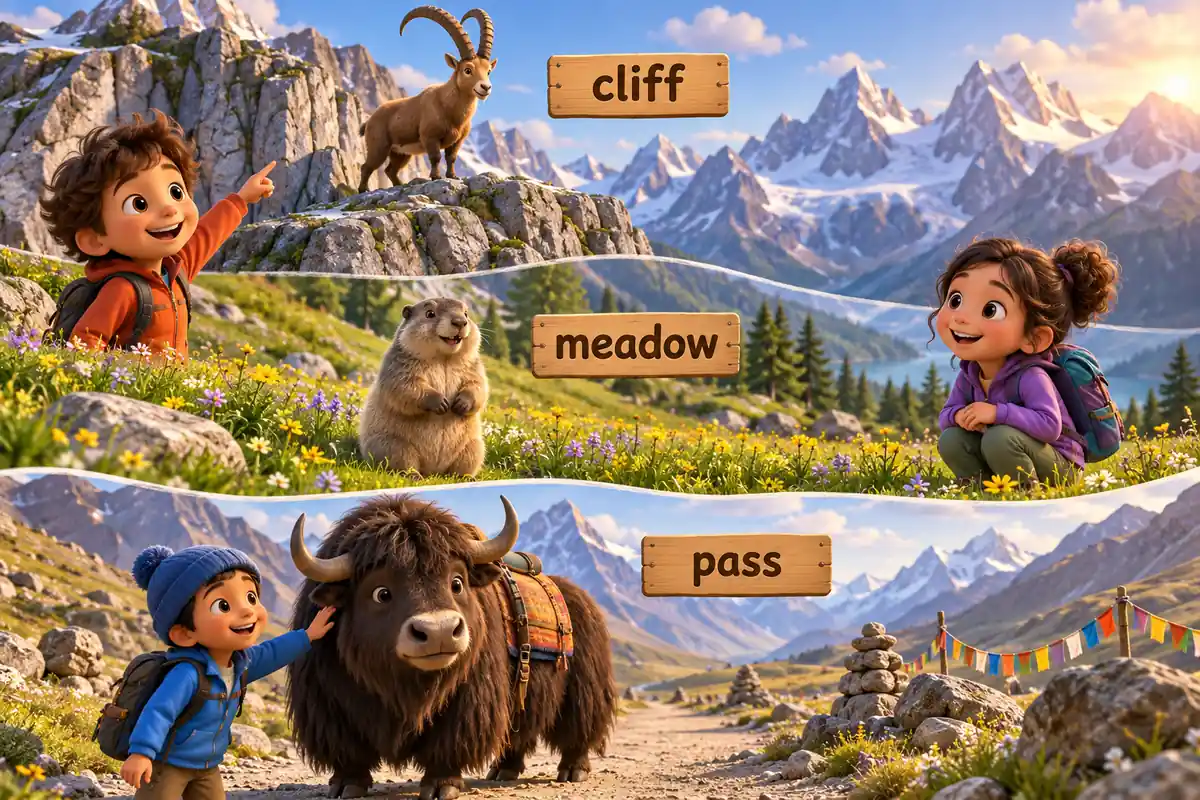
Mountain animal names are best learned by zone, starting with the cliff climbers such as the ibex, chamois and mountain goat, then the meadow animals such as the marmot and the pika, then the high-pass travellers such as the yak. Keep the describing noun singular in mountain animals, match each name to its real region, and remember that the puma, cougar and mountain lion are one animal. Learn the zones and the names settle in place.
Frequently asked questions about mountain animal names
What are some common mountain animal names?
Common mountain animal names include the snow leopard, ibex, mountain goat, bighorn sheep, chamois, yak, puma, vicuña, marmot, pika, golden eagle, Andean condor, mountain hare and takin. These live on peaks, cliffs and high meadows, where they cope with cold, thin air and steep, rocky ground.
Is a mountain lion the same as a puma?
Yes, the mountain lion, puma and cougar are all names for one large cat of the Americas. The choice of name varies by region and by habit of speech, but the animal is the same species. In careful writing, name the species once and then keep to that one term.
How do yaks survive the cold?
Yaks survive mountain cold with a long, dense, shaggy coat that traps warmth and sheds rain and snow. Their broad hooves grip rocky ground, and their large lungs cope with thin air at high altitude. People also keep them as pack animals on the Himalayan plateau because they carry loads over rough terrain.
What is the difference between a pika and a marmot?
A pika is a small, round mammal related to the rabbit, often seen on rocky slopes where it gathers grass. A marmot is a larger, ground-dwelling rodent of alpine meadows that burrows underground and whistles a warning. Both live high up, but the pika is much smaller and has short, rounded ears.