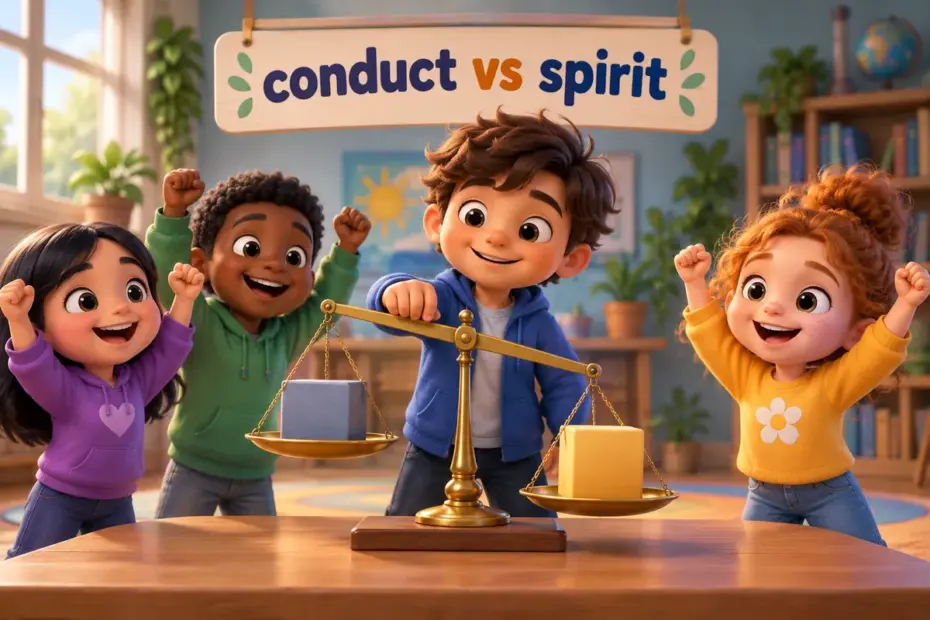
Moral vs morale look almost the same, but they sit in different parts of a sentence and in different worlds. Moral is an adjective about right and wrong, and a noun for the lesson of a story, while morale is a noun for the spirit and confidence of a person or group. One judges conduct, the other measures mood.
Moral vs Morale at a glance
- Moral is usually an adjective, and sometimes a noun; morale is always a noun.
- Moral means concerned with right and wrong, or the lesson of a story.
- Morale means the spirit, confidence or enthusiasm of a group.
- The final e in morale shifts the stress to the second syllable.
- The commonest error is writing moral for the spirit of a team.
What does moral mean and what does morale mean?
Moral is an adjective meaning concerned with right and wrong, and it also works as a noun meaning the lesson drawn from a story. Morale is a noun meaning the spirit, confidence or enthusiasm of a group or person. The Cambridge entry for moral and the Cambridge entry for morale confirm the split, and one line shows it: a moral duty binds a choice, while low morale drains a team.
| Sense | Word | Plain meaning | Example |
|---|---|---|---|
| Right and wrong | moral | Concerned with good conduct | She raised a moral objection to the plan. |
| A lesson | moral | The point of a story | The moral is that patience pays. |
| A person’s standards | morals | Principles of conduct | His morals guided the decision. |
| Group spirit | morale | Confidence of a team | The victory lifted morale in the camp. |
| Personal mood | morale | Confidence of one person | Her morale dipped after the setback. |
The two words share a root about conduct, yet they travelled apart. Moral kept the sense of right and wrong, while morale came to mean the spirit that a group feels, which is why it often follows words such as high, low, boost and lift.
What is the difference between moral and morale?
The difference is part of speech first and stress second. Moral is an adjective, or a countable noun for a lesson, while morale is a noun that names a shared feeling. A near-miss pair such as addition vs edition fails for a similar reason, and a one-letter trap such as abel vs able changes meaning the same way.
| Test | Moral | Morale |
|---|---|---|
| Part of speech | adjective, and a noun | noun only |
| Core meaning | right and wrong, or a lesson | spirit and confidence |
| Typical subject | conduct, stories, choices | people, teams, troops |
| Common collocations | moral duty, the moral of the story | high morale, a morale booster |
| Stress | first syllable, MOR-al | second syllable, mor-ALE |
| Common error | moral for team spirit | morale for conduct |
Choose moral when a choice, a duty or a lesson is at stake, and choose morale when a group or a person feels confident or discouraged.
How do you use moral and morale in a sentence?
Both words follow fixed patterns, and the words that gather around each one are a faster test than the definition. To watch the first word behave, read moral in a sentence.
| Pattern | Example | What it signals |
|---|---|---|
| a moral + noun | He refused on moral grounds. | a judgement of right and wrong |
| the moral of the story | The moral of the tale is simple. | a lesson drawn out |
| morals as a plural | Her morals never wavered under pressure. | personal standards |
| high or low morale | Morale is high after the win. | the level of group spirit |
| a morale booster | The outing was a real morale booster. | something that raises confidence |
| boost or lift morale | A kind word can lift morale. | an action that helps a group |
| morale among + group | Morale among staff improved slowly. | the spirit of a named group |
Moral and morale in a sentence: examples across contexts
Reading the pair in different registers makes the choice automatic, and more team-focused frames sit in morale in everyday sentences.
| Context | Example sentence | Why this works |
|---|---|---|
| Classroom | The teacher asked the class for the moral of the fable. | moral is the lesson |
| Sports report | The late goal lifted morale in the changing room. | morale is group spirit |
| Workplace email | Flexible hours have improved morale across the team. | morale names a shared feeling |
| News report | The debate turned on a moral question about fairness. | moral is about right and wrong |
| Military writing | Supplies were low and morale was falling. | morale of a unit |
| Literature essay | Every fable carries a moral for the reader. | a countable noun for a lesson |
| Conversation | It was a moral choice, not a practical one. | an adjective of principle |
| Business writing | Morale dropped after the layoffs were announced. | the mood of a workforce |
| Parenting | He tried to draw a moral from the mistake. | a lesson taken from events |
| Coaching | A short break can raise morale before a big match. | an action affecting spirit |
| Philosophy | The argument rests on a moral duty to help. | moral as an adjective |
| Community news | Morale among volunteers stayed high all winter. | spirit of a group |
Which should you use?
Match the word to what the sentence is measuring: a judgement of conduct takes moral, and a level of spirit takes morale.
| Situation | Use | Example |
|---|---|---|
| A question of right and wrong | moral | It is a moral issue. |
| The spirit of a team | morale | Morale is high. |
| The lesson of a story | moral | The moral is about honesty. |
| Encouragement for a group | morale | The news lifted morale. |
Register is the second test. Moral belongs to ethics, law, religion and literary analysis, where conduct and lessons are discussed. Morale belongs to leadership, sport, the workplace and the military, where confidence and mood are managed. When you hear the second-syllable stress, mor-ALE, you are almost certainly dealing with the spirit of a group.
Word forms and grammar of moral and morale
| Form | Part of speech | Example |
|---|---|---|
| moral | adjective | She took a moral stand. |
| moral | noun | The moral is easy to see. |
| morals | noun, plural | His morals were never in doubt. |
| morally | adverb | They acted morally and fairly. |
| morality | noun | The debate touched on public morality. |
| morale | noun | Morale stayed strong all term. |
| demoralize | verb | Repeated delays demoralized the crew. |
Common mistakes with moral and morale
Mistake 1: moral for group spirit. Incorrect: The surprise party lifted the whole team’s moral. Correct: The surprise party lifted the whole team’s morale. Rule: the spirit of a group is morale, with a final e.
Mistake 2: morale for a judgement. Incorrect: They raised a morale objection to the scheme. Correct: They raised a moral objection to the scheme. Rule: an objection about right and wrong is moral.
Mistake 3: morale for a lesson. Incorrect: The morale of the story is to be kind. Correct: The moral of the story is to be kind. Rule: the lesson of a tale is moral.
Mistake 4: morale as an adjective. Incorrect: It was a morale duty to speak up. Correct: It was a moral duty to speak up. Rule: morale is only a noun; the adjective is moral.
Mistake 5: the wrong stress in speech. Incorrect: reading morale with the stress on the first syllable. Correct: stress the second syllable, mor-ALE. Rule: morale is stressed on its last syllable, while moral is stressed on the first.
Practice using moral and morale
- Fill in the blank: The fable ends with a clear ___.
- Choose the better word: The bonus did a lot to raise (moral / morale) in the office.
- Correct the error: The committee faced a morale dilemma about the funding.
- Build a sentence: use high morale about a sports team.
- Spot the register: which line suits a leadership memo, (a) Everyone feels a bit down, or (b) We must protect morale during the change?
- Fill in the blank: He refused to lie on ___ grounds.
Answers
- moral, because it is the lesson of the story.
- morale, because it is the spirit of a group.
- The committee faced a moral dilemma; a question of right and wrong is moral.
- High morale helped the players recover from the early defeat.
- (b), because morale and its formal phrasing suit a leadership memo.
- moral, because it is an adjective describing the grounds for the refusal.
The bottom line
The moral vs morale choice rests on part of speech and on stress. Moral is the adjective and noun of right and wrong, while morale is the noun of spirit and confidence in a group. Stress the second syllable for morale, and let conduct stay with moral, and the pair will rarely mislead you again.
Frequently asked questions about moral and morale
Why does the extra e in morale matter?
The final e marks a different word with a different stress: moral is stressed on the first syllable and names right and wrong, while morale is stressed on the second and names group spirit. The letters look close, but the pronunciation and the grammar keep the two apart once you notice them.
Is morale ever spelt with a capital letter?
No. Morale is a common noun, so it takes a capital only at the start of a sentence. It is also normally uncountable, so it rarely takes a plural, and you would write high morale rather than many morales. The plural morales is not standard English.
What is the adjective form of morale?
Morale has no adjective of its own. To describe a person or group whose spirit has fallen, use the participle demoralized, from the verb demoralize. The adjective moral belongs to the other word, so a boost in spirit never becomes a moral boost.
Can moral be a noun as well as an adjective?
Yes. Moral works as a countable noun meaning the lesson of a story, as in the moral of the fable, and it appears in the plural as morals, meaning a person’s standards of conduct. As an adjective it means concerned with right and wrong, as in a moral duty.