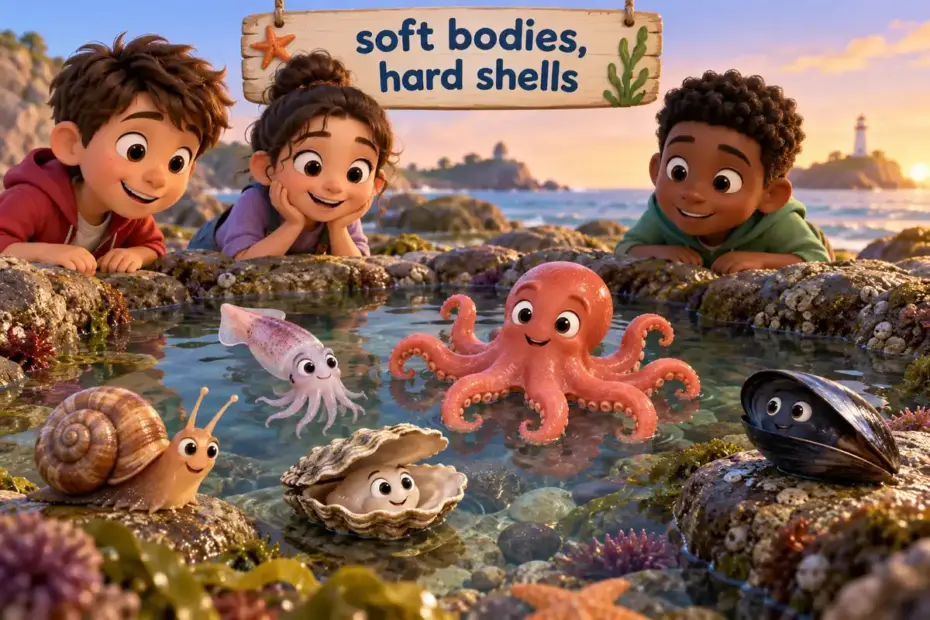
Mollusks names in English label a soft-bodied group of animals that includes the snail, the oyster, the squid and the octopus. Most of these names are short and old, and grouping them by shell type makes the list far easier to remember.
Mollusks names in English at a glance
- A mollusk is a soft-bodied animal, usually with a shell or a former shell.
- The group splits into gastropods, bivalves and cephalopods.
- Everyday names are short: snail, slug, oyster, mussel, clam, squid, octopus.
- The plural is regular for most names: snails, oysters, squids.
- The commonest error is mixing the noun mollusk with the unrelated verb mollify.
What are mollusks names in English?
Mollusks names in English are the common words for soft-bodied animals that often carry a shell. The group falls into three families, and the shell shape tells you which family a name belongs to. A related everyday word appears in moll in a sentence.
| Name | Group | One fact |
|---|---|---|
| Snail | gastropod | Carries a single coiled shell. |
| Slug | gastropod | Like a snail with no outer shell. |
| Sea snail | gastropod | Any snail that lives in the sea. |
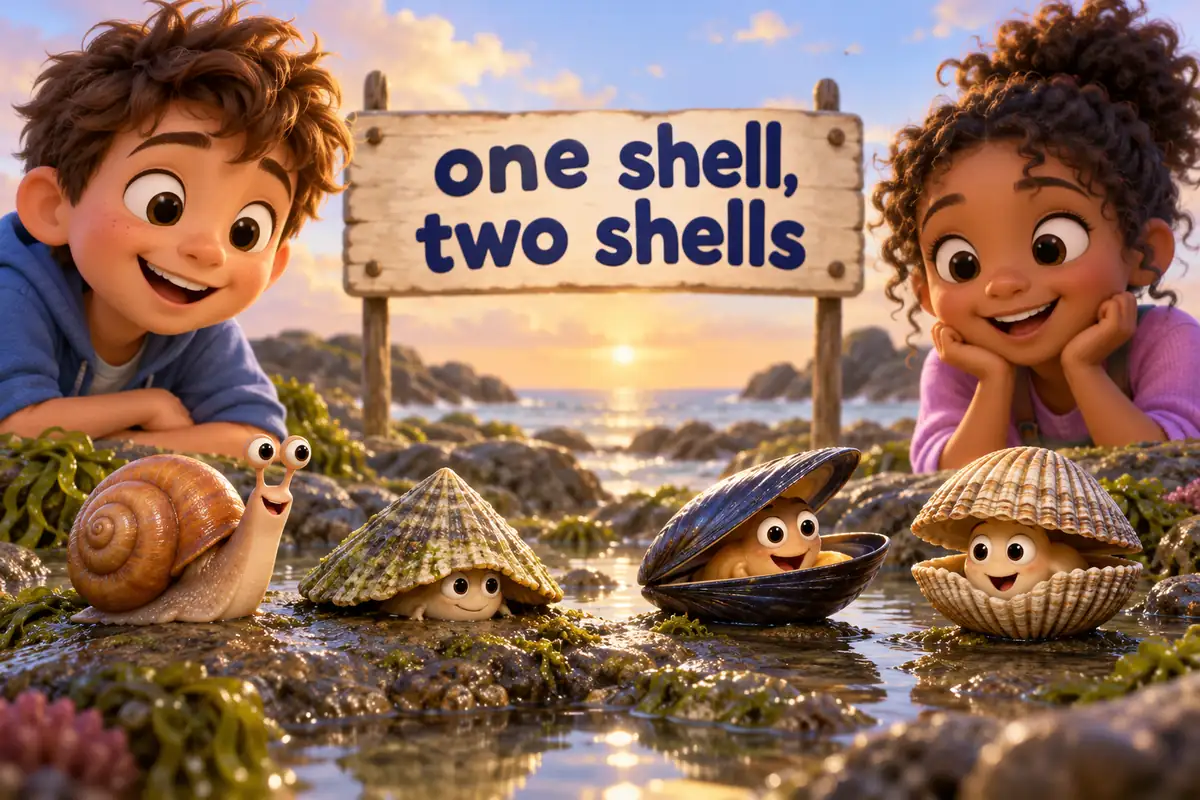
| Limpet | gastropod | A cone-shaped shell that clings to rocks. |
| Abalone | gastropod | An ear-shaped shell with a row of holes. |
| Whelk | gastropod | A spiral sea snail. |
| Conch | gastropod | A large spiral shell from warm seas. |
| Oyster | bivalve | Two hinged shells that can open and close. |
| Mussel | bivalve | A dark shell that grips rocks and ropes. |
| Clam | bivalve | Buries itself in sand or mud. |
| Scallop | bivalve | A fan-shaped shell that swims by clapping. |
| Cockle | bivalve | A small ribbed shell on sandy shores. |
| Squid | cephalopod | A long body with ten arms. |
| Octopus | cephalopod | Eight arms and no shell. |
| Cuttlefish | cephalopod | Has a chalky inner shell and shifts colour. |
| Nautilus | cephalopod | A spiral shelled survivor of an old group. |
| Periwinkle | gastropod | A small sea snail common on rocky shores. |
| Sea slug | gastropod | A shell-less sea mollusk, often brightly coloured. |
| Razor shell | bivalve | A long, narrow shell that burrows in sand. |
One honest limit belongs here. Mollusks name far more animals than any short list can hold, from tiny sea slugs to giant squid, so this table is a practical school set rather than a complete catalogue of the group.
How do you use mollusks names in a sentence?
Each name is a countable noun, and the small patterns around it stay the same. Read the pattern from left to right, because the small word before the name, not the name itself, decides whether you mean one animal or a group. The unrelated verb that learners confuse with this group appears in mollify in a sentence.
| Pattern | Example | What it signals |
|---|---|---|
| a + name | A snail crossed the wet path. | one animal |
| name + plural | Oysters grow on the harbour wall. | a group |
| a shell of a + name | The shell of a clam is hinged. | a body part |
| name + verb + preposition | The octopus slipped into a crevice. | movement |
| the + name + is + a + noun | The squid is a cephalopod. | classification |
| a group of + plural | A group of limpets clung to the rock. | a cluster |
Mollusks names in English: examples across contexts
The same names move from a rock pool to a restaurant menu, and each setting frames them a little differently.
| Context | Example sentence | Why this works |
|---|---|---|
| Rock pool | A limpet gripped the stone while the tide fell. | a field observation |
| Classroom | Sort the snail, the oyster and the squid into their three groups. | a sorting task |
| Menu | Grilled scallops are served with lemon. | a food setting |
| Fisherman’s note | Mussels were thick on the ropes this season. | a working record |
| Conversation | Have you ever seen an octopus change colour? | an everyday question |
| Beach sign | Please leave the living cockles in the sand. | a public instruction |
| Science blog | The nautilus drifts through warm water in a spiral shell. | a vivid description |
| News report | Oyster beds have recovered along the estuary. | a factual report |
| Aquarium label | The cuttlefish changes colour in seconds. | a display caption |
| Exam answer | An octopus is a cephalopod with eight arms. | a formal claim |
| Museum label | This razor shell burrows deep in the sand. | a display caption |
| Garden note | Slugs ate the young lettuce overnight. | a daily observation |
| Harbour notice | Do not collect live mussels from the pier. | a public rule |
| Recipe blog | Steam the cockles until the shells open. | a cooking instruction |
| Coastguard log | A cluster of limpets covered the sea wall. | a survey record |
| Nature talk | The nautilus drifts in a shell shaped like a spiral. | a spoken description |
| School report | We grouped the names by the number of shells. | a summary of work |
Which mollusk words cause confusion?
A few words look or sound like the group name but mean something else. Another unrelated verb sits in mollycoddle in a sentence.
| Word | Meaning | Example |
|---|---|---|
| mollusk | a soft-bodied animal group | A mussel is a mollusk. |
| mollusc | the same word, British spelling | British books write mollusc. |
| mollify | to calm someone down | He tried to mollify the crowd. |
| mollycoddle | to protect someone too much | Do not mollycoddle the boy. |
| octopus / octopuses | one / more than one | Two octopuses hid in the wreck. |
Word forms and grammar of mollusks names in English
The group word builds a small family, and the adjective is used in science writing rather than in everyday speech.
| Form | Part of speech | Example |
|---|---|---|
| mollusk | noun | A clam is a mollusk. |
| mollusks | plural noun | Mollusks live in sea and fresh water. |
| molluscan | adjective | The molluscan shell is often hard. |
| mollusc | noun, British spelling | British texts write mollusc. |
| shell | noun | The shell protects the soft body. |
| seashore | noun | Most names appear on the seashore. |
Common mistakes with mollusks names in English
Mistake 1: a verb for a noun. Incorrect: He tried to mollusk the angry crowd. Correct: He tried to mollify the angry crowd. Rule: mollusk is the animal; mollify is the verb meaning to calm.
Mistake 2: a plural after the article a. Incorrect: We saw a oysters on the rock. Correct: We saw an oyster on the rock. Rule: a and an come before a singular noun.
Mistake 3: an irregular plural for octopus in plain writing. Incorrect: Two octopi hid in the wreck. Correct: Two octopuses hid in the wreck. Rule: the everyday English plural is octopuses.
Mistake 4: a singular verb with a plural subject. Incorrect: The mussels is fresh. Correct: The mussels are fresh. Rule: a plural subject takes a plural verb.
Mistake 5: the wrong group word. Incorrect: A snail is a bivalve. Correct: A snail is a gastropod. Rule: bivalves have two shells, while gastropods usually have one.
Practice using mollusks names in English
Each item below asks for one name, one group or one correction, and every answer gives the reason rather than the key alone.
- Fill in the blank: An ___ has eight arms and no shell.
- Choose the better word: The fan-shaped shell that swims by clapping is a (clam / scallop).
- Correct the error: Two octopi hid under the rock.
- Build a sentence: use a shell of a about the mussel.
- Spot the register: which line suits a beach sign, (a) Please leave living shellfish in the sand, or (b) Leave the shellfish be, yeah?
- Fill in the blank: A snail carries one coiled shell, so it is a ___.
Answers
- octopus, because the octopus has eight arms and no shell.
- scallop, because the scallop has a fan-shaped shell and claps its shells to swim.
- Two octopuses hid under the rock; the everyday plural is octopuses.
- The shell of a mussel is dark and smooth.
- (a), because a public sign uses plain, direct language.
- gastropod, because a gastropod is a mollusk with a single coiled shell.
The bottom line
Mollusks names in English are best learned by shell shape, starting with the single-shelled gastropods such as the snail and the limpet, then the two-shelled bivalves such as the oyster and the mussel, then the many-armed cephalopods such as the squid and the octopus. Keep the plural regular, choose mollify only when you mean to calm, and treat the group word as the animal, not the action. Group the names this way and the whole list stays easy to recall.
Frequently asked questions about mollusks names in English
What are the main mollusks names in English?
The main mollusks names in English are the snail, slug, limpet, abalone, whelk and conch among the gastropods; the oyster, mussel, clam, scallop and cockle among the bivalves; and the squid, octopus, cuttlefish and nautilus among the cephalopods. Each group is named for the shape or number of its shells.
How do you spell mollusk in British English?
British English usually writes mollusc with a c, while American English writes mollusk with a k. The two spellings name exactly the same group of soft-bodied animals. Use one spelling consistently within a single piece of writing, and follow the house style if a teacher or editor has set one.
What is the plural of octopus?
The everyday plural in English is octopuses, as in two octopuses hid in the wreck. The form octopi is sometimes seen, but it comes from treating a Greek word as if it were Latin, so many teachers and dictionaries prefer octopuses or the formal octopodes. In plain writing, octopuses is the safest choice.
Is a snail a mollusk or an insect?
A snail is a mollusk, not an insect. Mollusks have soft bodies and usually a shell, while insects have jointed legs, a hard outer case and three body parts. A snail has one muscular foot and a coiled shell, so it belongs with the gastropods rather than with the insects.