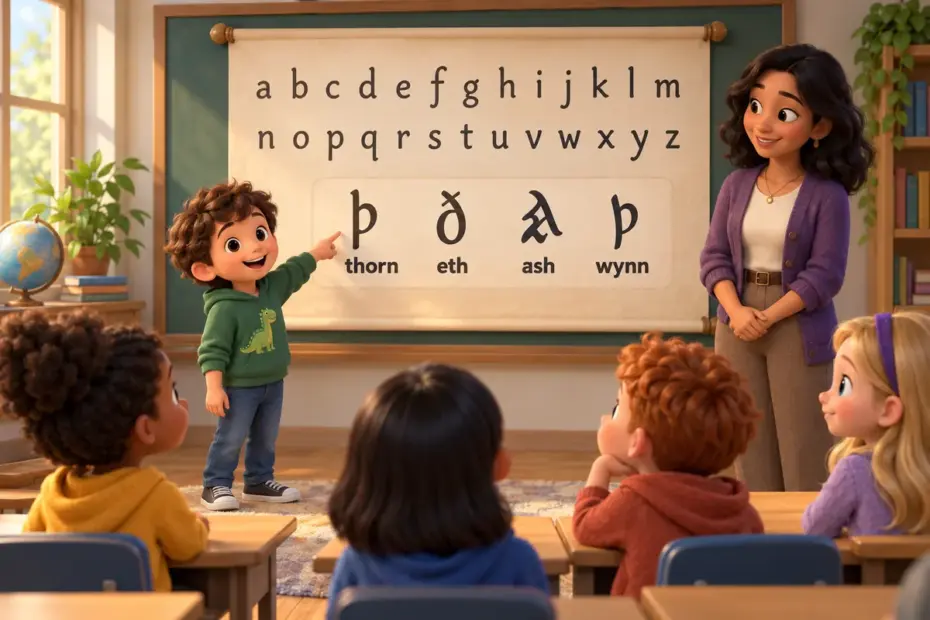
Old English letters A to Z are the alphabet used to write English before about 1150, and it added letters such as thorn, eth and ash to the Latin set. Reading these letters opens the oldest written English and shows how some survive in modern spelling.
Old English letters A to Z at a glance
- The Old English alphabet held about twenty-four letters, most of them Latin.
- Four special letters, thorn, eth, ash and wynn, joined the Latin set.
- Long vowels were marked with a bar in later printed editions, not in the oldest manuscripts.
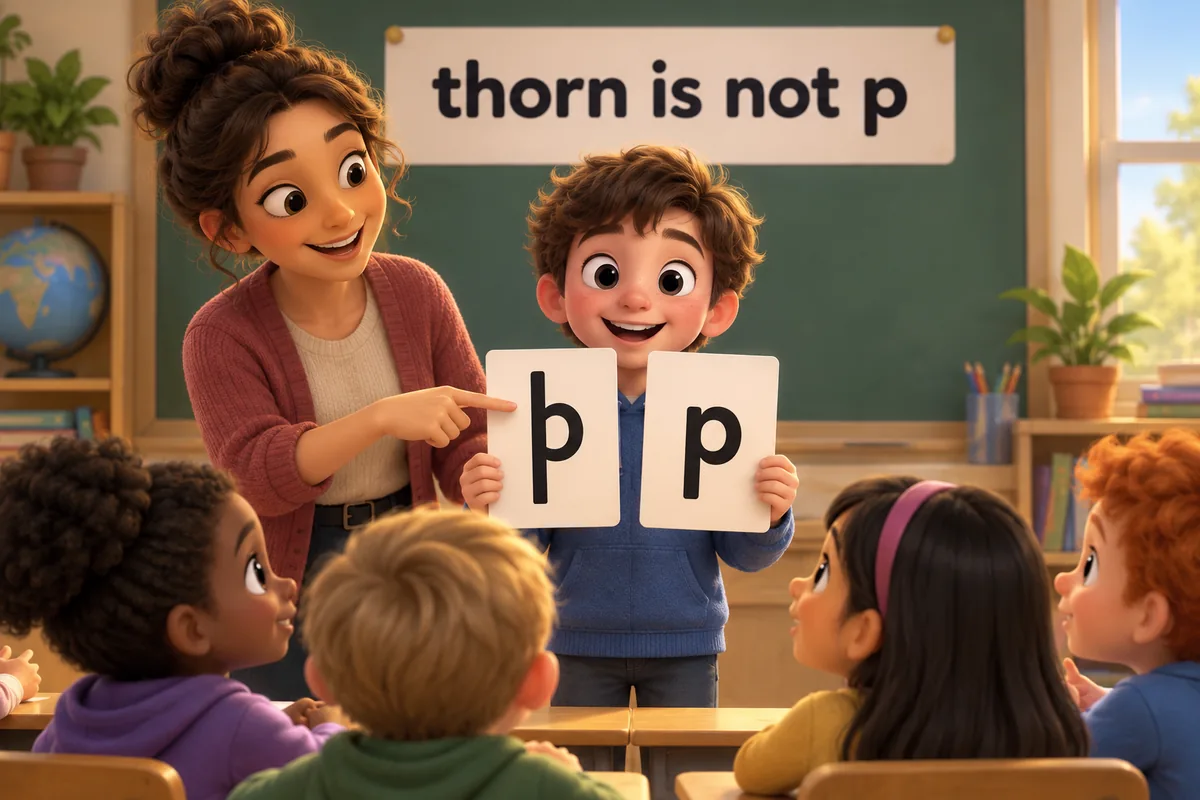
- Some letters changed shape over time, so thorn can look like p to a modern eye.
- The commonest error is calling the blackletter typeface Old English letters, which is a different thing.
What are Old English letters A to Z?
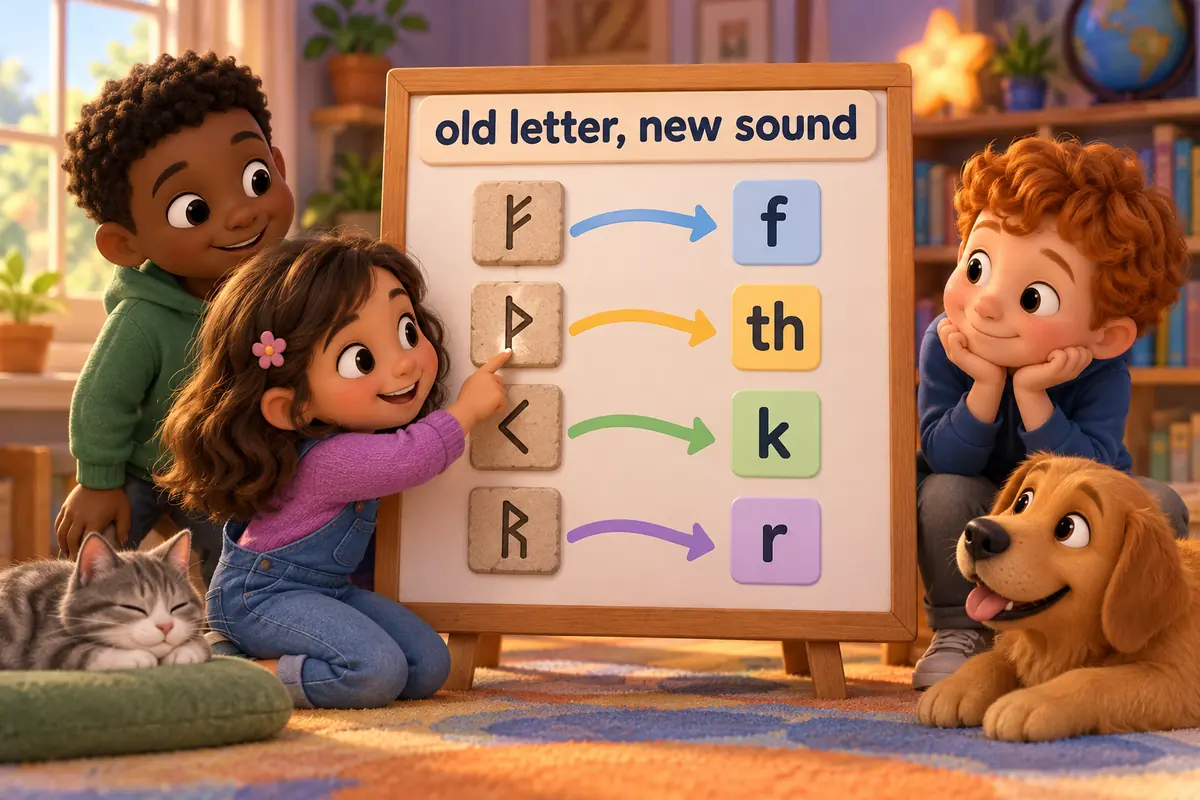
Old English letters A to Z are the set of written signs used in England before about 1150. Most came straight from Latin, and a few were borrowed from the older runic alphabet or built from Latin shapes. The names of the languages that used writing like this appear in a to z language names.
| Letter | Name | Sound or use | Modern note |
|---|---|---|---|
| A, a | a | the vowel a as in father or cat | spelled a today |
| Æ, æ | ash | a vowel between a and e | shown as ae in modern Latin words |
| B, b | be | the sound b | unchanged |
| C, c | ce | often k or ch | its sound changed over time |
| D, d | de | the sound d | unchanged |
| Ð, ð | eth | the voiced th in this | written th today |
| E, e | e | the vowel e | unchanged |
| F, f | ef | the sound f | unchanged |
| G, g | ge | often g or y | its sound changed over time |
| H, h | ha | the sound h | unchanged |
| I, i | i | a vowel or the sound y | later split into i and j |
| L, l | el | the sound l | unchanged |
| M, m | em | the sound m | unchanged |
| N, n | en | the sound n | unchanged |
| O, o | o | the vowel o | unchanged |
| P, p | pe | the sound p | easily confused with thorn |
| R, r | er | the sound r | unchanged |
| S, s | es | the sound s | a long form was used in early printing |
| T, t | te | the sound t | unchanged |
| Þ, þ | thorn | the voiceless th in thin | written th today |
| U, u | u | a vowel or the sound v | later split into u and v |
| W, w | wynn, written ƿ in manuscripts | the sound w | replaced by w |
| X, x | ex | the sounds ks | rare in native words |
| Y, y | y | a rounded vowel or the sound y | its sound changed over time |
One honest limit belongs here. The oldest manuscripts rarely marked vowel length, and modern editions add a small bar over long vowels, so a printed text can show signs that no medieval writer actually wrote.
How do you use the names of these letters in a sentence?
Each letter name is a noun, and a few settled patterns describe how a sign is read. A phrase for a writer appears in a man of letters in a sentence.
| Pattern | Example | What it signals |
|---|---|---|
| the letter + name | The letter thorn looks like a tall p. | naming one sign |
| name + stands for + sound | Eth stands for the th in this. | a sound value |
| written with + name | The word was written with ash. | spelling practice |
| the alphabet + verb | The alphabet added four extra letters. | a set of signs |
| a letter + that + clause | A letter that survives today is thorn, now written th. | a defining clause |
Old English letters A to Z: examples across contexts
The same signs move from a museum label to a school workbook, and each setting frames them a little differently. A parallel alphabetical list appears in a to z desserts list.
| Context | Example sentence | Why this works |
|---|---|---|
| Museum label | This line uses thorn for the sound th. | a display caption |
| Classroom | Copy the word and keep the ash in place. | a writing task |
| History essay | Early writers used eth and thorn for two th sounds. | a careful claim |
| Manuscript study | The scribe wrote wynn where we now write w. | a close reading |
| Conversation | Have you seen how thorn is shaped? | an everyday question |
| Type note | The old font copies medieval letter shapes closely. | a design comment |
| Language blog | Ash survives in a few Latin spellings today. | a link to the present |
| Exam answer | The alphabet was based on Latin with extra letters. | a formal claim |
| Reading list | Start with a text that glosses the hard letters. | practical advice |
| Puzzle | A letter name for the th sound in thin is thorn. | a definition in use |
Which old letters cause confusion?
A few signs look like modern ones, and one common phrase names a font rather than an alphabet. Describing words for such signs appear in adjectives for letters.
| Sign or term | Meaning | Example |
|---|---|---|
| thorn / p | a th sound / the letter p | Thorn has a taller stem. |
| eth / d | the voiced th / the letter d | Eth has a line through the top. |
| wynn / p | the letter w / the letter p | Wynn was replaced by w. |
| ash / ae | one sign / two letters | Ash is written ae in modern Latin. |
| Old English letters / blackletter | a medieval alphabet / a typeface | Blackletter is a style, not an alphabet. |
Word forms and grammar of letter words
The core words build a small family, from the noun to the describing form. Words that describe very old things appear in adjectives for old.
| Form | Part of speech | Example |
|---|---|---|
| letter | noun | Each letter stands for a sound. |
| letters | plural noun | These letters joined the Latin set. |
| lettering | noun | The lettering on the stone is worn. |
| alphabet | noun | The alphabet held about twenty-four signs. |
| runic | adjective | Some signs came from the runic alphabet. |
| manuscript | noun | The manuscript uses thorn throughout. |
Common mistakes with Old English letters
Mistake 1: the wrong sense of Old English. Incorrect: That poster uses Old English letters from the year 900. Correct: That poster uses a blackletter typeface. Rule: Old English letters name a historical alphabet, while blackletter names a printing style.
Mistake 2: thorn read as p. Incorrect: The word begins with a p that sounds like th. Correct: The word begins with thorn, which sounds like th. Rule: thorn has a taller stem than p.
Mistake 3: a plural after the article a. Incorrect: It is a letters from an old text. Correct: It is a letter from an old text. Rule: a and an come before a singular noun.
Mistake 4: a singular verb with a plural subject. Incorrect: The letters is hard to read. Correct: The letters are hard to read. Rule: a plural subject takes a plural verb.
Mistake 5: a plural modifier. Incorrect: Letters names are easy to forget. Correct: Letter names are easy to forget. Rule: a noun that describes another noun stays singular.
Practice using Old English letters A to Z
Each item below asks for one letter name, one meaning or one correction, and every answer gives the reason rather than the key alone.
- Fill in the blank: The letter ___ stands for the voiced th in this.
- Choose the better word: A printing style with heavy black shapes is (thorn / blackletter).
- Correct the error: The letters is hard to read in this manuscript.
- Build a sentence: use written with about the letter ash.
- Spot the register: which line suits a museum label, (a) This line uses thorn for the sound th, or (b) This bit here has a weird old letter, like?
- Fill in the blank: The letter borrowed for the w sound was ___.
Answers
- eth, because eth stands for the voiced th in a word such as this.
- blackletter, because blackletter is a typeface rather than a historical alphabet.
- The letters are hard to read; letters is a plural subject and takes a plural verb.
- The name was written with ash in the old text.
- (a), because a museum label uses clear, formal language.
- wynn, because wynn was the sign used for the w sound before it was replaced.
The bottom line
Old English letters A to Z are best learned by pairing each sign with a sound, starting with thorn and eth for the two th sounds, then ash for a vowel, then wynn for w. Learn the few that survived as th or ae, keep letter and blackletter in their correct senses, and remember that modern editions add vowel marks the manuscripts never had. Pair each sign with its sound and the old alphabet falls into place.
Frequently asked questions about Old English letters A to Z
What are the special Old English letters?
The four special letters that joined the Latin set are ash, eth, thorn and wynn. Ash is a vowel written as a joined a and e. Eth and thorn each stand for a th sound, one voiced and one voiceless. Wynn was used for the w sound before the letter w replaced it in most texts.
How many letters were in the Old English alphabet?
The Old English alphabet held about twenty-four letters, though the exact set varied a little between writers and periods. Most were Latin letters, and a few were added or adapted from the older runic alphabet. Some Latin letters now common, such as j and v, were not used as separate signs at that time.
Were thorn and eth used in the same way?
Thorn and eth were often used for the two th sounds, eth for the voiced sound in this and thorn for the voiceless sound in thin. In practice many scribes used them interchangeably, so the difference is clearer in today dictionary notes than in the oldest manuscripts themselves.
Do any Old English letters survive today?
Most survive only as the sounds they once marked. Thorn and eth both became the modern th spelling, and ash survives in a few Latin forms written ae. Wynn was replaced by w. A few letters, such as eth, also live on in the spelling of Icelandic, which still uses them.