An Old English nouns list shows the everyday words of the language spoken from about 450 to 1150, so mann meant a person and hus meant a house. Each noun also carried a grammatical gender and a set of endings. This guide groups the common nouns by family and gives the modern meaning.
Old English nouns list at a glance
- Old English nouns name people, nature, household things and abstract ideas.
- Every noun carried a grammatical gender: masculine, feminine or neuter.
- Gender belonged to the word, not to the thing it named.
- Many common nouns survive today in a slightly changed form.
- The ending of a noun changed with its case and number.
What is in an Old English nouns list?
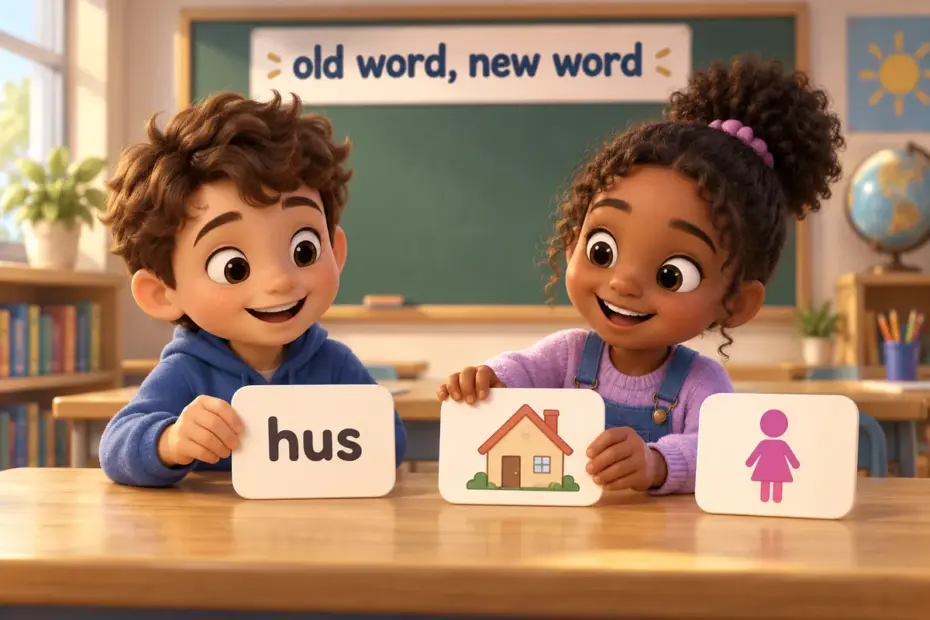
An Old English nouns list gathers the common nouns of the language, each with its grammatical gender and its modern meaning. Mann meant a person or a man, wif meant a woman, and hus meant a house, and all three are close to the words used today.
The list is usually grouped by theme, because the nouns for people, nature and household things carry different genders and endings. Learning a noun with its gender is the first step, since that gender decides which endings and which adjectives the word will take.
Which Old English nouns name people and family?
The people and family group is the easiest to recognise, because many of the modern words sit almost unchanged on the surface.
| Old English | Modern English | Gender | Example sentence |
|---|---|---|---|
| mann | person, man | masculine | Se mann aras. (The man rose.) |
| wer | man | masculine | Thaes weres nama (the man’s name) |
| wif | woman, wife | neuter | Thaet wif sang. (The woman sang.) |
| faeder | father | masculine | Min faeder com. (My father came.) |
| modor | mother | feminine | His modor waes thaer. (His mother was there.) |
| brothor | brother | masculine | Min brothor rad. (My brother rode.) |
| sweostor | sister | feminine | Hire sweostor bith waes. (Her sister was kind.) |
| cyning | king | masculine | Se cyning rixade. (The king ruled.) |
| cwen | queen | feminine | Seo cwen tha spraec. (The queen spoke then.) |
| freond | friend | masculine | He waes min freond. (He was my friend.) |
These words sit in the same family as the modern names gathered in nouns that start with c, where old and new share a single stem. Reading the pair old to new makes the list easier to hold in memory.
How do Old English nouns name nature?
Nature nouns are the oldest layer of the list, and several of them keep a gender that surprises a modern reader.
| Old English | Modern English | Gender | Example sentence |
|---|---|---|---|
| sunne | sun | feminine | Seo sunne scein. (The sun shone.) |
| mona | moon | masculine | Se mona com up. (The moon came up.) |
| eorthe | earth | feminine | Seo eorthe waes grenu. (The earth was green.) |
| heofon | heaven, sky | masculine | Se heofon waes blae. (The sky was blue.) |
| waeter | water | neuter | Thaet waeter fleow. (The water flowed.) |
| treow | tree | neuter | Thaet treow grew. (The tree grew.) |
| stan | stone | masculine | Se stan waes heard. (The stone was hard.) |
| land | land | neuter | Thaet land waes wide. (The land was wide.) |
| niht | night | feminine | Seo niht waes lang. (The night was long.) |
| daeg | day | masculine | Se daeg waes beorht. (The day was bright.) |
The sun is feminine and the moon is masculine, the reverse of many later traditions, which is why gender is best learned with each word rather than guessed from meaning.
Old English nouns list across everyday life
Household and object nouns show how the language named the things a family used every day.
| Old English | Modern English | Gender | Example sentence |
|---|---|---|---|
| hus | house | neuter | Thaet hus waes eald. (The house was old.) |
| boc | book | feminine | Seo boc waes lang. (The book was long.) |
| fisc | fish | masculine | Se fisc swamm. (The fish swam.) |
| fugol | bird | masculine | Se fugol sang. (The bird sang.) |
| hors | horse | neuter | Thaet hors ran. (The horse ran.) |
| hund | dog, hound | masculine | Se hund beark. (The dog barked.) |
| bread | bread | neuter | Thaet bread waes wearm. (The bread was warm.) |
| aeppel | apple | masculine | Se aeppel waes read. (The apple was red.) |
| sweord | sword | neuter | Thaet sweord waes scearp. (The sword was sharp.) |
| clath | cloth | masculine | Se clath waes hwit. (The cloth was white.) |
The household group shows how closely the old words track modern life, since bread, book, house and fish are unchanged in shape apart from their spelling. A clue to gender often sits in the demonstrative that came before the noun, so se marks a masculine word, seo a feminine one and thaet a neuter one.
Which gender does each Old English noun take?
Gender is a fixed property of the word, and the table below shows how the three genders share the list.
| Gender | Typical meaning | Examples |
|---|---|---|
| Masculine | Frequent for people, tools and the sky | mann, stan, daeg, heofon |
| Feminine | Frequent for the sun, the earth and books | sunne, eorthe, boc, niht |
| Neuter | Frequent for water, houses and cloth | waeter, hus, treow, bread |
A related list of describing words appears in adjectives for old, and those adjectives had to match the gender of the noun they described. The noun therefore set the ending on the adjective as well as on itself.
Word forms and endings of these nouns
The ending of a noun changed with its case and number, and a few patterns cover most of the list.
| Ending | Form | Example |
|---|---|---|
| -es | singular genitive | thaes cyninges (of the king) |
| -e | singular dative | on thaem huse (in the house) |
| -as | plural nominative | tha stanas (the stones) |
| -a | plural genitive | thaera worda (of the words) |
| -um | plural dative | mid clathum (with cloths) |
Old friends and familiar words cluster in the modern list too, as good old days sentence shows for a phrase that keeps the idea of age at its centre. The older nouns behind such phrases often survive only inside fixed expressions.
Common mistakes with an Old English nouns list
The errors come from reading the old words with modern habits, and each has a clear fix.
Mistake 1: guessing gender from meaning. Incorrect: Assume wif is feminine because it means woman. Correct: Learn that wif is neuter with the word itself. Rule: grammatical gender is a property of the word.
Mistake 2: expecting a modern article. Incorrect: Look for the word the before an Old English noun. Correct: Look for se, seo or thaet. Rule: the demonstrative did the work of the later article.
Mistake 3: keeping one ending for every case. Incorrect: Write stan in the genitive. Correct: Write stanes in the singular genitive. Rule: the ending changes with case and number.
Mistake 4: treating a surviving word as unchanged. Incorrect: Assume hund and hound share a meaning with no change. Correct: hund meant a dog, and the modern hound kept only the hunting sense. Rule: meaning can narrow over time.
Mistake 5: mismatching an adjective. Incorrect: Leave the adjective unchanged before a feminine noun. Correct: Match the adjective ending to the noun’s gender. Rule: the adjective agrees with its noun.
Practice with the Old English nouns list
Complete each item, then read the reason to confirm the word.
- Fill in the blank: The Old English word for house is ________ . (hus / land)
- Fill in the blank: The gender of the Old English word for sun is ________ . (feminine / masculine)
- Choose the better word: The Old English noun for friend is (freond / feond).
- Correct the error: The word wif is masculine in Old English.
- Build a sentence: name the Old English word for water and give its gender.
- Spot the register: which fits an Old English list, thaet waeter, or the water?
Answers
- hus. The neuter noun hus gives the modern word house.
- feminine. The word sunne is feminine, unlike the moon.
- freond. Freond means friend, while feond means enemy.
- The word wif is neuter in Old English. Gender is not tied to meaning.
- Sample: waeter, meaning water, is a neuter noun. Its gender is fixed with the word.
- Thaet waeter. An Old English list uses the older demonstrative form.
The bottom line
An Old English nouns list pairs each word with its modern meaning and its grammatical gender, and the three groups of people, nature and household things cover most daily life. Learn each noun with its gender, then see how the ending changes with case and number. Many of the words still sit almost unchanged in the language used today.
Frequently asked questions about the Old English nouns list
Is Old English the same as Old Norse?
No, they are two different languages, though both are Germanic and share roots. Old English was spoken in England, while Old Norse was spoken in Scandinavia. Centuries of contact brought many Norse words into English, which is why some nouns have close cousins in both languages.
Why did Old English nouns have grammatical gender?
Grammatical gender is a feature the language inherited from earlier Germanic speech, and it grouped nouns into masculine, feminine and neuter classes. The gender decided which endings a noun and its adjective would take. It carried no direct link to the sex of the thing named.
How many cases did these nouns take?
An Old English noun took four main cases, the nominative, accusative, genitive and dative, with a vestigial instrumental in a few phrases. Each case marked a different job in the clause. The ending changed with the case and the number together.
Do any Old English nouns still survive today?
Many survive almost unchanged, so hus, boc, bread and land still stand behind house, book, bread and land. Others narrowed in meaning over time, as hund did when it became hound. A few disappeared altogether and left only traces inside place names.