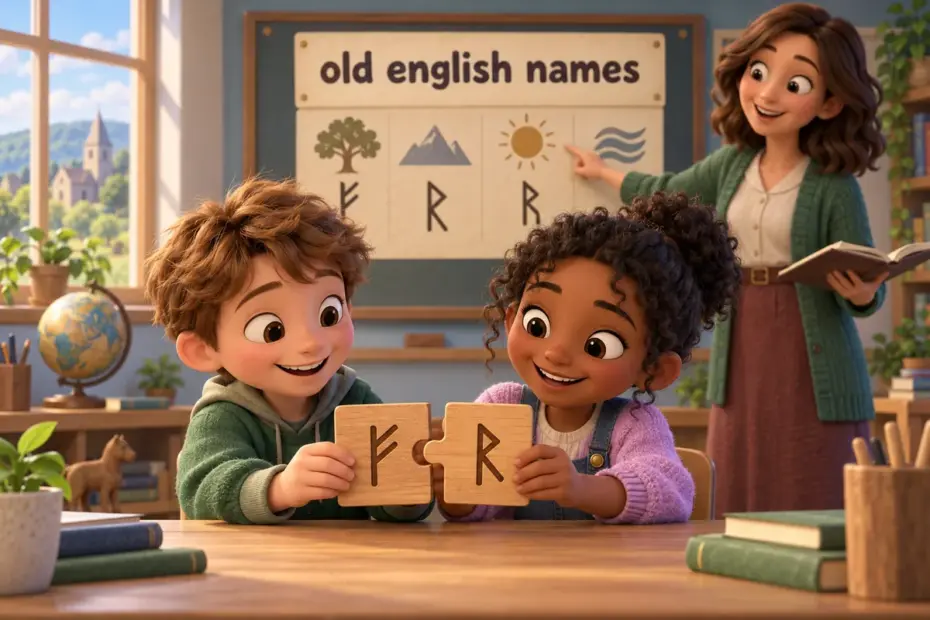
Old English names are the personal names used by the Anglo-Saxons, built from two elements that each carry a meaning. Alfred joins elf and counsel, while Edith joins wealth and war, so every name tells a small story about the family that chose it.
Old English names at a glance
- Most Old English names join two meaningful elements, as in ead plus weard.
- The elements repeat across names, so ead, æþel, and wine appear again and again.
- Male and female names often share the same elements.
- Many names survive today in shortened modern forms, such as Edith and Edward.
- The commonest error is reading a name as one unit instead of two elements.
What are Old English names?
Old English names are the names recorded in England before the Norman Conquest, mostly built from two elements of Old English words. Each element has its own sense, so ead means wealth and weard means guardian, and the pair gives the name Edward its sense of a wealthy guardian. Because the pool of elements was small, the same parts recur in many different names.
| Name | Old English form | Elements | Meaning |
|---|---|---|---|
| Alfred | Ælfræd | ælf (elf) + ræd (counsel) | elf-counsel |
| Edward | Eadweard | ead (wealth) + weard (guardian) | wealthy guardian |
| Edmund | Eadmund | ead (wealth) + mund (protection) | wealthy protector |
| Edgar | Eadgar | ead (wealth) + gar (spear) | wealthy spearman |
| Harold | Hereweald | here (army) + weald (ruler) | army ruler |
| Oswald | Oswald | os (god) + weald (ruler) | god-ruler |
| Edwin | Eadwine | ead (wealth) + wine (friend) | wealthy friend |
| Æthelred | Æþelræd | æþel (noble) + ræd (counsel) | noble counsel |
| Godwin | Godwine | god (god) + wine (friend) | friend of God |
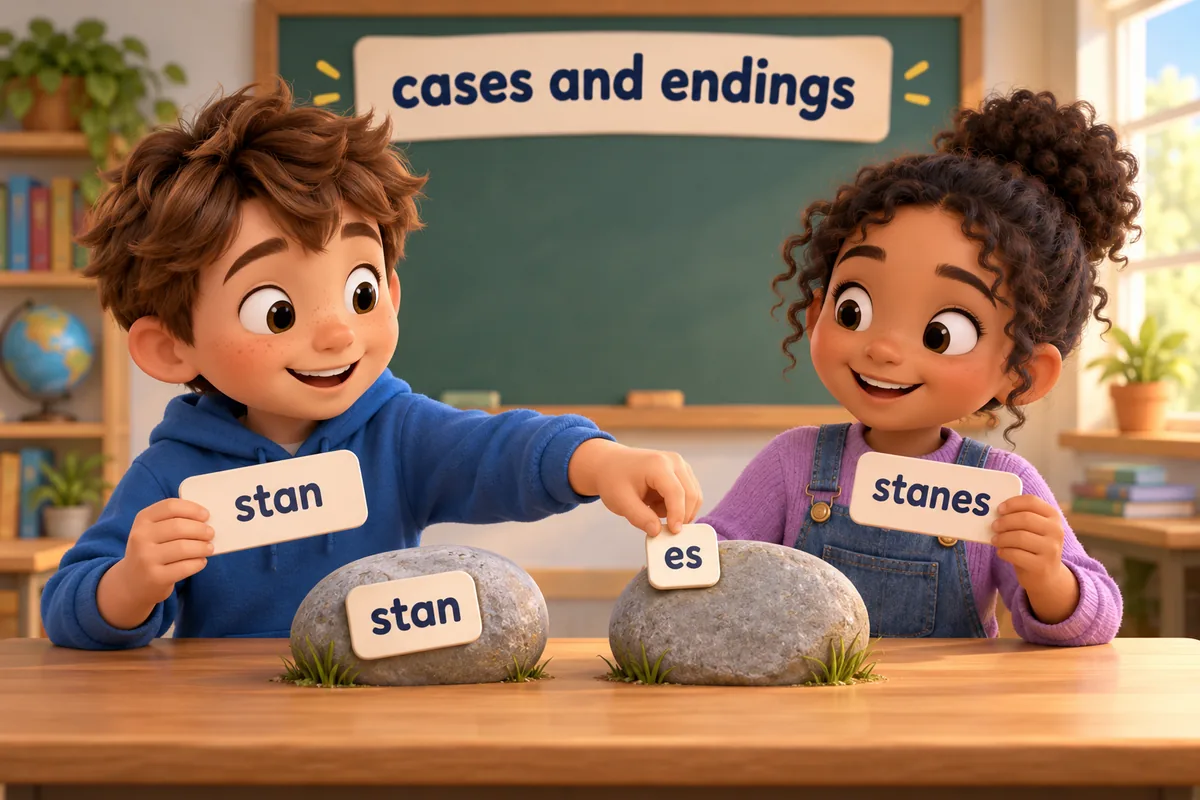
| Wulfstan | Wulfstan | wulf (wolf) + stan (stone) | wolf stone |
| Edith | Eadgyth | ead (wealth) + gyth (war) | wealthy war |
| Æthelflæd | Æþelflæd | æþel (noble) + flæd (beauty) | noble beauty |
| Leofric | Leofric | leof (beloved) + ric (ruler) | beloved ruler |
| Wulfrun | Wulfrun | wulf (wolf) + run (secret) | wolf secret |
| Mildred | Mildthryth | mild (gentle) + thryth (strength) | gentle strength |
Parents did not choose the elements at random. They often repeated an element from a parent or a king, so a family might carry ead through several generations, and a ruler’s name could spread to his followers. Alliteration, the matching of first sounds, also linked a father and son. Because the pool of elements was small, these habits produced names that share parts and yet stay distinct.
How do you use Old English names in a sentence?
The names behave like any other proper noun: they take a capital letter, and the element meanings sit in brackets after the name. Readers who want the adjective side can browse adjectives for old.
| Pattern | Example | What it signals |
|---|---|---|
| name + (meaning) | Edith (wealthy war) is a two-element name. | glosses the sense |
| element + means + word | The element ead means wealth. | explains one part |
| name + comes from + elements | Edward comes from ead and weard. | shows the build |
| name + survives as + modern form | Eadgyth survives as Edith. | links old and new |
| a name + made of + two elements | Alfred is a name made of two elements. | states the pattern |
| the element + appears in + names | The element wine appears in Edwin and Godwin. | shows a family |
Old English names in context: examples across contexts
The same names appear in a classroom, a history book, and a modern register, and the sentence around them changes with the setting. A related phrase such as old fashioned shows how the word old itself travels.
| Context | Example sentence | Why this works |
|---|---|---|
| Classroom | The teacher asked us to split each Old English name into its elements. | a school task about names |
| History book | Alfred and Æthelred were both Old English names of kings. | a plain factual statement |
| Name dictionary | Edith comes from the elements ead and gyth. | a short reference entry |
| Family tree | My great-grandmother carried the Old English name Mildred. | a personal record |
| Fantasy novel | She named her hero Wulfstan after an old warrior. | vivid narrative wording |
| Children’s story | The little prince was called Edgar. | simple narrative wording |
| Exam question | Give the meaning of the element weard. | a clear instruction |
| Museum label | Coins bear the name Æthelred in Old English letters. | a short caption |
| Baby-name guide | Alfred is an Old English name meaning elf-counsel. | a short product note |
| Linguistics note | The element ead survives in the modern name Edward. | a technical observation |
| Chronicle entry | The scribe wrote the king’s name in Old English letters. | a historical record |
| School project | Our project listed ten Old English names and their meanings. | a research task |
Old English names and modern names: how they differ
Grouping the names by the elements they share makes the whole system easy to read, because the parts repeat. A phrase such as as old as the hills shows how the same word old appears in everyday speech.
| Feature | Old English names | Modern names |
|---|---|---|
| Structure | usually two elements | often one word or a short form |
| Meaning | every element has a sense | the sense is often lost |
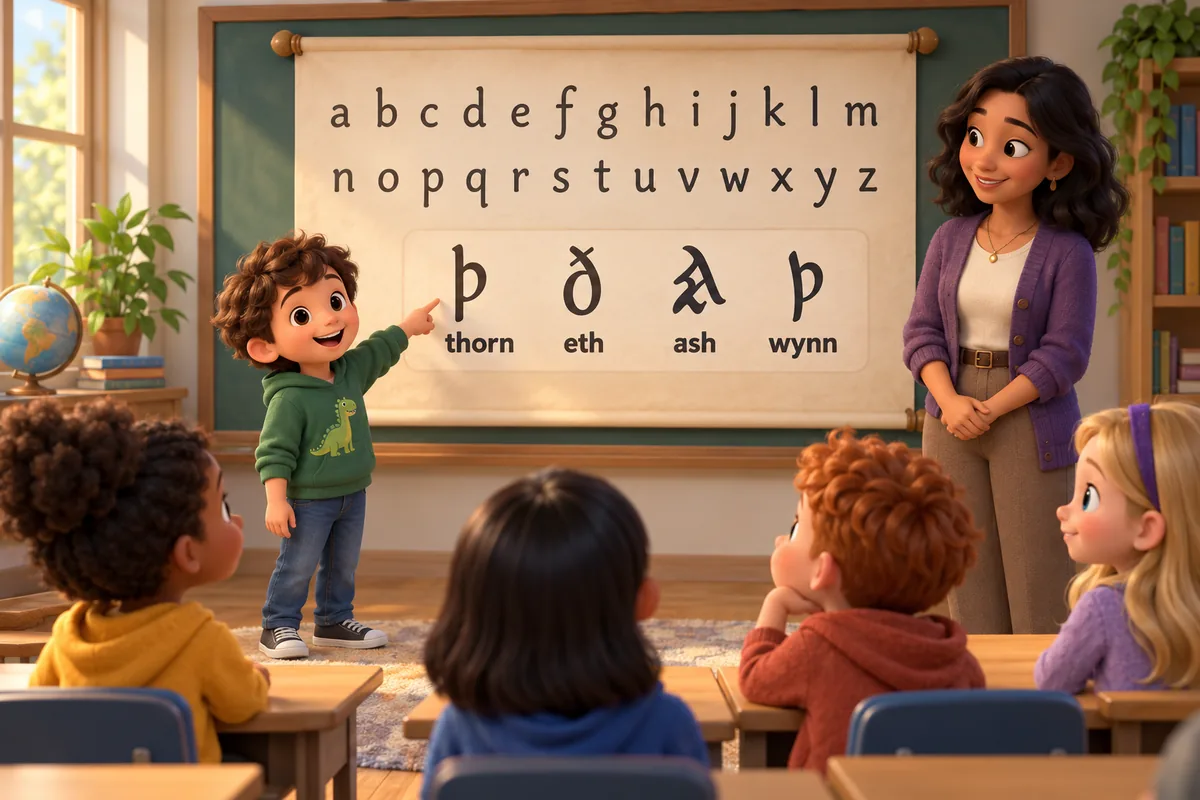
| Spelling | uses letters such as æ and þ | uses the modern alphabet |
| Examples | Eadweard, Æþelflæd | Edward, Ethel |
| Reuse | a small pool of elements | a wide range of sources |
Word forms and grammar of Old English names
The names are proper nouns and take a capital letter, and the elements are common nouns with their own senses. A related phrase such as the good old days shows the word old in a fixed expression.
| Form | Part of speech | Example |
|---|---|---|
| name | noun | Her name was Edith. |
| names | noun, plural | These names are Anglo-Saxon. |
| naming | verb, -ing | Naming a child took care. |
| named | verb, past | He was named after a king. |
| forename | noun | Alfred was his forename. |
| surname | noun | The surname came later. |
| element | noun | Each element had a meaning. |
| ead | noun element | Ead means wealth. |
| weard | noun element | Weard means guardian. |
| patronymic | noun or adjective | A patronymic marks the father. |
Common mistakes with Old English names
Mistake 1: reading a name as one unit. Incorrect: Alfred has no parts. Correct: Alfred joins the elements ælf and ræd. Rule: most Old English names split into two elements.
Mistake 2: Æ and E treated as identical. Incorrect: Ælfræd is the same spelling as Alfræd. Correct: Ælfræd begins with the letter æ. Rule: the Old English alphabet has letters the modern one does not.
Mistake 3: an element given the wrong sense. Incorrect: The element weard means sword. Correct: The element weard means guardian. Rule: learn each element’s sense.
Mistake 4: male and female names kept apart. Incorrect: Only men had two-element names. Correct: Women carried them too, as in Æþelflæd. Rule: both sexes used the same elements.
Mistake 5: Old English and Old Norse confused. Incorrect: Alfred is an Old Norse name. Correct: Alfred is an Old English name. Rule: the two languages are related but distinct.
Practice using Old English names
- Fill in the blank: The element ead means ___.
- Choose the better word: The name Edward joins ead with (weard / wine).
- Correct the error: Edith comes from a single element.
- Build a sentence: use elements to explain the name Edgar.
- Spot the register: which line suits a name dictionary, (a) Edgar is a cool old name, or (b) Edgar comes from the elements ead and gar?
- Fill in the blank: The element ___ means guardian.
Answers
- wealth, because ead carries the sense of riches.
- weard, because Edward joins ead and weard.
- Edith joins two elements, ead and gyth.
- Edgar joins ead, meaning wealth, and gar, meaning spear.
- (b), because a dictionary entry needs precise wording.
- weard, because weard means guardian.
The bottom line
Old English names are two-part names whose elements each carry a meaning, so Edward joins ead and weard to give a wealthy guardian. The same small pool of elements, such as ead, æþel, and wine, appears across many names for both men and women. Learn a handful of elements and most of these names open up at once.
Frequently asked questions about Old English names
What are some common Old English names?
Well-known examples include Alfred, Edward, Edmund, Edgar, Harold, Oswald, Edwin, and Æthelred for men, and Edith, Æthelflæd, Godiva, and Mildred for women. Many survive today in shortened forms, so Eadweard became Edward and Eadgyth became Edith. The pool of elements behind them was small.
How were Old English names formed?
Most Old English names joined two elements, each a word with its own sense, such as ead for wealth and weard for guardian. The two parts were fitted together to make a single name, and parents often echoed an element from a relative. This two-part pattern is called dithematic naming.
Do Old English names have meanings?
Yes. Each element carries a meaning, so the whole name has a compound sense, such as elf-counsel for Alfred or noble beauty for Æthelflæd. The meaning was understood when the name was given, though modern bearers rarely know it. The senses survive in the elements, not in the modern spelling.
Are Old English names still used today?
Many are. Alfred, Edward, Edith, and Mildred remain in use, often as short modern forms of longer originals. Others, such as Æthelred and Æthelflæd, are now rare outside history books. Parents who choose an Old English name today usually pick a familiar form rather than the original spelling.