Old English verbs fall into strong classes, which change the vowel of the stem, and weak classes, which add a dental ending for the past. A small set of preterite-present verbs grew into the modern modals. This guide gives the main tables with the forms behind the words used today.
Old English verbs at a glance
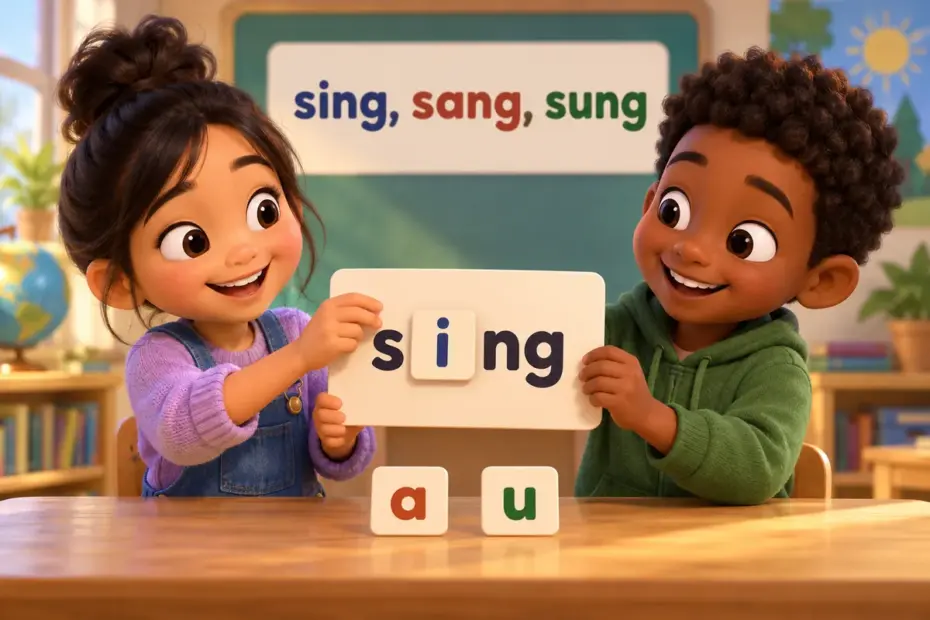
- Strong verbs form the past by changing their vowel, as singan becomes sang.
- Weak verbs add a dental ending, as lufian becomes lufode.
- The infinitive usually ends in -an.
- Person endings mark singular and plural, as -e, -est, -eth and -ath.
- A group of preterite-present verbs became the modern modals.
What are Old English verbs like?
Old English verbs carry the tense and the person in their own endings, so a single verb has a full set of forms for present and past. The infinitive usually ends in -an, and the past tense joins the stem to a fixed ending rather than to a separate helper word.
The whole system rests on two large groups. Strong verbs change the vowel of the stem across their forms, while weak verbs keep the stem steady and add a dental ending. That split reaches almost every verb in the language.
| Form | singan | lufian |
|---|---|---|
| Infinitive | singan | lufian |
| Present first person | singe | lufie |
| Past singular | sang | lufode |
| Past plural | sungon | lufodon |
| Past participle | sungen | lufod |
These old forms sit behind the modern verb families studied in adjective and verb pages, and adjective nominalizations verbs as descriptors shows how a verb can also feed a describing word. The same stem often serves several word classes.
A verb also changed for mood, with a subjunctive used for wishes, commands and conditions. The indicative stated a fact, while the subjunctive carried doubt or desire, and the two often differed by a single vowel. That extra layer of meaning lived entirely in the ending, with no helper word to show it.
How do strong and weak verbs differ?
The two groups build the past in different ways, and the difference decides how a verb will behave in every tense.
| Feature | Strong verb | Weak verb |
|---|---|---|
| Past tense | Vowel change, as sang | Dental ending, as lufode |
| Stem | Changes inside the word | Stays the same |
| Number in the past | Two past forms, singular and plural | One past form |
| Modern result | Mostly irregular verbs | Mostly regular verbs |
The strong verbs are sorted into seven classes, each with its own vowel pattern. A learner who knows the pattern of one verb usually knows the shape of the others in the same class.
A strong verb also keeps two past forms, one for the singular and one for the plural, so the number of the subject shows in the verb itself. A weak verb uses a single past form for both numbers and lets the ending do the rest of the work. This small difference is why the strong verbs look so irregular to a modern reader.
Old English verbs across the strong classes
The six largest strong classes each have a familiar pattern, and the table shows the past forms beside the modern verb.
| Verb | Past singular | Past plural | Past participle |
|---|---|---|---|
| writan (write) | wrat | writon | writen |
| beodan (offer) | bead | budon | boden |
| bindan (bind) | band | bundon | bunden |
| beran (bear) | baer | baeron | boren |
| helpan (help) | healp | hulpon | holpen |
| faran (travel) | for | foron | faren |
A phrase that borrows the idea of long ago, such as as old as the hills sentence, feels close to the age of these forms. The vowel changes in the table are the same kind of shift that produced the modern irregular verbs.
Each strong class follows one vowel sequence, so the table above shows more than six words: it shows six patterns. A learner who meets the class of writan can predict the shapes of many other verbs that share the same vowel path. The classes are a shortcut through what looks like a long list of exceptions.
Which verbs became the modern modals?
A special group, the preterite-present verbs, used a past-tense shape with a present meaning, and the modern modals grew from them.
| Old English | Modern modal | Example sense |
|---|---|---|
| cann | can | to be able |
| sceal | shall | to owe or must |
| mot | must | to be allowed |
| wat | wot, know | to know |
| dear | dare | to venture |
A much older turn of phrase survives in modern speech, and old fashioned sentence shows how such forms carry an older grammar inside them. The modals are the clearest trace of it.
Because these verbs carried a past-tense shape with a present sense, they dropped the ordinary person endings that other verbs kept. That is why the modern modal can takes no -s in the third person, so a sentence reads she can and never she cans. The odd behaviour of today’s modals is a direct result of this old pattern.
Word forms and endings of the verbs
The personal endings differ across the singular and the plural, and a few common verbs keep a shape of their own.
| Verb | Present singular | Present plural | Past singular |
|---|---|---|---|
| beon (be) | eom, eart, is | sind | waes |
| habban (have) | haebbe, haefst, haefth | habbath | haefde |
| don (do) | do, dest, deth | doth | dyde |
| gan (go) | ga, gaest, gaeth | gath | eode |
| willan (will) | wille, wilt, wile | willath | wolde |
The endings -e, -est and -eth mark the singular, and -ath marks the plural, which is why the modern third-person -s looks so small beside the old set. The verb be was irregular even then, just as it is today.
The infinitive could also take the preposition to and an inflected ending, which gave a form close to the modern to sing. That construction let a verb work as a noun or an aim inside a sentence. It is the ancestor of the modern infinitive with to, though the old ending has long since gone.
Common mistakes with Old English verbs
The errors come from reading the old forms with modern habits, and each has a clear fix.
Mistake 1: adding a helper verb for do. Incorrect: Write ic do singe for the present tense. Correct: Write ic singe. Rule: the ending, not a helper, marks the person.
Mistake 2: one past form for every number. Incorrect: Write thaet word sung for the plural. Correct: Write sungon in the past plural. Rule: a strong verb kept two past forms.
Mistake 3: making a weak verb change its vowel. Incorrect: Write lufian as laf in the past. Correct: Write lufode in the past. Rule: a weak verb adds a dental ending.
Mistake 4: treating the modals as ordinary verbs. Incorrect: Add a usual personal ending to sceal. Correct: Keep the preterite-present shape, as in ic sceal. Rule: these verbs kept an older pattern.
Mistake 5: forcing modern word order on the verb. Incorrect: Place the verb after the subject in every clause. Correct: Keep the main-clause verb second and the subordinate verb late. Rule: the older order differed from today’s.
Practice using Old English verbs
Complete each item, then read the reason to confirm the form.
- Fill in the blank: A verb that changes its vowel in the past is ________ . (strong / weak)
- Fill in the blank: The past-of-lufian form is ________ . (lufode / laf)
- Choose the better word: the modern modal that grew from cann is (can / know).
- Correct the error: The past plural of singan is sang.
- Build a sentence: give the Old English present form that means I sing.
- Spot the register: which fits an Old English grammar note, ic eom, or I am?
Answers
- strong. A strong verb changes the vowel of its stem.
- lufode. A weak verb adds the dental ending -ode.
- can. The preterite-present cann became the modern modal can.
- The past plural of singan is sungon. The form sang is the singular.
- Sample: ic singe, meaning I sing. The ending marks the person.
- Ic eom. An Old English grammar note uses the older form.
The bottom line
Old English verbs carry tense and person in their own endings, and the language sorts them into strong classes that change vowel and weak classes that add a dental ending. Learn one verb from each strong class, note the preterite-present modals, and the old patterns behind the modern irregular verbs become clear. The endings do the work that a helper verb does today.
Frequently asked questions about Old English verbs
Why do English irregular verbs change their vowel?
They are the old strong verbs, which formed the past by changing the vowel of the stem. As the endings wore away, the vowel change became the main signal of tense, so sing, sang and sung kept the pattern. A few hundred such verbs survive, and most are very common.
What is a preterite-present verb?
A preterite-present verb uses a past-tense shape with a present meaning, which is why the modern modals behave so oddly. Old English cann looked like a past form yet meant can in the present. That mix produced modals such as can, shall and must, which take no ordinary endings.
Did Old English have a helper verb for do?
No, Old English formed questions and negatives without a helper verb for do. A question moved the verb near the front, and a negative attached the particle ne to the verb. The modern helper do appeared much later, so the older language never used it.
How did weak verbs get their name?
Weak verbs are called weak because they rely on an ending rather than on a vowel change to mark the past, so lufian becomes lufode with the dental ending added. The stem itself stays whole. This pattern is the ancestor of the regular English verb, which adds -ed.