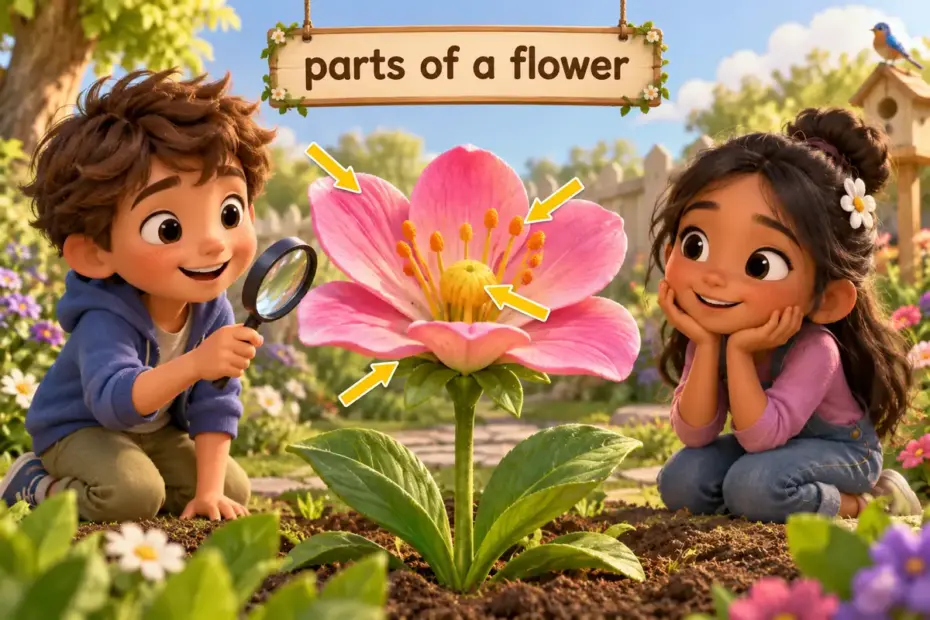
The parts of a flower are the petals, sepals, stamens, and pistil that together let a plant make seeds. Petals attract insects, the stamens make pollen, and the pistil receives that pollen so a seed can form at the centre.
Parts of a flower at a glance
- A flower has four main parts: petals, sepals, stamens, and the pistil.
- Petals attract pollinators, and sepals protect the bud before it opens.
- The stamen is the male part, and the pistil is the female part.
- The ovary at the base of the pistil holds the seeds.
- The commonest error is writing pedal for petal or pistol for pistil.
What are the parts of a flower?
The parts of a flower are the structures that together produce seed: a ring of petals, a ring of sepals beneath them, the stamens that make pollen, and the pistil at the centre that receives it. The receptacle holds every part at the base, and the nectary rewards the insects that carry pollen from one flower to the next.
| Part | Where it is | What it does | Example sentence |
|---|---|---|---|
| Petal | Ring around the centre | Attracts pollinators | The petals of a flower are bright and soft. |
| Sepal | Just below the petals | Protects the bud | The sepals of a flower are usually green. |
| Receptacle | At the base of the head | Holds the flower parts | The receptacle of a flower supports every part. |
| Stamen | Around the centre | Makes pollen | The stamens of a flower stand like small pins. |
| Anther | Tip of the stamen | Holds pollen grains | The anther of a flower opens to release pollen. |
| Filament | Stalk of the stamen | Holds the anther up | The filament of a flower lifts the anther. |
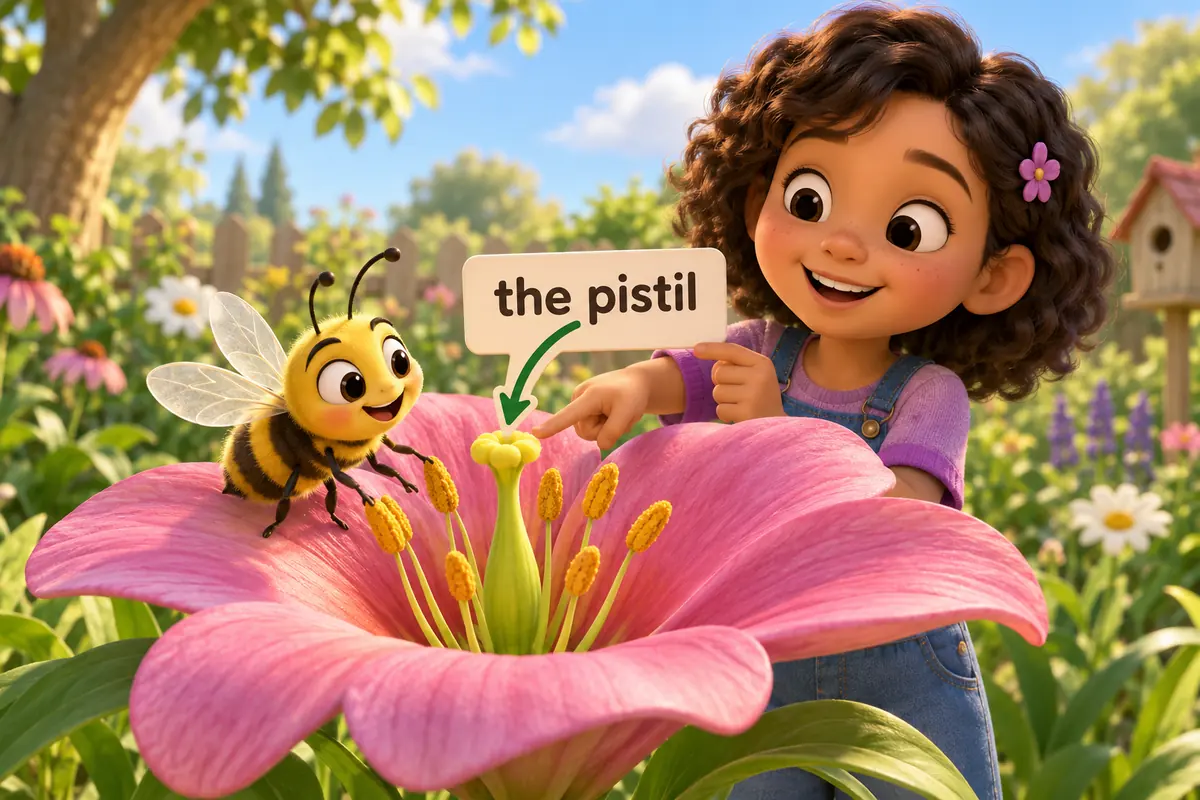
| Pistil | Centre of the flower | Receives pollen | The pistil of a flower sits at the very centre. |
| Stigma | Top of the pistil | Catches pollen | The stigma of a flower feels sticky. |
| Style | Neck of the pistil | Carries pollen down | The style of a flower leads to the ovary. |
| Ovary | Base of the pistil | Holds the seeds | The ovary of a flower becomes the fruit. |
| Nectary | Near the base | Makes sugary nectar | The nectary of a flower rewards a visiting bee. |
How do you use the parts of a flower in a sentence?
The naming phrase works the same way as any other: put the part before of a flower, or let the flower own it with an apostrophe. Readers who want describing words can browse adjectives for flower.
| Pattern | Example | What it signals |
|---|---|---|
| the + part + of a flower | The petals of a flower attract bees. | names one structure |
| a flower’s + part | A flower’s stamens make pollen. | shows possession |
| plural part + of a flower | The sepals of a flower protect the bud. | talks about a ring |
| part + verb | The stigma catches pollen. | describes a job |
| label + part | Children labelled each part of a flower. | school and diagram use |
| part + helps + verb | The style helps pollen reach the ovary. | explains a function |
Parts of a flower in context: examples across contexts
The same names appear in a classroom, a garden guide, and a poem, and the sentence around them changes with the setting. A familiar mix-up such as flour vs flower fails in the same way.
| Context | Example sentence | Why this works |
|---|---|---|
| Classroom | The teacher asked us to name each part of a flower on the worksheet. | a school task about labelling |
| Science textbook | The stamens of a flower make the pollen. | a plain factual statement |
| Garden guide | Deadhead the flower by cutting below the petals. | a practical instruction |
| Poem | The flower opened its golden petals to the sun. | vivid descriptive wording |
| Lab report | The stigma of the flower held several pollen grains. | a measured observation |
| Children’s story | The little bee sat on the flower and rested. | simple narrative wording |
| Nature documentary | The pistil of the flower waits for a single grain of pollen. | dramatic description |
| Exam question | Label the parts of a flower shown in the diagram. | a clear instruction |
| Seed packet | This flower blooms from early summer to autumn. | a short product note |
| Cooking note | Use the flower petals to decorate the cake. | a kitchen instruction |
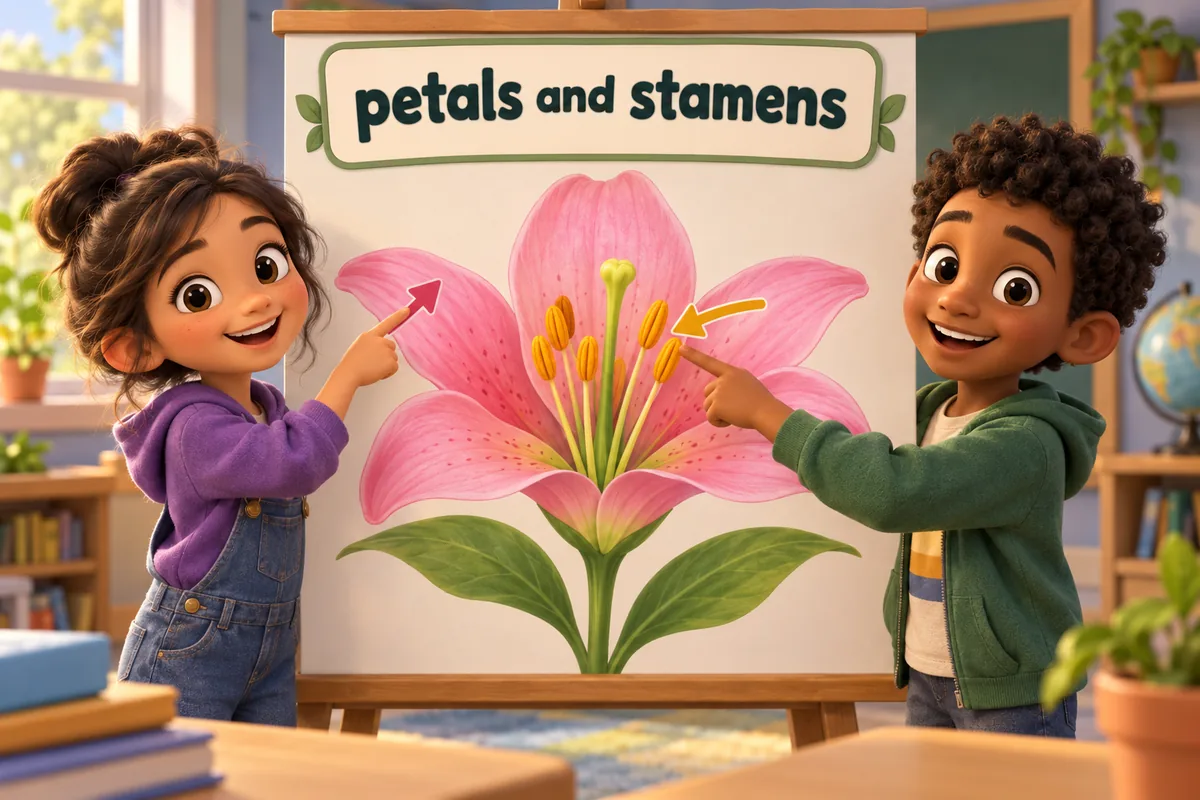
Petals, stamens, and pistil: how the parts differ
Grouping the parts by job makes the diagram easy to read, because attraction, pollen, and seed use different structures. The same grouping idea appears in a flower bud, which is simply the closed stage before the petals open.
| Feature | Petals | Stamens | Pistil |
|---|---|---|---|
| Main job | attract pollinators | make pollen | receive pollen and hold seed |
| Position | outer ring | around the centre | dead centre |
| Typical number | three to many | usually several | one or a few |
| Male or female | neither | male | female |
| Diagram label | petal | stamen | pistil |
Word forms and grammar of the parts of a flower
Most part names are nouns, and a few take unusual plurals. The adjective floral describes the whole structure, and the verb bloom describes the opening of the petals. To see the noun used in real frames, read flower in a sentence.
| Form | Part of speech | Example |
|---|---|---|
| flower | noun | The flower opened at dawn. |
| flowers | noun, plural | The flowers filled the bed. |
| petal | noun | One petal had fallen. |
| petals | noun, plural | Its petals were bright yellow. |
| sepal | noun | A green sepal cupped the bud. |
| stamen | noun | Each stamen ends in an anther. |
| stamens | noun, plural | The stamens dusted the bee with pollen. |
| pistil | noun | The pistil rose from the centre. |
| floral | adjective | The floral scent filled the room. |
| bloom | verb | The roses bloom in June. |
Common mistakes with the parts of a flower
Mistake 1: pedal for petal. Incorrect: The flower has bright pedals. Correct: The flower has bright petals. Rule: a flower has petals, while a pedal is part of a bicycle.
Mistake 2: pistol for pistil. Incorrect: The pistol sits at the centre. Correct: The pistil sits at the centre. Rule: the female part of a flower is the pistil.
Mistake 3: a singular verb with stamens. Incorrect: The stamens is long. Correct: The stamens are long. Rule: a plural subject takes a plural verb.
Mistake 4: green sepals called petals. Incorrect: The green petals hold the bud. Correct: The green sepals hold the bud. Rule: sepals are the green parts beneath the petals.
Mistake 5: the ovary makes pollen. Incorrect: The ovary makes pollen. Correct: The anther makes pollen, and the ovary holds the seeds. Rule: each part has one job.
Practice using the parts of a flower
- Fill in the blank: The ___ attracts insects to the flower.
- Choose the better word: The (stamen / pistil) makes pollen.
- Correct the error: The flower has bright pedals.
- Build a sentence: use pistil to say where pollen lands.
- Spot the register: which line suits a science worksheet, (a) That pretty bloom is nice, or (b) Label the stigma on the diagram?
- Fill in the blank: The green ___ protect the flower while it is still a bud.
Answers
- petal, because petals attract pollinators.
- stamen, because the stamen is the pollen-making part.
- The flower has bright petals; a pedal belongs to a bicycle.
- Pollen lands on the stigma at the top of the pistil.
- (b), because a worksheet needs precise labels.
- sepals, because sepals protect the bud.
The bottom line
The parts of a flower split into three clear groups: petals and sepals for show and protection, stamens for pollen, and the pistil for receiving it. Learn the positions, because petals form the outer ring, stamens ring the centre, and the pistil sits in the middle. Once position and job are linked, the diagram stops being a memory test.
Frequently asked questions about the parts of a flower
How many parts does a flower have?
A complete flower has four main parts: sepals, petals, stamens, and one or more pistils, all held by the receptacle at the base. The stamens and pistil are the reproductive parts, while the petals and sepals support them. A flower missing one of the four is called incomplete.
What is the difference between the stamen and the pistil?
The stamen is the male part and makes pollen, and the pistil is the female part and receives it. A stamen has an anther on a filament, while the pistil has a stigma, a style, and an ovary. Pollen moves from an anther to a stigma to begin a seed.
Why do flowers have petals?
Petals attract pollinators with their colour, scent, and shape, and some also give an insect a place to land. The bright ring guides a bee or butterfly toward the nectary at the base. In wind-pollinated flowers, where no insect is needed, the petals are usually small or absent.
What is a sepal on a flower?
A sepal is one of the small, usually green leaf-like parts just below the petals that enclose and protect the bud before it opens. Once the flower blooms, the sepals stay at the base as a supporting cup. Together the sepals are called the calyx.