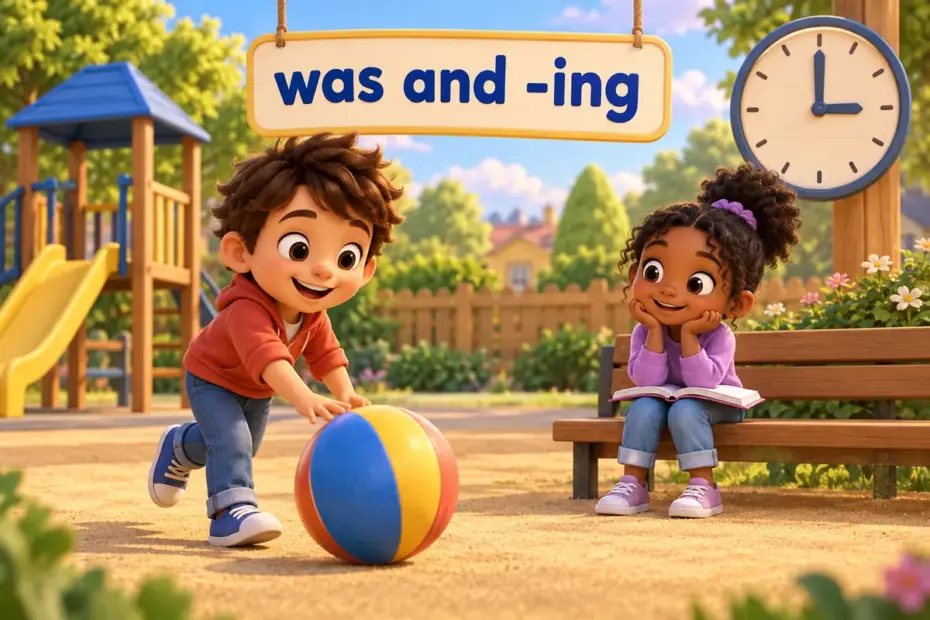
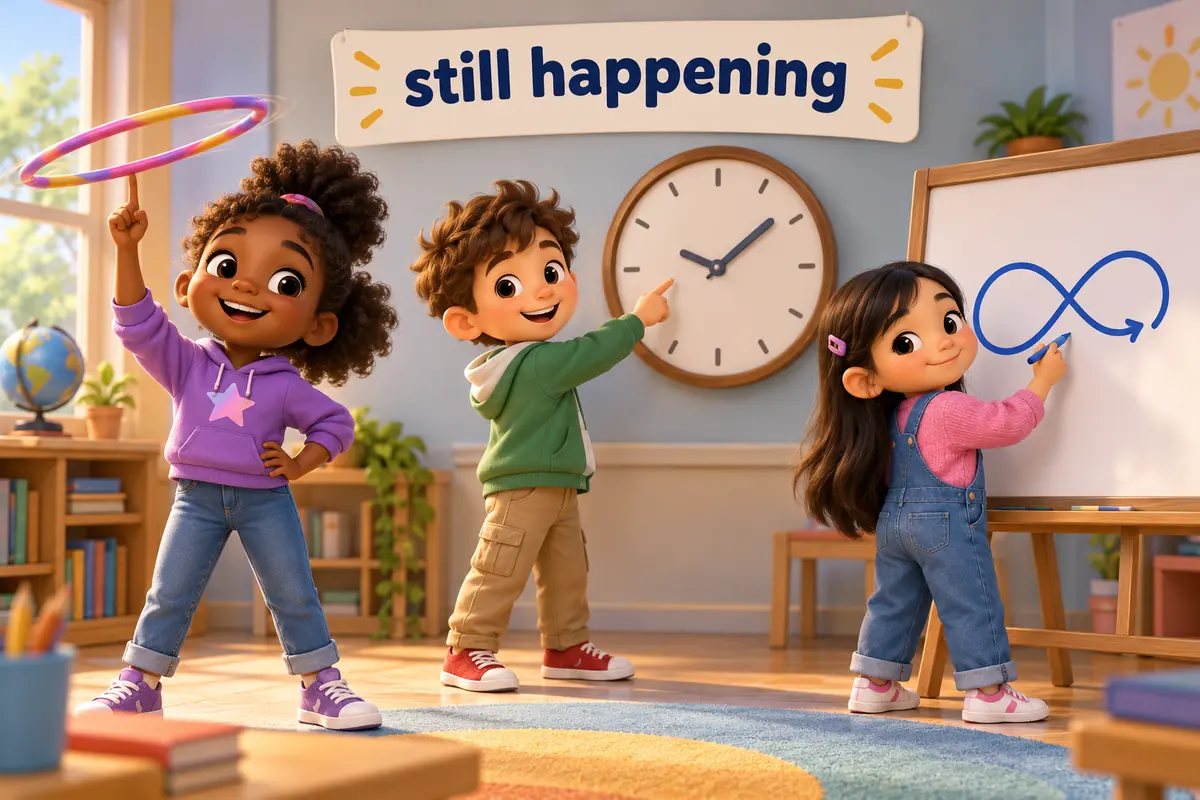
Past continuous tense structure and examples centre on one pattern: was or were plus an -ing verb. The tense describes an action in progress at a moment in the past. In “I was reading at eight,” the action was still happening at that time.
Past continuous tense structure and examples at a glance
- The past continuous is a verb tense formed with was or were plus the -ing form.
- Use was with I, he, she, and it; use were with you, we, and they.
- It shows an action in progress at a past time, often interrupted.
- Signal words include while, at eight, and when in the past simple clause.
- The commonest error is using it for a finished action that needs the past simple.
What does the past continuous tense mean?
The past continuous is a verb tense that presents a past action as unfinished, open, or continuing at a stated moment. It rarely stands alone; it usually leans on a time phrase or a second clause that shows what interrupted the action.
| Use | Plain meaning | Example |
|---|---|---|
| Action in progress | ongoing at a stated past moment | At nine, she was cooking. |
| Interrupted action | a longer action broken off | I was walking when it began to rain. |
| Background scene | sets the setting of a story | The wind was howling all night. |
| Two actions at once | both happening at the same time | He was reading while she was writing. |
| Repeated annoyance | a habit felt irritating, often with always | He was always losing his keys. |
An honest limit matters here: the tense is the wrong choice for a completed action at a definite time. “I finished the report at noon” reports a result, while “I was finishing the report at noon” describes the work in progress, so the second is only right if something else happened next. A useful habit is to ask what happened next: if the answer is another event, the continuous belongs; if the answer is nothing, the past simple does.
The tense names an action, not a time, so the clock is carried by an adverb: the examples for past in a sentence show how a phrase such as at eight fixes the moment.
How do you form the past continuous tense?
Choose the past of be that matches the subject, then add the -ing form of the main verb, and the frame is complete.
| Pattern | Example | What it signals |
|---|---|---|
| subject + was/were + -ing | They were waiting outside. | an ongoing action |
| subject + was/were not + -ing | I was not listening. | the absence of action |
| Was/Were + subject + -ing? | Were you sleeping? | asking about progress |
| Wh-word + was/were + subject + -ing? | Why was he shouting? | asking for a reason |
| … was/were + -ing when + past simple | She was leaving when the phone rang. | interruption |
| while + was/were + -ing, … was/were + -ing | While I was cooking, he was cleaning. | two actions at once |
Every verb slots into the same frame once the auxiliary is chosen, and the page on tense in a sentence sets this tense beside the others that share the pattern.
Past continuous tense examples across contexts
The tense carries the same meaning in every register, but the time phrase and the surrounding verbs change with the setting.
| Context | Example sentence | Why this works |
|---|---|---|
| Classroom | The pupils were sketching when the bell rang. | a lesson action cut short |
| Workplace email | I was preparing the figures when the call came in. | explains a delay politely |
| News report | Witnesses were queueing when the power failed. | sets the scene before an event |
| Story opening | The rain was falling and the street was empty. | builds a background |
| Everyday speech | We were just talking about you. | a relaxed, ongoing action |
| Diary entry | I was studying all evening and never left the desk. | reports a long stretch |
| Police statement | He was driving north when the lights changed. | fixes one moment precisely |
| Sports report | The keeper was diving as the ball flew past. | two actions overlap |
| Academic writing | The students were revising while the tutor was marking. | parallel processes |
| Travel writing | The sun was setting as we reached the coast. | paints a scene |
| Customer service | I was checking your order when the system stopped. | justifies a hold-up |
| Complaint | He was always leaving the door open. | an irritating habit |
The -ing ending keeps the action open rather than closed, a point the examples for continuous in a sentence make plain.
Past continuous vs past simple
The two tenses often share a sentence, so the choice comes down to which action is open and which is finished at the moment being described.
| Feature | Past continuous | Past simple |
|---|---|---|
| Focus | action in progress | action completed |
| Shape | was/were + -ing | past form of the verb |
| Time taken | a moment unfolding | a finished point |
| Typical frame | while, at eight, as | yesterday, in 1999, last week |
| In an interrupted sentence | the longer action | the shorter interruption |
| Example | I was reading at eight. | I read the letter at eight. |
Choose the past continuous for the action that is still unfolding, and the past simple for the action that is over; when both appear, the interruption usually takes the past simple. Reading the pair aloud settles it faster than any rule, because the open action and the closed one sound different the moment the two clauses join.
Word forms and grammar of the past continuous tense
| Form | Structure | Example |
|---|---|---|
| Affirmative | was/were + -ing | She was singing. |
| Negative | was/were + not + -ing | They were not helping. |
| Yes or no question | Was/Were + subject + -ing | Was it raining? |
| Wh-question | Wh-word + was/were + subject + -ing | Where were you going? |
| -ing spelling, drop the final e | make becomes making | He was making tea. |
| -ing spelling, double the consonant | run becomes running | The dog was running. |
| -ing spelling, ie becomes y | lie becomes lying | She was lying down. |
| Contracted negative | was not becomes wasn’t | We weren’t waiting long. |
Attaching -ing trips up many learners, and the guide to word structure in a sentence shows how endings join a base.
Common mistakes with the past continuous tense
Mistake 1: the wrong auxiliary for the subject. Incorrect: They was playing. Correct: They were playing. Rule: plural subjects and you take were.
Mistake 2: using it for a completed action. Incorrect: I was finishing the report at noon and then went home. Correct: I finished the report at noon and then went home. Rule: a finished result takes the past simple.
Mistake 3: putting the interruption in the wrong tense. Incorrect: When she was arriving, I was cooking. Correct: When she arrived, I was cooking. Rule: the short interruption takes the past simple.
Mistake 4: leaving out the -ing form. Incorrect: He was cook dinner. Correct: He was cooking dinner. Rule: was or were always needs the -ing form after it.
Mistake 5: using it with a state verb. Incorrect: I was knowing the answer. Correct: I knew the answer. Rule: state verbs such as know, like, and believe rarely take the continuous.
Practice using the past continuous tense
- Fill in the blank: At noon, they ___ (eat) lunch in the yard.
- Choose the better tense: I (was reading / read) when the lights went out.
- Correct the error: She was write a letter all morning.
- Build a sentence: use while to show two actions happening at once.
- Spot the register: which line suits a police statement, (a) He was driving north, or (b) He drove north?
- Fill in the blank: We ___ (not wait) when the bus arrived.
Answers
- were eating, because were matches they and -ing shows the action in progress.
- was reading, because the action was still going when it was interrupted.
- She was writing a letter all morning; was needs the -ing form, not the base verb.
- While I was cooking, my brother was setting the table.
- (a), because the statement fixes one moment in progress.
- were not waiting, because the past continuous negative uses was not or were not plus -ing.

The bottom line
Past continuous tense structure and examples come down to was or were plus an -ing verb, used for an action still in progress at a past moment. Keep the past simple for the shorter action that interrupts or finishes the scene, and let the past continuous carry the longer action around it. Match was to I, he, she, and it, and were to you, we, and they, and the pattern stays reliable.
Frequently asked questions about the past continuous tense
When do you use was and when do you use were?
Use was with the singular subjects I, he, she, and it, and use were with the plural subjects we and they plus the pronoun you. That split is the only real choice in the tense, because the -ing form does not change with the subject.
Can the past continuous appear without another clause?
Yes, when a time phrase fixes the moment. A sentence such as at nine she was cooking stands on its own because the adverb supplies the missing time. Without either a time phrase or a second clause, the sentence usually feels incomplete to a listener.
What is the difference between while and when here?
While introduces an action that runs alongside another, so it usually pairs with the past continuous in both clauses. When introduces a point in time, so it often pairs with the past simple and marks the interruption inside a longer past continuous action.
Is the past continuous the same as the past progressive?
Yes. Past continuous and past progressive are two names for the same tense, and the choice depends on the textbook rather than the meaning. Both describe was or were plus an -ing verb showing an action in progress at a past moment.