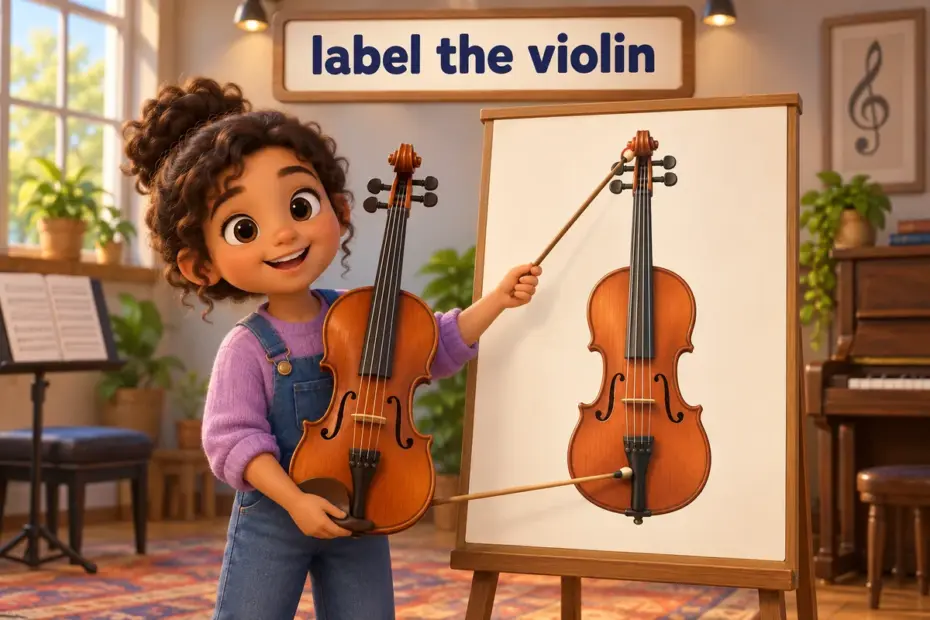
Parts of violin instrument with diagram is a topic that becomes simple once the pieces are grouped. A violin has a body, a neck with a fingerboard, a pegbox with four pegs, four strings, a bridge and a tailpiece. A sentence such as “the bridge lifts the strings above the top” already joins two of them.
Parts of the violin at a glance
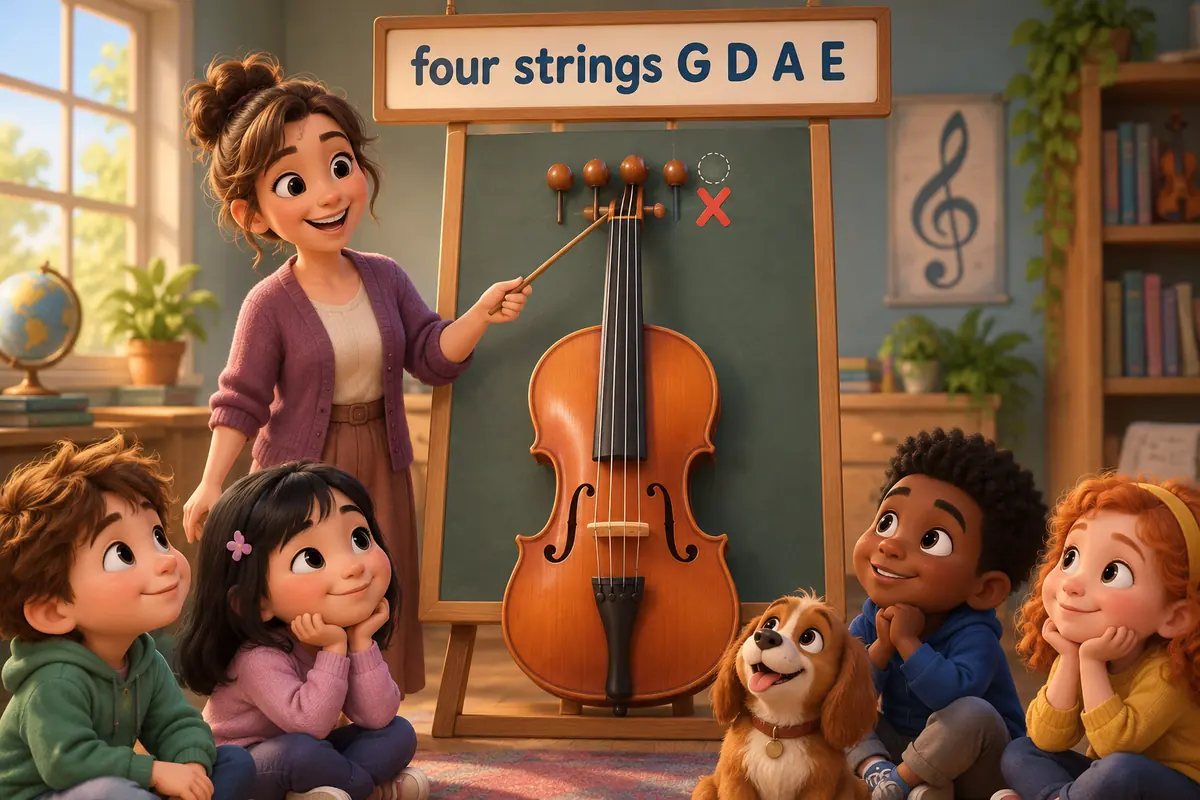
- A violin has four strings, tuned G, D, A and E.
- The body is a hollow wooden box, larger at the bottom than at the top.
- The neck carries the fingerboard, where the left hand stops the strings.
- The bridge stands on the top and carries the string vibration into the body.
- The bow is a separate tool, not a part of the violin itself.
What are the parts of a violin?
A violin is a bowed string instrument whose parts divide into the body that makes the sound and the fittings that hold and tune the strings. A diagram usually groups them from the top down. The table names each piece and the job it does.
| Part | Where it is | What it does |
|---|---|---|
| Scroll | the carved spiral at the very top | finishes the neck and balances the look |
| Pegbox | the small box below the scroll | holds the four tuning pegs |
| Tuning pegs | four tapered pegs in the pegbox | tighten or loosen the strings |
| Nut | a small ridge at the top of the fingerboard | spaces the strings before they run down |
| Neck | the long piece between pegbox and body | supports the left hand |
| Fingerboard | the black strip glued to the neck | gives the fingers a surface to press |
| Top plate (belly) | the front surface of the body | vibrates to make the tone |
| F-holes | two curved openings in the top | let air move and colour the sound |
| Bridge | stands on the top under the strings | lifts the strings and passes on vibration |
| Strings | four strings from nut to tailpiece | produce the notes G, D, A and E |
| Back | the rear surface of the body | reflects the sound |
| Ribs (sides) | the curved strips joining top and back | set the body depth |
| Tailpiece | the frame at the lower end | anchors the strings |
| Chinrest | a shaped rest on the lower left | holds the violin steady under the chin |
A labeled chart of car parts that starts with a to z groups pieces the same way, a list of human body parts that start with a names each item by position, and the same alphabet method carries on with human body parts that start with b.
How do you use violin-part words in a sentence?
Part names follow a few set frames. Each pattern below shows the frame, a natural example, and the job it does.
| Pattern | Example | What it signals |
|---|---|---|
| the + part + verb | The bridge carries the vibration into the body. | describes a part’s job |
| verb + the + part | She tightened the pegs before tuning. | describes an action on a part |
| the + part + of the violin | The neck of the violin felt smooth. | names one part precisely |
| play + the + violin | He plays the violin in the school orchestra. | names the instrument, not a part |
| on/under + the + part | A small label sat under the tailpiece. | names a location |
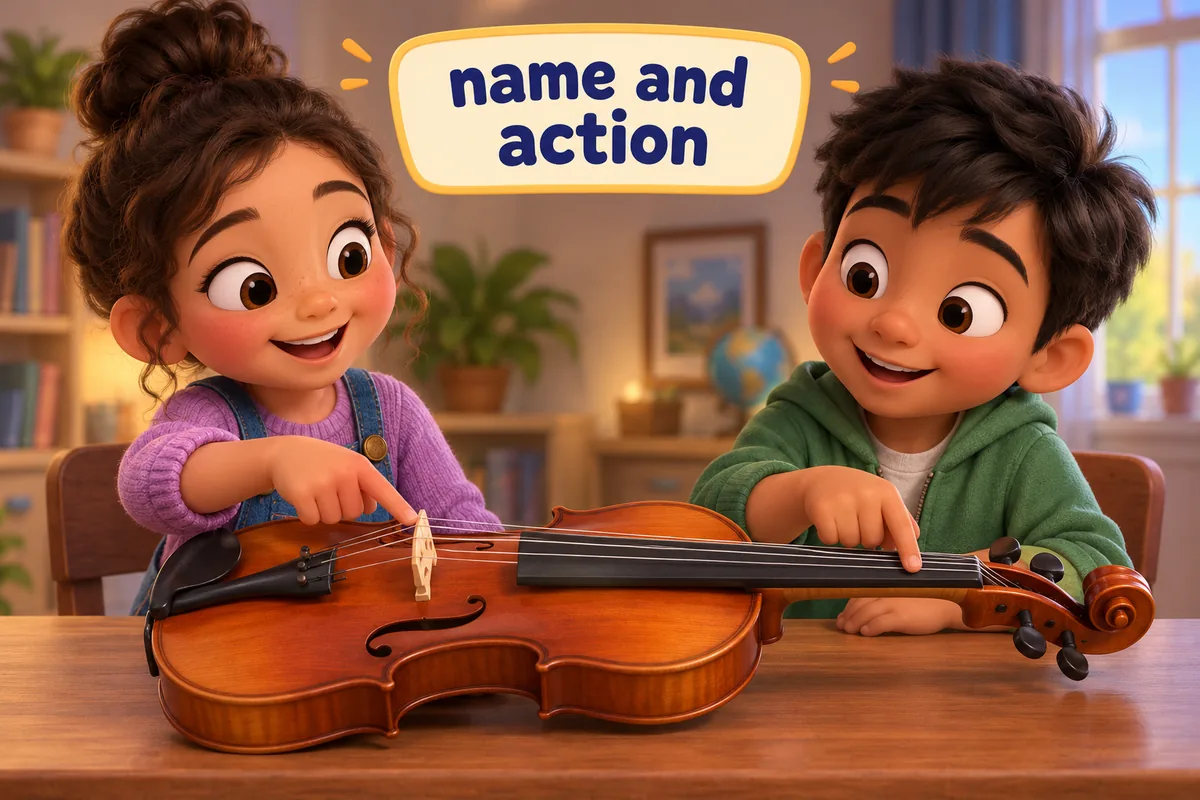
Violin-part words in sentences: examples across contexts
The same names appear in lessons, repairs, reviews and casual talk. The table pairs each context with a sentence and the reason it fits.
| Context | Sentence | Why this works |
|---|---|---|
| Music lesson | Keep the bow parallel to the bridge. | names the two objects in one instruction |
| Repair shop | The soundpost shifted, so the tone went thin. | names an internal part by its job |
| Orchestra rehearsal | Tune the A string to the oboe first. | uses the string name and the reference note |
| Beginner guide | Rest the chin on the chinrest, not on the tailpiece. | separates two nearby parts |
| Concert review | The soloist’s fingerboard work was effortless. | uses a part for a playing skill |
| Online listing | The scroll and pegs show light wear. | describes the condition of parts |
| Parent at home | Do not touch the strings with sticky hands. | gives a simple care rule |
| Technical note | The bass bar supports the top against string pressure. | explains an engineering job |
| Friendly chat | I love the colour of the back of your violin. | names a surface casually |
| Textbook | Each string passes over the nut and the bridge. | places two parts in a path |
Which instrument is it: violin or viola?
Violin and viola look alike, so diagrams often confuse the two. The table separates them on the points that matter.
| Attribute | violin | viola |
|---|---|---|
| Size | the smaller of the two | about a fifth larger |
| Strings | four, tuned G, D, A, E | four, tuned C, G, D, A |
| Pitch | higher, brighter sound | lower, warmer sound |
| Clef | usually treble clef | usually alto clef |
| Role | melody and high lines | inner harmony and warmth |
| Common error | called a viola | called a violin |
Choose violin for the smaller, higher instrument and viola for the larger, lower one.
Word forms and grammar of violin-part words
Form causes as many slips as meaning. This table collects the everyday shapes and the odd ones learners build.
| Form | Part of speech | Example |
|---|---|---|
| violin | noun | She bought a violin. |
| violinist | noun | He is a fine violinist. |
| viola | noun | The viola sits beside the violins. |
| fiddle | noun (informal) | They played a lively fiddle tune. |
| bow | noun / verb | Rosin the bow; then bow the string. |
| string | noun | The string broke mid-concert. |
| peg | noun / verb | Turn the peg to tune, then peg it firmly. |
| bridge | noun | The bridge must stay upright. |
| fingerboard | noun | The fingerboard is smooth and black. |
| tune | verb / noun | Tune each string; check the tune again. |
| chinrest | noun | She adjusted the chinrest. |
Common mistakes with violin-part words
Five errors show up again and again. Each one gives the wrong sentence, the fix, and the rule.
He plays a violin in the orchestra.He plays the violin in the orchestra. Instruments after play take the definite article.The violin has five strings.The violin has four strings. The standard tuning is G, D, A, E.She is a good violiner.She is a good violinist. The person noun ends in -ist.The bridge is inside the violin.The soundpost is inside; the bridge stands on the top. Name the part by its position.Please tie the bow.Please rosined the bow, then bow the string. The bow is prepared with rosin, not tied.
Practice using violin-part words
Try the six exercises, then read the answers and the reason beside each one.
- The four strings pass over the ___ before they run down the fingerboard.
- Choose the better word: the (bridge / soundpost) stands on the top under the strings.
- Correct the error: The violin has five strings.
- Build a sentence using “tuning peg” about preparing to play.
- Which sentence fits a repair note: “The soundpost shifted” or “The scroll got wet”?
- The ___ holds the violin steady under the chin.
Answers
- Nut. The nut is the small ridge at the top of the fingerboard that spaces the strings.
- Bridge. The bridge stands on the top; the soundpost is the piece inside.
- The violin has four strings. The standard tuning is G, D, A, E.
- Turn each tuning peg slowly until the string sounds the right note. The phrase names the peg that tightens the string.
- The soundpost shifted. A repair note names the internal part whose movement changes the tone.
- Chinrest. The chinrest is the shaped rest that holds the violin steady under the chin.
The bottom line
A parts of violin instrument with diagram set is easy to learn once you group it: body, neck and fittings. The body includes the top, back, ribs and f-holes; the neck carries the fingerboard; the fittings hold and tune four strings. Name the part and its job, and any sentence about a violin becomes exact.
Frequently asked questions about the parts of a violin
How many parts does a violin have?
A labeled violin names about twenty parts, but they fall into three groups. The body holds the top, back, ribs and f-holes. The neck carries the fingerboard, nut, pegbox, pegs and scroll. The fittings add the strings, bridge, tailpiece and chinrest that hold and tune the strings.
What are the four strings tuned to?
The four violin strings are tuned to G, D, A and E from the lowest to the highest. Each string passes from its tuning peg, over the nut, down the fingerboard, across the bridge and onto the tailpiece. Players tune by turning the pegs at the top.
What is the difference between a violin and a fiddle?
A fiddle and a violin are the same instrument under two names. Violin is the standard term in classical music, while fiddle is common in folk, country and bluegrass playing. The parts do not change; only the style of music and the word used to describe it change.
What holds the violin under the chin?
The chinrest is the shaped piece that holds the violin steady under the chin. It sits on the lower left of the body, near the tailpiece. A shoulder rest is a separate accessory, not a part of the violin, and many players use both together.