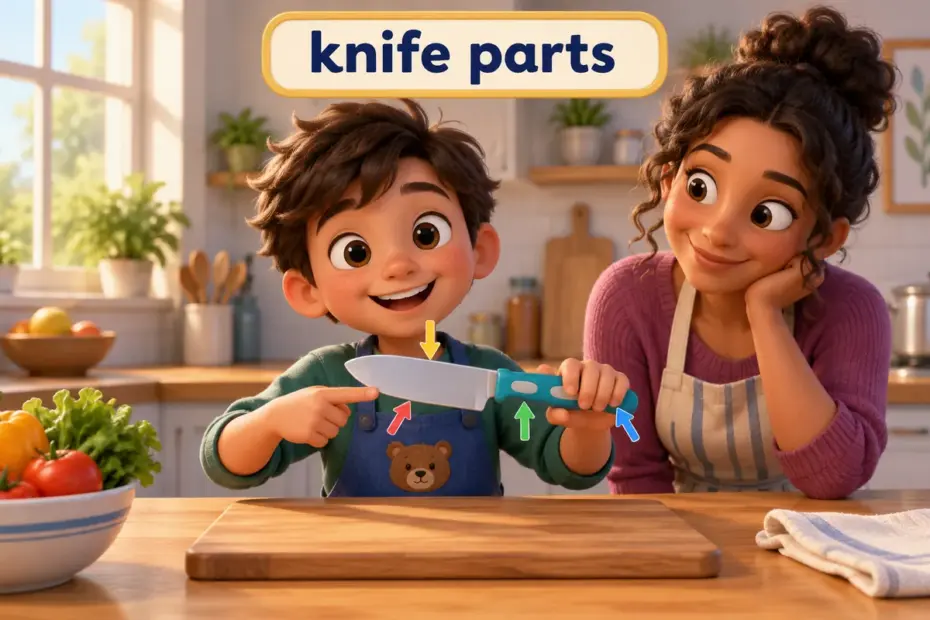
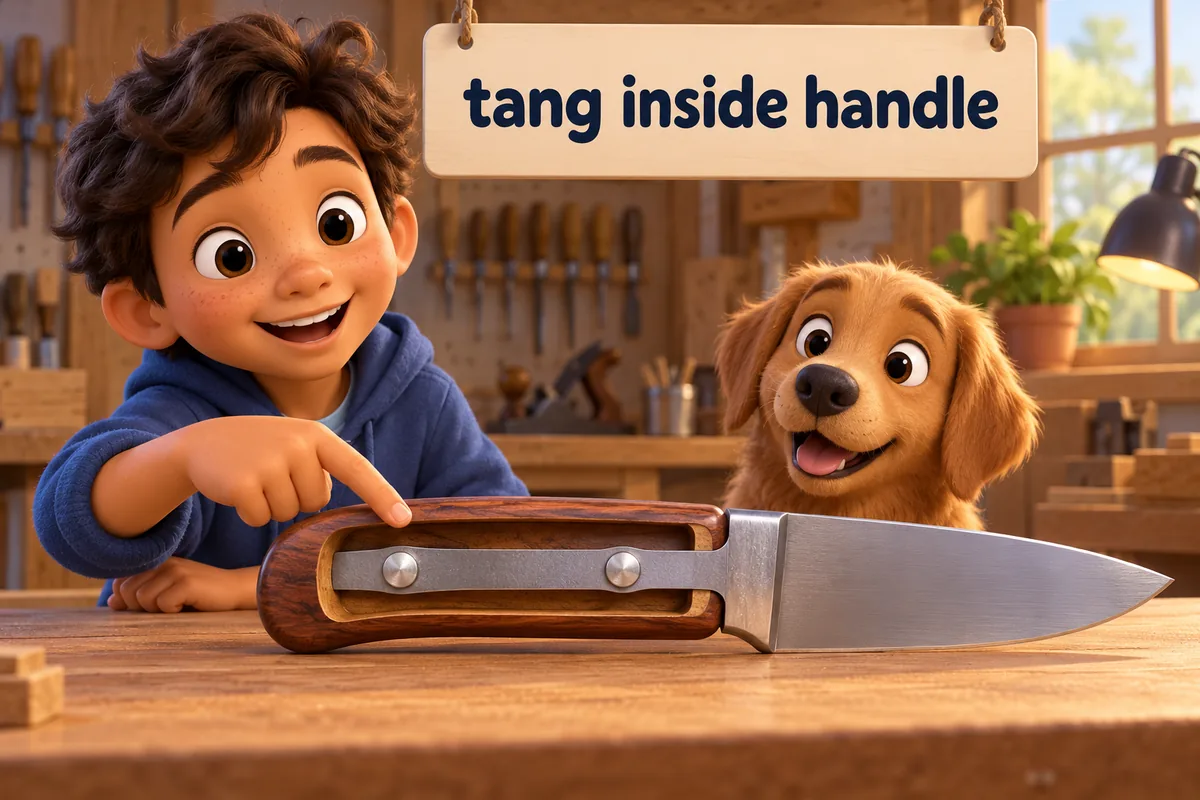
Parts of knife design come down to two pieces joined into one tool: the blade and the handle. The edge cuts, the tip pierces, the spine adds strength, and the tang runs inside the handle to hold the blade firm. A bolster sits between them and guards the fingers.
Parts of Knife at a Glance
- A knife has two main parts: the blade and the handle.
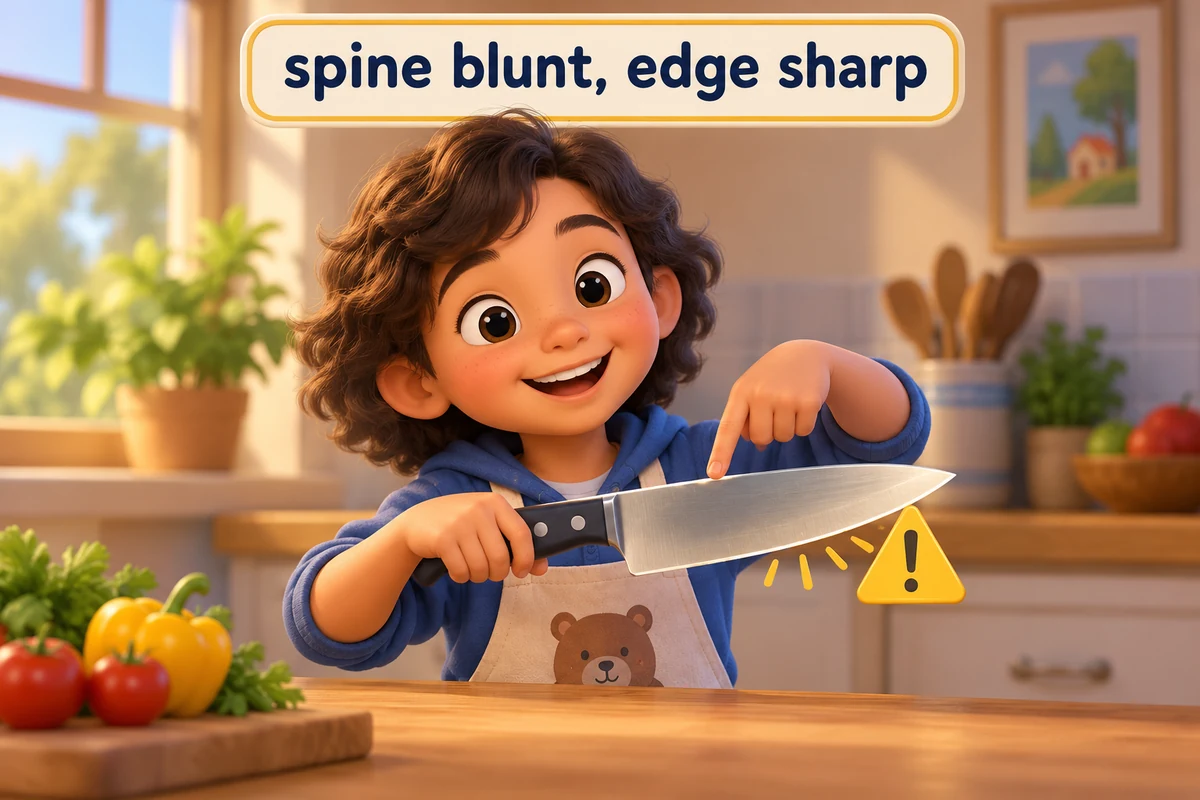
- The edge is the sharp side that cuts; the spine is the blunt top.
- The tip, or point, is the sharpest end of the blade.
- The tang is the metal strip that extends into the handle.
- The bolster is the metal collar between the blade and the handle.
- The handle, or scales, is the part you grip, pinned by rivets.
What are the parts of a knife?
A knife divides into the blade, which does the cutting, and the handle, which you hold. Between them sit the bolster and the tang, while the blade itself has named regions such as the tip, the edge, the spine and the heel.
| Part | Where it sits | What it does |
|---|---|---|
| Blade | Front half of the knife | Carries the cutting edge |
| Tip (point) | Far end of the blade | Pierces and makes fine cuts |
| Edge | Lower side of the blade | The sharpened side that cuts |
| Spine | Top side of the blade | Stays blunt and adds strength |
| Heel | Rear of the blade | Handles heavier chopping close to the handle |
| Choil | Small notch before the handle | Marks where the sharp edge ends |
| Bolster | Collar between blade and handle | Balances the knife and guards the fingers |
| Tang | Inside the handle | Extends the blade metal for a firm join |
| Handle (scales) | Grip of the knife | Lets you hold and control the blade |
| Rivets | Through the handle | Pin the scales to the tang |
What does each part of a knife do?
Each part answers one need: cutting, strength, balance or grip. Grouping the parts by job shows why a good knife joins a hard blade to a comfortable handle through a strong tang.
| Job | Part responsible | Why it matters |
|---|---|---|
| Cut | Edge | The sharpened side separates material |
| Pierce | Tip | The point starts a cut in the middle of food |
| Add strength | Spine | The blunt top keeps the blade stiff |
| Join blade to handle | Tang and rivets | Stop the blade working loose |
| Balance and guard | Bolster | Keeps the hand from slipping forward |
| Control | Handle | Gives the hand a steady grip |
How do you use knife-part words in a sentence?
Knife vocabulary behaves like most equipment nouns. Each part takes the when you name it, and prepositions such as on, along and between say where the part sits.
| Pattern | Example | What it signals |
|---|---|---|
| the + part + of the knife | The edge of the knife runs along the blade. | Names one part of the whole |
| part + action verb | The tang keeps the blade fixed to the handle. | Describes the part’s job |
| verb + the + part | Hold the handle with a firm grip. | Uses the part as an object |
| adjective + part | A blunted edge tears food instead of slicing. | Adds a quality to the part |
| there is / are + part | There are three rivets in the handle. | States how many parts are present |
Parts of a Knife in Everyday Contexts
The same terms appear in kitchens, workshops and shops. Each sentence below uses an exact name so the reader knows which piece is meant.
| Context | Example sentence | Why this works |
|---|---|---|
| Kitchen | Keep the edge away from the other cutlery. | Names the part that can be damaged |
| Knife shop | This model has a full tang for strength. | Points to the joining metal |
| Sharpening | Draw the blade along the stone at a steady angle. | Uses blade and edge precisely |
| Safety talk | Pass the handle forward, never the blade. | Names the safe part to hold |
| Repair bench | One rivet is loose, so the scale wobbles. | Locates a handle fault |
| Word study | We practised the noun knife in a sentence before the parts. | Starts with the whole object |
| Cooking lesson | Use the heel for heavier chopping. | Connects a part to technique |
| Everyday talk | The tip of the knife is ideal for trimming. | Uses the common name for the point |
Knife names share their logic with other object lists. Learning the body parts that start with A and the body parts that start with B trains the same habit of pairing a name, a place and a job.
Knife Parts That Are Easy to Confuse
Four pairs cause most of the muddle. Two involve parts that sit close together, and two involve words that name different things.
| Pair | How they differ | Quick test |
|---|---|---|
| edge / spine | The edge is the sharp side; the spine is the blunt top. | If it cuts, it is the edge. |
| blade / handle | The blade cuts; the handle is the part you grip. | Hold the handle, cut with the blade. |
| tang / bolster | The tang runs inside the handle; the bolster is the collar before it. | Inside is the tang, outside is the bolster. |
| tip / heel | The tip is the pointed end; the heel is the rear of the blade. | Point forward, heel back. |
The label-and-function habit carries across object lists, which is why a page about the parts of a car follows the pattern you are practising here.
Word Forms and Plurals for Knife Parts
A few knife words change form in ways that surprise learners. The table below shows the form to write and one that people often get wrong.
| Form | Part of speech | Example |
|---|---|---|
| knife / knives | noun with a voiced plural | Both knives were sharpened today. |
| blade / blades | countable noun | The blades sit in a wooden block. |
| edge / edges | countable noun | Dull edges tear the food. |
| knife / knifed | verb and past form | He knifed the butter thinly. |
| sharpen / sharpened | verb and participle | She sharpened the edge on a stone. |
| blunt / blunted | adjective and participle | The blunted edge needed a new grind. |
Common Mistakes When Naming Knife Parts
These errors appear in student notes and kitchen talk. Each one shows the wrong version, the corrected version and the rule behind the fix.
Incorrect: Wash both knifes in warm water. Correct: Wash both knives in warm water. The plural of knife is knives, with a voiced v.
Incorrect: Hold the knife by the blade. Correct: Hold the knife by the handle. The handle is made for the hand, while the blade carries the cutting edge.
Incorrect: The sharp part on top is the blade. Correct: The sharp edge is on the lower side, and the top is the spine. The spine stays blunt by design.
Incorrect: The bolster is inside the handle. Correct: The tang is inside the handle, and the bolster is the collar between the blade and the handle. Position separates the two.
Incorrect: Grip the haft of the knife. Correct: Grip the handle of the knife. Haft is an old word for a handle and sounds odd in modern cooking talk.
Practice Using Knife Part Vocabulary
Six tasks cover the terms you have met. Write your own answers before you read the reasoned list below.
- Fill in the blank: The metal strip inside the handle is the _____.
- Fill in the blank: The blunt top of the blade is the _____.
- Choose the better word: The sharp side that cuts is the (edge / spine).
- Correct the error: Pass the blade to your friend handle first, but he gripped the point.
- Build a sentence: use bolster to explain what protects the fingers.
- Spot the register: which sentence belongs in a safety notice, and which in a friendly note?
Answers
- tang; it runs inside the handle and joins the blade firmly.
- spine; it stays blunt and gives the blade strength.
- edge; the spine is the blunt top of the blade.
- Pass the knife handle first; the grip is the handle, and the point should never face the receiver.
- One model answer: The bolster sits between blade and handle and keeps the fingers from slipping forward.
- The rule to pass a knife handle first suits a safety notice; the note about a favourite paring knife suits a friendly message.
The Bottom Line
Naming the parts of knife hardware comes down to the blade and the handle joined by the tang. The edge cuts, the tip pierces, the spine adds strength, and the bolster balances the knife between blade and grip. Keep edge apart from spine and tang apart from bolster, since each pair names a different place. With these terms secure, you can sharpen, choose or describe a knife precisely.
Frequently asked questions about parts of knife
What are the parts of a knife called?
The parts are the blade with its tip, edge, spine and heel, the choil, the bolster, the tang, the handle or scales, the rivets and the butt. The blade does the cutting while the handle lets you grip it safely. The tang joins the two, and the bolster sits between them.
What is the tang of a knife?
The tang is the strip of blade metal that extends into the handle. A full tang runs the whole length of the handle, which makes the knife strong and well balanced, while a partial tang stops partway. Rivets pin the handle scales to the tang so the blade cannot work loose.
What is the difference between the spine and the edge of a blade?
The edge is the sharpened side that cuts, and the spine is the blunt top that gives the blade its strength. Cooks keep fingers and thumbs off the edge and sometimes press on the spine to guide a cut. The spine is never sharpened on a standard kitchen knife.
What is a bolster on a knife?
The bolster is the thick metal collar where the blade meets the handle. It balances the knife, adds weight near the hand and forms a small guard that stops fingers slipping forward onto the edge. On some knives the bolster is a separate piece, and on others it is forged with the blade.