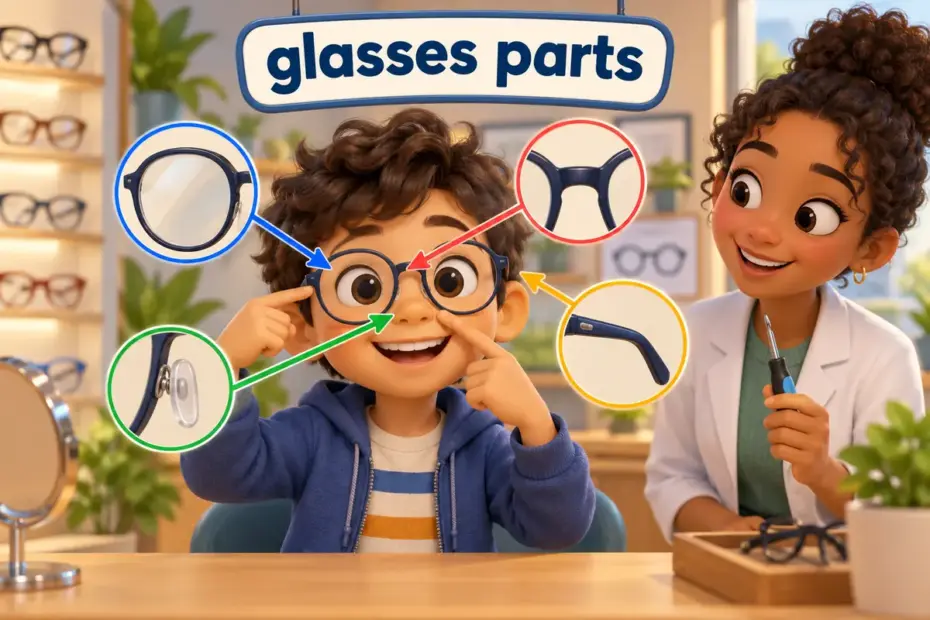
Parts of eyeglasses with diagram start with the two lenses and the frame that holds them. The frame front carries the rims, the bridge and the nose pads, while the temples run along the sides and hook over the ears. Small hinges and screws keep the whole frame together.
Parts of Eyeglasses at a Glance
- Eyeglasses have two lenses set in a frame front.
- The bridge joins the two lens rims across the nose.
- Nose pads sit on the sides of the bridge and rest on the nose.
- The temples, or arms, run from the frame front back over the ears.
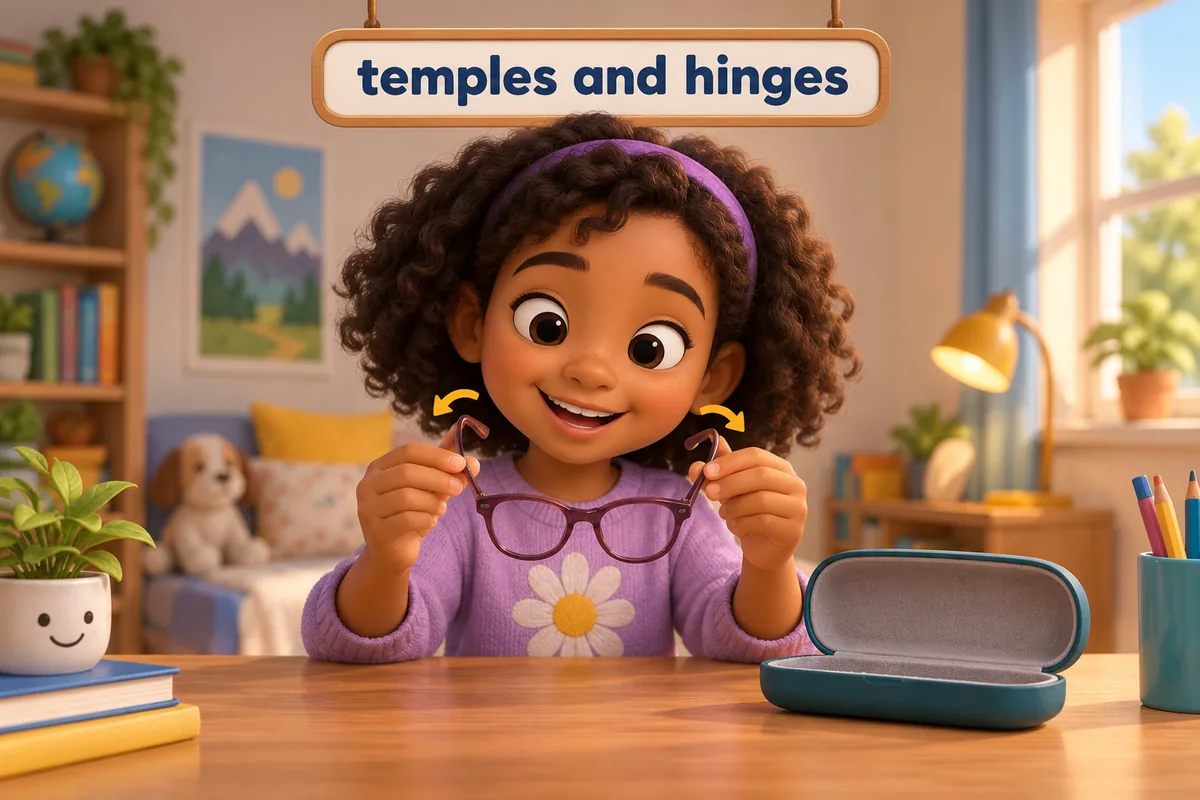
- Hinges let the temples fold flat when the glasses are stored.
- Tiny screws hold the hinges, the bridge and the nose-pad arms together.
What are the parts of eyeglasses?
Eyeglasses divide into the front, which holds the lenses, and the temples, which hold the glasses on your head. The front carries the rims, the bridge and the nose pads, while the temples join it at the end pieces through small hinges.
| Part | Where it sits | What it does |
|---|---|---|
| Lenses | Inside the rims | Bend light so the wearer sees clearly |
| Frame front | Across the eyes | Holds both lenses in the right position |
| Rims | Around each lens | Grip the lens and connect to the bridge |
| Bridge | Between the two lenses | Connects the rims across the nose |
| Nose pads | On the bridge | Rest on the nose and set the fit |
| Pad arms | Behind the pads | Hold the nose pads at the right angle |
| End pieces | Outer corners of the front | Join the front to the hinges |
| Hinges | At each end piece | Let the temples swing open and fold |
| Temples | Along the sides of the head | Hook over the ears and steady the frame |
| Temple tips | Ends of the temples | Curl gently behind the ears for comfort |
What does each part of eyeglasses do?
Each part answers one need: where the lens sits, how the frame rests on the nose, or how the glasses stay on the head. Grouping the parts by job is easier than memorising a long list.
| Job | Part responsible | Why it matters |
|---|---|---|
| Correct vision | Lenses | Focus light so the image lands clearly |
| Hold the lenses | Rims and frame front | Keep each lens centred over the eye |
| Rest on the face | Bridge and nose pads | Set the height and comfort of the fit |
| Grip the head | Temples | Hold the glasses steady while you move |
| Store flat | Hinges | Let the temples fold into a slim shape |
| Stay assembled | Screws | Keep the joints firm and aligned |
How do you use eyeglass part words in a sentence?
Glasses vocabulary behaves like most equipment nouns. Each part takes the when you name it, and prepositions such as on, over and behind say where the part rests.
| Pattern | Example | What it signals |
|---|---|---|
| the + part + of the glasses | The bridge of the glasses rests on the nose. | Names one part of the whole |
| part + action verb | The temples hook over the ears. | Describes the part’s job |
| verb + the + part | Tighten the hinge screw with a small screwdriver. | Uses the part as an object |
| adjective + part | Rubber nose pads grip a slippery nose. | Adds a quality to the part |
| there is / are + part | There are two lenses in this frame. | States how many parts are present |
Parts of Eyeglasses in Everyday Contexts
The same terms appear in optician visits, repair shops and classrooms. Each sentence below uses an exact name so the reader knows which piece is meant.
| Context | Example sentence | Why this works |
|---|---|---|
| Optician visit | The bridge needs widening so the frame sits higher. | Names the part being adjusted |
| Repair shop | The left temple is bent near the hinge. | Locates the fault precisely |
| Classroom | Clean the lenses with a soft cloth. | Uses the plural lens correctly |
| Online shop | These frames have adjustable nose pads. | Names a comfort feature |
| Sport advice | Curved temple tips keep the glasses on during a run. | Links a part to its purpose |
| Word study | We met the noun glasses in a sentence before the parts. | Starts with the whole object |
| Anatomy link | The temple tips rest on the side of the head beside the ear. | Connects the term to the body |
| Everyday talk | One of the screws worked loose, so the arm wobbles. | Describes a common fault in plain words |
Naming parts works the same way for every object. Learning lists such as the body parts that start with A and the body parts that start with B builds the habit of looking for a name, a location and a job.
Eyeglass Parts That Are Easy to Confuse
Four pairs cause most of the muddle. Two involve parts that sit close together, and two involve words that name different things.
| Pair | How they differ | Quick test |
|---|---|---|
| temple / arm | Temple is the correct term; arm is an informal word and legs is wrong. | In a repair shop, say temple. |
| bridge / nose pads | The bridge connects the rims; the nose pads rest on the nose. | If it touches skin, it is a pad. |
| rim / frame front | A rim circles one lens; the frame front is the whole piece. | One lens, one rim. |
| lens / lenses | Lens is singular; a pair of glasses has two lenses. | Count them: one lens, two lenses. |
The label-and-function habit carries across object lists, which is why a page about the parts of a car follows the pattern you are practising here.
Word Forms and Plurals for Eyeglass Parts
Most part names are regular, but a few need care. The table below shows the form to write and one that learners often get wrong.
| Form | Part of speech | Example |
|---|---|---|
| lens / lenses | countable noun | Both lenses were scratched. |
| temple / temples | countable noun | The temples fold inward. |
| hinge / hinges | countable noun | One of the hinges squeaks. |
| glasses | plural noun | My glasses are on the desk. |
| rimless | adjective | Rimless frames look almost invisible. |
| adjust / adjusted | verb and participle | The optician adjusted the pad arms. |
Common Mistakes When Naming Eyeglass Parts
These errors appear in shop notes and student writing. Each one shows the wrong version, the corrected version and the rule behind the fix.
Incorrect: One of the legs of my glasses is loose. Correct: One of the temples of my glasses is loose. The side arms are temples; legs names something else.
Incorrect: I need a new lens for both eyes. Correct: I need new lenses for both eyes. A pair of glasses holds two lenses, so the plural form is needed.
Incorrect: The nose pads join the two rims. Correct: The bridge joins the two rims, and the nose pads rest on the nose. Pads cushion the fit rather than connecting the frame.
Incorrect: The bridge hooks over my ear. Correct: The temple hooks over my ear, while the bridge crosses the nose. Each part has one clear position.
Incorrect: This is a spectacle. Correct: These are spectacles, or better, these are glasses. The noun is almost always plural for a single pair.
Practice Using Eyeglass Part Vocabulary
Six tasks cover the terms you have met. Write your own answers before you read the reasoned list below.
- Fill in the blank: The side arm that hooks over the ear is the _____.
- Fill in the blank: The part that connects the two rims is the _____.
- Choose the better word: The small pads that rest on the nose are (nose pads / bridge).
- Correct the error: Please straighten the left leg of my glasses.
- Build a sentence: use hinge to explain how the glasses fold.
- Spot the register: which sentence belongs in a repair request, and which in a friendly note?
Answers
- temple; the plural is temples, and they steady the frame.
- bridge; it crosses the nose and joins the two rims.
- nose pads; the bridge is the connecting bar, not the cushioning pads.
- Please straighten the left temple of my glasses; the side arm is called a temple.
- One model answer: Each hinge lets a temple fold inward so the glasses slip flat into a case.
- The request to replace a hinge screw suits a repair request; the note about a favourite frame suits a friendly message.

The Bottom Line
Naming the parts of eyeglasses comes down to the front and the temples. The frame front holds the lenses in their rims, the bridge and nose pads set the fit on the face, and the temples hook over the ears at the hinges. Call the side arms temples rather than legs, and remember that a single pair holds two lenses. With these terms secure, you can order, adjust or repair glasses without pointing and guessing.
Frequently asked questions about parts of eyeglasses with diagram
What are the parts of eyeglasses called?
The parts are the lenses, the frame front with its rims, the bridge, the nose pads and pad arms, the end pieces, the hinges and the temples with their tips. The frame front holds the lenses across the eyes, while the temples run along the sides and hook behind the ears. Screws hold the joints together.
What are the temples on a pair of glasses?
The temples are the two side arms that run from the front of the frame back over the ears. They hold the glasses steady as you move and fold inward at the hinges for storage. In everyday speech people sometimes call them arms, but temple is the term an optician uses when adjusting a fit.
What is the bridge of eyeglasses?
The bridge is the bar that connects the two lens rims across the nose. It sets how high the glasses sit and how much of the nose they cover. On metal frames the bridge often carries separate nose pads on small arms, while many plastic frames rest directly on the nose through a moulded bridge.
What is the difference between rimless and full-rim frames?
A full-rim frame surrounds each lens completely with a rim, which gives the most support. A rimless frame holds the lenses with small screws and no rim, so the edges of the lens stay visible and the glasses look lighter. Semi-rimless frames sit between the two, holding only the top of each lens.