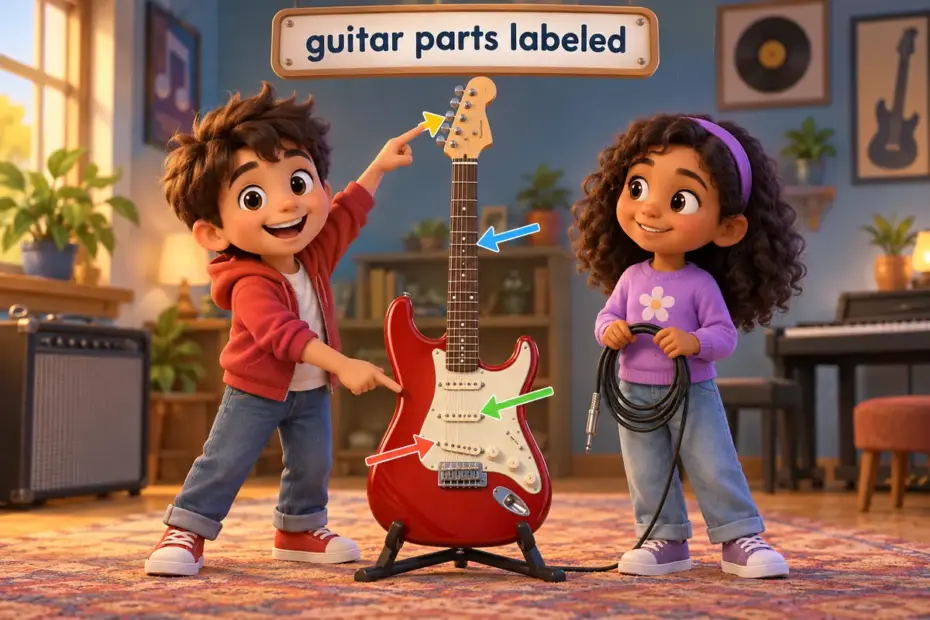
Parts of an electric guitar fall into the body, the neck and the hardware that shapes the sound. The body carries the pickups and controls, the neck holds the fretboard, and the bridge and nut keep the strings in place. A pickup turns the moving strings into a signal that an amplifier can play.
Parts of an Electric Guitar at a Glance
- An electric guitar has three main regions: the body, the neck and the headstock.
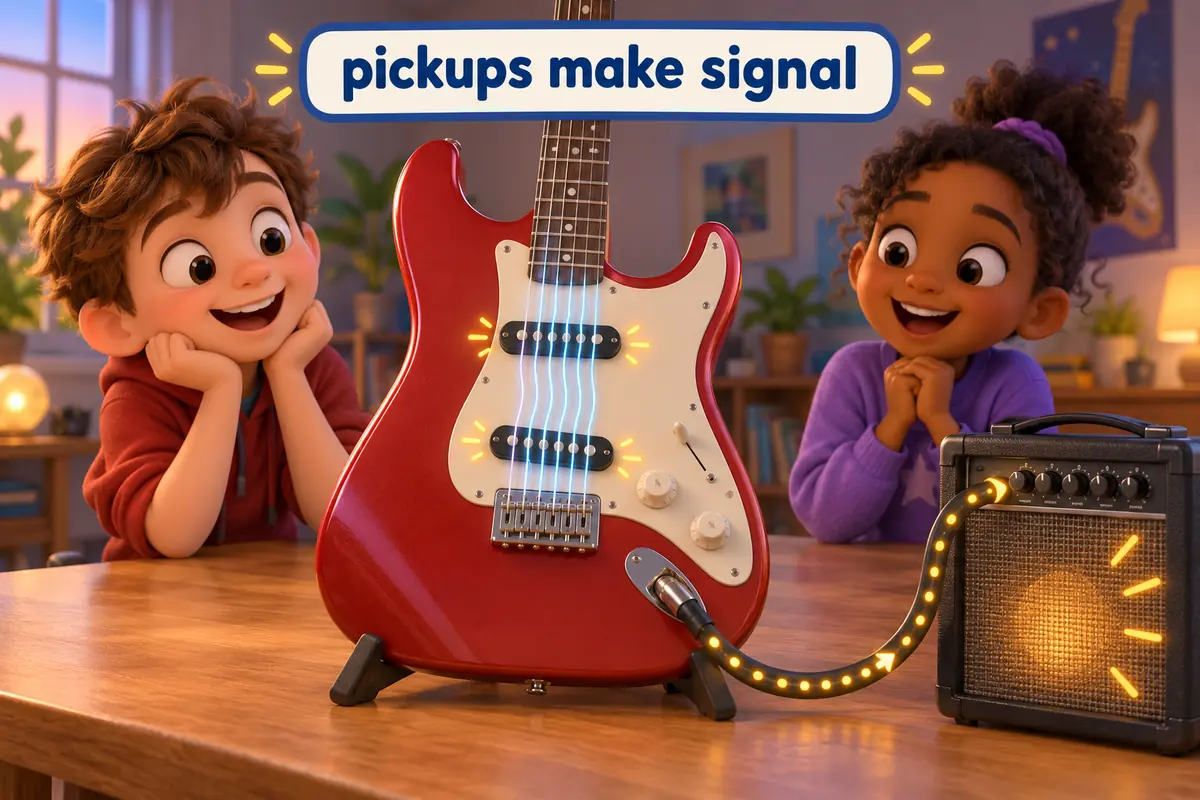
- The pickups convert string vibration into an electrical signal.
- The bridge anchors the strings at the body end and sets their height.
- Frets are the metal strips that divide the neck into fixed notes.
- Tuning pegs, or machine heads, adjust each string to the right pitch.
- Volume and tone knobs shape how loud and how bright the sound is.
What are the parts of an electric guitar?
An electric guitar splits into the wooden body, the neck that carries the strings, and the hardware that turns vibration into sound. Unlike an acoustic guitar, it has no large sound hole, because the pickups and an amplifier do the work of projecting sound.
| Part | Where it sits | What it does |
|---|---|---|
| Body | Main block below the neck | Holds the pickups, bridge and controls |
| Neck | Long section above the body | Carries the fretboard and the strings |
| Fretboard | Front face of the neck | Surface where fingers press the strings |
| Frets | Metal strips along the fretboard | Divide the neck into fixed pitches |
| Strings | Run from bridge to tuners | Vibrate to create the raw sound |
| Pickups | Under the strings on the body | Turn string vibration into an electrical signal |
| Bridge | Lower end of the body | Anchors the strings and adjusts their height |
| Nut | Top of the neck | Guides the strings to the tuning pegs |
| Tuning pegs | On the headstock | Adjust string tension to tune the guitar |
| Output jack | Edge of the body | Takes the cable that leads to an amplifier |
What does each part of an electric guitar do?
Each part answers a single question: where the string rests, how the string moves, or how that movement becomes sound. Grouping the parts by job makes the hardware easier to remember than a flat list.
| Job | Part responsible | Why it matters |
|---|---|---|
| Hold the string | Bridge and nut | Keep both ends fixed so the string can vibrate evenly |
| Set the pitch | Frets and tuning pegs | Divide the neck into notes and tune each string |
| Capture sound | Pickups | Change physical movement into a signal a cable can carry |
| Choose a sound | Pickup selector switch | Switch between one pickup or a blend of two |
| Shape loudness and tone | Volume and tone knobs | Set how loud and how bright the output is |
| Carry the signal | Output jack and cable | Send the signal to an amplifier or pedal |
How do you use guitar part words in a sentence?
Guitar vocabulary behaves like most equipment nouns. The parts take the when you name them, and they often follow prepositions such as on, under and at that say where the part sits.
| Pattern | Example | What it signals |
|---|---|---|
| the + part + on the guitar | The pickups sit on the guitar beneath the strings. | Locates a part on the instrument |
| part + action verb | The bridge holds the strings in place. | Describes the part’s job |
| verb + the + part | Turn the tuning pegs slowly. | Uses the part as the object of an action |
| adjective + part | A single-coil pickup sounds bright. | Adds a quality to the part |
| there is / are + part | There are two pickups on this model. | States how many parts are present |
Parts of an Electric Guitar in Everyday Contexts
The same part names appear in shops, lessons and repair notes. Each sentence below uses an exact term so the reader knows which piece of hardware is meant.
| Context | Example sentence | Why this works |
|---|---|---|
| Music shop | This model has three single-coil pickups. | Names the pickup type a buyer compares |
| Guitar lesson | Press the string just behind the fret. | Uses fret and string precisely |
| Repair bench | The output jack needs a new solder joint. | Points to the exact part that failed |
| Recording studio | Roll the tone knob back for a warmer part. | Names the control being turned |
| Online review | The bridge is fixed, so the tuning stays stable. | Links a part to a playing experience |
| Beginner guide | Tune each string with the matching tuning peg. | Gives an instruction with the right term |
| Word study | We looked at the noun electric guitar in a sentence before the hardware. | Starts with the whole instrument |
| Science link | A pickup works much like a simple electric circuit. | Connects the guitar to a familiar idea |
An electric guitar is a lesson in applied physics. A vibrating string changes the magnetic field around a pickup, which produces an alternating electric current that travels along a cable. Pages on an electric circuit and on electric current use the same core vocabulary, so the terms reinforce one another.
Guitar Parts That Are Easy to Confuse
Four pairs trip up beginners. Two involve hardware that sits close together, and two involve words that look similar but name different things.
| Pair | How they differ | Quick test |
|---|---|---|
| fret / fretboard | A fret is one metal strip; the fretboard is the whole wooden surface. | If it is one thin bar, it is a fret. |
| bridge / nut | The bridge sits on the body; the nut sits at the top of the neck. | Follow the string to its ends. |
| pickup / pick up | Pickup is a noun; pick up is a verb meaning to lift. | One word as a thing, two words as an action. |
| tuning peg / tuning device | A peg is part of the guitar; a tuning device is separate. | If it is built in, it is a peg. |
The same label-and-function habit carries across object lists, which is why a page about the parts of a car follows the pattern you are learning here.
Word Forms and Plurals for Guitar Parts
Most part names are regular nouns, but a few have spellings that learners mix up. The table below shows the form to write and one that people often get wrong.
| Form | Part of speech | Example |
|---|---|---|
| pickup / pickups | countable noun | Two pickups share the signal. |
| fret / frets | countable noun | Twenty-two frets line the neck. |
| string / strings | countable noun | Replace the strings every few months. |
| humbucker / humbuckers | countable noun | A humbucker cancels background hum. |
| tune / tuned | verb and participle | He tuned the guitar before the show. |
| single-coil | compound adjective | A single-coil pickup sounds bright. |
Common Mistakes When Naming Guitar Parts
These errors appear in student notes and shop emails. Each one shows the wrong version, the corrected version and the rule behind the fix.
Incorrect: Press the string down on the fret. Correct: Press the string onto the fretboard just behind the fret. Fingers stop the string against the wooden board, and the fret is the metal strip that sets the note.
Incorrect: The pick ups turn sound into electricity. Correct: The pickups turn string vibration into an electrical signal. As a noun the word is one term, pickup; the two-word pick up is a verb.
Incorrect: Use the volume knob to tune the guitar. Correct: Use the tuning pegs to tune the guitar. The volume knob controls loudness, while the tuning pegs change string tension.
Incorrect: The nut sits at the bottom of the neck. Correct: The nut sits at the top of the neck, beside the headstock. The bridge anchors the strings at the body end.
Incorrect: Plug the cable into the pickup. Correct: Plug the cable into the output jack. The jack is the socket that takes the cable; the pickup is the coil under the strings.
Practice Using Electric Guitar Part Vocabulary
Six tasks cover the terms you have met. Write your own answers before you read the reasoned list below.
- Fill in the blank: The part that turns string vibration into a signal is the _____.
- Fill in the blank: The strip of metal that sets each note is a _____.
- Choose the better word: Adjust string tension with the (volume knob / tuning pegs).
- Correct the error: The pick ups are under the strings.
- Build a sentence: use output jack to explain how the signal leaves the guitar.
- Spot the register: which sentence belongs in a repair note, and which in a friendly message?
Answers
- pickup; it changes string movement into an electrical signal.
- fret; the plural is frets, and they divide the neck into notes.
- tuning pegs; the volume knob changes loudness, not pitch.
- The pickups are under the strings; the noun is one word, pickup.
- One model answer: The signal leaves through the output jack and travels along a cable to the amplifier.
- The note about a solder joint on the output jack suits a repair note; the sentence about tuning up before practice suits a message to a friend.

The Bottom Line
Naming the parts of an electric guitar comes down to three groups: the wooden body and neck, the strings and frets that set pitch, and the electronics that carry the sound. Pickups capture vibration, the bridge and nut hold the strings, and the tuning pegs set each string to pitch. Keep pickup as one word and fret apart from fretboard. With those terms secure, you can describe, buy or repair a guitar without guessing at hardware names.
Frequently asked questions about parts of an electric guitar
What are the main parts of an electric guitar?
The main parts are the body, the neck, the fretboard, the frets, the strings, the pickups, the bridge, the nut, the tuning pegs, the output jack and the control knobs. The body and neck form the frame, the strings and frets produce notes, and the pickups and jack carry the signal to an amplifier.
What do pickups do on an electric guitar?
Pickups convert the vibration of the strings into an electrical signal. Each pickup holds magnets wrapped in wire, and when a metal string moves nearby the magnetic field changes, producing a small current. That signal travels through the output jack and a cable to an amplifier, which makes it loud enough to hear.
What is the difference between single-coil and humbucker pickups?
A single-coil pickup has one coil and gives a bright, clear tone, though it can pick up background hum. A humbucker has two coils wired to cancel that hum, which produces a fuller, warmer sound. Neither is better; players choose according to the music, and many guitars combine both types with a selector switch.
What is the whammy bar used for?
The whammy bar, or tremolo bar, changes the tension of all the strings at once. Pulling it up raises the pitch and pushing it down lowers the pitch, which creates a dipping or wailing effect. It fits into the bridge, and on a fixed bridge there is no place to attach one.