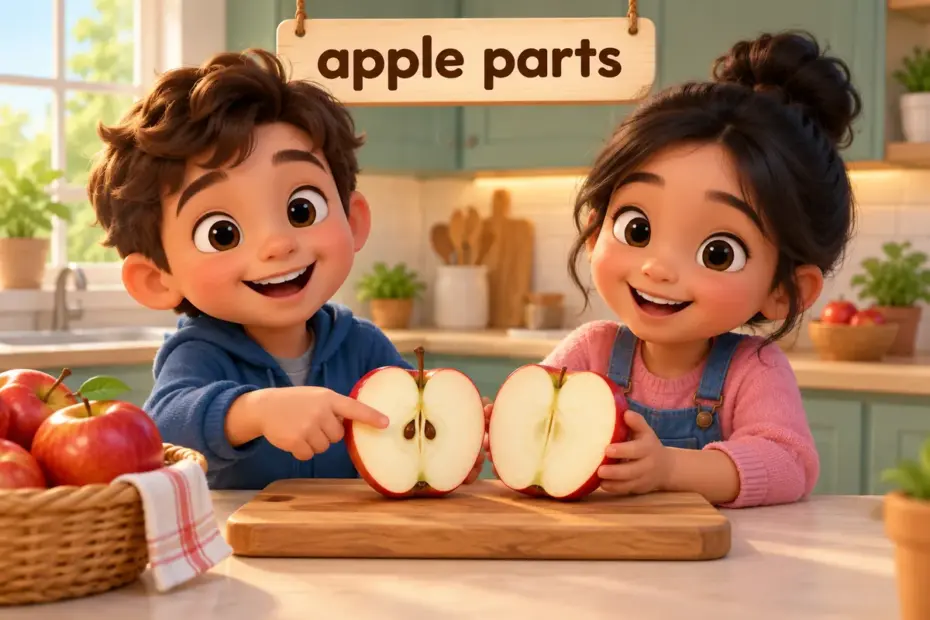
Parts of an apple include the skin, the flesh, the core, the seeds, the stem and the calyx, and each one has a clear job in the fruit. The skin protects the fruit, the flesh stores food and water, and the core holds the seeds that can grow into a new tree.
Parts of an apple at a glance
- The main parts of an apple are the skin, the flesh, the core, the seeds, the stem and the calyx.
- The skin is the thin outer layer, and the flesh is the soft edible tissue beneath it.
- The core is the tough centre that holds the seeds in small chambers called carpels.
- The stem joins the fruit to the branch, and the calyx forms the five points at the base.
- The commonest error is calling the whole centre a seed, when only the small dark pips are seeds.
What are the parts of an apple?
Parts of an apple fall into three zones: the outer skin, the fleshy middle, and the central core that protects the seeds. Fruit growers use formal names for these zones, but everyday English uses short, familiar words. A cross-section of a halved apple shows every part at once.
| Part | Plain meaning | Where it sits | Example sentence |
|---|---|---|---|
| skin | thin outer covering, also called the peel | the whole outside surface | The skin of a ripe apple is smooth and firm. |
| flesh | soft edible tissue | between skin and core | The flesh is pale and juicy when cut. |
| core | tough central column | the middle of the fruit | She cut around the core and left it aside. |
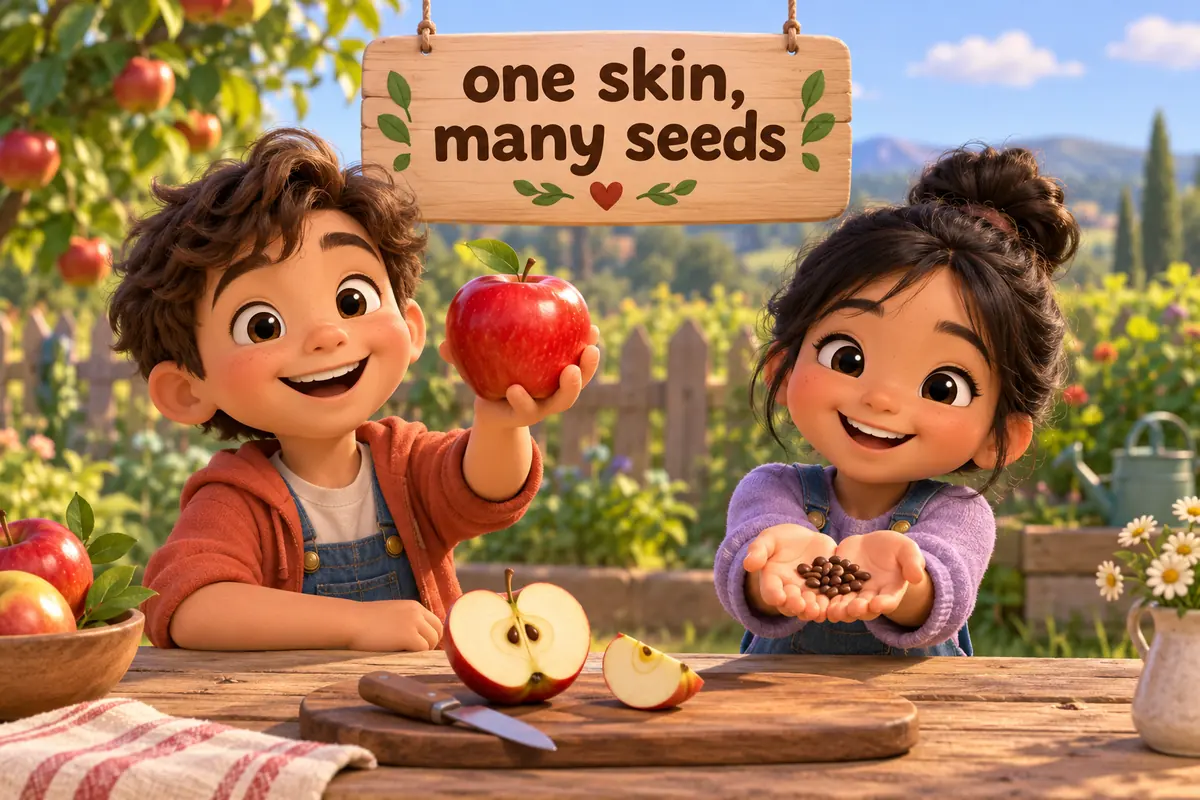
| seed | small dark pip, also called a pip | inside the core | Each seed can grow into a new tree. |
| stem | short stalk, also called the stalk | in the hollow at the top | The stem still held a small green leaf. |
| calyx | dry five-point remnant of the flower | the base, opposite the stem | The calyx looks like a tiny star at the bottom. |
| carpel | papery seed chamber | inside the core | Five carpels usually sit in a ring. |
| stem cavity | the dip where the stem sits | the top of the fruit | The stem cavity holds the stalk firmly. |
The skin and the core are the two parts learners meet first. The skin is the coloured covering that protects the fruit, and the core is the firm centre that most people remove before eating. The blossom end, where the flower once sat, is the same spot as the calyx, so growers sometimes call it the eye of the fruit.
How do you name the parts in a sentence?
The part names are ordinary count nouns, so they take articles, plurals and possessives in the usual way. The table below shows the patterns that appear most often in recipes, science books and shops.
| Pattern | Example | What it signals |
|---|---|---|
| the + part | the core | one specific part that both speakers can see |
| a + part | a seed | one single example of that part |
| plural part | the seeds | all of the parts taken together |
| possessive | the apple’s skin | the part belongs to one fruit |
| colour + part | the red skin | the part with a visible feature |
| part + of + apple | the core of an apple | a precise or formal description |
| part + is + adjective | The flesh is sweet. | a description of one part |
Notice that the possessive form uses an apostrophe: the apple’s skin, not the apple skin, when you mean one fruit. The plural form drops the apostrophe entirely: the seeds are small. In sentences like these the part noun stays singular after the, even when it means the whole layer.
Parts of an apple in sentences across contexts
The same part names appear in kitchens, classrooms and orchards, and each setting favours a different level of detail.
| Context | Example sentence | Why this works |
|---|---|---|
| Classroom | The skin protects the flesh inside the apple. | names two parts and their relationship |
| Recipe | Peel the skin, then slice around the core. | uses part names as cooking instructions |
| Science book | Each carpel holds one or two seeds. | uses the precise botanical term |
| Orchard | Wind can pull the fruit from its stem too early. | ties a part to a growing problem |
| Everyday speech | Cut the core out and throw the seeds away. | plain words in a short command |
| Shop label | The calyx stays fresh while the apple is firm. | uses an unusual part as a quality clue |
| Nature writing | Birds peck through the skin to reach the seeds. | shows animals using the parts |
| Gardening guide | Save a few seeds from the core to sow in spring. | connects parts to a later action |
| Exam answer | Name two parts of an apple that you can eat. | asks for parts as a list |
The context decides how formal the part name becomes. A recipe says core and skin, a science book says carpel and seed, and a produce label may name the calyx. Use the familiar word unless the task calls for the botanical one. Growers judge ripeness long before fruit leaves apple orchards for the market, and they look at the skin first.
Which word: skin, core or seed?
These three names are easy to mix up because they all name something inside the fruit, but they sit in different places and do different jobs.
| Feature | skin | core | seed |
|---|---|---|---|
| Position | outer surface | central column | inside the core |
| Do you eat it? | often yes | usually no | rarely |
| Job | protects the fruit | holds the seeds | grows a new tree |
| Plural | skins | cores | seeds |
| Everyday use | the commonest part word | the part you remove | the part you plant |
The position settles it: the skin is outside, the core is in the middle, and the seed is inside the core. When a sentence mentions planting, the correct word is always seed; when it mentions peeling, the correct word is skin. In a kitchen the same words appear when a cook peels, cores and slices the fruit for apple pie.
Word forms and grammar of the apple parts
Several part names also work as verbs or adjectives, which is why learners sometimes build forms that do not exist.
| Form | Part of speech | Example |
|---|---|---|
| skin | noun | The skin is thin and firm. |
| peel | noun or verb | Peel the apple before baking. |
| peelings | noun, plural | Save the peelings for the compost. |
| core | noun or verb | Core the apple with a small knife. |
| cored | adjective | Add the cored apples to the pan. |
| seed | noun or verb | Seeds grow when they are planted. |
| seedless | adjective | Some varieties are seedless. |
| seedy | adjective | The old fruit was seedy and dry. |
The verb use is regular: peel, peeled, peeling; core, cored, coring. The adjective cored means the core has already been removed, as in cored apples ready to stuff. Seedy usually describes fruit that has too many seeds rather than fruit that lacks them, so it is not the opposite of seedless.
Common mistakes with apple parts
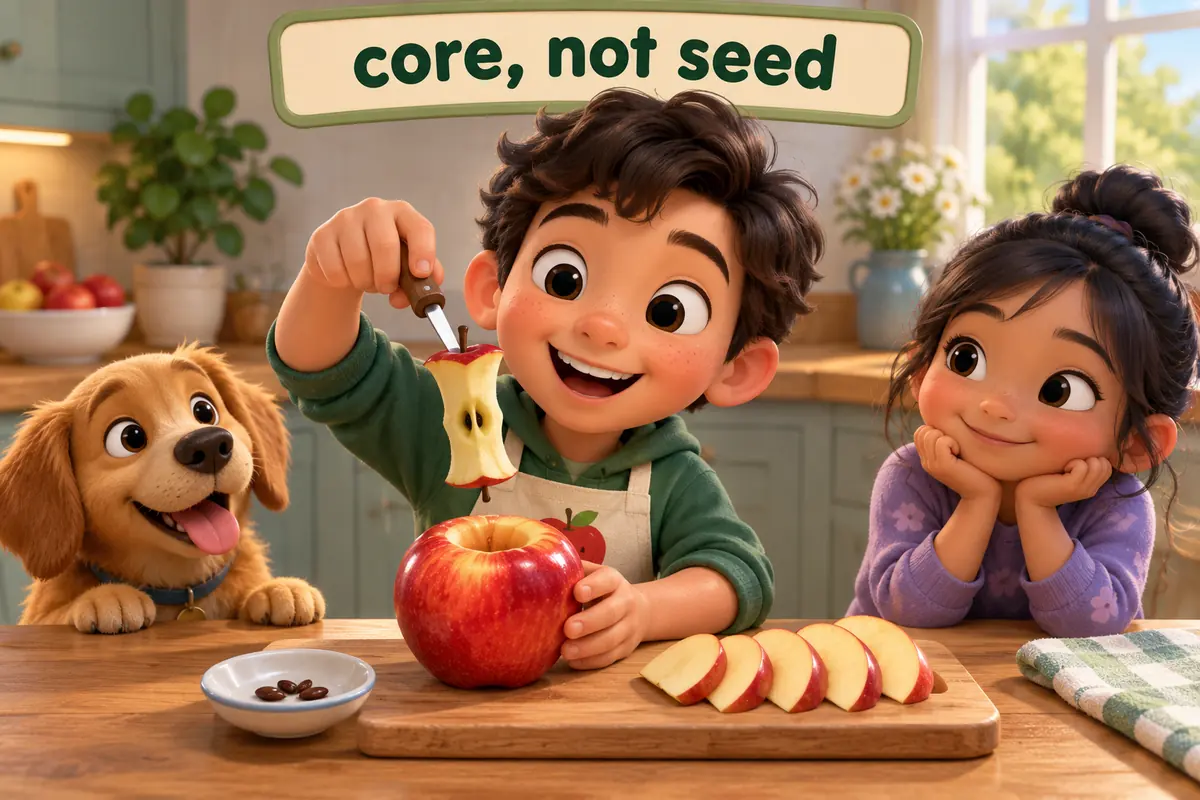
Mistake 1: core called a seed. Incorrect: Remove the seed before you slice the fruit. Correct: Remove the core before you slice the fruit. Rule: the seed is the small pip inside; the core is the whole tough centre.
Mistake 2: seed used for the whole centre. Incorrect: The seeds take up most of the middle. Correct: The core takes up most of the middle. Rule: only the small dark pips are seeds.
Mistake 3: missing apostrophe on a possessive. Incorrect: The apples skin is shiny. Correct: The apple’s skin is shiny. Rule: a singular noun takes an apostrophe before the s.
Mistake 4: peel and skin treated as two objects. Incorrect: Remove the peel and the skin together. Correct: Remove the peel, also called the skin. Rule: peel and skin name the same outer layer.
Mistake 5: calyx confused with the stem. Incorrect: The calyx at the top joins the branch. Correct: The stem at the top joins the branch. Rule: the stem is at the top, the calyx at the base.
Practice using the parts of an apple
- Fill in the blank: The ___ is the thin outer layer that protects the fruit.
- Choose the better word: The (core / seed) holds all the small dark pips.
- Correct the error: The apples skin is smooth.
- Build a sentence: use stem to describe how the fruit joins the branch.
- Spot the register: which suits a science book, (a) the little pips, or (b) the seeds sit inside the carpels?
- Fill in the blank: The five-point remnant at the base is the ___.
Answers
- skin, because the skin is the coloured outer covering.
- core, because the core is the tough centre that surrounds the seeds.
- The apple’s skin is smooth; a singular noun needs an apostrophe before the s.
- The stem joins the apple to the branch of the tree.
- (b), because a science book uses precise terms such as carpels.
- calyx, because the calyx is the dry five-point remnant of the flower.
Descriptions of the skin often need a colour word, and the collection of adjectives for apple gathers them in one place for revision.
The bottom line
Parts of an apple are easy to name once you picture the cross-section: skin outside, flesh in between, and a core holding the seeds at the middle. The skin and the peel are the same layer, and the stem at the top is different from the calyx at the base. To see the fruit word itself in use, read apple in a sentence, then apply the part names to any apple you cut.
Frequently asked questions about the parts of an apple
Is the core of an apple a seed?
No. The core is the whole tough central column that you remove before eating, while a seed is one small dark pip inside it. A single apple usually holds about five to ten seeds, and each one sits in a papery chamber called a carpel.
Can you eat the skin of an apple?
Yes. The skin, also called the peel, is edible and firm, and many people leave it on because it holds colour and fibre. Wash the fruit first, then decide whether to peel it or eat it whole with the crisp flesh inside.
What is the small star at the bottom of an apple?
That small star is the calyx, the dried remnant of the flower that produced the fruit. It sits at the base, opposite the stem, and its five points show where the petals once attached. Growers sometimes call it the eye.
Do all apples have the same number of seeds?
No. The count varies with the variety and the growing season, but most apples form five seed chambers, and each chamber may hold one or two seeds. A typical fruit therefore carries between five and ten seeds in its core.