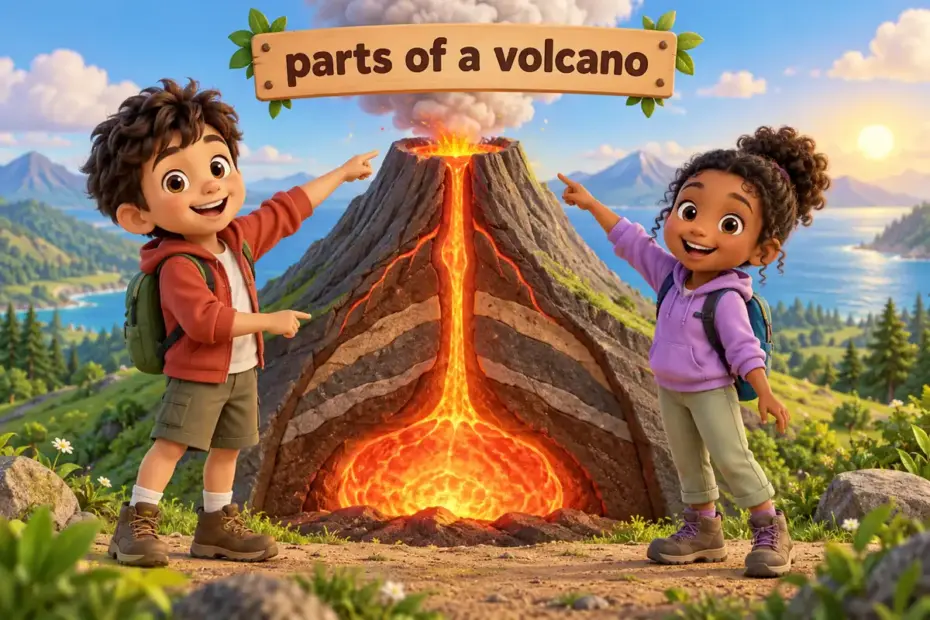
The parts of a volcano are the magma chamber, the conduit, the vent, the crater, and the cone that builds around them. Magma rises from the chamber, travels up the conduit, and escapes through the vent, so each part sits on a path from deep rock to the open air.
Parts of a volcano at a glance
- A volcano has five main parts: the magma chamber, conduit, vent, crater, and cone.
- Magma is molten rock underground, and lava is the same rock at the surface.
- The conduit is the pipe that carries magma upward.
- The vent is the opening, and the crater is the bowl around it.
- The commonest error is calling magma lava before it erupts.
What are the parts of a volcano?
A volcano is an opening in the Earth’s crust where molten rock, ash, and gas escape. The magma chamber is a pool of molten rock below, the conduit is the main pipe that leads up, and the vent is the surface opening. Around the vent, layers of cooled lava and ash slowly build the cone.
| Part | Where it is | What it does | Example sentence |
|---|---|---|---|
| Magma chamber | Deep underground | Stores molten rock | The magma chamber of a volcano filled slowly. |
| Conduit | Between chamber and vent | Carries magma up | The conduit of a volcano is a long pipe. |
| Vent | At the surface | Lets material out | The vent of a volcano hissed and steamed. |
| Crater | Around the vent | Forms a bowl | The crater of a volcano held a small lake. |
| Cone | The mountain shape | Builds from erupted rock | The cone of a volcano rose above the plain. |
| Throat | Top of the conduit | Narrows near the surface | The throat of a volcano clogged with ash. |
| Lava | Flowing on the surface | Molten rock above ground | The lava of a volcano glowed orange. |
| Lava flow | Down the slopes | Travels away from the vent | A lava flow of a volcano reached the sea. |
| Ash cloud | Above the vent | Rises into the sky | The ash cloud of a volcano darkened the sun. |
| Fumarole | On the flanks | Vents gas and steam | A fumarole of a volcano steamed quietly. |
| Dike | In the rock below | Feeds a side vent | A dike of a volcano splits the rock. |
| Crater lake | Inside the crater | Collects rain and snow | The crater lake of a volcano was deep. |
How do you use the parts of a volcano in a sentence?
The naming phrase puts one part before of a volcano, or lets the volcano own that part with an apostrophe. Match the verb to the number of parts you name, because several parts, such as the dikes and fumaroles, take a plural verb.
| Pattern | Example | What it signals |
|---|---|---|
| the + part + of a volcano | The crater of a volcano was wide. | names one part |
| a volcano’s + part | A volcano’s cone is steep. | shows possession |
| plural part + of a volcano | The walls of a volcano are layered. | talks about many |
| part + verb | The vent releases the gas. | describes a job |
| label + part | The class drew the conduit first. | school and diagram use |
| part + helps + verb | The conduit helps move the magma. | explains a function |
Parts of a volcano in context: examples across contexts
The same names appear in a classroom, a geology report, and a news bulletin, and the wording around them changes with the setting. A set of describing words sits in adjectives for volcano.
| Context | Example sentence | Why this works |
|---|---|---|
| Classroom | The teacher asked us to label each part of a volcano. | a school labelling task |
| Geology report | The magma chamber of a volcano was mapped by sound. | a technical statement |
| News bulletin | Ash from the vent of a volcano closed the airport. | a public report |
| Safety notice | Stay clear of the lava flow of an active volcano. | a warning |
| Science book | Magma becomes lava at the surface. | a plain factual statement |
| Field note | A fumarole of a volcano released warm steam. | a measured observation |
| Exam question | Name the part that stores the magma. | a clear instruction |
| Documentary | The crater of a volcano filled with green water. | dramatic description |
| Story | The children watched the far volcano smoke at dusk. | simple narrative wording |
| Museum sign | This cone of a volcano last erupted in 1902. | a short exhibit note |
Magma chamber, conduit, and crater: how the parts differ
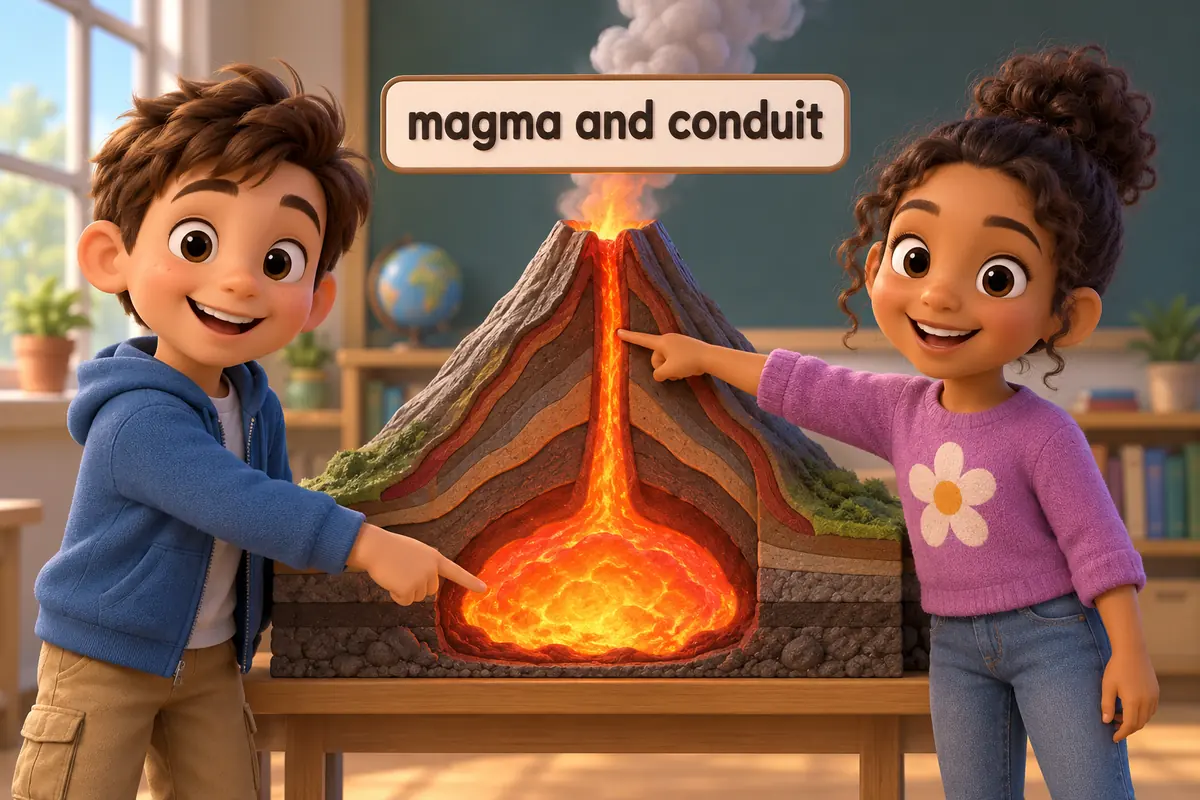
Grouping the parts by depth makes the diagram easy to read, because storage, transport, and escape happen at three different levels. A similar one-name-one-job list appears in human body parts that start with a.
| Feature | Magma chamber | Conduit | Crater |
|---|---|---|---|
| Main job | stores molten rock | carries it up | holds the opening |
| Where it is | deep underground | a vertical pipe | at the top surface |
| What it holds | magma | rising rock and gas | ash, rock, or water |
| State of the rock | liquid | liquid and gas | solid after cooling |
| Diagram label | magma chamber | conduit | crater |
Word forms and grammar of the parts of a volcano
Most part names are nouns, and the volcano itself gives a family of related words. The verb erupt names the action, the noun eruption names the event, and the adjective eruptive describes an active phase. A comparable list of human body parts that start with b shows the same naming habit.
| Form | Part of speech | Example |
|---|---|---|
| volcano | noun | The volcano is dormant. |
| volcanoes | noun, plural | Many volcanoes ring the sea. |
| erupt | verb | The volcano may erupt. |
| eruption | noun | The eruption lasted days. |
| eruptive | adjective | The eruptive phase began. |
| magma | noun | Magma rose underground. |
| lava | noun | Lava cooled into rock. |
| molten | adjective | Molten rock glows. |
| dormant | adjective | A dormant volcano sleeps. |
| seismic | adjective | Seismic tremors shook the ground. |
Common mistakes with the parts of a volcano
One word pair and one plural ending cause most of the errors, so keep the underground rock and the surface rock apart.
Mistake 1: lava underground. Incorrect: The lava rose in the chamber underground. Correct: The magma rose in the chamber underground. Rule: magma is underground and becomes lava only at the surface.
Mistake 2: volcanos for volcanoes. Incorrect: Two volcanos were active. Correct: Two volcanoes were active. Rule: volcano makes the plural volcanoes by adding es.
Mistake 3: erupt for erupted. Incorrect: The volcano erupt last night. Correct: The volcano erupted last night. Rule: use the past tense erupted for a finished event.
Mistake 4: conduit for crater. Incorrect: The conduit is the bowl around the vent. Correct: The crater is the bowl around the vent. Rule: the conduit carries magma, and the crater is the surface bowl.
Mistake 5: vent for chamber. Incorrect: The vent stores molten rock deep below. Correct: The magma chamber stores molten rock deep below. Rule: the vent is the surface opening, not the store.
Practice using the parts of a volcano
- Fill in the blank: The ___ is the pipe that carries magma to the surface.
- Choose the better word: Rock at the surface is called (magma / lava).
- Correct the error: Two volcanos were active last night.
- Build a sentence: use crater to say where the opening sits.
- Spot the register: which line suits a safety notice, (a) The hot stuff is scary, or (b) Stay clear of the lava flow of an active volcano?
- Fill in the blank: The ___ chamber stores molten rock deep underground.
Answers
- conduit, because the conduit is the pipe that carries magma upward.
- lava, because rock at the surface is lava, not magma.
- Two volcanoes were active last night; the plural is volcanoes.
- The crater is the bowl at the top that holds the vent and any crater lake.
- (b), because a safety notice uses precise, neutral warnings.
- magma, because the magma chamber stores molten rock underground.
The bottom line
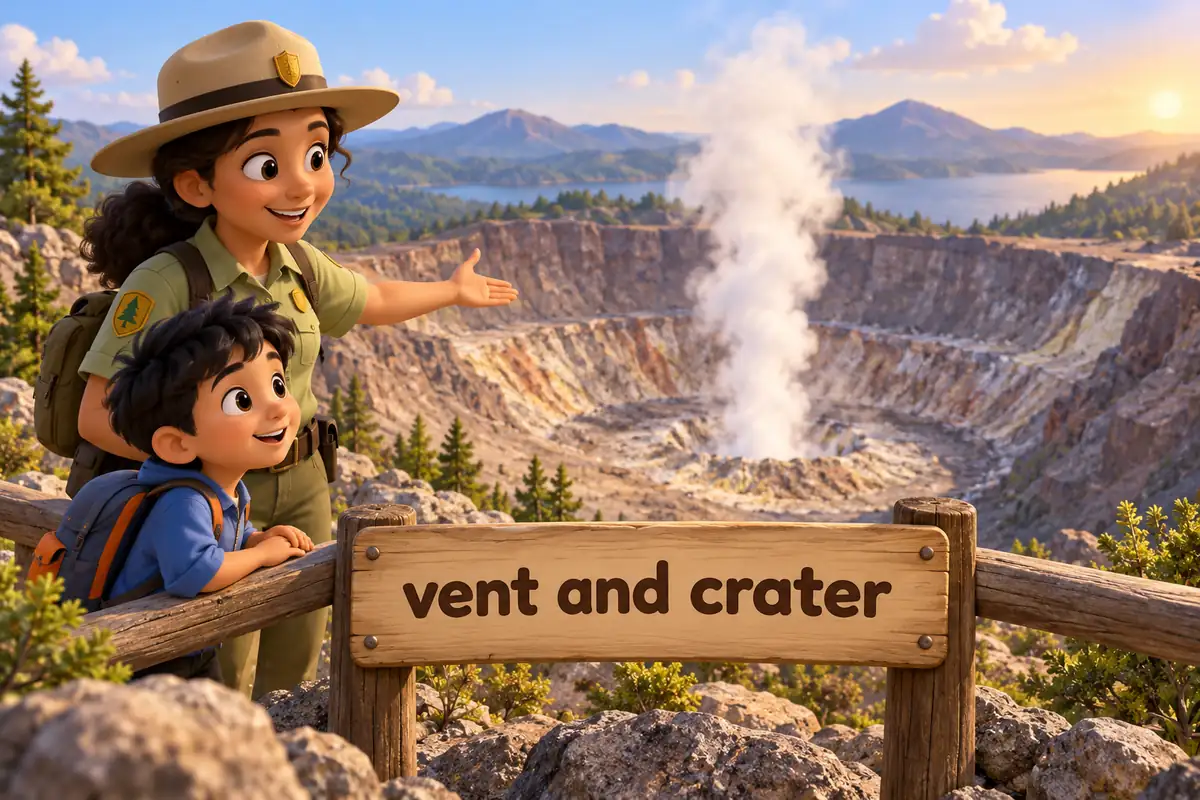
The parts of a volcano trace one path from depth to air: the magma chamber stores molten rock, the conduit carries it up, and the vent releases it at the crater. Learn which stage each name belongs to, because magma stays underground and only becomes lava outside. Once the path is clear, the diagram reads in one direction.
Frequently asked questions about the parts of a volcano
What are the main parts of a volcano?
A volcano has five main parts: the magma chamber, the conduit, the vent, the crater, and the cone. The chamber stores molten rock, the conduit carries it up, the vent releases it, the crater is the bowl around the vent, and the cone is the mound of cooled rock and ash.
What is the difference between magma and lava?
Magma is molten rock still underground, inside the chamber and the conduit, and lava is the same molten rock once it reaches the surface. The change of name marks the change of place, not a change in the material. So a volcano erupts magma that immediately becomes lava.
Why do volcanoes have a crater?
The crater is the bowl-shaped hollow left around the vent, formed when erupted rock and ash pile up on the sides or when the top of the cone collapses. Over time it may fill with rain and snow to make a crater lake. Its rim is simply the top edge of the surrounding cone.
How does a volcano build a cone?
Each eruption throws out lava, ash, and rock that settle around the vent and harden. Layer after layer of these cooled materials builds upward and outward into the familiar cone shape. Over many eruptions the cone grows steep and tall, which is why older volcanoes have the largest cones.