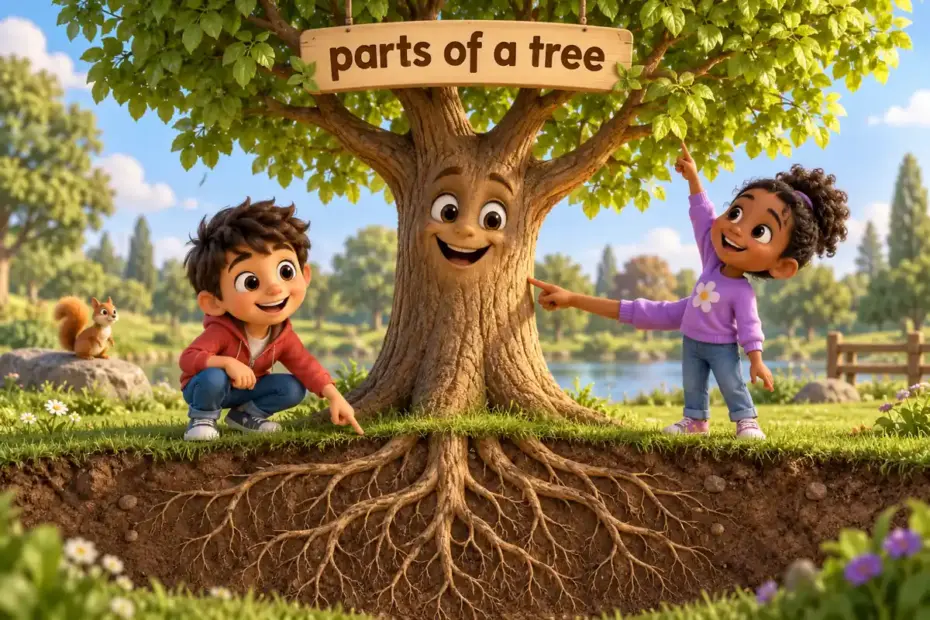
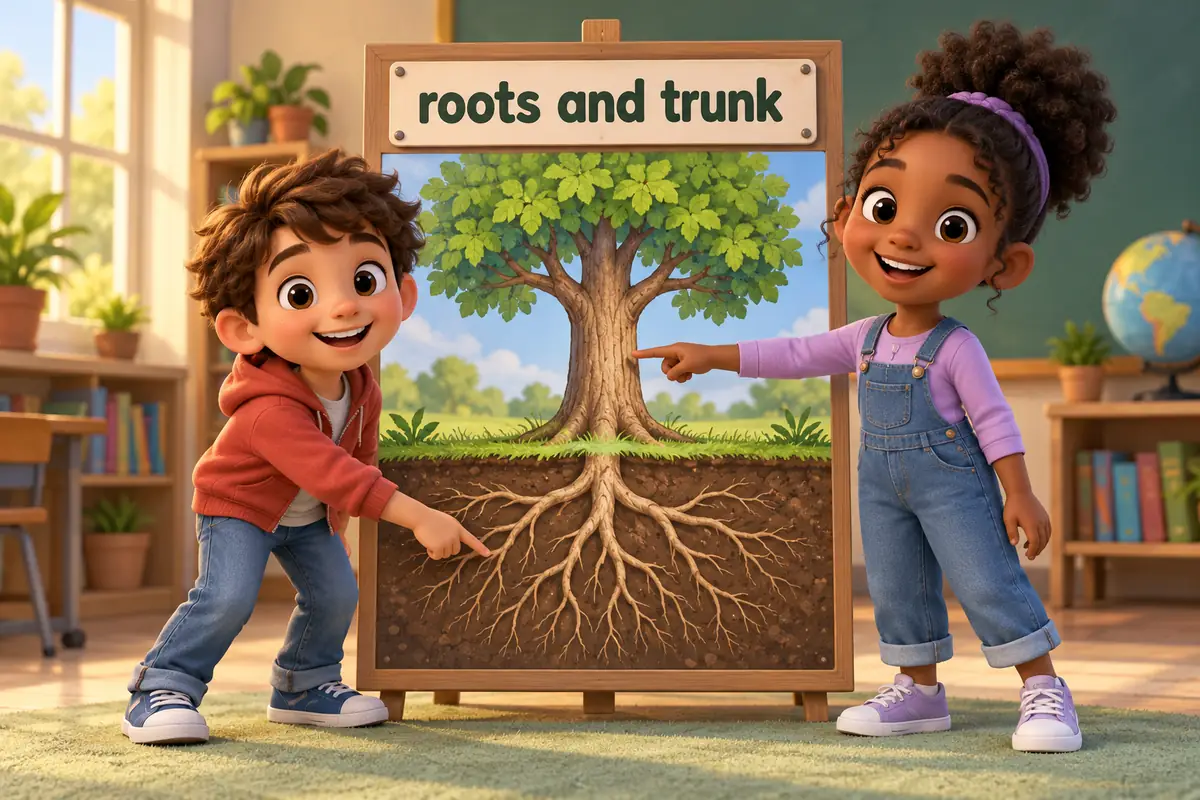
The parts of a tree are the roots, the trunk, the branches, the leaves, and the bark that covers them. The roots take in water, the trunk carries it up, and the leaves make food, so every part plays a role in keeping the tree alive.
Parts of a tree at a glance
- A tree has five main parts: the roots, trunk, branches, leaves, and bark.
- Roots take in water and hold the tree steady in the ground.
- The trunk carries water up and food down through inner layers.
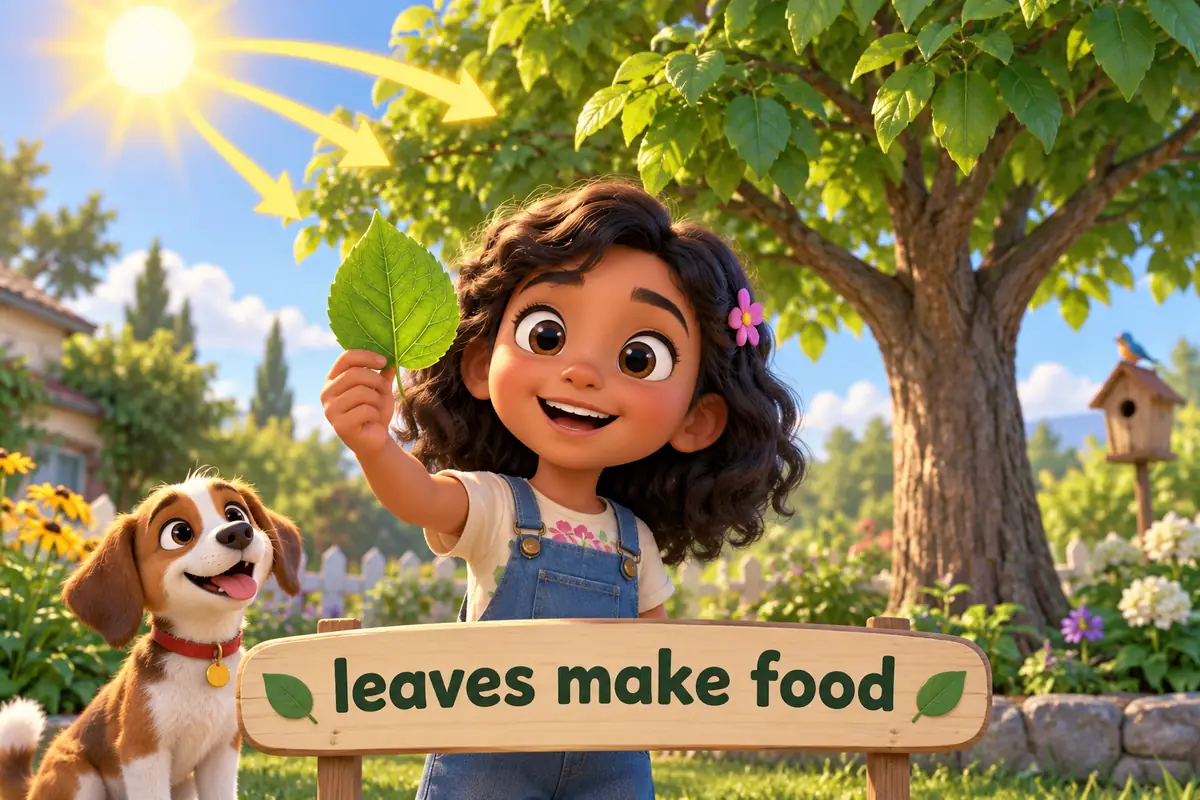
- Leaves make food using sunlight, water, and air.
- The commonest error is writing leafs instead of leaves.
What are the parts of a tree?
A tree is a tall woody plant with a single main stem that lives for many years. The roots anchor it and draw water, the trunk lifts the crown into the light, the branches spread the leaves outward, and the leaves turn sunlight into food. Inside, thin layers called xylem and phloem move water and sap up and down.
| Part | Where it is | What it does | Example sentence |
|---|---|---|---|
| Root | Below the ground | Takes in water and holds firm | The roots of a tree spread wide. |
| Trunk | The main stem | Holds the tree up | The trunk of a tree was very thick. |
| Bark | The outer layer | Protects the wood | The bark of a tree felt rough. |
| Branch | Off the trunk | Spreads the leaves outward | The branches of a tree reached the roof. |
| Twig | The smallest branch | Holds the leaves and buds | A twig of a tree bent in the wind. |
| Leaf | On the twigs | Makes food from sunlight | The leaves of a tree turned yellow. |
| Crown | The top of the tree | Gathers sunlight | The crown of a tree shaded the path. |
| Canopy | The leafy layer | Cools the air | The canopy of a tree blocked the rain. |
| Xylem | Inside the trunk | Carries water up | The xylem of a tree moves water upward. |
| Phloem | Inside the trunk | Carries food down | The phloem of a tree carries sap. |
| Heartwood | The dark centre | Supports the trunk | The heartwood of a tree is dead and hard. |
| Sapwood | Just under the bark | Carries water | The sapwood of a tree is pale. |
How do you use the parts of a tree in a sentence?
The naming phrase puts one part before of a tree, or lets the tree own that part with an apostrophe. Match the verb to the number of parts you name, because parts such as the roots and the leaves take plural verbs while the trunk takes a singular one.
| Pattern | Example | What it signals |
|---|---|---|
| the + part + of a tree | The trunk of a tree is thick. | names one part |
| a tree’s + part | A tree’s roots run deep. | shows possession |
| plural part + of a tree | The leaves of a tree make food. | talks about many |
| part + verb | The roots take in water. | describes a job |
| label + part | The class labelled the trunk first. | school and diagram use |
| part + helps + verb | The bark helps protect the wood. | explains a function |
Parts of a tree in context: examples across contexts
The same names appear in a classroom, a garden guide, and a poem, and the wording around them changes with the setting. A familiar tree in gardens is the subject of an apple tree, whose parts match the same diagram.
| Context | Example sentence | Why this works |
|---|---|---|
| Classroom | The teacher asked us to label each part of a tree. | a school labelling task |
| Science textbook | The trunk of a tree carries water to the leaves. | a plain factual statement |
| Garden guide | Water young trees at the roots, not the trunk. | a practical instruction |
| Poem | The old tree lifted its branches to the sky. | vivid descriptive wording |
| Field note | The bark of a tree was grey and smooth. | a measured observation |
| Children’s story | A squirrel ran up the trunk of a tree. | simple narrative wording |
| Nature documentary | The canopy of a tree shelters a whole world. | dramatic description |
| Exam question | Label the roots and the crown of a tree. | a clear instruction |
| Seed packet | This tree grows tall in full sun. | a short product note |
| Craft blog | Press a leaf from a tree between two sheets. | an everyday use |
Roots, trunk, and leaves: how the parts differ
Grouping the parts by what they need makes the diagram easy to read, because soil, no light, and sunlight are three different conditions. A similar labelled list appears in a banyan tree whose roots hang from its branches.
| Feature | Roots | Trunk | Leaves |
|---|---|---|---|
| Main job | take in water | lift the crown | make food |
| Where it is | underground | the centre stem | on the twigs |
| What it needs | soil and water | no light | sunlight and air |
| Typical material | woody and fine | wood and bark | flat green blades |
| Diagram label | roots | trunk | leaves |
Word forms and grammar of the parts of a tree
Most part names are nouns, and one very common one has an unusual plural, because leaf becomes leaves. The adjective wooded describes a landscape full of trees, and the verb shade describes what a crown does. A seasonal example appears in a Christmas tree that is decorated indoors.
| Form | Part of speech | Example |
|---|---|---|
| tree | noun | The tree is old. |
| trees | noun, plural | The trees line the road. |
| leaf | noun | One leaf fell. |
| leaves | noun, plural | The leaves are green. |
| branch | noun | A branch broke. |
| branches | noun, plural | The branches sway. |
| root | noun and verb | The roots run deep. |
| bark | noun | The bark is rough. |
| wooded | adjective | A wooded hill rose beyond. |
| shade | noun and verb | The shade was cool. |
Common mistakes with the parts of a tree
Two homophones and one odd plural cause most of the errors, and an idiom such as bark up the wrong tree leans on the very word that trips learners.
Mistake 1: leafs for leaves. Incorrect: The leafs turned brown. Correct: The leaves turned brown. Rule: leaf makes the plural leaves, changing f to v.
Mistake 2: routes for roots. Incorrect: The tree’s routes reach deep. Correct: The tree’s roots reach deep. Rule: roots are underground, while routes are paths.
Mistake 3: trunk for roots. Incorrect: The trunk takes in water from the soil. Correct: The roots take in water from the soil. Rule: roots absorb water, and the trunk carries it up.
Mistake 4: branchs for branches. Incorrect: The tree has many branchs. Correct: The tree has many branches. Rule: words ending in ch add es in the plural.
Mistake 5: bark mixed with a dog’s sound. Incorrect: The bark of the tree made a loud noise. Correct: The dog made a loud noise, and the bark of the tree is its outer coat. Rule: bark means the tree’s outer layer, and also the sound a dog makes.
Practice using the parts of a tree
- Fill in the blank: The ___ take in water from the soil.
- Choose the better word: Food is made in the (leaves / trunk).
- Correct the error: The leafs turned brown.
- Build a sentence: use trunk to say how water travels up the tree.
- Spot the register: which line suits a field note, (a) The tree’s skin is wrinkly, or (b) The bark was grey and smooth?
- Fill in the blank: The ___ of a tree carries water up from the roots.
Answers
- roots, because the roots take in water and hold the tree steady.
- leaves, because the leaves make food using sunlight.
- The leaves turned brown; leaf makes its plural as leaves.
- The trunk carries water up from the roots to the leaves and branches.
- (b), because a field note uses precise, neutral description.
- xylem, because the xylem carries water upward through the trunk.
The bottom line
The parts of a tree split into three stages: the roots take in water, the trunk carries it up, and the leaves make food from sunlight. Learn the inner layers, because the xylem moves water up and the phloem moves sap down. Once the flow is clear, the whole tree reads as one working system.
Frequently asked questions about the parts of a tree
What are the main parts of a tree?
A tree has five main parts: the roots, trunk, branches, leaves, and bark. The roots draw water and anchor the tree, the trunk lifts the crown, the branches spread the leaves, and the leaves make food. Bark covers and protects the woody parts.
How does a tree carry water?
Water rises from the roots through thin tubes called xylem inside the trunk and branches. The tubes reach every leaf, where water is used to make food. A second set of tubes, the phloem, then carries the finished food from the leaves back down to the roots.
Why do trees have bark?
Bark is the tough outer layer that protects the living wood from weather, insects, and disease. It also slows water loss from the trunk. If a ring of bark is stripped away, the tree can no longer move food from its leaves, and that part above the damage dies.
What do the leaves of a tree do?
Leaves make food for the whole tree using sunlight, water, and carbon dioxide, in a process called photosynthesis. Small openings underneath let air in and out, and the green colour helps capture light. Leaves also release water vapour, which cools the tree on hot days.