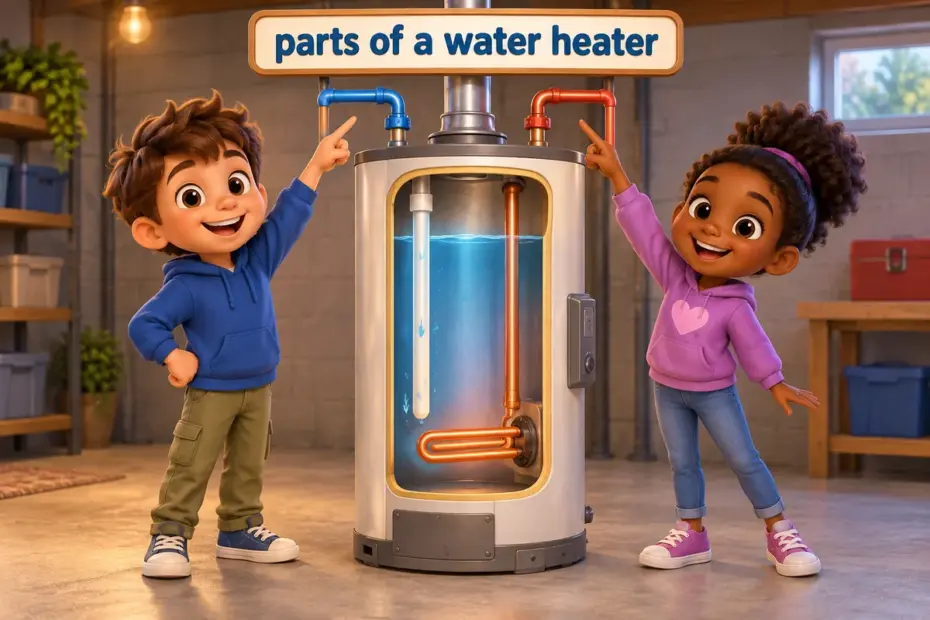
The parts of a water heater functions and diagram begin with the tank, the dip tube, the heating element or burner, and the thermostat. Cold water enters the top, drops down the dip tube, gets heated, and leaves from the hot outlet, so the flow is easy to follow.
Parts of a water heater at a glance
- A tank water heater has a tank, a dip tube, a heating element or burner, and a thermostat.
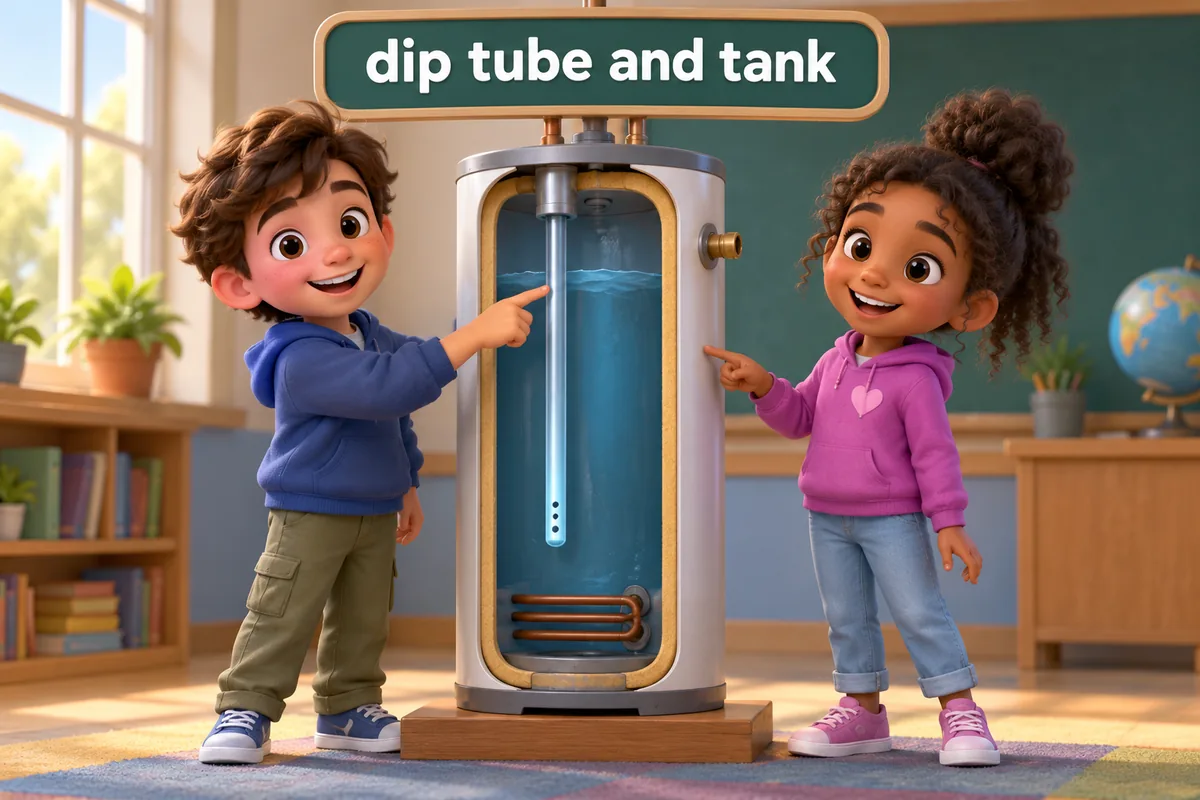
- The cold inlet sends water down a dip tube to the bottom of the tank.
- The hot outlet draws heated water from the top, where it is warmest.
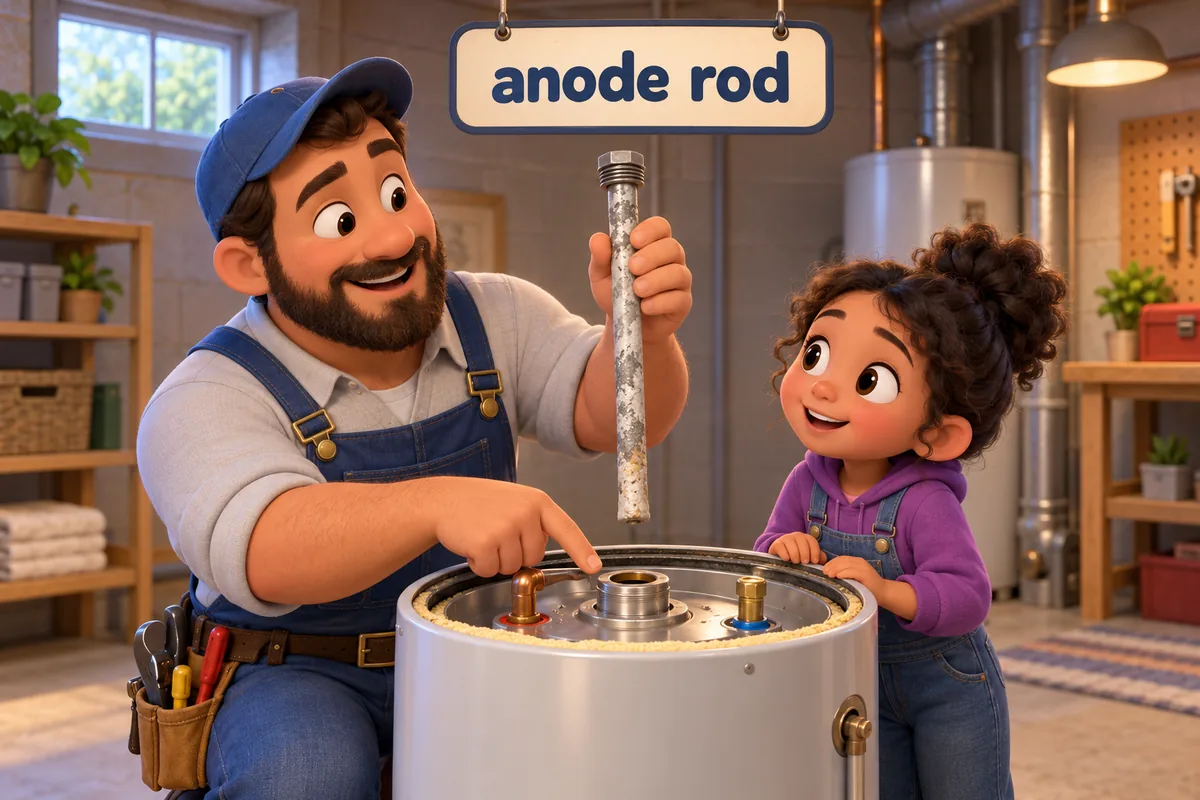
- The anode rod sacrifices itself to stop the tank from rusting.
- The commonest error is confusing a water heater with a boiler or a furnace.
What are the parts of a water heater?
A water heater is a tank that stores water and keeps it hot until a tap calls for it. Cold water enters a dip tube that reaches the bottom, a heating element or gas burner warms it, and hot water leaves from the top outlet. A thermostat controls the heat, and a pressure relief valve keeps the tank safe.
| Part | Where it is | Function | Example sentence |
|---|---|---|---|
| Tank | The main cylinder | Stores hot water | The tank of a water heater holds fifty gallons. |
| Dip tube | Cold inlet, top | Sends cold water to the bottom | The dip tube of a water heater reaches low. |
| Cold inlet | Top of the tank | Brings cold water in | The cold inlet of a water heater has a valve. |
| Hot outlet | Top of the tank | Sends hot water out | The hot outlet of a water heater feeds the taps. |
| Heating element | Electric models, inside | Warms the water | The heating element of a water heater glowed. |
| Burner | Gas models, at the base | Heats from below | The burner of a water heater lit with a click. |
| Thermostat | On the side | Sets the temperature | The thermostat of a water heater was set to warm. |
| Anode rod | Inside the tank | Sacrifices itself to rust | The anode rod of a water heater wore away. |
| Relief valve | Top or side | Releases excess pressure | The relief valve of a water heater dripped. |
| Drain valve | Bottom of the tank | Empties the tank | The drain valve of a water heater was opened. |
| Insulation | Around the tank | Keeps heat in | The insulation of a water heater saves energy. |
| Flue | Gas models, up the middle | Carries smoke away | The flue of a water heater vents outside. |
How do you use the parts of a water heater in a sentence?
The naming phrase puts one part before of a water heater, or lets the water heater own that part with an apostrophe. Match the verb to the number of parts you name, because parts such as the elements and the valves take plural verbs.
| Pattern | Example | What it signals |
|---|---|---|
| the + part + of a water heater | The tank of a water heater is steel. | names one part |
| a water heater’s + part | A water heater’s anode rod rusts first. | shows possession |
| plural part + of a water heater | The valves of a water heater wear out. | talks about several |
| part + verb | The thermostat controls the heat. | describes a function |
| label + part | The plumber checked the relief valve. | trade and repair use |
| part + helps + verb | The dip tube helps feed the bottom. | explains a function |
Parts of a water heater in context: examples across contexts
The same names appear in a classroom, an installer’s manual, and an energy guide, and the wording around them changes with the setting. A set of describing words sits in adjectives for water, and a longer collection appears in adjectives for water 2.
| Context | Example sentence | Why this works |
|---|---|---|
| Classroom | The teacher asked us to label each part of a water heater. | a school labelling task |
| Installer manual | Connect the cold inlet of a water heater first. | a practical instruction |
| Energy guide | Insulate the tank to cut standing losses. | a money-saving tip |
| Repair note | Replaced the anode rod of a water heater. | a short trade record |
| Safety notice | Do not block the relief valve of a water heater. | a warning |
| Home inspection | The flue of a water heater was correctly vented. | a formal record |
| Exam question | Name the part that stores the water. | a clear instruction |
| Energy article | A tankless model heats water on demand. | a technical statement |
| Story | The water heater hummed softly in the basement. | simple narrative wording |
| Shop listing | This anode rod fits most fifty-gallon tanks. | a buyer note |
Tank, dip tube, and heating element: how the parts differ
Grouping the parts by function makes the diagram easy to read, because storing, feeding, and heating are three separate jobs. A related everyday phrase appears in above water, which literally describes keeping something afloat.
| Feature | Tank | Dip tube | Heating element |
|---|---|---|---|
| Main job | stores hot water | feeds cold water down | heats the water |
| Where it is | the cylinder | inside, from the top | inside, electric models |
| What it holds | the stored water | the cold inlet | the water directly |
| Typical material | steel with a glass lining | plastic or metal | metal that glows |
| Diagram label | tank | dip tube | heating element |
Word forms and grammar of the parts of a water heater
Most part names are nouns, and the machine itself gives a family of related words. The noun heating names the process, and the adjective tankless describes a model with no tank. The same word also carries an idiom, as in in hot water, which means in trouble.
| Form | Part of speech | Example |
|---|---|---|
| heater | noun | The heater works. |
| heaters | noun, plural | Both heaters are new. |
| heat | noun and verb | Heat rises in the tank. |
| heating | noun | Heating costs money. |
| thermal | adjective | A thermal blanket helps. |
| tankless | adjective | A tankless model saves space. |
| inlet | noun | The inlet is at the top. |
| outlet | noun | The outlet feeds the house. |
| anode | noun | The anode slows rust. |
| thermostat | noun | Set the thermostat lower. |
Common mistakes with the parts of a water heater
Mixing the machine with its neighbours and mixing the parts with each other cause most of the errors, so keep each name with one job.
Mistake 1: boiler for water heater. Incorrect: The boiler heats our tap water. Correct: The water heater heats our tap water. Rule: a water heater serves taps, and a boiler serves radiators.
Mistake 2: broke for broken. Incorrect: The heater is broke. Correct: The heater is broken. Rule: use the adjective broken after is.
Mistake 3: hot outlet for the cold inlet. Incorrect: Cold water leaves through the hot outlet. Correct: Cold water enters the cold inlet, and hot water leaves the hot outlet. Rule: each opening has one direction.
Mistake 4: dip tube for the element. Incorrect: The dip tube warms the water. Correct: The heating element warms the water, and the dip tube carries cold water down. Rule: each part has one function.
Mistake 5: thermostat for the drain valve. Incorrect: Turn the thermostat to empty the tank. Correct: Open the drain valve to empty the tank. Rule: the thermostat controls heat, and the drain valve empties water.
Practice using the parts of a water heater
- Fill in the blank: The ___ carries cold water to the bottom of the tank.
- Choose the better word: The temperature is set by the (thermostat / flue).
- Correct the error: The boiler heats our tap water.
- Build a sentence: use anode rod to say how the tank is protected from rust.
- Spot the register: which line suits an installer manual, (a) Twist that pipe thing on, or (b) Connect the cold inlet first?
- Fill in the blank: The ___ valve releases excess pressure from the tank.
Answers
- dip tube, because the dip tube sends cold water down to the bottom.
- thermostat, because the thermostat sets the water temperature.
- The water heater heats our tap water; a boiler serves radiators.
- The anode rod rusts first so the steel tank itself is protected.
- (b), because an installer manual uses precise, neutral instructions.
- relief, because the relief valve releases pressure to keep the tank safe.
The bottom line
The parts of a water heater functions and diagram follow one path: cold water drops down the dip tube, a heating element or burner warms it, and hot water leaves from the top outlet. Learn the safeguards, because the anode rod fights rust and the relief valve releases pressure. Once the flow is clear, the diagram reads from inlet to outlet.
Frequently asked questions about the parts of a water heater
What are the main parts of a water heater?
A tank water heater has a tank, a dip tube, a cold inlet, a hot outlet, a heating element or burner, a thermostat, an anode rod, a relief valve, and a drain valve. The tank stores the hot water, and the fittings control how it enters, heats, and leaves. Insulation wraps the whole cylinder.
How does a water heater heat water?
Cold water enters the cold inlet and drops down the dip tube to the bottom of the tank, where the heating element or gas burner is. Heat rises through the water, and because hot water is lighter it collects at the top near the hot outlet. The thermostat switches the heat on and off to hold the set temperature.
Why does a water heater have an anode rod?
The anode rod is a metal rod that corrodes in place of the steel tank, which is why it is often called a sacrificial rod. It attracts the rust that would otherwise eat through the lining and cause a leak. Replacing a worn anode rod can extend the life of the tank.
What does the relief valve on a water heater do?
The relief valve opens to release water or steam if the pressure or temperature inside the tank gets too high. That release prevents the tank from rupturing, so it is a safety part rather than a comfort feature. It should never be blocked, capped, or tied shut.