Prepositional phrases with sentences connect a preposition to the noun or pronoun that follows it, adding place, time or manner to a clause. In “the keys are on the table,” the phrase on the table tells the reader where the keys are. The phrase always begins with a preposition and ends with its object.
Prepositional phrases with sentences at a glance
- A prepositional phrase begins with a preposition and ends with its object.
- The object is a noun, a pronoun or a longer noun phrase.
- The phrase works as an adjective when it describes a noun.
- The phrase works as an adverb when it describes a verb, telling place, time or manner.
- The commonest error is leaving out the object after the preposition.
What is a prepositional phrase?
A prepositional phrase is a group of words that starts with a preposition and finishes with the object of that preposition. The object is a noun or pronoun, often with a determiner or modifier attached, so under the old wooden bridge is one phrase, not a sentence. The role of the phrase depends on the word it describes. When it describes a noun, it behaves like an adjective; when it describes a verb, it behaves like an adverb.
| Role | What the phrase does | Example |
|---|---|---|
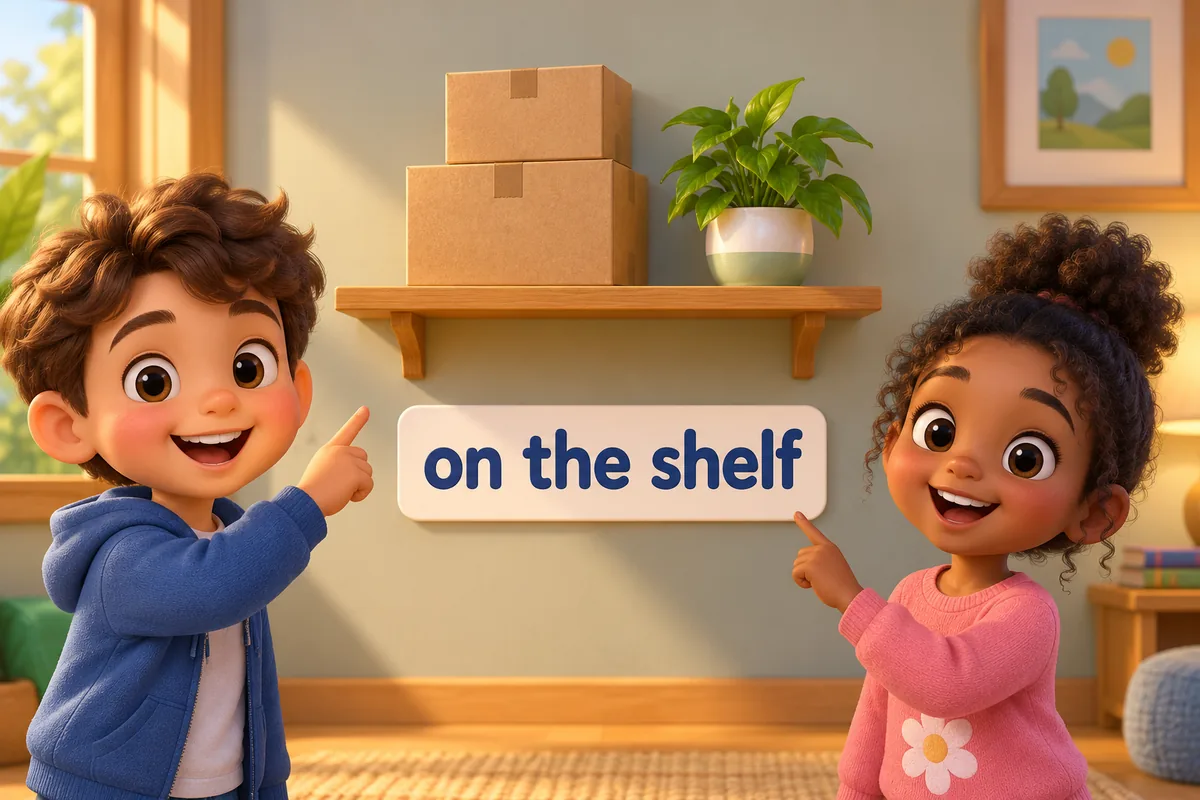
| Adjectival | Describes a noun | the book on the shelf |
| Adverbial of place | Tells where something happens | She waited at the gate. |
| Adverbial of time | Tells when something happens | We left after lunch. |
| Adverbial of manner | Tells how something happens | He spoke with patience. |
| Adverbial of reason | Tells why something happens | They cheered for the win. |
One honest limit is worth naming. A prepositional phrase cannot stand alone as a sentence, and a string of them makes a clause feel heavy. When a shorter adverb does the same job, such as here instead of at this place, the single word usually reads better.
How do you use prepositional phrases in a sentence?
Prepositional phrases attach to the word they describe, and the attachment point decides the meaning. Two phrases can sit side by side, each adding a separate layer of detail.
| Pattern | Example | What it signals |
|---|---|---|
| Preposition + noun | under the bridge | Simple place with a bare noun. |
| Preposition + determiner + noun | behind the shed | Place tied to one specific thing. |
| Preposition + pronoun | between us | The object is a pronoun, not a noun. |
| Preposition + noun + modifier | across the wide river | Extra detail inside the object. |
| Two phrases in a row | in the box on the shelf | Each phrase attaches to the one before. |
Prepositional phrases with sentences: examples across contexts
The same structure shifts its job from one kind of writing to the next, so a reason beside each line keeps the role visible.
| Context | Sentence | Why this works |
|---|---|---|
| Classroom | The poster above the board lists the rules. | An adjectival phrase describes the poster. |
| Workplace email | We will meet in the small room at noon. | Two phrases give place and time. |
| News report | The crowd gathered outside the town hall. | An adverbial phrase tells where. |
| Technical writing | Insert the bolt through the upper hole. | The phrase names the exact route. |
| Story opening | Beyond the hills lay a quiet lake. | A fronted phrase sets the scene. |
| Academic essay | The results differ across three age groups. | The phrase limits the comparison. |
| Conversation | I left the bag by the door. | A short phrase gives a quick location. |
| Instructions | Bake the cake for twenty minutes. | The phrase measures duration. |
| Letter | Thank you for your kind note. | The phrase gives a reason. |
Learners who collect phrases by topic learn them faster. A guide to how to use adjectives in sentences and phrases shows how a prepositional phrase slides in beside an adjective. A page on adjective clauses in complex sentences explains when a full clause replaces the shorter phrase.
Prepositional phrases vs adjective phrases
The two are easy to confuse because both can describe a noun, yet they are built from different heads and behave differently in a sentence.
| Feature | Prepositional phrase | Adjective phrase |
|---|---|---|
| Head word | A preposition | An adjective |
| Example | the girl in the red coat | a very happy girl |
| Typical job | Adjective or adverb | Describes a noun |
| Can it move? | Yes, if it is adverbial | Usually stays beside its noun |
| Typical slip | Dropping the object | Using it where a clause is needed |
A fuller account of adjective phrases makes the split clear, and a reference on adjectives with prepositions shows how the two combine for precision.
Word forms and grammar of prepositional phrases
Each part of the phrase has a name, and knowing the names makes it easy to see what is missing when a sentence goes wrong.
| Form | Part of speech | Example |
|---|---|---|
| Prepositional phrase | phrase | on the table |
| Preposition | preposition | on |
| Object of the preposition | noun or pronoun | the table |
| Adverbial phrase | phrase acting as an adverb | before dawn |
| Adjectival phrase | phrase acting as an adjective | with blue eyes |
Common mistakes with prepositional phrases
| Wrong | Right | Rule |
|---|---|---|
| She walked into the room. | A preposition always needs its object. | |
| the boy with blue eyes is here | The subject, not the phrase, controls the verb. | |
| We arrived at the station. | Arrive pairs with at, not to, for places. | |
| Between you and me, it failed. | A pronoun after a preposition takes object form. | |
| He is good at maths. | The adjective fixes which preposition follows. |
Practice using prepositional phrases
These exercises ask you to spot, build and repair prepositional phrases. Write each answer in a full sentence where the task asks for one.
- Underline the prepositional phrase: The cat slept under the warm blanket.
- Add a phrase of place: The students queued ____.
- Correct the error: She looked at.
- Choose the correct pronoun: This secret stays between you and (I / me).
- Build a sentence about a library using the pattern in the corner of the room.
- Decide the role: In The man with the hat waved, does the phrase describe a noun or a verb?
Answers
- under the warm blanket. It begins with a preposition and ends with its object.
- The students queued at the gate. A place phrase answers where they queued.
- She looked at the painting. The preposition needs an object, so the sentence must supply one.
- between you and me. A pronoun after a preposition uses the object form.
- The old map lay in the corner of the room. Two stacked phrases place the map precisely.
- It describes the noun man. The phrase with the hat acts as an adjective here.

The bottom line
Prepositional phrases with sentences do one steady job: they attach a preposition and its object to a word that needs more detail. Learn to name the object, because a missing object is the error that breaks the phrase. Watch the attachment point too, since the same phrase can describe a noun or a verb, and that choice changes the meaning.
Frequently asked questions about prepositional phrases
Can a prepositional phrase be the subject of a sentence?
No. A prepositional phrase describes another word and cannot carry the subject role. In under the bed is dusty, the phrase under the bed describes the place, and the real subject, something like the space, has been left out. A complete sentence needs a noun or pronoun as its subject.
How many prepositional phrases can one sentence hold?
A sentence can hold several, but two or three usually read best. Each phrase adds a layer of detail, so a long string of them makes the clause dense. When a phrase repeats a point another already made, cut it and let the shorter sentence stand.
Is a prepositional phrase the same as an adverb?
Not exactly. An adverb is a single word such as quickly or here, while a prepositional phrase is a group of words doing the same describing job. Both can tell place, time, manner or reason, so they compete for the same space in a sentence.
Why do some verbs need a fixed preposition?
Many verbs travel with a set preposition, so we arrive at a place but listen to a song and depend on a friend. The choice is not logical and rarely matches another language. Learning the pair as one unit, arrive at, is faster than learning the parts separately.