Possessive nouns show who owns or has something, usually by taking an apostrophe and an s. A singular noun adds ‘s, so the teacher’s desk marks the teacher as the owner. A regular plural ending in s adds only the apostrophe, as in the teachers’ lounge.
Possessive nouns at a glance
- Possessive nouns are nouns that show ownership, usually with an apostrophe and an s.
- A singular noun adds ‘s, as in the teacher’s book.
- A regular plural adds only the apostrophe, as in the teachers’ room.
- An irregular plural adds ‘s, as in the children’s toys.
- The commonest error is putting the apostrophe before the s in a regular plural.
What are possessive nouns?
Possessive nouns are nouns that name an owner and the thing owned in one short phrase, formed by adding an apostrophe, an s, or both. The mark does the work of the English word of but in a tighter package: the manager’s report means the report of the manager. Where the noun already ends in s as a plural, the apostrophe stands alone, so the managers’ report points to more than one manager. The four shapes below cover almost every case a learner meets.
| Type of noun | How to form it | Example |
|---|---|---|
| Singular noun | Add apostrophe and s | the teacher’s desk |
| Singular noun ending in s | Add apostrophe and s, or the apostrophe alone | the boss’s office |
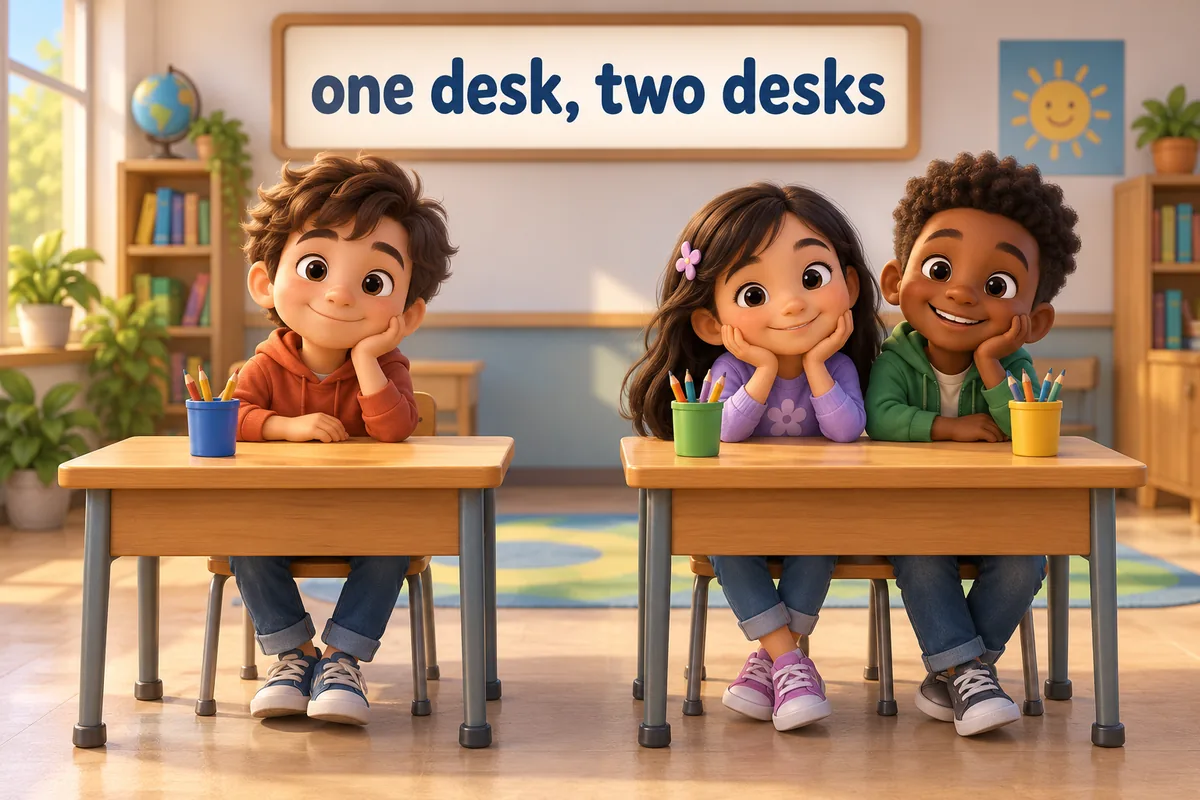
| Regular plural ending in s | Add the apostrophe after the s | the teachers’ lounge |
| Irregular plural | Add apostrophe and s | the children’s books |
| Name ending in s | Add the apostrophe, with an optional s | James’ coat |
Two details cause most of the trouble, and both are visible on the page rather than in speech. Possessive nouns differ from possessive pronouns, which never take an apostrophe, so its collar and the dog’s collar express the same ownership in different machinery. The apostrophe also changes nothing about how the noun sounds, which is why the rule has to be learned from writing and not from the ear. An honest limit sits here too: a possessive noun is the wrong tool for most objects, and the of pattern reads better for them.
How do you use possessive nouns in a sentence?
Possessive nouns sit in front of the noun they describe, and the position of the apostrophe tells the reader whether the owner is one person or many. The pattern stays steady across registers, though the of phrase sounds more natural with things than with people.
| Pattern | Example | What it signals |
|---|---|---|
| Singular noun + ‘s | the dog’s bone | One owner holds the thing. |
| Regular plural + s’ | the dogs’ bones | More than one owner shares it. |
| Irregular plural + ‘s | the men’s coats | A plural with no s still takes ‘s. |
| Possessive pronoun | its collar | Ownership without any apostrophe. |
| Of phrase | the roof of the house | Possession expressed with a preposition. |
Possessive nouns in a sentence: examples across contexts
The same rule appears in very different writing, and seeing it beside a reason makes the apostrophe position easier to keep straight.
| Context | Sentence | Why this works |
|---|---|---|
| Classroom | The principal’s announcement quieted the hall. | A singular noun takes ‘s before the thing owned. |
| Family note | The children’s boots dried by the stove. | An irregular plural adds ‘s because it has no s. |
| Workplace email | Please file the clients’ invoices by Friday. | A regular plural puts the apostrophe after the s. |
| News report | The mayor’s office confirmed the schedule. | The owner is one public figure. |
| Recipe card | Stir in the onions’ juice before serving. | Even object nouns can take a possessive. |
| Academic essay | The authors’ findings matched earlier work. | Plural authorship shifts the apostrophe right. |
| Shop sign | Sam’s Barbers opens at nine. | A shop name carries a possessive as a fixed label. |
| Conversation | The team’s bus left without us. | A collective noun is treated as one owner. |
| Letter | Your sister’s letter arrived this morning. | Family members take ‘s like any singular noun. |
Building a bank of examples speeds up learning. A wall chart of nouns that start with c gives children concrete owners such as the captain’s whistle. A nouns that start with d list adds the doctor’s coat and the driver’s seat. A nouns that start with e page supplies the engineer’s plan and the explorer’s map. A nouns that start with f set completes the pattern with the farmer’s field and the florist’s ribbon.
Possessive nouns vs possessive pronouns
Readers mix these two because both show ownership, yet they follow opposite habits with the apostrophe. A pronoun never borrows the mark, while a noun almost always does.
| Feature | Possessive noun | Possessive pronoun |
|---|---|---|
| Form | Adds an apostrophe to a noun | Has no apostrophe at all |
| Example | Maya’s violin | Her violin |
| Standing alone | Cannot stand without its noun | Can stand alone: that violin is hers |
| Typical slip | teachers instead of teachers’ | it’s instead of its |
| Position | Directly before the noun | Before the noun or alone as a subject |
The verdict is short: put the apostrophe on the noun that owns something and leave the pronoun bare.
Word forms and grammar of possessive nouns
Possessive nouns belong to a small set of related forms, and telling them apart keeps the apostrophe in the right place.
| Form | Part of speech | Example |
|---|---|---|
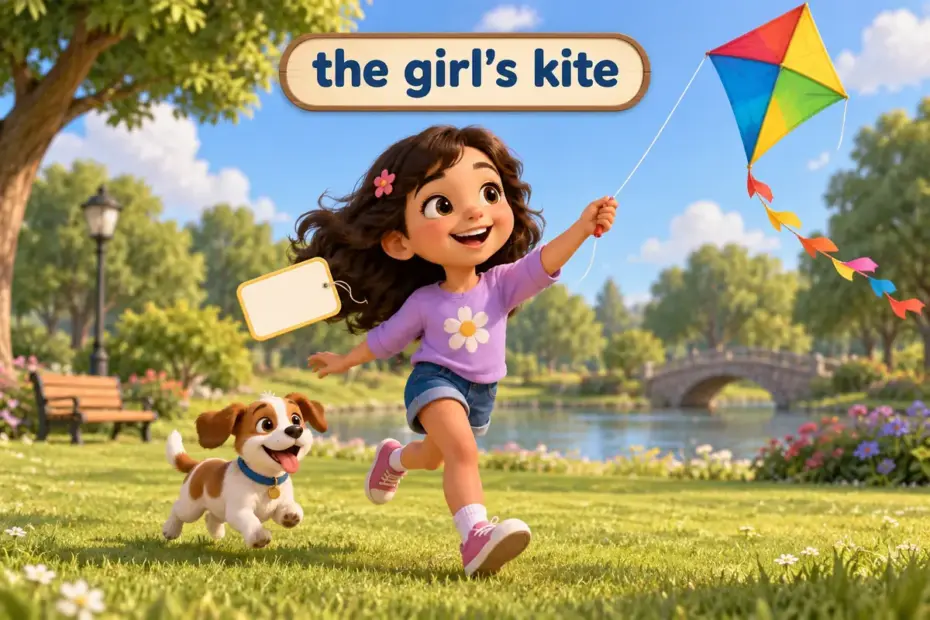
| Possessive noun | noun with a possessive ending | the girl’s kite |
| Plural possessive noun | plural noun with an ending | the girls’ kites |
| Possessive pronoun | pronoun | That kite is hers. |
| Possessive determiner | determiner | her kite |
| Of phrase | prepositional phrase | the kite of the girl |
Common mistakes with possessive nouns
| Wrong | Right | Rule |
|---|---|---|
| The dog wagged its tail. | Its shows ownership; it’s means it is. | |
| All the students’ bags were here. | A plural owner puts the apostrophe after the s. | |
| The children’s toys were packed. | Irregular plurals add ‘s because they lack an s. | |
| The roof of the house leaked. | Objects usually take an of phrase instead. | |
| That book is hers. | Possessive pronouns never take an apostrophe. |
Practice using possessive nouns
These exercises move from recognition to production. Rewrite each item so the ownership is clear, or choose the form the sentence needs.
- Rewrite: the tail of the cat was fluffy.
- Rewrite: the lockers of the students were empty.
- Choose the correct form: The (dog’s / dogs’) owner called twice. One owner only.
- Correct the error: The girls’s bracelets matched.
- Build a sentence about a school trip using the pattern the team’s coach.
- Choose the form that fits an email: We reviewed the (client’s / clients’) files, and there were three clients.
Answers
- The cat’s tail was fluffy. A singular noun takes ‘s before the thing owned.
- The students’ lockers were empty. A regular plural puts the apostrophe after the s.
- The dog’s owner called twice. One owner means a singular possessive, so ‘s comes before the noun.
- The girls’ bracelets matched. The plural already ends in s, so the apostrophe goes after it.
- The team’s coach checked the bus. A collective noun is treated as a single owner and takes ‘s.
- We reviewed the clients’ files. Three clients make a regular plural, so the apostrophe follows the s.
The bottom line
Possessive nouns mark ownership with an apostrophe, and the only real decision is where that apostrophe goes. Put ‘s on a singular noun and on any plural that lacks an s, and put the apostrophe after the s for a regular plural. Keep the mark off pronouns, and reach for an of phrase when the owner is an object rather than a person.
Frequently asked questions about possessive nouns
Is a plural possessive ever written with the apostrophe before the s?
Yes, whenever the plural does not end in s. Children becomes children’s and men becomes men’s, so the apostrophe comes before the added s. For regular plurals such as teachers, cats or keys, the s is already present and the apostrophe follows it, giving teachers’, cats’ and keys’.
How do I make a possessive from a name that ends in s?
Add an apostrophe, and add a second s only when you would say it aloud. James’ coat and James’s coat are both accepted, and the choice comes down to the sound of the name in your sentence. The apostrophe itself is never optional.
Do possessive nouns always need an apostrophe?
Almost always. The apostrophe is what turns a plain noun into a possessive noun, so dropping it changes the meaning from the report of the manager to a report about managers. The only nouns that show ownership without one are possessive pronouns such as hers, ours and theirs.
What is the difference between its and it’s?
Its shows ownership and takes no apostrophe, as in the cat licked its paw. It’s is a contraction of the two words it is or it has, as in it’s cold today. Because both sound identical, the apostrophe is the only signal a reader has.