
The present continuous tense describes an action happening at the moment of speaking or around the present time. It is built from a form of be and a verb ending in ing, so “she is reading” shows the reading in progress. The tense also covers temporary situations and arranged future plans.
Present continuous tense at a glance
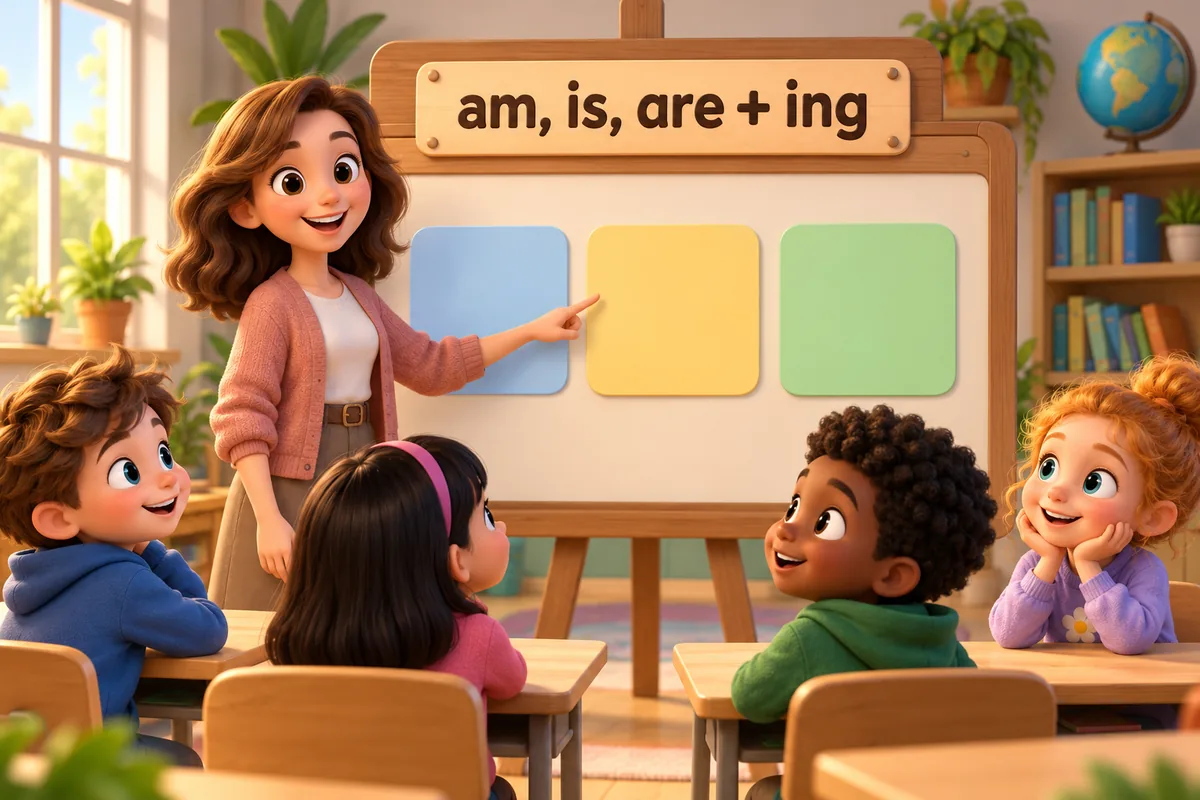
- The present continuous tense uses am, is or are plus a verb ending in ing.
- It describes an action happening now, as in they are playing.
- It also covers temporary situations, as in I am staying with a friend.
- It can mark a fixed future plan, as in we are meeting at six.
- The commonest error is using it with state verbs such as know or believe.
What is the present continuous tense?
The present continuous tense is a verb form that shows an action in progress, usually at or around the time of speaking. The helper verb am, is or are carries the tense, and the main verb adds ing. Because the action is unfinished, the tense suits anything still unfolding, from a child running now to a project running all week.
| Use | Example | Why the tense fits |
|---|---|---|
| Action happening now | She is cooking dinner. | The cooking is in progress. |
| Temporary situation | They are living in Bristol. | The arrangement is not permanent. |
| Changing situation | The days are getting longer. | The change is ongoing. |
| Fixed future plan | We are flying on Friday. | The plan is already arranged. |
| Repeated annoyance | He is always losing his keys. | The habit irritates the speaker. |
One honest limit belongs here. State verbs such as know, believe, love and own describe conditions rather than actions, so they normally stay in the simple form. Saying I am knowing the answer sounds wrong even though the meaning is clear, and the simple present is the correct choice.
How do you form the present continuous tense?
The tense has one steady shape: the correct form of be, followed by the main verb with ing. Only the helper verb changes, and it changes to match the subject.
| Subject | Helper verb | Full example |
|---|---|---|
| I | am | I am walking. |
| He, she, it | is | She is walking. |
| You, we, they | are | They are walking. |
| Negative | be plus not | He is not walking. |
| Question | be before the subject | Are they walking? |
Present continuous tense examples across contexts
The tense appears in every register, and each sentence below shows a different reason for choosing it.
| Context | Sentence | Why this works |
|---|---|---|
| Classroom | The pupils are writing quietly. | The action is happening now. |
| Workplace email | We are updating the schedule today. | A temporary task in progress. |
| News report | Rain is falling across the county. | An ongoing weather event. |
| Phone call | I am cooking, so I will call back. | The speaker is busy at this moment. |
| Story opening | The wind is howling through the trees. | The scene unfolds as it is told. |
| Academic note | The numbers are rising each year. | A change still in progress. |
| Travel plan | They are leaving in the morning. | A fixed arrangement. |
| Complaint | She is always interrupting me. | A repeated habit that annoys. |
| Recipe | The sauce is simmering gently. | The process is under way. |
Examples land better when the topic is familiar. A set of continuous sentence models gives extra practice with the ing form, and a page of tense sentence work shows how the form compares with the simple present.
Present continuous vs present simple
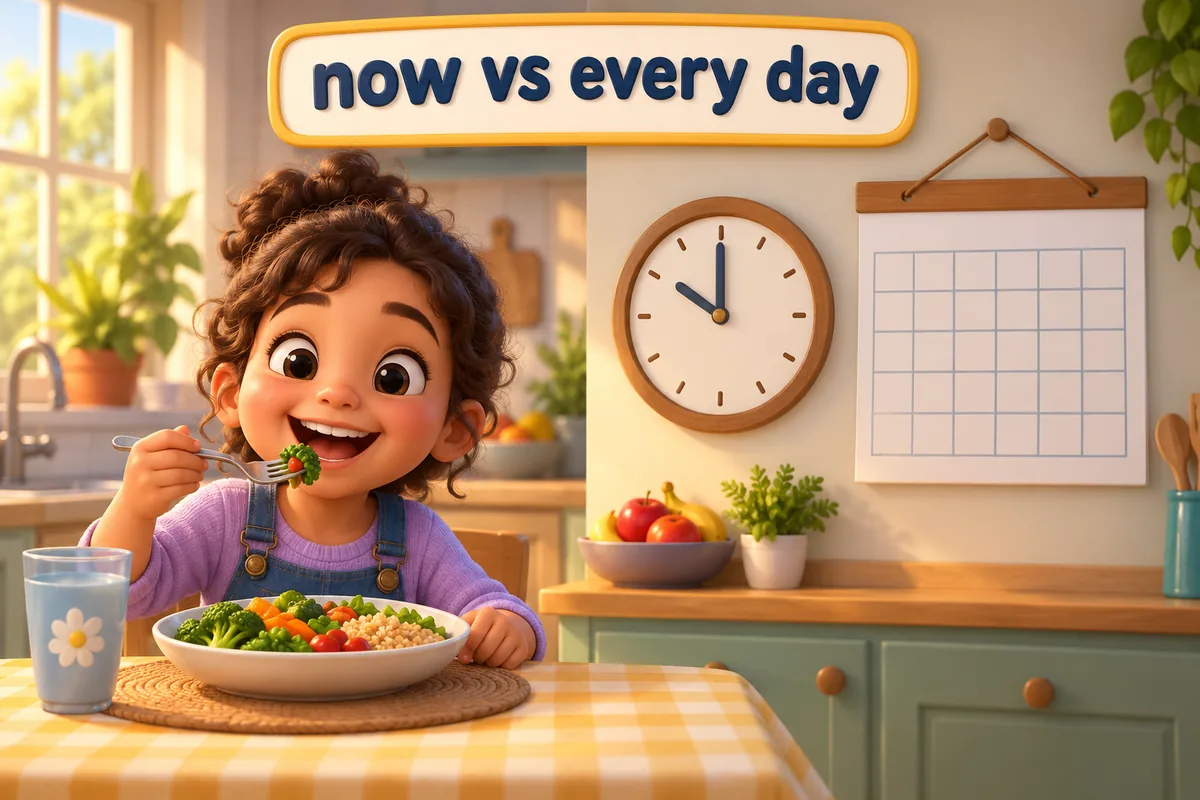
The two tenses split the present between now and always, and choosing between them is the decision learners face most often.
| Feature | Present continuous | Present simple |
|---|---|---|
| Time focus | Happening now or around now | Happening always or in general |
| Example | He is eating lunch. | He eats lunch at noon. |
| State verbs | Avoided with know or own | Preferred with know or own |
| Future use | Marks fixed plans | Marks timetables |
| Signal words | now, at the moment, today | always, usually, every day |
Phrases such as at present and for the present both point to the current moment and often sit beside the continuous form.
Word forms and grammar of the ing verb
The spelling of the ing form follows a small set of rules, and the exceptions are worth memorising.
| Verb ending | Change | Example |
|---|---|---|
| Most verbs | Add ing | play, playing |
| Silent e | Drop the e, add ing | write, writing |
| One vowel plus consonant | Double the consonant | run, running |
| Ends in ie | Change ie to y, add ing | lie, lying |
| Ends in ee | Add ing unchanged | see, seeing |
Common mistakes with the present continuous tense
| Wrong | Right | Rule |
|---|---|---|
| I know the answer. | State verbs stay in the simple form. | |
| She is running down the hill. | The main verb always takes ing. | |
| They are playing football. | The helper be is followed by the ing form. | |
| He is waiting outside. | The helper verb agrees with the subject. | |
| See you tomorrow, I am going to the fair. | A fixed plan uses the continuous, not the base form. |
Practice using the present continuous tense
These exercises test the form and the choice between the two present tenses. Write a full sentence for each answer.
- Fill the gap: The children ____ (play) in the yard right now.
- Fill the gap: My sister ____ (study) for her test this week.
- Correct the error: They is watching a film.
- Choose the tense: I (am believing / believe) your story.
- Build a sentence about a train using the temporary situation pattern.
- Change to a question: She is helping her father.
Answers
- The children are playing in the yard right now. The plural subject takes are plus the ing form.
- My sister is studying for her test this week. A temporary situation suits the continuous.
- They are watching a film. The plural subject takes are, not is.
- I believe your story. Believe is a state verb, so it stays in the simple present.
- The train is stopping at every station today. The temporary timetable suits the continuous.
- Is she helping her father? A question moves the helper verb before the subject.
The bottom line
The present continuous tense marks an action in progress, and the formula am, is or are plus ing carries it in every sentence. Choose it for what happens now, for temporary arrangements and for fixed future plans. Switch to the present simple for habits and for state verbs such as know, because those conditions do not unfold moment by moment.
Frequently asked questions about the present continuous tense
Can the present continuous tense refer to the future?
Yes, when the plan is already arranged. We are meeting the manager at ten means the meeting is fixed, not merely intended. The forward-looking use of the continuous signals a settled arrangement, while will and going to suit decisions made at the moment of speaking.
Is the present continuous the same as the progressive?
They are two names for the same tense. Progressive is the term used in many grammar books, and continuous is the more common label in teaching materials for learners. The form and every rule are identical, so either name points to the same am, is or are plus ing pattern.
Which verbs are never used in the continuous form?
State verbs that describe thoughts, feelings or possession rarely take the ing form. Know, believe, want, love, own and belong are common examples. Some of them shift meaning when the continuous is used, so think about is fine but believe about is not.
What time words suit the present continuous tense?
Now, right now and at the moment point to action in progress and pair naturally with the tense. Today, this week and these days suit temporary situations. Always with the continuous suggests a habit that annoys the speaker, as in he is always forgetting his pass.