
Quick answer: Use work-related adjectives such as reliable, adaptable, collaborative, or thorough to describe an employee. In a review, pair the word with an observable example and its effect. In a job description or resume, choose terms that fit the role and support them with clear evidence.
Positive Adjectives for Employees: Quick List
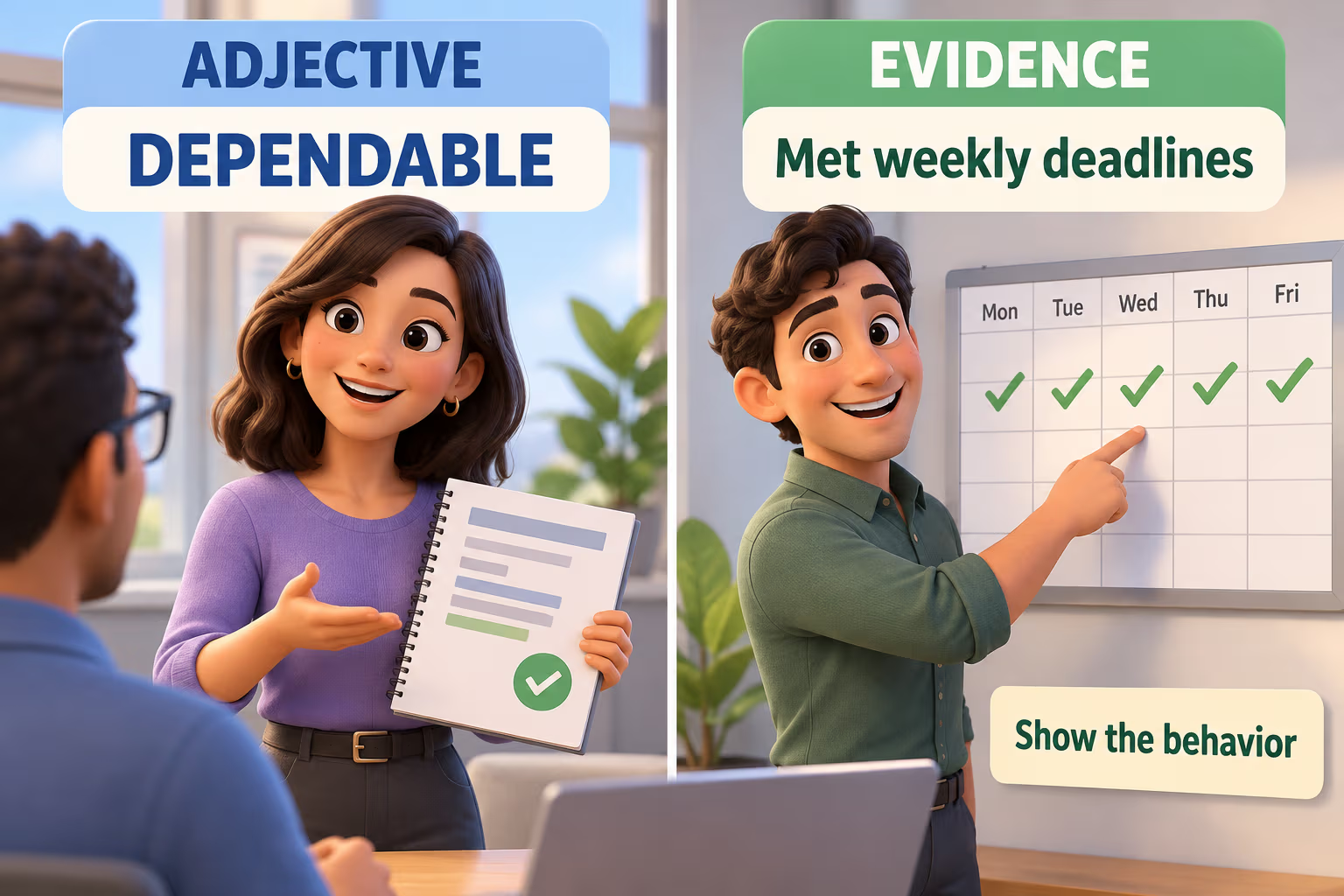
Choose a word that matches a work habit, skill, or result—not a guess about someone’s personality. The examples below are a starting point. A quality can matter differently across roles, so connect each description to the duties and expectations of the job.
| Quality | Adjectives | Evidence-based example |
|---|---|---|
| Reliability | dependable, reliable, accountable, consistent | “Consistently sent the weekly report before the agreed deadline.” |
| Work quality | accurate, thorough, meticulous, detail-oriented | “Checked the final order against the source list and corrected missing fields.” |
| Initiative | proactive, resourceful, curious, self-directed | “Flagged a missing approval early and suggested who could resolve it.” |
| Teamwork | collaborative, cooperative, supportive, considerate | “Shared a clear handoff so the next shift could continue the task.” |
| Communication | clear, concise, responsive, tactful | “Summarized the decision, owner, and next deadline after the meeting.” |
| Adaptability | adaptable, flexible, versatile, resilient | “Reordered the work when the project deadline changed.” |
| Leadership | decisive, encouraging, empathetic, strategic | “Asked for the team’s constraints before assigning the revised plan.” |
O*NET groups work-style descriptors such as dependability, attention to detail, cooperation, adaptability, initiative, and integrity, and provides occupation-level ratings rather than one universal list. Use those categories as vocabulary prompts, not as a substitute for role-specific evidence; see the U.S. Department of Labor’s O*NET Work Styles.
How to Describe an Employee With Clear Evidence
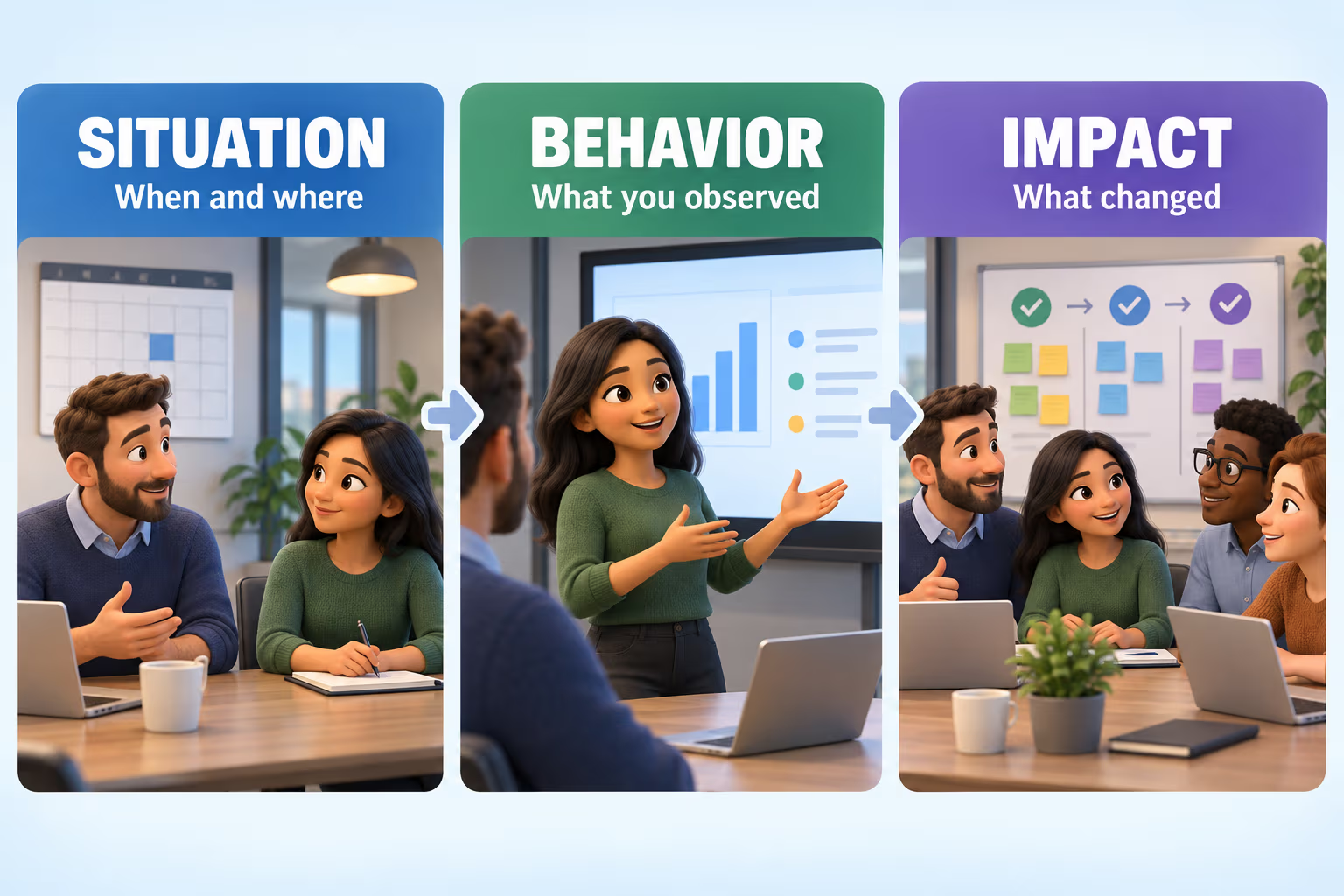
A positive adjective can recognize a strength, but a label by itself is hard to act on. Explain what happened, what the employee did, and why it mattered. The Center for Creative Leadership’s Situation–Behavior–Impact (SBI) model uses those three parts to keep feedback specific and focused on observable behavior.
- Situation: Name when and where the example occurred.
- Behavior: Describe the action someone could observe, without guessing at intent.
- Impact: State the result you can verify, such as clearer handoffs or a completed task.
Illustrative example: “During Tuesday’s project handoff, Jordan listed the open questions and assigned owners, so the next shift could continue without repeating the review.” This sentence shows why a manager might call Jordan organized or collaborative. Use a real event and a verified effect when writing about an actual employee; do not copy the sample as a claim about someone.
The U.S. Office of Personnel Management advises that performance standards be objective, measurable, realistic, and clearly stated. Its guidance identifies quality, quantity, and timeliness as common measures. For feedback examples, OPM also recommends specific, actionable comments and illustrates the Situation–Behavior–Impact model in its employee performance quick guide. The Center for Creative Leadership explains the SBI feedback model in more detail.
Adjectives for Performance Reviews and Recognition
For a review, choose a descriptor that matches an agreed expectation and the employee’s work during the review period. Words such as accurate, responsive, dependable, or collaborative become meaningful when you include a specific example. Distinguish a repeated pattern from a single incident, and identify any support, training, or next step that would help.
For recognition, name the contribution rather than offering only a broad compliment: “Your careful check caught the duplicate invoice before payment” explains what was thorough. When an outcome is measurable, use the real figure and its time period. Do not invent a number or imply that a result came from one employee if the work was shared.
For concerns, describe the work and expectation in neutral language. Instead of “You’re careless,” a manager might say, “Two submitted forms were missing the required account number; let’s use the checklist on the next batch.” Instead of “lazy,” describe the agreed task, what was or was not completed, and any blocker to resolve. These examples are illustrative; adapt them to documented facts and the organization’s process.
Adjectives for Job Descriptions and Resumes
In a job description, use adjectives only when they clarify a duty or a work condition. “Detail-oriented” is more useful when the posting explains the checks the role performs; “fast-paced” should describe a real feature of the work, not appear as filler. Connect screening criteria to job duties and relevant competencies, and apply them consistently. The EEOC’s employer guidance recommends objective, job-related standards based on duties, functions, and competencies.
On a resume, do not rely on a string of traits such as “hardworking, motivated, and reliable.” Support one relevant adjective with an accomplishment: “Maintained accurate inventory records by reconciling weekly counts and documenting discrepancies.” Tailor the example to the job, and include results only when they are true and supportable.
For related word lists, see our guides to adjectives for a job, adjectives for teamwork, adjectives for communication, and describing coworkers.
When to Use Neutral or Constructive Adjectives
Not every useful workplace adjective is praise. Terms such as inconsistent, reserved, hesitant, unresponsive, or inflexible may describe a pattern, but they can sound like fixed judgments when left unexplained. Define the behavior, show the relevant example, and say what change or support is needed. A quiet communication style, for example, is not automatically a performance problem; describe the job expectation that was or was not met.
Words such as assertive, ambitious, cautious, and independent can be helpful or unhelpful depending on the task. A cautious review may prevent an error in safety-critical work, while the same approach may slow a time-sensitive decision. Explain the context instead of treating any trait as universally good or bad.
When describing employees or comparing applicants, focus on relevant work and apply expectations consistently. The EEOC recommends analyzing job duties and competencies and establishing objective, job-related criteria; see its best practices for employers.
When it comes to describing employees, finding the right words can make all the difference. Whether you’re writing a performance review, crafting a job description, or simply trying to articulate the qualities that make a great team member, having a strong vocabulary of adjectives is essential. In this article, I’ll share a comprehensive list of adjectives that can be used to describe employees, along with examples of how to use them effectively. From dependable and diligent to innovative and adaptable, these words will help you paint a vivid picture of your team’s strengths and contributions. So let’s dive in and explore the power of descriptive words when it comes to evaluating and celebrating our employees.
As a manager or HR professional, it’s important to have a robust toolkit of adjectives to accurately describe your employees’ qualities and performance. By using specific and impactful words, you can provide valuable feedback, inspire growth, and recognize achievements. In this article, I’ll provide you with a wide range of adjectives that can be used to describe employees, from their work ethic and communication skills to their creativity and problem-solving abilities. Whether you’re writing a performance evaluation or crafting a job advertisement, these descriptive words will help you effectively communicate the unique strengths and qualities of your team members. So let’s get started and explore the power of adjectives in capturing the essence of our employees.
How to Describe employees? – Different Scenarios
When it comes to describing employees, using the right adjectives is crucial. It not only helps you accurately convey their qualities and performance but also highlights their unique strengths. Whether you’re writing a performance review, crafting a job description, or providing valuable feedback, here are some tips on how to describe employees in different scenarios:
1. Performance Reviews:
During performance reviews, it’s important to provide a comprehensive evaluation of an employee’s performance. Here are some adjectives that you can use to describe their strengths, skills, and achievements:
| Adjectives | Examples |
|---|---|
| Dependable | John consistently meets deadlines and delivers high-quality work. |
| Creative | Sarah always comes up with innovative solutions to complex problems. |
| Collaborative | Emily works well with others and fosters a positive team environment. |
| Proactive | Mark takes initiative and goes above and beyond in his role. |
| Adaptable | Jennifer quickly adjusts to changing circumstances and priorities. |
Remember, be specific and provide evidence to support your claims. This helps employees better understand their strengths and areas for improvement.
2. Job Descriptions:
When creating job descriptions, it’s important to use adjectives that accurately describe the qualities and skills required for the role. This helps attract suitable candidates and ensures a good fit. Here are some adjectives that you can use:
- Detail-oriented
- Analytical
- Customer-focused
- Self-motivated
- Excellent communication skills
These adjectives offer a clear understanding of the expectations and requirements for the role.
3. Recognition and Appreciation:
Recognizing and appreciating employees’ achievements is vital for their motivation and growth. Here are some impactful adjectives you can use when recognizing their accomplishments:
- Outstanding
- Exceptional
- Remarkable
- Dedicated
- Valuable contributor
By using such adjectives, you not only acknowledge their efforts but also inspire them to continue performing at their best.
4. Teamwork and Collaboration:
When describing employees’ teamwork and collaboration skills, it’s important to use adjectives that highlight their ability to work well with others and contribute to the overall success of the team. Some examples include:
- Supportive
- Committed
- Cooperative
- Effective communicator
- Team player
Describing Words for employees in English
When it comes to describing employees, using the right adjectives is crucial. These words not only help paint a clear picture of an employee’s qualities and achievements but also play a significant role in attracting suitable candidates, recognizing achievements, and highlighting teamwork and collaboration skills. In this section, I will discuss some effective describing words for employees, along with examples of how to use them accurately.
Positive Describing Words
- Dedicated: This word describes an employee who is committed, focused, and consistently puts in effort to achieve their goals. For instance, “John is a dedicated employee who always goes the extra mile to ensure customer satisfaction.”
- Innovative: Use this word to describe an employee who brings fresh perspectives and ideas to the table. For example, “Emily’s innovative thinking has led to several successful projects.”
- Reliable: This adjective is used to describe employees who can be depended on to deliver high-quality work consistently. You can say, “Sarah is a reliable employee who always meets deadlines without compromising on quality.”
Negative Describing Words
- Inflexible: This word describes an employee who is resistant to change or unwilling to adapt. For instance, “Tom’s inflexible approach makes it challenging to introduce new processes.”
- Lackluster: Use this word to describe an employee who lacks enthusiasm or effort in their work. For example, “Jim’s lackluster performance is reflected in the declining sales figures.”
- Unorganized: This adjective is used to describe employees who struggle with managing their tasks and maintaining order. You can say, “Kate’s unorganized work habits often lead to delays in project completion.”
- Collaborative: This word describes employees who work well with others, contribute ideas, and actively participate in team efforts. For instance, “Maria is a collaborative team member who ensures everyone’s opinions are heard and valued.”
- Supportive: Use this word to describe employees who provide assistance and encouragement to their colleagues. For example, “Eric is always supportive and offers help whenever a team member faces challenges.”
- Adaptable: This adjective is used to describe employees who can adjust to changing circumstances and work effectively in different team dynamics. You can say, “Alex’s adaptable nature makes him an asset to any team, as he easily adjusts to new situations.”
Adjectives for employees
As a teacher, I understand the importance of using the right words to describe employees. Whether it’s in a performance review, a job description, or simply recognizing their achievements, the adjectives we choose make a difference. They can motivate, inspire, and set expectations. In this section, I will provide you with positive and negative adjectives that can accurately describe employees, along with example sentences.
List-placement clarification: Collaborative, supportive, and adaptable are generally positive descriptions of workplace behavior. They are not negative adjectives in ordinary usage, although any quality can have limits depending on the role and context.
Positive Adjectives for Employees
- Dedicated: My coworker is always committed to completing tasks on time.
- Dependable: I can always count on my team member to deliver high-quality work.
- Efficient: She consistently finds ways to streamline processes and increase productivity.
- Innovative: John’s creative thinking often leads to unique solutions for our company.
- Motivated: She is always willing to go the extra mile to achieve success.
- Reliable: He is someone I can trust to get the job done right.
- Versatile: Our team member is skilled in various areas, making her a valuable asset.
- Adaptable: In challenging situations, he quickly adjusts and finds solutions.
- Passionate: Our colleague’s enthusiasm for the project is contagious.
- Proactive: She takes initiative and anticipates problems before they arise.
- Resourceful: He consistently finds creative solutions in limited circumstances.
- Team-player: She actively collaborates and supports others in achieving common goals.
- Unreliable: He consistently fails to deliver on his responsibilities.
- Inefficient: She often takes longer than necessary to complete tasks.
- Inflexible: My colleague is resistant to change and unwilling to adapt.
- Unmotivated: He lacks enthusiasm and shows little drive to excel.
- Disorganized: She frequently struggles to keep track of her assignments.
Remember, it’s important to be specific and provide evidence to support these claims. Let’s make sure our descriptions accurately reflect the qualities and achievements of our employees.
Synonyms and Antonyms with Example Sentences
Synonyms for employees
When describing employees, it’s important to use a variety of adjectives to accurately showcase their qualities and achievements. Here are some synonyms for employees that you can use:
- Staff
- Workers
- Team members
- Colleagues
- Associates
Use these synonyms to add depth and diversity to your descriptions. For example:
Word-choice note: Staff, workers, team members, colleagues, and associates are related nouns, not exact substitutes in every sentence. Staff often refers to a group, colleagues to people one works with, and associates can be a formal or role-specific title. Choose the noun that fits the relationship.
- Staff: The dedicated staff at our company ensures smooth operations and excellent customer service.
- Workers: The hardworking workers on our construction site have completed the project ahead of schedule.
- Team members: Our team members collaborate seamlessly, resulting in innovative solutions to complex problems.
- Colleagues: I am fortunate to work with talented colleagues who inspire and motivate me every day.
- Associates: Our associates bring valuable expertise and contribute to the success of our organization.
Antonyms for employees
On the other hand, when describing employees, it’s also important to be aware of antonyms or opposite words that indicate negative qualities or behaviors. Here are some antonyms for employees:
Word-class clarification: Incompetent, lazy, unreliable, disorganized, and neglectful are adjectives that can describe a person or behavior; they are not antonyms of the noun employee. Employer names the other party in an employment relationship, but it is a role contrast rather than a universal opposite. Keep the heading’s words as a vocabulary list, not as dictionary antonyms.
- Incompetent
- Lazy
- Unreliable
- Disorganized
- Neglectful
Be cautious when using these antonyms, as it’s essential to provide constructive feedback rather than criticize. Here are a few examples to illustrate the use of these antonyms:
- Incompetent: Unfortunately, the new hire turned out to be highly incompetent and unable to meet the job requirements.
- Lazy: Some employees have been consistently displaying lazy behavior, failing to meet deadlines and deliver results.
- Unreliable: It’s challenging to work with unreliable employees who frequently miss meetings and fail to fulfill their commitments.
- Disorganized: The disorganized employee often struggles to keep track of important tasks, resulting in delays and errors.
- Neglectful: The neglectful behavior of certain employees has led to poor customer service and negative feedback.
Remember to use these antonyms sparingly and in appropriate contexts. It’s important to focus on constructive criticism and improvement rather than simply highlighting negative traits.
By incorporating a diverse range of synonyms and antonyms into your descriptions, you can provide a comprehensive and accurate portrayal of employees’ qualities and achievements.
Conclusion
Using the right adjectives when describing employees is crucial in accurately showcasing their qualities and achievements. Throughout this article, we have explored a range of synonyms and antonyms for employees, along with example sentences, to help you effectively describe your team members.
By incorporating these adjectives sparingly and in appropriate contexts, we can provide constructive criticism and encourage improvement, rather than simply highlighting negative traits. It is important to remember that our goal is to create a comprehensive and accurate portrayal of employees’ qualities and achievements.
Whether you are writing a performance review, crafting a job description, or simply providing feedback, choosing the right adjectives can make a significant impact. By utilizing a diverse range of synonyms and antonyms, we can ensure that our descriptions are well-rounded and provide a holistic view of our employees’ abilities.
Remember, the words we choose have the power to inspire, motivate, and recognize the hard work and dedication of our team members. So, take the time to choose your adjectives wisely and create descriptions that truly reflect the talents and contributions of your employees.
Frequently Asked Questions
What are positive adjectives for employees?
Useful positive adjectives include dependable, accurate, collaborative, adaptable, resourceful, responsive, thoughtful, and thorough. Choose a word that fits the role and support it with an example of work. “Dependable” is clearer when a review explains which agreed deadlines or handoffs the employee met.
How do I describe an employee’s strengths in a review?
Name the strength, describe a specific action, and explain a result you can verify. For example, “organized” might be supported by a clear project tracker that helped the team see owners and due dates. Use examples from the review period and connect them to the employee’s responsibilities.
What are constructive adjectives for an employee?
Words such as inconsistent, hesitant, or unresponsive may describe a work pattern, but they are not complete feedback by themselves. State the relevant expectation, give a recent observable example, and identify a useful next step. Avoid guessing about a person’s motives or treating one incident as a permanent trait.
Are “lazy” and “incompetent” antonyms of “employee”?
No. “Lazy” and “incompetent” are adjectives sometimes used to criticize a person; they are not opposites of the noun “employee.” “Employer” is a role on the other side of an employment relationship. For workplace feedback, describe the observed work and the expectation instead of relying on a personal label.
How can I describe an employee without sounding judgmental?
Use neutral, job-related language and refer to behavior that can be observed. Explain the situation, what happened, and the impact; then discuss expectations or support. This keeps the description specific and gives the employee something concrete to understand or act on, unlike a label such as “careless.”


