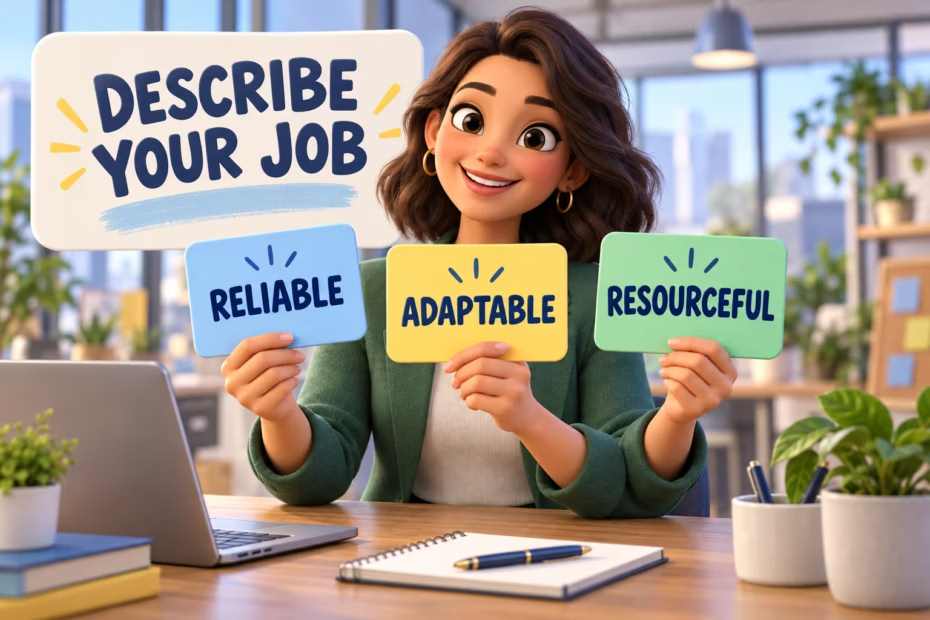
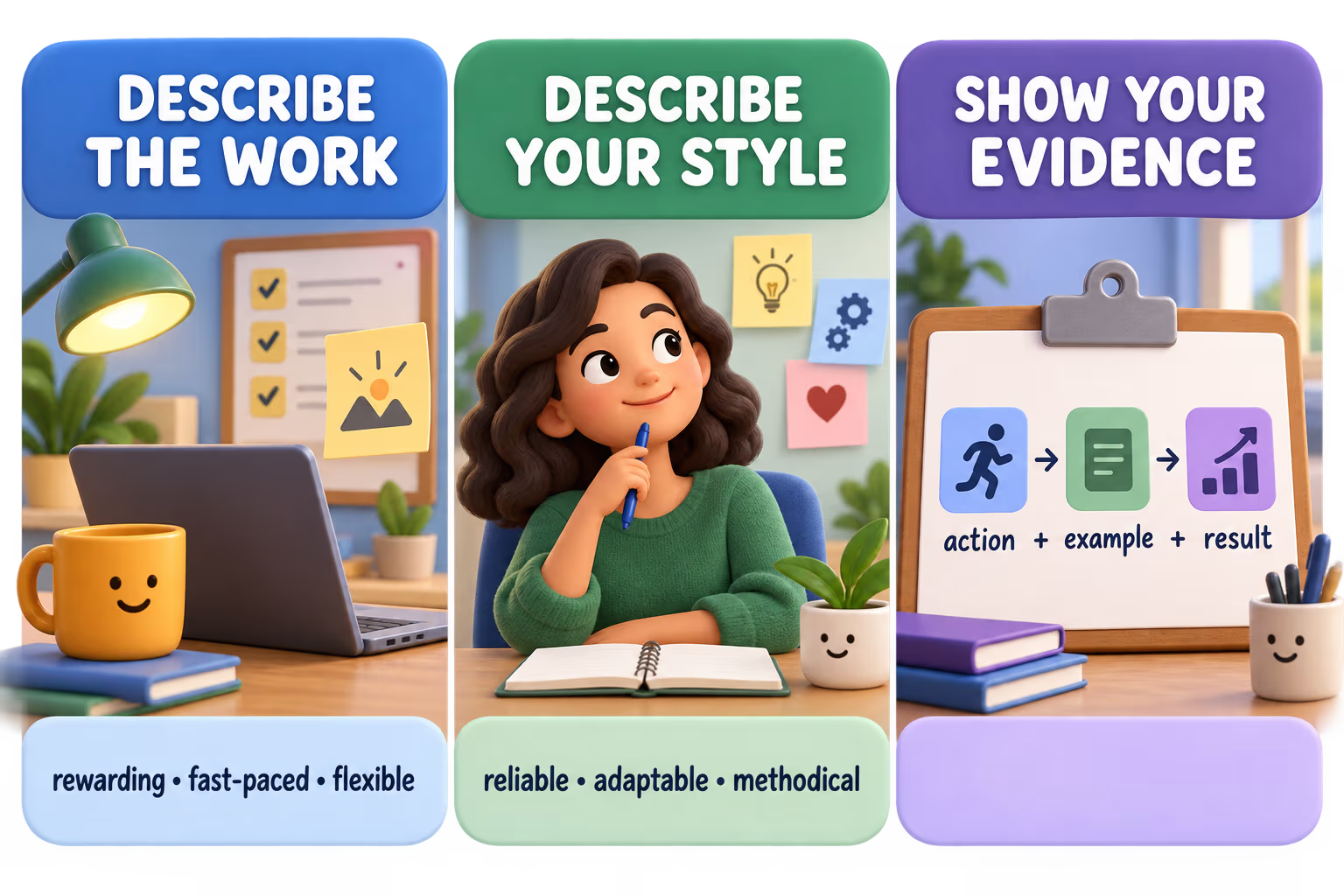
Useful adjectives for a job describe either the work itself—such as demanding, rewarding, or fast-paced—or a worker’s approach—such as reliable, adaptable, or methodical. Choose terms that fit the role, and support a claim about yourself with a concrete task, result, or example; a positive adjective alone does not prove a skill.
At a Glance
- Use adjectives such as fast-paced or demanding to describe the work and its conditions.
- Use reliable, adaptable, or methodical to describe a person’s work style.
- Choose words that match the specific role and the reader’s question.
- On a resume, pair a quality claim with a specific action and a truthful example or result.
- A neutral or challenging job description can be accurate; avoid unsupported praise or criticism.
Which Adjectives Describe a Job?
Choose the adjective by what you are describing: the duties and conditions of the role, the skills it requires, or a person’s work habits. The table separates those meanings so a word describing a job is not mistaken for evidence about an employee.
| What you mean | Useful adjectives | Example |
|---|---|---|
| The work and its conditions | fast-paced, demanding, flexible, repetitive, rewarding | “It is a fast-paced customer-support role.” |
| The knowledge or task type | technical, analytical, creative, client-facing, detail-heavy | “The position is analytical and data-focused.” |
| A person’s work style | reliable, adaptable, methodical, collaborative, resourceful | “She is a methodical project coordinator.” |
How Do You Use Adjectives on a Resume?
Use a resume adjective only when the experience section gives a specific reason to believe it. Career guidance from Harvard’s Mignone Center for Career Success recommends specific, active, clear, fact-based language tailored to the position; CareerOneStop advises connecting responsibilities to context and outcomes, using numbers where possible.
Example only: Instead of writing only “detail-oriented,” describe the action: “Reviewed invoices carefully and flagged mismatches before payment.” Replace that sample with a truthful example from your own work, school, volunteer, or project experience. The U.S. Office of Personnel Management describes accomplishment statements through the situation, action, and result, with details that can be verified.
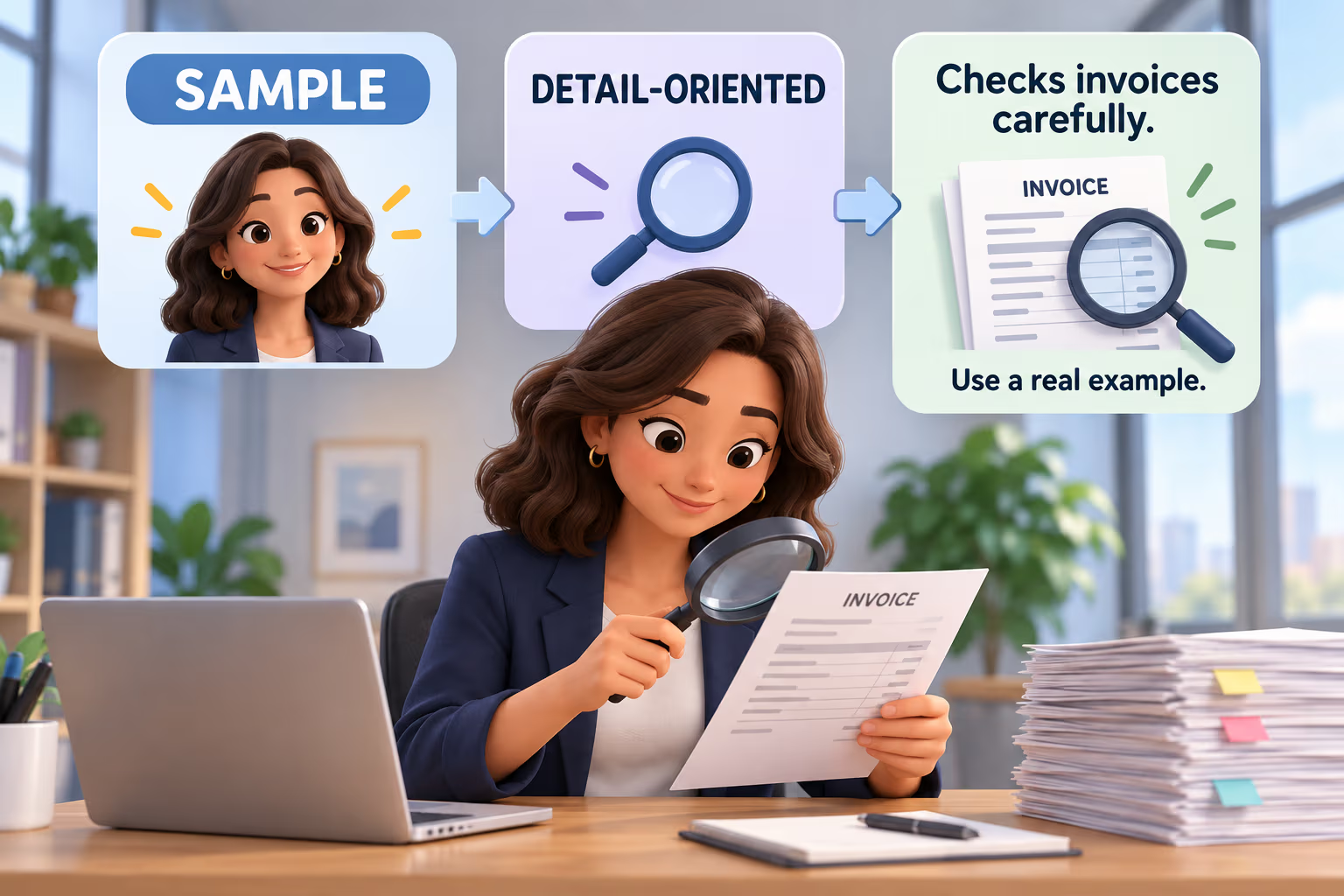
For detailed accomplishment records, OPM recommends describing the situation, actions, and results related to the job’s competencies. Do not invent a percentage or achievement to make an adjective sound stronger; use a measurable result only when you can support it.
Should You Avoid Negative Adjectives?
No. The original advice to avoid negative adjectives is too broad when the subject is the job itself: words such as demanding, high-pressure, or repetitive can accurately describe working conditions. For a resume or interview, describe the conditions neutrally and support claims about your own qualities with evidence rather than relying on praise alone.
For adjacent word lists, browse our guides to adjectives for a job interview and adjectives for job skills.
Looking for the right words to describe your job? Look no further! In this article, I’ll be sharing a comprehensive list of adjectives that can help you effectively describe your job and highlight your skills and experiences. Whether you’re updating your resume, preparing for an interview, or simply looking to enhance your professional profile, these adjectives will add depth and clarity to your job descriptions. From dynamic and innovative to meticulous and results-driven, these adjectives will help you paint a vivid picture of your work style and abilities. I’ll also provide examples of how to use these adjectives in a sentence, so you can see them in action and easily incorporate them into your own job descriptions. By using these powerful describing words, you’ll be able to showcase your strengths and stand out from the competition in the job market. So, let’s dive in and explore the world of adjectives for job descriptions. Get ready to transform your professional narrative and make a lasting impression on potential employers.How to Describe job? – Different Scenarios
When it comes to describing a job, it’s important to choose the right adjectives to effectively showcase your skills and experiences. The words you use can make a significant impact on how potential employers perceive you and your abilities. Let’s explore different scenarios and see how adjectives can be used to describe jobs:- Creative Roles: If you’re in a creative field like graphic design or marketing, it’s essential to highlight your innovation and imagination. Some adjectives that can help convey this include:
- Analytical Roles: For jobs that require strong analytical skills, it’s crucial to emphasize your attention to detail and problem-solving abilities. Consider using adjectives such as:
- Leadership Roles: If you’re in a leadership position, it’s important to highlight your ability to motivate and inspire others. Use adjectives like:
Describing Words for job in English
As someone who has spent years in the job market, I understand the importance of using the right adjectives to describe your job and highlight your skills. In this section, I will provide you with a list of powerful adjectives that can be used to effectively describe different types of jobs. These adjectives will help you make a lasting impression on potential employers and showcase your unique abilities. When it comes to describing your job, it’s important to avoid using generic adjectives that don’t truly capture the essence of your role. Instead, opt for specific and powerful words that highlight your strengths and contributions. Here are some examples of adjectives that can be used to describe jobs in creative, analytical, and leadership roles: Creative Jobs:- Innovative
- Imaginative
- Artistic
- Expressive
- Visionary
- Detail-oriented
- Logical
- Methodical
- Systematic
- Critical-thinking
- Influential
- Motivational
- Strategic
- Charismatic
- Inspiring
Adjectives for job
When it comes to describing your job, using the right adjectives can make all the difference. It not only helps showcase your skills and experiences but also leaves a lasting impression on potential employers. Let’s explore some positive and negative adjectives that can effectively describe a job, along with example sentences to provide a better understanding.Positive Adjectives for Job
Using positive adjectives is a great way to highlight your strengths and convey a positive image to potential employers. Here are twelve examples of positive adjectives that can be used to describe your job:| Adjective | Definition |
|---|---|
| Reliable | Able to be trusted and depended on |
| Efficient | Able to deliver results in a timely and effective manner |
| Creative | Demonstrating originality and imaginative thinking |
| Ambitious | Having a strong desire to achieve success |
| Adaptable | Capable of adjusting to new situations or challenges |
| Collaborative | Willing to work cooperatively with others |
| Resourceful | Skilled at finding innovative solutions and making the most of available resources |
| Dedicated | Committed to giving your best effort to the job |
| Versatile | Able to handle a variety of tasks or responsibilities |
| Proactive | Taking initiatives and being prepared for future needs |
| Detail-oriented | Attentive to small details and accuracy |
| Energetic | Demonstrating enthusiasm and high levels of physical or mental activity |
- My reliable nature allowed me to successfully manage multiple projects simultaneously.
- With my efficient approach, I was able to streamline processes and improve productivity.
- I constantly strive to bring creative ideas to the table, resulting in innovative solutions.
- Being ambitious, I consistently challenge myself to achieve new goals and exceed expectations.
- I am adaptable and thrive in fast-paced and constantly changing work environments.
- My collaborative nature enables me to effectively work in cross-functional teams and achieve common objectives.
- I am resourceful, always finding creative solutions to problems and maximizing available resources.
- Being dedicated to my work, I consistently go above and beyond to meet deadlines and deliver quality results.
- I am versatile, capable of handling a wide range of tasks and responsibilities with ease.
- Proactively identifying potential issues, I take the necessary steps to prevent them from arising.
- My attention to detail ensures that my work is accurate and free from errors.
- With my energetic approach, I bring a positive and motivated attitude to the workplace every day.
Negative Adjectives for Job
While it’s essential to highlight the positive aspects of your job, it’s also important to be aware of negative adjectives that should be avoided during job descriptions. Here are five examples of negative adjectives to keep in mind:| Adjective | Definition |
|---|---|
| Inflexible | Not open to change or new ideas |
| Disorganized | Lacking in order or the ability to stay organized |
| Inefficient | Not achieving maximum productivity or effectiveness |
| Unreliable | Not able to be trusted or depended on |
| Inattentive | Lacking focus or attention to detail |
Synonyms and Antonyms with Example Sentences
Synonyms for job
When it comes to describing a job, there are various synonyms that can effectively showcase your skills and experiences. Here are some alternative words you can use to describe your job:- Position: I currently hold a managerial position at ABC Company.
- Occupation: My occupation is in the healthcare industry as a registered nurse.
- Role: I play a vital role as a project manager in overseeing the entire development cycle.
Antonyms for job
On the other hand, if you want to contrast your current job with a previous role or emphasize a change in direction, you can consider using antonyms. Here are some antonyms for the word “job”:- Unemployment: After a period of unemployment, I am thrilled to have finally secured a new job.
- Retirement: I have recently retired from my previous job and am now enjoying my well-deserved retirement.
- Sabbatical: I decided to take a sabbatical from my job to travel the world and explore new opportunities.
Conclusion
Selecting the right adjectives to describe your job is crucial in making a strong impression on potential employers. This article has provided a comprehensive list of positive adjectives that can effectively highlight your skills and experiences. By carefully choosing the right words, you can showcase your abilities and create a positive image of yourself. It is important to remember that using negative adjectives should be avoided. Instead, focus on highlighting your strengths and positive attributes. By doing so, you can present yourself as a desirable candidate for any job opportunity. Synonyms and antonyms have been explored in this article to provide you with a range of options when describing your job. The examples and sentences provided illustrate how these adjectives can be used effectively. By selecting adjectives that accurately reflect the essence of your job, you can create a lasting impression on potential employers. So, take the time to choose your words wisely and present yourself in the best possible light.Frequently Asked Questions
What is a good adjective to describe a job?
The best adjective depends on the feature you mean. Rewarding describes meaningful or satisfying work, fast-paced describes its speed, collaborative describes teamwork, and demanding describes effort or difficulty. Choose the word that fits the actual job rather than selecting the most flattering-sounding option.
Which adjectives describe someone’s work style?
Reliable describes dependability, adaptable describes adjusting to change, methodical describes an orderly approach, collaborative describes working with others, and resourceful describes finding workable solutions. Use a word only when a specific example from work, education, volunteering, or a project supports it.
How should I choose an adjective for my resume?
Start with a requirement in the target job description, then select a truthful adjective that your experience can demonstrate. Explain the action you took and its outcome, using a verified number when one is available. A tailored example such as “coordinated a weekly handoff” says more than an unsupported claim like “excellent communicator.”
Are negative adjectives always wrong for a job?
No. When describing the work itself, demanding, high-pressure, or repetitive may be accurate and useful. In an application, describe the condition factually instead of turning it into an unsupported judgment about people. The right adjective depends on the subject, audience, and evidence.
Can I use adjectives without giving an example?
Yes, ordinary descriptions do not always need an example, but a resume claim is stronger when its evidence is visible. Follow an adjective with a task, situation, or result that supports it. If you include numbers, use figures you can explain and verify rather than estimates invented to make the claim sound impressive.


