350+ Adjective Words to Describe Sleep and Relaxation
Quick guide:sound suggests undisturbed sleep, fitful suggests repeated interruptions, and restful expresses a sense of rest. Choose the word that matches the detail you mean; these descriptions do not measure a person’s sleep or diagnose a problem.
Note about the original introduction: It says a person should get “at least six hours of deep sleep” each night. Do not treat that sentence as health guidance: the CDC says recommended sleep duration changes with age, and the NHLBI describes deep sleep as one stage in the sleep cycle. This page explains word choice; it does not set a personal sleep target.
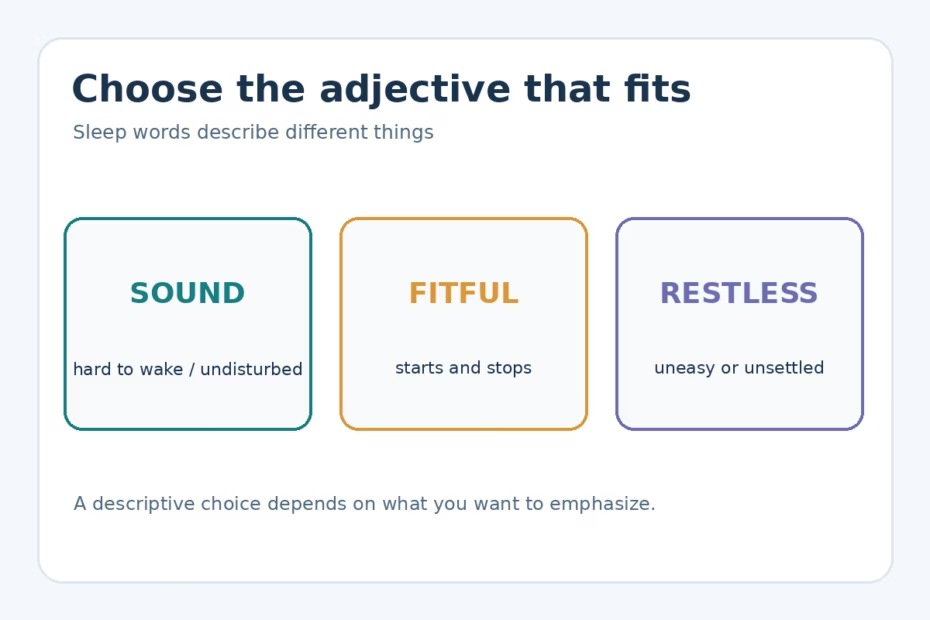
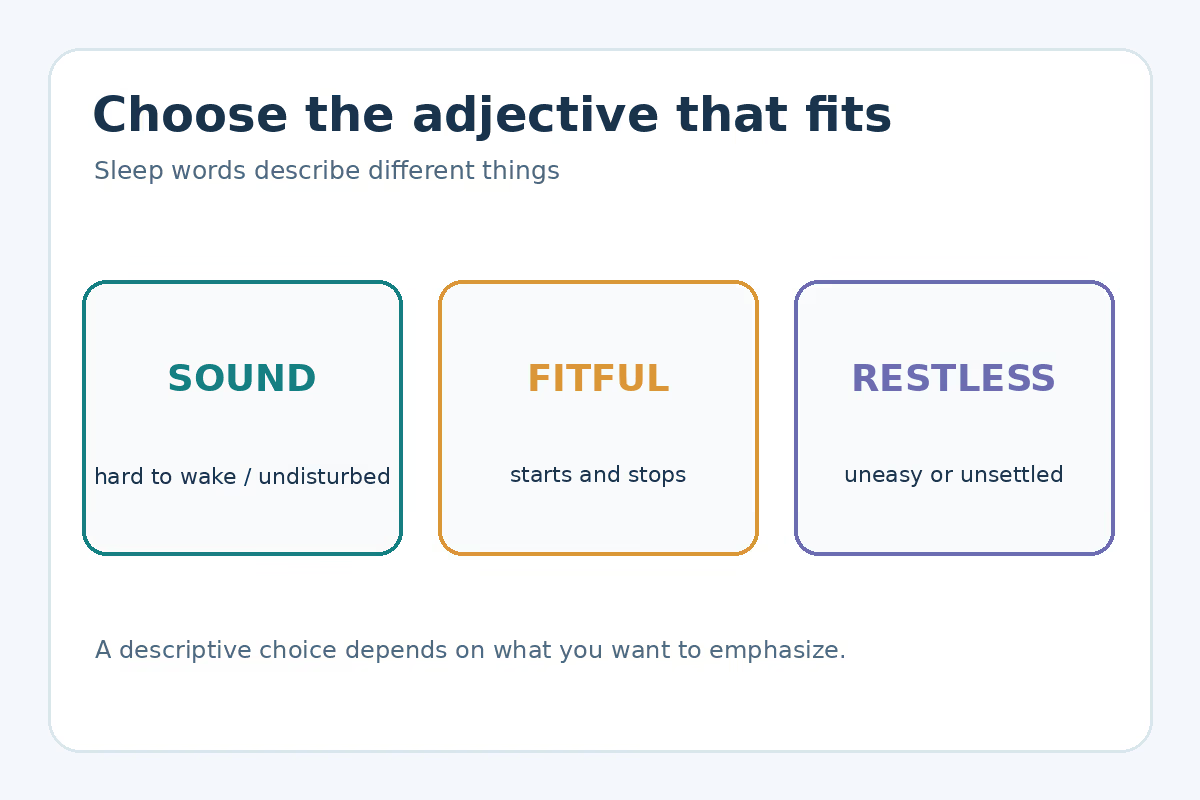
Sound, fitful, and restless describe different qualities of sleep.
Start with the aspect you want to describe. Was the sleep peaceful, broken, brief, difficult to begin, or simply deep? A precise adjective gives readers that clue. The words below are ordinary descriptions of experience; they are not clinical measurements.
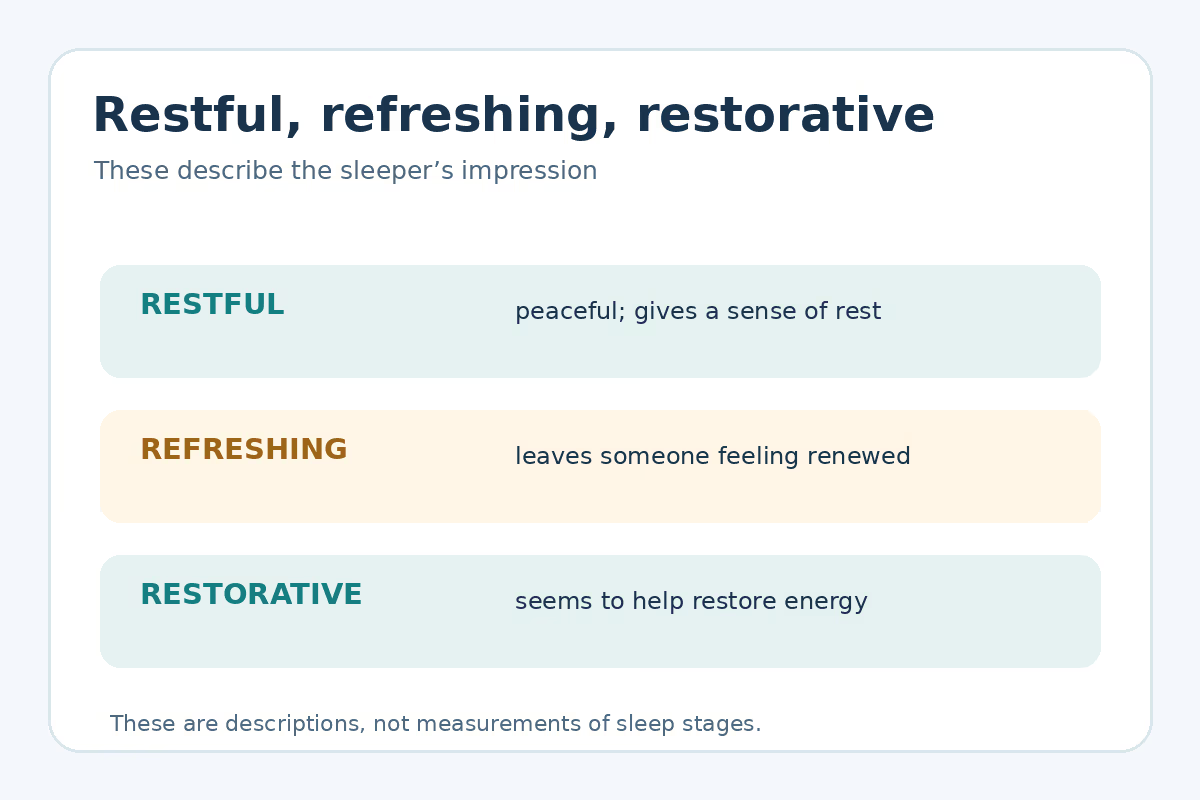
Restful emphasizes that sleep felt peaceful or gave a sense of rest: “After the quiet weekend, Maya had a restful night.”
Refreshing emphasizes how someone felt afterward: “A refreshing nap helped Luis feel ready for the afternoon.” It reports a perceived effect, not a guaranteed result.
Restorative means seeming to restore strength or energy: “She described the long, restorative sleep as a welcome break.”
Sound often describes sleep that is deep and undisturbed, as in “The baby slept soundly.” Use sound sleep for the noun phrase and slept soundly when modifying the verb.
Light can mean not deep or easily interrupted in everyday descriptions: “I was a light sleeper and heard the hallway door.” Here light characterizes sleep; it does not specify a measured stage.
Restful, refreshing, and restorative emphasize different impressions.
Words for interrupted or difficult sleep
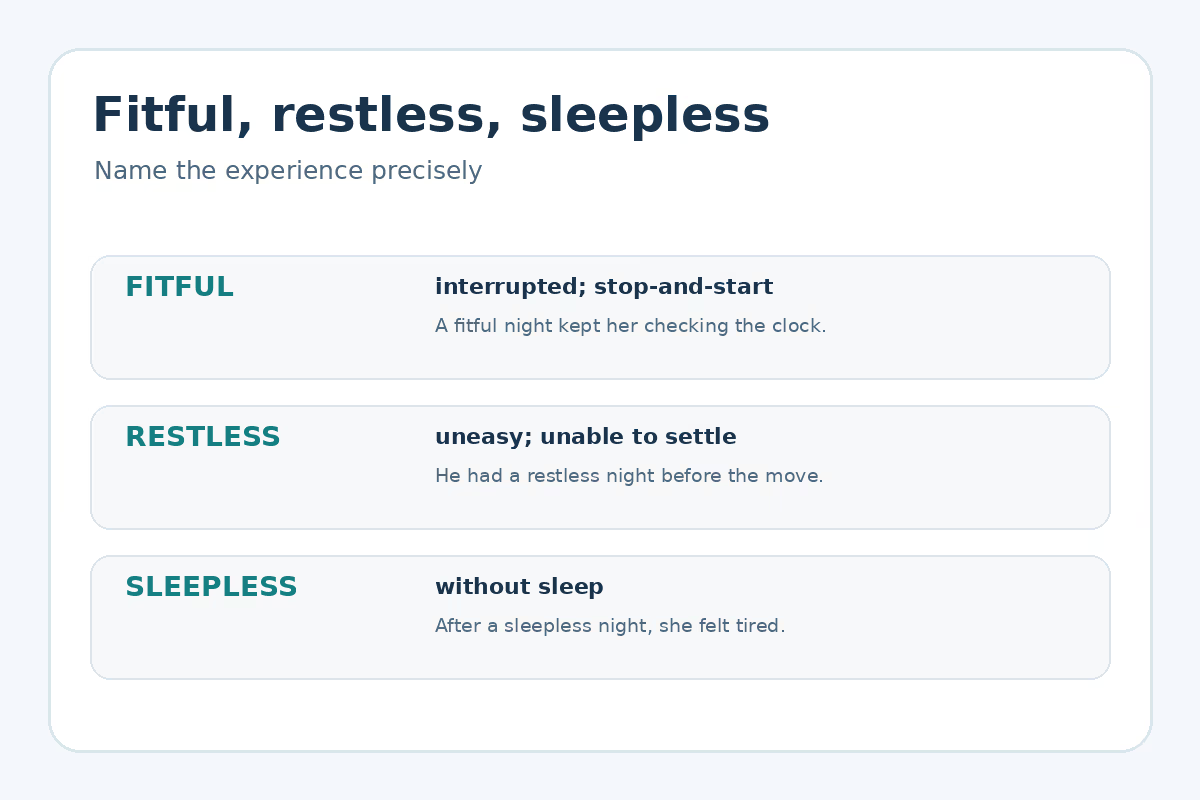
Fitful means irregular or interrupted, often stopping and starting. Cambridge gives the example “a fitful night’s sleep,” while Oxford likewise uses “a fitful night’s sleep.” Restless emphasizes unease or an inability to settle; it can describe a person, a night, or sleep. Uneasy is similar when worry or discomfort is central. Broken or interrupted plainly indicates that sleep was repeatedly disturbed.
Use sleepless when someone did not sleep, or use nearly sleepless if they got very little sleep. It is stronger than fitful: someone with fitful sleep may have slept in short stretches, while a sleepless night means no sleep. Wakeful can describe a period when a person is awake, and restless does not by itself say whether they fell asleep.
Choose fitful, restless, or sleepless according to the experience.
Sleep adjective examples
“The cabin was so quiet that we had a peaceful night’s sleep.”
“A brief nap on the train left him alert for the next stop.”
“She had a fitful night and woke several times.”
“The cat’s light sleep ended when the front door clicked.”
“After the late flight, I was sleepy during the morning meeting.”
“They enjoyed a blissful nap in the shaded hammock.”
“He described the unfamiliar room as unsettling, and his sleep was restless.”
“We hoped for an uninterrupted night, but the storm woke us.”
“Her deep sleep continued despite the rain outside.”
“The child’s sound sleep ended at sunrise.”
“A short sleep gave the travelers time to rest before the connection.”
“The writer called the afternoon nap rejuvenating because she felt renewed afterward.”
Adjectives vs. adverbs: asleep, sleepy, and soundly
Sleepy means drowsy: “I felt sleepy after lunch.” Asleep means in the state of sleeping and usually follows a linking verb: “The child was asleep.” Say a sleeping child when sleeping comes before the noun. These forms are not interchangeable: sleepy child means drowsy, while sleeping child means currently asleep.
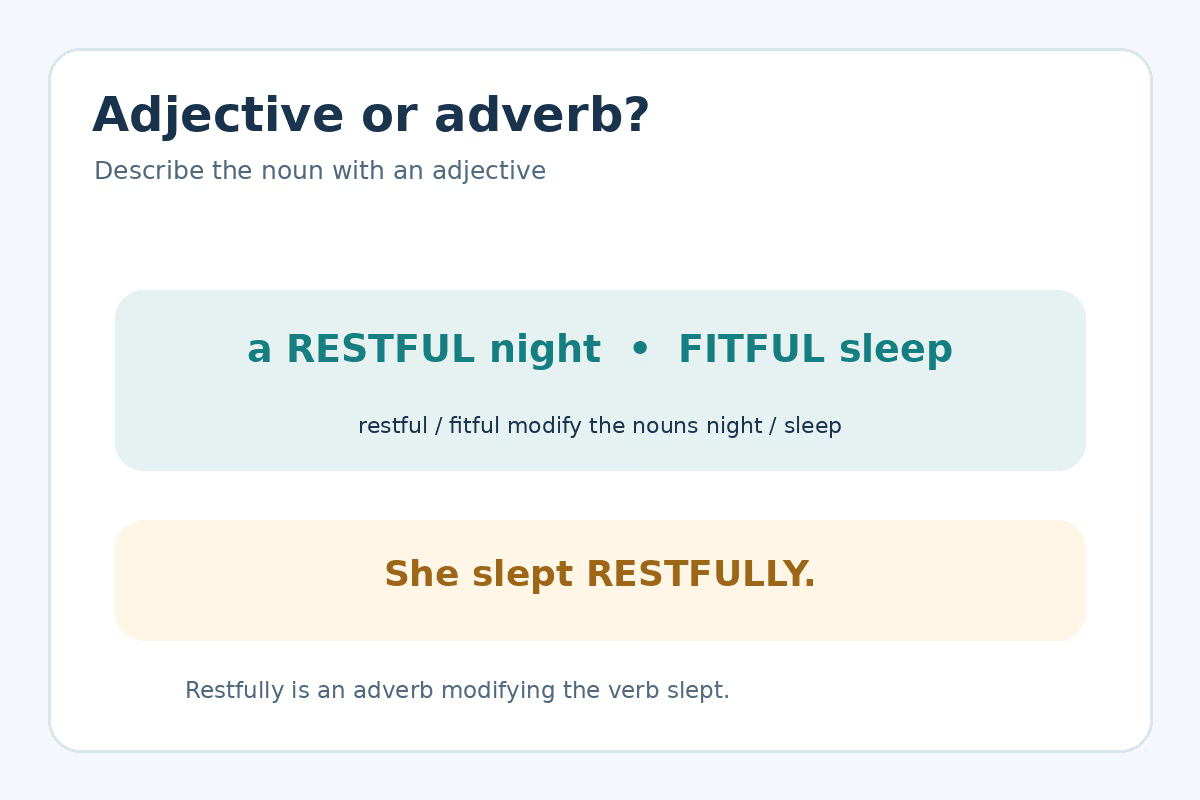
An adjective modifies a noun: a restful night, fitful sleep, or a sleepy passenger. An adverb modifies a verb: she slept restfully or he slept soundly. Avoid she slept restful; use she had restful sleep or she slept restfully.
Use an adjective with a noun and an adverb with a verb.
Does “deep sleep” mean the same as “sound sleep”?
In ordinary writing, deep sleep and sound sleep can both suggest sleep that is hard to interrupt, but they do not always mean exactly the same thing. Sound often emphasizes undisturbed sleep. In sleep science, “deep sleep” also names a specific stage (slow-wave sleep, or N3), as the U.S. National Heart, Lung, and Blood Institute explains. A casual description such as “I slept deeply” does not identify a measured stage. Avoid turning an adjective into a claim about someone’s sleep data.
Common mistakes when describing sleep
Confusing sleepy and asleep:sleepy means drowsy; asleep means sleeping.
Using an adjective where an adverb is needed: write “slept soundly” or “had sound sleep.”
Treating fitful as sleepless: fitful sleep is interrupted; sleepless means no sleep.
Calling a feeling a medical result:refreshing describes how sleep felt to someone, not a clinical measurement.
Assuming light and deep always name stages: in everyday prose these can be informal descriptions; technical claims need evidence from an appropriate measurement.
Adjectives for sleep are important to know when you are trying to get a good night’s sleep. There are many adjectives for sleep, such as deep sleep, light sleep, and fitful sleep. Each of these adjectives has a different meaning, and each can help you get a better night’s sleep.
Deep sleep is the most restful type of sleep, and it is important to get at least six hours of deep sleep each night. Light sleep is not as restful as deep sleep, but it is still important to get some light sleep each night. Fitful sleep is when you wake up frequently during the night, and this can be disruptive to your Sleep. To get a good night’s sleep, it is important to choose the right adjective for your needs.
Adjectives For Sleep
In this article, we’ll explore some of the most commonly used adjectives for sleep. We’ll start with adjectives that describe the act of sleeping itself, such as “slumberous” and “soporific.” Then we’ll move on to adjectives that describe the quality of sleep, such as “restful” and ” refreshing.” Finally, we’ll look at adjectives that describe the effects of sleep, such as “energizing” and ” rejuvenating.” By the end of this article, you should have a good understanding of how to use adjectives to describe sleep.
A
Accustomed
Active
Actual
Adequate
Agitated
Agonized
Agreeable
Ample
Amusing
Anæsthetic
Analogous
Ancient
Apoplectic
Apparent
Artificial
Ashen
Awake
Awful
B
Beautiful
Beggar
Beloved
Besotted
Best
Bestial
Blank
Bleary
Blessed
Blue
Boyish
Breezeless
Brief
Broken
Brutish
C
Calm
Canst
Cataleptic
Certain
Charmed
Cherished
Chilly
Christian
Clear
Cold
Collisional
Comfortable
Comic
Compleat
Complete
Compotatory
Comprehensive
Congenial
Conqueror
Conscious
Consecutive
Consolidated
Continuous
Convivial
Coolest
Creep
Curtained
Customary
D
Daily
Dangerous
Dark
Day
Daysmy
Dead
Deadly
Dear
Decent
Deep
Definite
Delicious
Delightful
Delirious
Didst
Difficult
Ding
Disrupted
Distempered
Distressing
Disturbed
Downy
Dreadful
Dreamy
Drugged
Drunken
Dull
E
Earthly
Easeful
Easy
Enchanted
Endless
Entire
Ere
Eternal
Everlasting
Excellent
Excessive
Exciting
Exemplary
Exhausted
Extra
Eyed
F
Faint
Fair
Fallen
Fancy
Farther
Fatal
Favorable
Favorite
Favourable
Fearful
Feeble
Feign
Feigned
Fellow
Feverish
Final
Fine
Fitful
Fond
Foodor
Fresh
Friendly
Frightful
Frozen
Future
G
Gentle
Genuine
Gloomy
Glorious
Golden
Good
Gradual
Grave
Great
Green
Guilty
H
Habitual
Half
Hamlet
Happy
Hardy
Harmless
Haunted
Healthful
Healthy
Heavy
Hectic
Helpless
Hidden
Holy
Horizontal
Horrible
Human
Hypnotic
I
Icy
Imaginable
Imaginary
Immoderate
Immortal
Improved
Inadequate
Incommunicable
Indian
Inevitable
Initial
Innocent
Insensible
Instant
Instantaneous
Insufficient
Intellectual
Intermittent
Interrupted
Intimate
Invaluable
Inward
Irregular
K | L
Kindred
Known
Lagrangian
Lasting
Lengthened
Lethargic
Light
Lighthearted
Like
Logarithmic
Long
Loose
Losing
Lost
Lovely
Luxurious
M
Magic
Magnetic
Mental
Mesmeric
Mighty
Moderate
Momentary
Morphia
Multiple
Mysterious
N
Natural
Needed
Needful
Nervous
Nice
Night
Nightly
Nighttime
Normal
Noticeable
O
Oblivious
Obstructive
Occasional
Ordinary
Overmuch
P
Paradoxical
Partial
Passive
Pattlemany
Peaceful
Pelvic
Perfect
Permanent
Perpetual
Pet
Physical
Physiological
Picturesque
Pitiful
Pituitary
Placid
Pleasant
Pleasing
Poor
Popular
Present
Pretended
Previous
Primitive
Profitable
Profound
Progressive
Prolonged
Proper
Protective
Prudent
Pure
Q | R
Queer
Quiet
Rare
Real
Recuperative
Refreshing
Regular
Rem
Repose
Resolute
Restful
Restless
Restorative
Rosy
Round
Rusty
S
Sacred
Sad
Safe
Semidefinite
Senseless
Separate
Shadowy
Short
Shortest
Sighing
Silent
Sinful
Sleep
Sleepa
Sleeponly
Slightest
Sluggish
Smooth
Soft
Softest
Sole
Solemn
Solid
Sound
Soundest
Spiritual
Splendid
Startled
Stertorous
Straight
Strange
Strangled
Substantive
Sudden
Sundry
Supernatural
Surprising
Sweet
Sweetest
Swinish
Swoonlike
T
Temporary
Tender
Terrible
Thick
Thou
Timely
Timorous
Tired
Torpid
Transient
Transparent
Treacherous
Tremendous
Troubled
Troublesome
Truant
U
Ultimate
Unawaking
Unbroken
Uncanny
Uncomfortable
Unconscious
Underground
Undisturbed
Uneasy
Unihemispherical
Uninterrupted
Unnatural
Unpremeditated
Unquiet
Unreserved
Unsatisfactory
Unstirring
Unsuspecting
Untried
Untroubled
Unusual
Unwakeable
Unwilling
Upno
Usual
Utter
V | W
Victorious
Vile
Wayward
Weary
Wholesome
Wonted
Wouldst
Wounded
Final verdict
In conclusion, adjectives for sleep can help to describe the experience of sleeping in more detail. By using adjectives such as “restful,” “refreshing,” or “rejuvenating,” we can capture the feeling of a good night’s sleep. In addition, adjectives can also be used to describe less pleasant experiences, such as “tired,” “exhausted,” or “drained.” Ultimately, adjectives are a Powerful tool for describing sleep, and by using them we can gain a greater understanding of this essential human experience.
Robin founded StartsWithy in 2022 to make English words easier to understand and use. Robin oversees our 30,000+ guides, checks meanings and grammar against trusted dictionaries such as Cambridge, Oxford Learner’s and Collins, and is accountable for every correction we make.