Quick answer: An adjective tells more about a noun, as in “red apple” or “happy child.” This guide keeps its original examples and tables, then adds a short Grade 1 practice routine, sentence frames, and teaching notes aligned with Common Core Language Standard L.1.1.f. Start with familiar words for color, size, and feelings.
First Grade Adjectives at a Glance
- Common Core Language Standard L.1.1.f asks first graders to use frequently occurring adjectives.
- Begin with a noun children know, then add a word that tells more: “red apple,” “big elephant,” or “happy child.”
- Sort familiar words by color, size, feeling, texture, or quantity before asking children to use them in a sentence.
- Pictures, repetition, and sentence frames give early readers more than one way to learn and practice new vocabulary.
- Positive and negative examples describe words or situations; avoid turning a temporary action or feeling into a fixed label for a child.
What Does an Adjective Do?
An adjective gives information about a noun or pronoun. In “the red apple,” red describes the apple. In “the apple is shiny,” shiny describes the apple after the linking verb is. The Common Core grade 1 standards ask students to use frequently occurring adjectives; they also ask students to sort words into categories and notice simple shades of meaning, such as “large” and “gigantic.”
| Word group | Noun | Example phrase or sentence |
|---|---|---|
| Color | apple | red apple |
| Size | elephant | big elephant |
| Feeling | child | happy child |
| Texture | blanket | soft blanket |
| Quantity word | balloons | three balloons |
A Five-Minute Adjective Practice Routine
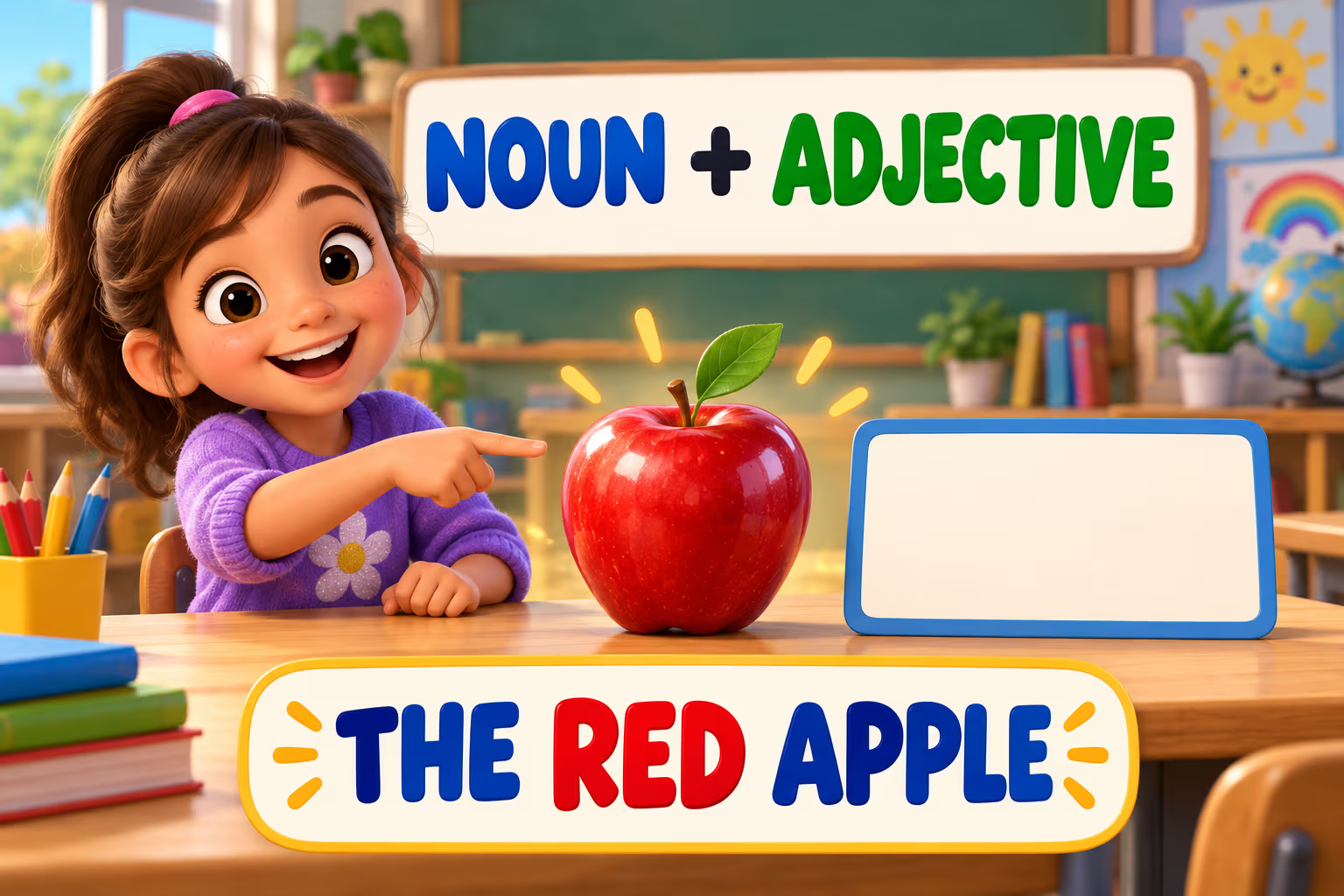
Choose one real classroom object or clear picture. Say the noun first, offer two familiar describing words, and let the child choose the one that fits. Then build a sentence together: “I see a ___ apple,” or “The apple is ___.” Ask the child to point to the detail that supports the word, such as the apple’s red skin or shiny surface.
- Show an object or picture and name the noun.
- Model one familiar adjective and explain the detail it adds.
- Use a sentence frame such as “The ___ noun is ___.”
- Repeat the word in a new example, then invite the child to make an original sentence.
The U.S. Department of Education’s Institute of Education Sciences describes a PreK–1 vocabulary routine using repetition, images, and sentence frames. Those supports help children connect a new word with a concrete example before they practice it independently. For a vocabulary challenge, compare two familiar choices—“big” and “gigantic”—and ask which one suggests a greater size.
How to Use Positive and Negative Adjectives Respectfully
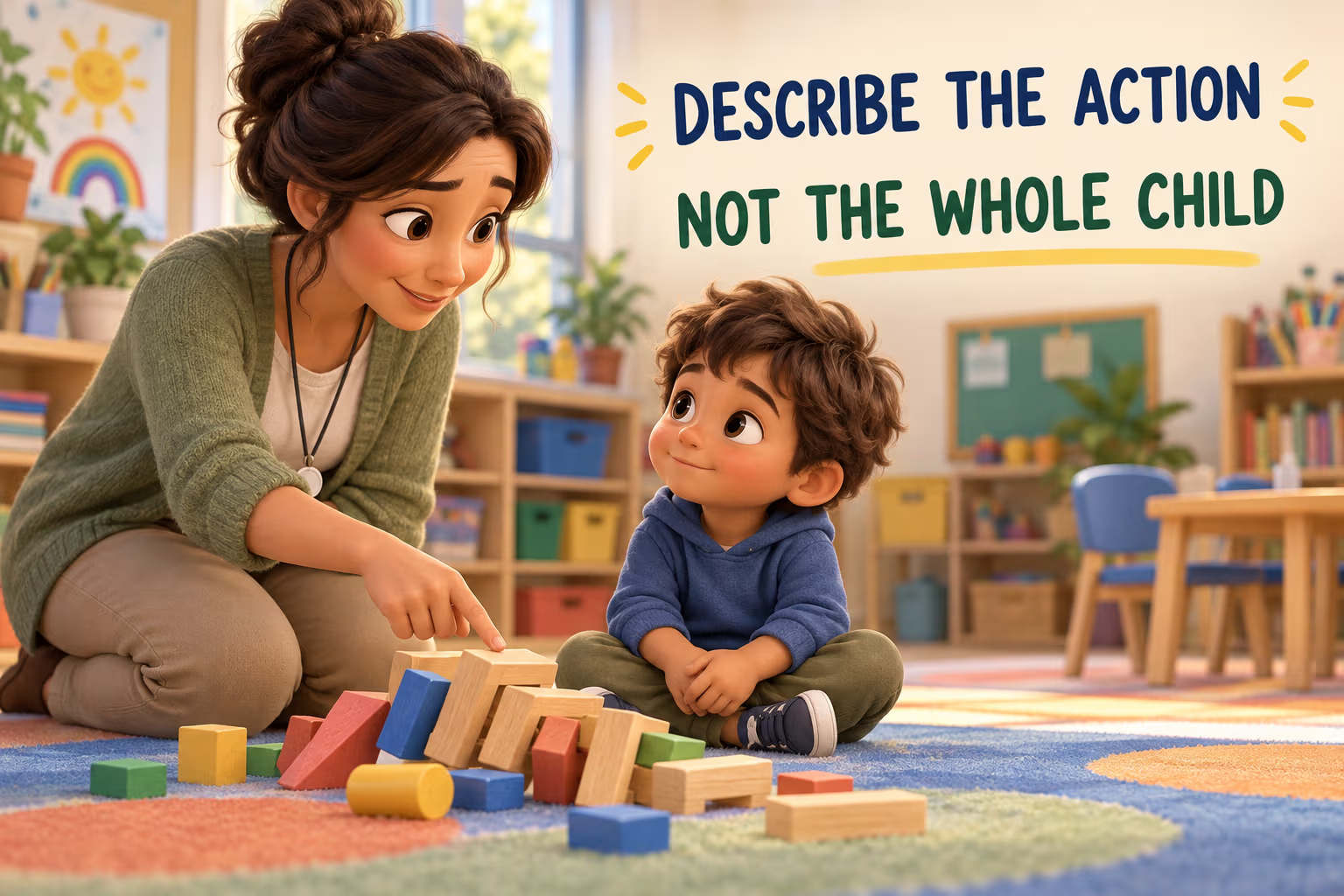
In a vocabulary lesson, “positive” and “negative” often describe the feeling a word gives, not whether a person is good or bad. Some words in the original negative list—such as sad and tired—name ordinary feelings or states; scary depends on the situation. Teach students to describe an object, a story, a feeling, or a specific action. Instead of “You are mean,” an adult can name what happened: “You took the marker while Sam was using it.”
NAEYC recommends briefly describing a child’s observable behavior and helping the child identify feelings. That approach gives children language for what happened without defining them by one moment. Keep the original negative-word examples as vocabulary contrasts, and choose neutral subjects—such as a messy desk or a scary story—for practice sentences.
A Note About Number and Quantity Words
The original guide includes “one,” “many,” and “few” in its describing-word examples. These words tell how many or how much, and elementary worksheets may group them with adjectives. Some grammar lessons discuss number words as determiners or quantity words instead. Keep the examples, and follow the terminology used in the child’s curriculum.
Hey there! Are you ready to dive into the world of adjectives with me? In this article, I’ll be sharing some awesome examples of describing words that are perfect for first graders. Adjectives are like little superheroes that add color and life to our sentences, making them more exciting and interesting to read. So, let’s get started and discover the power of adjectives together! When it comes to describing things, adjectives are our secret weapon. They help us paint a picture in the reader’s mind and make our writing more engaging. Imagine describing a beautiful flower without using any adjectives – it just wouldn’t be the same! In this article, I’ll be introducing you to some simple yet powerful adjectives that are perfect for first graders. Get ready to learn how to make your sentences sparkle with these descriptive words!How to Describe first grade? – Different Scenarios
Classifying and describing first grade scenarios can be a fun exercise that helps young learners develop their language skills. Let’s explore various scenarios and learn how to describe them using adjectives!1. Describing Classroom Objects
In the first-grade classroom, there are many objects that can be described using adjectives. Let me give you some examples:- Chalkboard: The chalkboard is big and green.
- Desks: The desks are wooden and small.
- Books: The books are colorful and educational.
2. Describing Classmates
Describing our classmates is another opportunity to practice using adjectives. Here are a few examples:- Emily: Emily is a friendly and helpful classmate.
- Alex: Alex is a curious and creative student.
- Sophia: Sophia is a caring and talented friend.
3. Describing Activities
First-grade activities offer a chance to use adjectives while describing the things we do. Let’s see some examples:- Reading: Reading books is enjoyable and educational.
- Singing: Singing songs is fun and energetic.
- Drawing: Drawing pictures is creative and expressive.
- Playing: Playing games is exciting and interactive.
- Big
- Green
- Wooden
- Small
- Colorful
- Educational
Describing Words for first grade in English
As a teacher, I understand the importance of introducing adjectives to first graders. These describing words add depth and detail to their sentences, making their writing more vibrant and engaging. In this section, I will provide you with a range of adjectives that are suitable for first graders, along with examples to help them understand and use them effectively.Colors
One way to introduce adjectives to first graders is by describing objects based on their colors. Not only does this help expand their vocabulary, but it also encourages them to observe and describe the world around them. Here are some examples:| Noun | Adjective |
|---|---|
| Apple | Red |
| Car | Blue |
| Sunflower | Yellow |
Sizes
Teaching first graders about adjectives that describe sizes is a great way to enhance their language skills. Here are some examples of how to describe objects using size adjectives:| Noun | Adjective |
|---|---|
| Elephant | Big |
| Mouse | Small |
| House | Tall |
Feelings
Introducing adjectives that describe feelings helps first graders express emotions and experiences in their writing. Here are some examples of feeling adjectives:| Noun | Adjective |
|---|---|
| Cat | Happy |
| Dog | Sad |
| Child | Excited |
Numbers
Adding numbers to adjectives helps first graders understand quantity and comparisons. Here are some examples of adjectives with numbers:| Noun | Adjective |
|---|---|
| Pencil | One |
| Balloons | Many |
| Flowers | Few |
Adjectives for first grade
As a first-grade teacher, I understand the importance of introducing adjectives to young minds. Adjectives add color and detail to our sentences, making our writing more vibrant and engaging. In this section, I’ll share some positive and negative adjectives that are perfect for first graders, along with example sentences to help reinforce their understanding.Positive Adjectives for First Grade with Example Sentences
Here are twelve positive adjectives that will help expand your students’ vocabulary and encourage them to express themselves more confidently:| Adjective | Example Sentence |
|---|---|
| Happy | I am happy because I got a gold star today. |
| Brave | Sarah was brave enough to speak in front of the class. |
| Kind | Jake is always kind and shares his toys with others. |
| Funny | The clown at the circus was really funny and made us laugh. |
| Smart | Emily is a smart student who always pays attention in class. |
| Friendly | Our new neighbor is very friendly and always says hello. |
| Creative | We had a creative art lesson and made beautiful paintings. |
| Curious | Max is a curious little boy who asks a lot of questions. |
| Colorful | The flowers in the garden are so colorful and vibrant. |
| Brave | The firefighter showed a lot of bravery when rescuing the cat from the tree. |
| Honest | It’s important to be honest and tell the truth. |
| Responsible | Sarah is a responsible student who always completes her homework on time. |
Negative Adjectives for First Grade with Example Sentences
While it’s important to focus on positive adjectives, it’s also beneficial for first graders to learn about negative adjectives. Here are five examples of negative adjectives that can be introduced to expand their vocabulary:| Adjective | Example Sentence |
|---|---|
| Sad | I felt sad when my ice cream fell on the ground. |
| Scary | The haunted house was scary, but I still had fun. |
| Mean | The bullies were mean to the new student. |
| Messy | My room is messy, and I need to clean it up. |
| Tired | After playing all day, I feel tired and ready for bed. |
Synonyms and Antonyms with Example Sentences
Synonyms for First Grade
When teaching adjectives to first graders, it’s important to introduce them to synonyms – words that have a similar meaning. Synonyms can help expand their vocabulary and give them more options for expressing themselves. Here are some examples of synonyms for common adjectives used in first grade:| Adjective | Synonyms |
|---|---|
| Happy | Joyful, cheerful, glad |
| Big | Large, huge, enormous |
| Fast | Quick, speedy, rapid |
| Pretty | Beautiful, lovely, cute |
| Smart | Intelligent, clever, wise |
- I’m happy because it’s my birthday today!
- The dog was big and could easily jump over the fence.
- The rabbit was fast and caught up to the tortoise quickly.
- She wore a pretty dress to the party.
- My sister is very smart and always gets good grades in school.
Antonyms for First Grade
In addition to synonyms, it’s also important to introduce first graders to antonyms – words that have the opposite meaning. Learning antonyms can help students better understand the nuances of language and expand their vocabulary. Here are some examples of antonyms for common adjectives used in first grade:| Adjective | Antonyms |
|---|---|
| Happy | Sad, unhappy |
| Big | Small, tiny |
| Fast | Slow, sluggish |
| Pretty | Ugly, plain |
| Smart | Dumb, foolish |
- She was happy when she got a new toy, but she became sad when she lost it.
- The big balloon popped, and only a small piece was left.
- The turtle was slow and couldn’t keep up with the fast rabbit.
- The cat thought the mouse was ugly, but the mouse thought it was pretty.
- He wasn’t very smart and could never solve the puzzle.
Conclusion
Teaching adjectives to first graders is an essential part of their language development. In this article, we have explored the importance of introducing synonyms and antonyms when teaching adjectives to young learners. By providing examples of synonyms and antonyms for common adjectives, we can help expand their vocabulary and enhance their language skills. By teaching synonyms, we encourage students to find alternative words that have similar meanings. This not only enriches their vocabulary but also allows them to express themselves more confidently. Similarly, teaching antonyms helps them understand opposite meanings and further strengthens their language abilities. Creating a positive and supportive learning environment is crucial when teaching adjectives to first graders. By fostering a safe space, we encourage them to explore and experiment with language. This helps them develop a love for words and a curiosity for learning. By incorporating synonyms and antonyms into our adjective lessons, we can empower first graders to become more expressive and articulate individuals. Let’s continue to nurture their language skills and watch them grow into confident communicators.Easy First Grade Adjective Sentences
Try short sentences with one clear detail: “The small dog runs.” “I see three blue kites.” “The blanket feels soft.” Ask which word adds information and what noun it describes. When children are ready, invite them to replace a broad word—such as “big”—with a more precise choice, while keeping the sentence understandable.
For more age-friendly vocabulary, browse adjectives for kids, adjectives for school, and words that describe happy feelings.
Frequently Asked Questions
What is an adjective for a first grader?
An adjective is a word that tells more about a noun, such as a person, place, animal, or thing. In “green frog,” green describes the frog. First graders can begin with familiar adjectives for color, size, and feelings, then use them in short spoken and written sentences.
How can I teach adjectives quickly?
Hold up an object or picture, name it, and ask what detail a child notices. Model one adjective, use a sentence frame such as “I see a ___ ball,” and repeat the word with another example. Pictures, repetition, and sentence frames are supports used in early-grade vocabulary routines.
What are some positive adjectives for first graders?
Words such as kind, helpful, curious, creative, and brave can describe positive actions or qualities. Give a concrete example so children understand the word: “Mia was helpful when she picked up the books.” Praise the specific action as well as offering the adjective, and avoid using a single word to rank children.
Should children use negative adjectives to describe classmates?
For practice, use negative adjectives to describe objects, stories, feelings, or specific situations rather than defining a classmate. “The desk is messy” describes an object; “the story was scary” describes an experience. If a child hurts someone, name the observable action and talk about its effect instead of labeling that child as mean.
Are numbers adjectives in first grade?
Many elementary lessons group number and quantity words with describing words because they tell how many. Grammar materials may classify some, including “three” in “three balloons,” as determiners. The original guide keeps its number examples; use the terminology taught at school and help children notice what the word tells about the noun.


