
Quick answer: Adjectives for school describe a campus, classroom, learning experience, or school community. Use “welcoming” for how newcomers are received, “engaging” for lessons that invite participation, “orderly” for predictable routines, and “supportive” when learners can access help. Match each word to a specific observation because students may experience the same school differently.
Key Facts: Adjectives for School
- The U.S. Department of Education describes school climate as broad and multifaceted, spanning students’ educational experience.
- The CDC defines school connectedness through students’ sense that adults and peers care about them and their learning.
- A campus, classroom, lesson, and student community may call for different adjectives.
- “Safe,” “inclusive,” and “academically rigorous” make meaningful claims; explain the evidence or perspective behind them.
- A precise sentence names one feature and gives a concrete example instead of stacking generic praise.
What Do Adjectives for School Describe?
A school adjective can describe the physical campus, the mood in one classroom, the way a lesson works, the relationships people experience, or the routines that organize a day. Those subjects are related but not interchangeable: a lively hallway does not prove that every class is noisy, and a well-kept building does not by itself show how students feel about learning there.
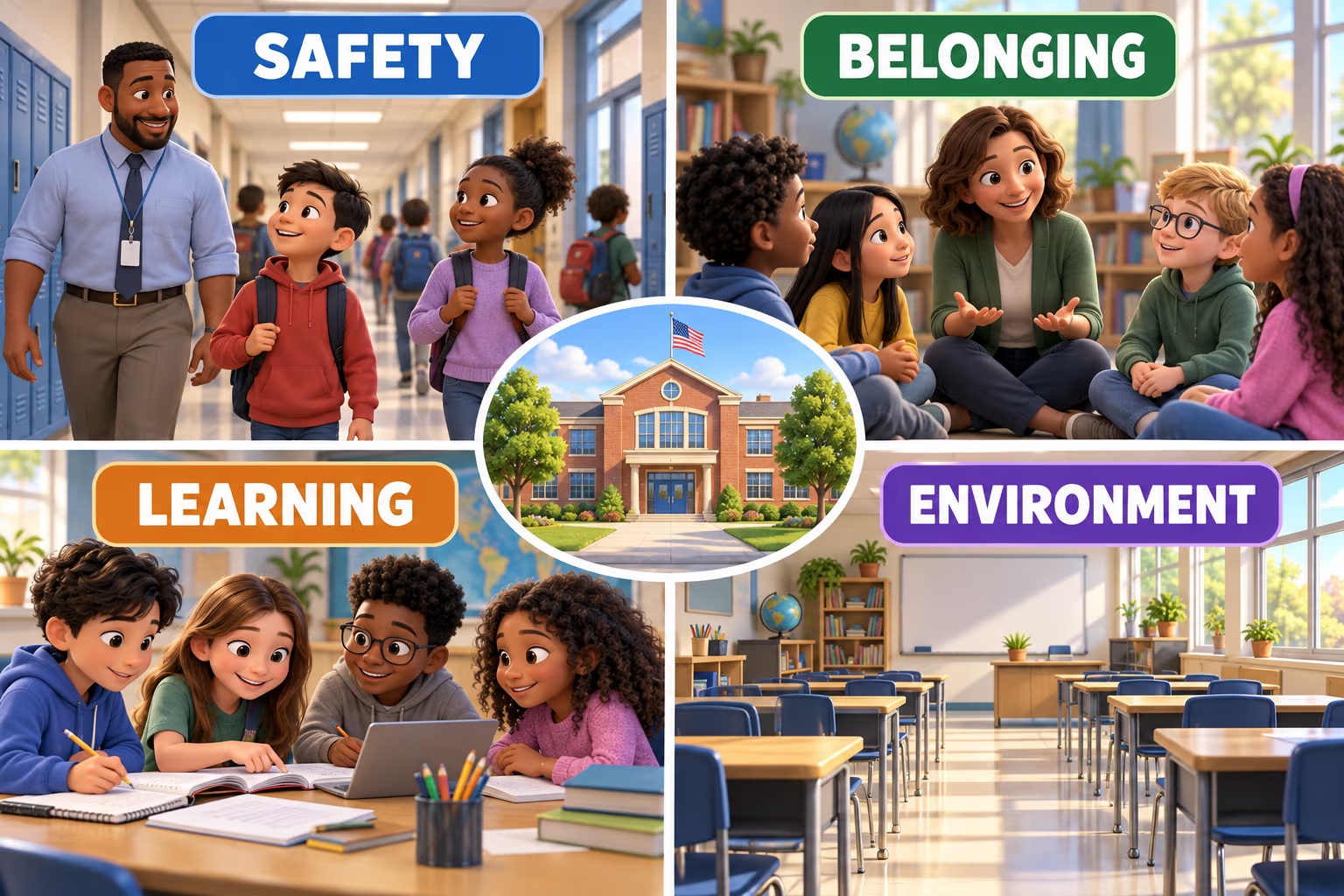
The U.S. Department of Education calls school climate a broad, multifaceted concept. A useful vocabulary checklist can therefore separate four practical areas—safety, belonging, learning, and physical environment—rather than trying to compress a whole school into a single label. This four-part checklist is a writing aid, not a formal rating or a claim that all students share one experience.
Which Adjectives for School Fit Each Feature?
Choose a word that matches the part of school you observed. “Welcoming” describes reception, “collaborative” describes how people work together, and “spacious” describes available room; using one of these words for the wrong feature can make a sentence vague or misleading.
| Feature | Useful adjectives | Example with a concrete detail |
|---|---|---|
| Arrival and atmosphere | welcoming, bustling, calm, lively | A welcoming front office greeted families as they arrived. |
| Relationships | supportive, respectful, caring, collaborative | Supportive teachers made time to answer students’ questions. |
| Lessons | engaging, hands-on, challenging, structured | An engaging science lesson asked teams to compare their results. |
| Daily routines | orderly, predictable, flexible, busy | Predictable routines helped the class move from reading to group work. |
| Building and grounds | bright, spacious, historic, crowded | The bright library had large windows and tables for small groups. |
| Resources | well-equipped, well-resourced, limited, under-resourced | The art room was well-equipped, with shared paints and drying racks. |
| Community and participation | diverse, multicultural, inclusive, connected | The school’s multicultural fair featured families’ languages and traditions. |
| Academic expectations | rigorous, ambitious, demanding, supportive | A demanding writing task included clear criteria and revision time. |

A word can shift meaning with its subject. “Quiet” may describe a focused library, an empty corridor, or a classroom where students have little opportunity to speak; each sentence suggests something different. Name the room, time, or activity so readers can understand whether the adjective is neutral, positive, or critical.
How Can You Describe School Climate Fairly?
Describe a school climate as a set of experiences, not a slogan. The CDC says school connectedness includes students feeling cared for, valued, supported, and that they belong; its summary also reports associations between connectedness and outcomes such as attendance and grades. Those findings describe population-level relationships, not a guarantee about any one campus.
CDC’s school-connectedness guidance is useful when deciding whether words such as “supportive” or “connected” fit. For example, a description can say students “had access to a named counselor” if that is verified, but should not claim that every student feels supported based on one conversation or a school poster.
| Adjective | What it can mean | How to keep it accurate |
|---|---|---|
| Safe | Physical or emotional security, or a person’s sense of safety. | Specify the source: a measured feature, school policy, survey, or student perspective. |
| Inclusive | People are welcomed and able to participate. | Name the practice, access, or experience; do not use the word as a substitute for evidence. |
| Diverse | The community includes varied identities, languages, or backgrounds. | Describe the dimension meant; diversity alone does not establish belonging. |
| Supportive | People can get help, encouragement, or useful feedback. | Give an example of the support and avoid implying every learner receives the same help. |
| Rigorous | Work or standards are demanding or high-level. | Name the task and expectations; “rigorous” is not a synonym for a large workload. |
| Modern | Recently built, updated, or using current tools. | Say what is modern—building, equipment, or teaching resource—and avoid equating it with quality. |
The federal School Climate Survey model separates safety, engagement, and environment, including distinct measures for physical and emotional safety. That distinction is useful in writing: a school may have locked entrances while students’ social experiences still vary. Avoid using the single adjective “safe” as if it answered every question.
What Do Positive, Neutral, and Critical Words Add?
Positive, neutral, and critical school adjectives do different work. Positive words express approval, neutral words describe observable conditions, and critical words point to a difficulty; a balanced description can use any of the three when the word fits the evidence and the writer’s purpose.
- Positive: welcoming, nurturing, inspiring, collaborative, well-equipped. Add a detail to show what creates the positive impression.
- Neutral: urban, suburban, large, small, historic, multilingual, quiet, busy. These words describe context without automatically judging it.
- Critical: overcrowded, noisy, disorganized, rigid, under-resourced, impersonal. Identify the room, routine, resource, or time period instead of blaming students as a group.
CDC describes teacher care and support as relevant to students’ connectedness. An expert editing rule is to describe the practice rather than praise a label: instead of “a nurturing school,” write that staff check in after absences or explain how a student can get help—if those practices were observed or documented. This keeps the sentence specific and avoids turning a general value into a universal promise.
How Should You Choose a Precise School Adjective?
Use this five-step process to turn a broad impression into an accurate description:
- Choose the subject: campus, classroom, lesson, routine, relationship, resource, or school community.
- Decide your purpose: a personal reflection, factual report, fictional scene, or school profile needs a different tone.
- Observe a specific detail: note what people do, what a room contains, or how an activity is organized.
- Select the matching adjective: choose “crowded” for limited space, “collaborative” for joint work, or “welcoming” for a received greeting.
- Check the scope: identify whether the observation applies to one class, one day, a grade level, or the whole school.
Vague: “The school is excellent.” More informative: “In the library, students worked in quiet pairs while a teacher helped them find books.” The second sentence does not rate the entire institution; it gives a reader a concrete scene and leaves room for other experiences.
For related vocabulary, see classroom adjectives, adjectives for teachers, and college adjectives. Keep the scope clear: a classroom, teacher, college, and whole school call for overlapping but different descriptions.
As an experienced writer, I’ve come across countless topics that require a descriptive touch. Today, I’d like to dive into the world of adjectives for school. You see, adjectives have the power to bring life and color to our descriptions, and when it comes to describing schools, they play a crucial role. So, in this article, I’ll be sharing a collection of adjectives that perfectly capture the essence of a school environment, along with some examples to illustrate their usage. When we think of schools, certain adjectives immediately come to mind – vibrant, bustling, and educational, to name a few. But there are so many more adjectives that can be used to paint a detailed picture of what a school is like. From the atmosphere in the classrooms to the interactions in the hallways, each aspect of a school can be beautifully described with the right choice of words. So without further ado, let’s explore a wide range of adjectives that will help you bring your school-related descriptions to life. Remember, choosing the right adjectives can make all the difference in creating vivid and engaging descriptions. So, join me as we delve into the world of adjectives for school, and discover how these words can transform your writing into a captivating masterpiece.How to Describe school? – Different Scenarios
When it comes to describing a school, there are various scenarios in which you may find yourself needing to paint a vivid picture with your words. Whether you are writing a school brochure, creating educational content, or simply trying to capture the essence of a school environment, choosing the right adjectives can make all the difference. Here are a few different scenarios and examples of how to describe a school:- Describing a school’s atmosphere:
- Vibrant: The school is filled with energy and enthusiasm.
- Inclusive: Students from diverse backgrounds come together in a welcoming environment.
- Positive: The school promotes a culture of optimism and encouragement.
- Nurturing: Teachers provide a caring and supportive environment for their students.
- Depicting the facilities and infrastructure:
- Modern: The school boasts state-of-the-art facilities and technology.
- Spacious: The classrooms and common areas are ample, allowing for comfortable learning and movement.
- Safe: The school has secure premises and ensures the well-being of its students.
- Well-equipped: The school provides students with the tools and resources they need for a comprehensive education.
- Describing the teaching approach:
- Innovative: The school embraces creative teaching methods and encourages critical thinking.
- Engaging: Lessons are designed to captivate students’ interest and promote active participation.
- Empowering: Students are encouraged to take ownership of their learning and develop a sense of independence.
- Adaptive: Teachers tailor their instruction to meet the needs and abilities of individual students.
- Portraying the school’s achievements and reputation:
- Outstanding: The school has a track record of exceptional academic performance and accomplishments.
- Respected: The school is highly regarded within the educational community and among parents and students.
- Diverse: The school celebrates diversity and fosters an inclusive learning environment.
- Collaborative: The school encourages teamwork and collaboration among students, teachers, and parents.
Describing Words for school in English
When it comes to describing a school, using the right adjectives can make all the difference. Not only do they give readers a clear picture of what the school is like, but they also help create an engaging and compelling description. In this section, I’ll provide you with a list of adjectives that can be used to describe schools in English, along with some examples for each.- Welcoming
- Innovative
- Safe
- Nurturing
- Multicultural
- Academically rigorous
- Supportive
Adjectives for school
When it comes to describing schools, choosing the right adjectives can make all the difference in creating engaging and compelling descriptions. From the atmosphere to the educational approach, the adjectives used should accurately reflect the unique qualities of the school. In this section, I will provide examples of positive and negative adjectives that can be used to describe schools, along with example sentences to illustrate their usage.Positive Adjectives for School with 12 Example Sentences
- Innovative: The school embraces innovative teaching methods, providing students with a dynamic and interactive learning experience.
- Welcoming: The school creates a welcoming environment where students feel comfortable and valued.
- Safe: Safety is a top priority at our school, ensuring that all students can learn in a secure and protected environment.
- Nurturing: Our school fosters a nurturing atmosphere, encouraging students to explore their potential and grow academically, socially, and emotionally.
- Multicultural: Our school celebrates diversity, creating a multicultural environment that promotes understanding and respect among students.
- Academically Rigorous: Our school offers an academically rigorous curriculum, challenging students to excel and reach their full intellectual potential.
- Supportive: Our school provides a supportive network, offering resources and guidance to help students succeed in their educational journey.
- Engaging: The school’s curriculum is designed to be engaging, captivating students’ interest and instilling a love for learning.
- Collaborative: Our school encourages collaboration among students, fostering teamwork and interactive learning experiences.
- Inclusive: Our school promotes inclusivity, ensuring that every student’s voice is heard and respected.
- Empowering: The school empowers students by providing them with the necessary tools and opportunities to take charge of their own learning.
- Inspiring: Our school is dedicated to inspiring students, sparking their curiosity and igniting a passion for knowledge.
- Dated: The school’s facilities are outdated and in need of renovation.
- Chaotic: The school’s lack of discipline leads to a chaotic learning environment.
- Inattentive: The teachers at the school often seem inattentive, failing to provide proper guidance and support to students.
- Unruly: The students’ unruly behavior disrupts the classroom and hinders the learning process.
- Inadequate: The school’s resources are inadequate, making it difficult for students to fully engage in their education.
Synonyms and Antonyms with Example Sentences
Synonyms for School
When it comes to describing a school, there are a variety of adjectives that can be used to capture its unique qualities. Here are some synonyms for the word “school” that can help paint a vivid picture:| Synonym | Definition | Example Sentence |
|---|---|---|
| Institution | A place of education | The institution provides quality education to its students. |
| Academy | A specialized school | The academy focuses on STEM subjects. |
| Learning center | A facility for acquiring knowledge | The learning center offers a variety of resources for students. |
| Educational establishment | A place dedicated to learning | The educational establishment prides itself on its academic achievements. |
| Institute | An organization for education or research | The institute offers advanced courses for aspiring professionals. |
Antonyms for School
Contrasting adjectives can also be used to provide a well-rounded description of a school. Here are some antonyms for the word “school” that highlight different aspects of educational settings:| Antonym | Definition | Example Sentence |
|---|---|---|
| Playground | An outdoor area for recreational play | The school has a spacious playground for students to enjoy. |
| Workplace | A professional environment | The school provides a workplace-like atmosphere to prepare students for the future. |
| Community center | A gathering place for the community | The school serves as a community center, hosting various events throughout the year. |
| Summer camp | A seasonal program for recreational activities | The school transforms into a summer camp during the vacation period. |
| Library | A place for reading and studying | The school library is stocked with a wide range of books for students to explore. |
Conclusion
In this article, I have explored the power of adjectives in describing schools. By using descriptive words, we can paint a vivid picture of educational settings and capture their unique characteristics. We began by discussing the importance of synonyms in expanding our vocabulary. I provided examples of synonyms for the word “school,” such as “institution,” “academy,” and “learning center,” along with example sentences to demonstrate their usage. These synonyms allow us to convey different nuances and perspectives when describing schools. Next, we delved into the world of antonyms, which offer contrasting viewpoints. I highlighted words like “playground,” “workplace,” and “community center” as antonyms for “school.” These words help us explore different aspects of educational settings and showcase their multifaceted nature. By incorporating synonyms and antonyms into our descriptions, we can create engaging narratives that capture the essence of a school. This approach allows us to provide a more comprehensive and diverse portrayal of educational environments. Adjectives play a crucial role in describing schools. They enable us to go beyond the basic definition and delve into the intricacies and nuances of educational settings. By harnessing the power of descriptive words, we can create compelling narratives that truly showcase the unique features of a school.Are “Playground” and “Library” Antonyms of School?
Cambridge defines an antonym as a word with the opposite meaning. “Playground,” “workplace,” “community center,” “summer camp,” and “library” are not antonyms of “school”; they name other places, programs, or facilities. The original comparison table is preserved above, but read those entries as related settings or alternatives, not grammatical opposites. Words such as “safe” and “unsafe” are antonyms because their meanings contrast along the same feature.
The Bottom Line: Adjectives for School
The best adjectives for school match a clearly named feature: “welcoming” for reception, “engaging” for a participatory lesson, “orderly” for predictable routines, or “spacious” for room to move. Add the detail that supports the word, and state whether it describes one place, one experience, or the broader school community.
Frequently Asked Questions About Adjectives for School
What is a positive adjective for school?
“Welcoming,” “supportive,” and “inspiring” can describe a positive school, but each word should fit the evidence and the writer’s perspective. “Welcoming” may describe how visitors are greeted; “supportive” needs examples of help or encouragement. Avoid treating one person’s experience as proof that every student feels the same way.
How can I describe my school in one sentence?
Name the setting, choose one or two accurate adjectives, and add a concrete detail. For example: “Our busy middle school feels collaborative because student teams share ideas during science projects.” A sentence about your own school can be personal; a public description should avoid broad claims that you cannot verify.
What does “academically rigorous” mean?
“Academically rigorous” generally signals demanding or high-level work, but the phrase alone does not explain what students learn or what support they receive. Cambridge includes a sense of difficulty or severity for “rigorous.” A clearer description names the task, expected thinking, and feedback rather than relying on the label alone.
Is “playground” an antonym of “school”?
No. A playground is a place or facility associated with recreation, not a word with the opposite meaning of “school.” The same is true of “library,” “workplace,” and “community center.” An antonym expresses an opposite meaning; when comparing settings, call these related places or alternatives instead.
Are “diverse” and “inclusive” interchangeable?
No. “Diverse” usually describes a mix of people or perspectives, while “inclusive” describes whether people are welcomed and able to participate. A school can have a varied student population without every student feeling a sense of belonging. Use each term for the feature you mean and support broad claims with evidence.


