
Quick answer: Adjectives for teamwork describe observable ways people coordinate toward a shared goal. Words such as cooperative, collaborative, dependable, accountable, inclusive, adaptable, and supportive work best when paired with a specific action—such as sharing a handoff or inviting a teammate’s input—so the description explains what the person contributed.
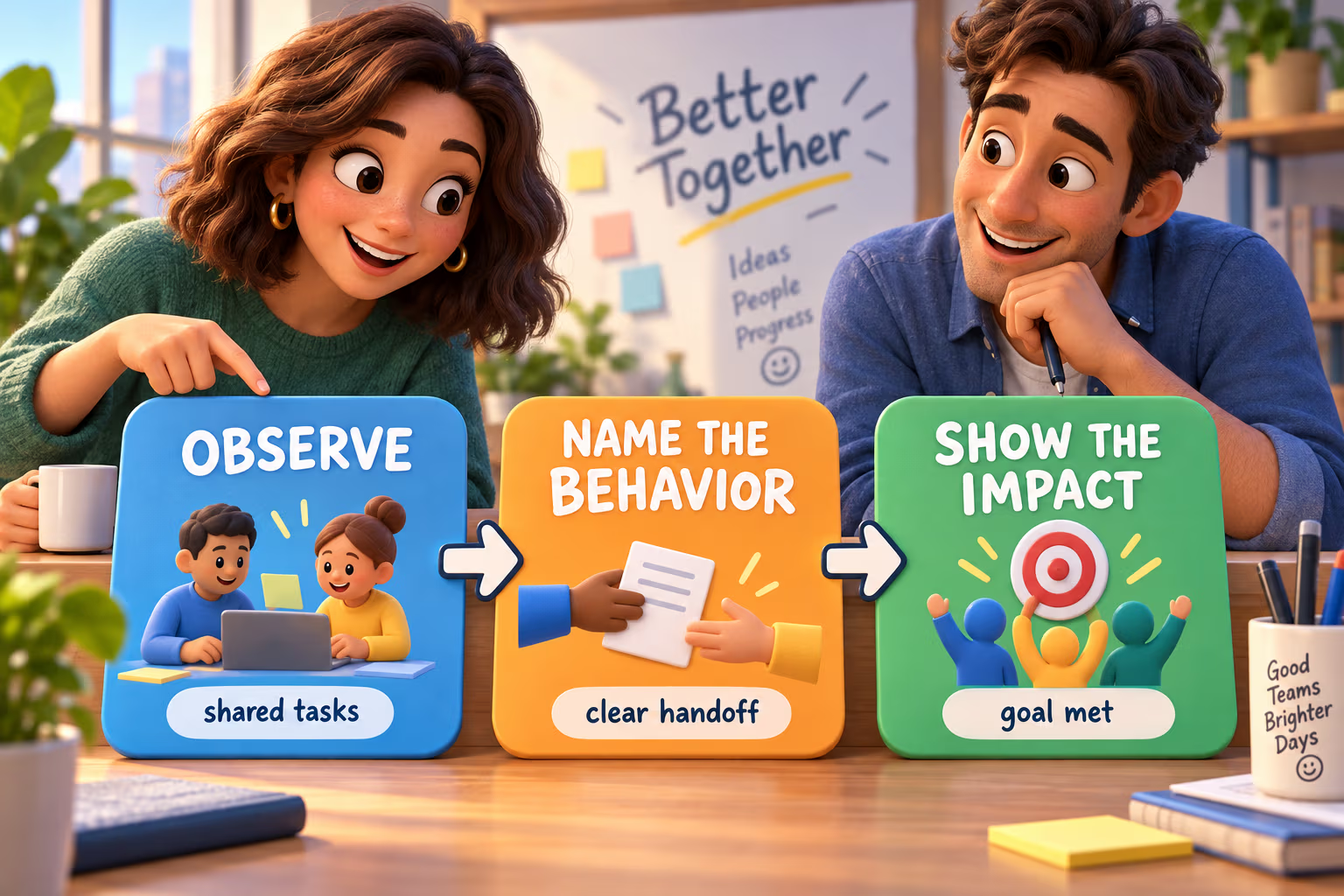
Teamwork Adjectives at a Glance
- Cooperative describes a willingness to help; collaborative describes people actively building work together.
- Words such as accountable and dependable describe follow-through, while inclusive and respectful describe how a group treats contributions.
- A useful example names the situation, an observable action, and a result that can be checked.
- Choose a word that fits the role and task; the same behavior can be useful in one context and unhelpful in another.
- Describe a repeated pattern as a pattern, and a single event as a single event.
How Do You Choose an Accurate Teamwork Adjective?
Start with what someone did, then select the adjective that most closely describes that behavior. This order makes a description more concrete than choosing a flattering label first and searching for a justification afterward.
- Name the task: For example, a client handoff, a shared report, or a project deadline.
- Recall an observable action: Did the person share information, offer help, invite input, clarify an owner, or finish an agreed task?
- Choose a precise word: Use collaborative for joint work, dependable for consistent follow-through, or inclusive for making room for relevant contributions.
- Check the evidence and scope: State the actual impact and whether the example happened once or reflects a pattern.
For occupational vocabulary, the U.S. Department of Labor’s O*NET description of cooperation calls it a tendency to be pleasant, helpful, and willing to assist at work. O*NET also groups work styles by category and notes that occupation ratings are specific to occupations; its terms are prompts for describing work, not universal performance standards. For more words to describe colleagues, see our adjectives for coworkers guide.
Positive Adjectives for Teamwork and What They Show
These positive adjectives point to different contributions rather than one vague idea of being a “good team player.” Use the example as a sentence pattern, then replace its details with something that actually happened.
| Adjective | What it describes | Observable example |
|---|---|---|
| Cooperative | Willing to assist and work with others. | “I was cooperative by covering the agreed handoff while a teammate handled an urgent customer request.” |
| Collaborative | Contributing ideas or effort to shared work. | “Our group was collaborative: we combined the research and design notes before choosing a direction.” |
| Supportive | Offering practical help, encouragement, or useful feedback. | “She was supportive when she reviewed the draft and explained two changes before submission.” |
| Dependable | Following through on an agreed responsibility. | “He was dependable, sending the status update before each scheduled review.” |
| Accountable | Taking responsibility for commitments and corrections. | “I was accountable: I flagged my mistake, corrected the file, and told the project owner.” |
| Inclusive | Making a genuine opportunity for relevant voices to contribute. | “The facilitator was inclusive, asking remote participants to share before closing the decision.” |
| Communicative | Sharing timely, relevant information and clarifying questions. | “The team was communicative, posting the revised deadline and owner in the shared channel.” |
| Adaptable | Adjusting the plan when requirements or evidence change. | “We were adaptable when we redistributed the work after the client changed the scope.” |
| Constructive | Offering criticism that identifies a problem and a useful next step. | “His constructive review identified the unclear step and suggested a test case.” |
| Respectful | Listening and responding to people without dismissing their contribution. | “She was respectful, asked a follow-up question, and credited the idea’s source.” |
| Resourceful | Finding a practical way forward with available time or tools. | “The group was resourceful, using the existing checklist to catch missing approvals.” |
| Focused | Keeping attention on agreed priorities and next actions. | “We stayed focused by recording new ideas and returning to the release checklist.” |

Word-choice note: Effective often evaluates an outcome, not a specific interpersonal behavior. It is more informative to say what made the work effective—for instance, “the team’s clear handoff prevented a missed review”—than to use effective by itself.
Which Words Fit Reviews, Resumes, and Peer Feedback?
Choose the format before choosing the adjective. A resume needs a concise accomplishment, a review needs evidence against expectations, and peer feedback should identify a useful behavior and its effect.
| Use | Helpful pattern | Example |
|---|---|---|
| Peer recognition | Adjective + specific contribution | “You were collaborative when you shared the test results before we finalized the plan.” |
| Performance review | Expectation + evidence + period or result | “During the spring release, Jordan was dependable, completing each assigned review by the agreed checkpoint.” |
| Resume | Action verb + scope + verifiable outcome | “Coordinated handoffs across design and support teams to deliver four release checklists on schedule.” |
| Self-evaluation | Strength + one example + next step | “I was adaptable when requirements changed; next quarter I will confirm owners earlier to reduce rework.” |
A standalone string such as “collaborative, reliable, and motivated” tells a reader little about what happened. Pair adjectives with evidence, and do not add a metric unless you can verify the number and its time period. Our guides to adjectives for employees and adjectives for jobs cover related workplace wording.
What Can You Say Instead of a Negative Label?
When a behavior makes teamwork harder, describe the action and the effect rather than treating the person’s character as fixed. A label such as dominating or unreliable may express frustration, but it does not tell someone what to change or how to repair a specific handoff.
| Broad label | More observable wording | Constructive next step |
|---|---|---|
| “Dominating” | “You spoke through two proposed solutions before the other owners had time to respond.” | “Could we pause after each option and hear from each owner?” |
| “Disengaged” | “The last two planning notes did not include an update for your assigned section.” | “Is the owner or deadline unclear, or do you need a different check-in?” |
| “Unreliable” | “The draft arrived after the agreed review time on Tuesday and Thursday.” | “Let’s confirm a realistic due date and flag blockers earlier.” |
| “Micromanaging” | “The task was reassigned before the agreed check-in, without a change to the requirements.” | “Can we agree which decisions the owner can make independently?” |
| “Uncooperative” | “The requested handoff details were not shared with the next shift.” | “Which information should the handoff template require?” |
These examples are sentence patterns, not conclusions about any real colleague. Check the shared expectations, workload, authority, and available support before drawing a conclusion. A missed commitment may reflect a blocked dependency or unclear ownership, so ask what happened and document only evidence relevant to the work.
How Can You Give Specific Feedback About Teamwork?
Use a short sequence: identify the situation, describe the behavior you observed, and explain the impact you can verify. The Center for Creative Leadership’s Situation–Behavior–Impact (SBI) feedback model provides this structure and recommends describing specific behavior rather than inserting a judgment about intent.
- Situation: Say when and where the example occurred, such as “At yesterday’s launch handoff.”
- Behavior: State what a person did or said, such as “you listed the two open checks and named an owner for each.”
- Impact: Explain a known effect, such as “the next shift could see what remained before approving the release.” Do not claim an effect you cannot establish.
Illustrative example: “During Monday’s planning call, Priya invited the support lead to describe the top customer issue before the team selected a fix. That brought the issue into the decision notes, so I’d describe the facilitation as inclusive and collaborative.” Substitute a real event and outcome before using the wording in feedback.
For formal reviews, the U.S. Office of Personnel Management says performance standards should be objective, measurable, realistic, and stated clearly. Its example for “Team Participation” considers whether an employee takes an appropriate share of group-project responsibility, accepts other responsibilities as needed, and shares relevant knowledge. These standards are a useful reminder to tie adjectives to duties and agreed criteria, not popularity or personality. Read OPM’s guidance on developing performance standards.
Teamwork also has limits that a list of adjectives cannot fix. In Amy Edmondson’s field study of 51 work teams in one manufacturing company, team psychological safety was associated with learning behavior; that study supports a relationship in that setting, not a guarantee that being supportive alone will make every team perform well. The Harvard record of the study defines psychological safety as a shared belief that interpersonal risk-taking is safe. Respectful disagreement and raising a concern can be part of healthy teamwork; agreement is not the same as collaboration.
Working effectively as a team is crucial in today’s fast-paced and collaborative work environments. Whether you’re a part of a small startup or a large corporation, the ability to work well with others can make all the difference in achieving success. But how do we describe teamwork? What are the key adjectives that capture the essence of effective collaboration? In this article, I’ll explore a range of adjectives that can be used to describe teamwork, along with real-life examples to illustrate their meanings. So, if you’re looking to enhance your team’s dynamics or simply want to appreciate the power of working together, keep reading to discover the descriptive words that define great teamwork.
Teamwork is about more than just individuals coming together. It’s about synergy, trust, and a shared vision. When we think about teamwork, we often think of words like “cooperative” and “collaborative.” But there are many other adjectives that can paint a fuller picture of what effective teamwork looks like. From “supportive” to “innovative,” these adjectives capture the various aspects of successful teamwork, highlighting the qualities that make teams thrive. In this article, I’ll delve into these adjectives and provide examples to help you understand how they apply in a real-world context. So, whether you’re a team leader or a team member, get ready to explore the descriptive words that define exceptional teamwork.
How to Describe teamwork? – Different Scenarios
In order to paint a vivid picture of teamwork, it’s important to use descriptive adjectives that capture the essence of different scenarios. Let’s explore some examples of how teamwork can be described in different contexts:
- Cooperative
- Collaborative
- Supportive
- Innovative
- Effective
It’s clear that teamwork can take on various forms, depending on the context and the goals of the team. By using descriptive adjectives, we can effectively capture the essence of what makes teamwork successful and impactful.
Remember, whether you’re leading a team or a part of one, understanding the power of teamwork and the descriptive words that define it is crucial for fostering collaboration and achieving collective success. So, experiment with these adjectives and discover how they can enhance your team’s dynamics and achievements.
Describing Words for teamwork in English
When it comes to teamwork, there are several adjectives that can capture the essence of effective collaboration. These words not only describe the qualities needed for successful teamwork but also inspire individuals to work together towards a common goal. Let’s explore some descriptive words that are often used to describe teamwork:
- Cooperative: Working in a cooperative manner means being willing to collaborate and work together harmoniously. It involves sharing ideas, listening to others, and respecting different perspectives. Cooperation allows individuals to combine their strengths and overcome challenges as a united team.
- Collaborative: Collaboration is all about actively working together, pooling resources, and leveraging each other’s expertise to achieve a shared objective. It involves open communication, effective problem-solving, and a collective effort towards reaching a desired outcome.
- Supportive: A supportive team environment is where each member encourages and uplifts one another. It involves offering assistance, providing feedback, and fostering a sense of trust and psychological safety. When team members feel supported, they are more likely to contribute their best and thrive together.
- Innovative: Innovative teamwork involves thinking outside the box, coming up with creative solutions, and embracing new approaches. It means being open to exploring new ideas, taking calculated risks, and continuously seeking improvement. An innovative team welcomes change and supports experimentation to drive progress.
- Effective: Effective teamwork is characterized by the ability to accomplish goals efficiently and produce high-quality outcomes. It involves clear communication, well-defined roles and responsibilities, and a strong sense of accountability. An effective team understands the importance of coordination and cooperation, resulting in productive and successful outcomes.
Now that we have explored these describing words for teamwork, it’s important to remember that they are not just words to be used in isolation. The power lies in embodying these qualities and applying them to our collaboration efforts. By embracing a cooperative, collaborative, supportive, innovative, and effective mindset, we can foster a positive team dynamic and achieve collective success.
Remember, teamwork is not just about working together, but also about the way we work together. Harnessing the power of these adjectives can help create a more cohesive and productive team environment.
Adjectives for teamwork
Positive Adjectives for Teamwork with 12 Example Sentences
When it comes to teamwork, positive adjectives play a crucial role in describing the qualities that contribute to a successful collaboration. Let’s explore some of these adjectives, along with example sentences showcasing their usage in a teamwork setting:
- Cooperative: Working together as a team is essential for success. “I appreciate my teammates for being cooperative and always helping each other out.”
- Collaborative: Collaboration allows us to combine our strengths and ideas. “We had a collaborative meeting where everyone shared their thoughts and opinions.”
- Supportive: Supporting one another creates a positive team environment. “My teammates have been incredibly supportive throughout this project.”
- Innovative: Thinking outside the box can lead to innovative solutions. “We came up with an innovative approach to solve the problem.”
- Effective: When teamwork is efficient, tasks are completed successfully. “Our team’s effective communication ensured we met our project deadline.”
- Inspiring: A team that inspires one another can achieve great things. “Working with such a motivated team is truly inspiring.”
- Dedicated: Dedication is essential for achieving shared goals. “I admire my teammates for their dedication to our project.”
- Resilient: Overcoming challenges and setbacks is easier when a team is resilient. “Despite the difficulties, our team remained resilient and never gave up.”
- Empathetic: Being empathetic towards one another fosters strong teamwork. “Showing empathy towards your teammates can strengthen relationships within the team.”
- Adaptable: Teams that can adapt are better equipped to handle changes. “We needed to be adaptable in order to meet the new client’s requirements.”
- Trustworthy: Trust is the foundation of effective teamwork. “I trust my teammates to always deliver their best work.”
- Empowering: An empowering team encourages growth and collaboration. “Our team has a culture that empowers everyone to bring their ideas to the table.”
Negative Adjectives for Teamwork with 5 Example Sentences
While teamwork is generally positive, it’s essential to be aware of negative qualities that can hinder collaboration. Here are some negative adjectives often associated with teamwork, along with example sentences demonstrating their impact:
- Uncooperative: When team members refuse to work together, progress is difficult. “His uncooperative attitude made it challenging to complete the project.”
- Dominating: Team members who dominate conversations can stifle creativity and input from others. “Her dominating behavior prevented others from expressing their ideas.”
- Micromanaging: Constantly overseeing and controlling team members can lead to resentment. “His micromanaging approach made us feel undervalued and demotivated.”
- Disengaged: Lack of interest or involvement can bring down team morale. “His disengaged attitude affected the team’s enthusiasm for the project.”
- Unreliable: Team members who consistently fail to deliver on their commitments can hamper progress. “Her unreliability placed unnecessary pressure on the rest of the team.”
Remember, identifying these negative qualities doesn’t mean labeling individuals. It’s about recognizing behaviors that can hinder teamwork and finding ways to address them for a more successful collaboration.
Positive adjectives describe the qualities that contribute to effective teamwork, while negative adjectives highlight behaviors to be aware of and address. By understanding and embodying the positive adjectives, teams can cultivate a healthy and productive working environment.
Terminology note: The words in a teamwork word bank are related descriptors, not all strict synonyms for teamwork. Cooperation and collaboration describe ways people work together; innovation or effectiveness can describe a quality or result. The “antonyms” below are better understood as behaviors that may hinder teamwork, rather than grammatical opposites of the noun teamwork.
Synonyms and Antonyms with Example Sentences
Synonyms for Teamwork
When it comes to teamwork, there are several words that can be used interchangeably to describe the qualities and actions that contribute to successful collaboration. Here are some synonyms for teamwork:
- Cooperation: Working together towards a common goal.
- Collaboration: Joint effort and active participation from all team members.
- Support: Providing assistance and encouragement to one another.
- Innovation: Creatively finding new solutions and ideas as a team.
- Effectiveness: Achieving desired outcomes efficiently and successfully.
- Inspiration: Motivating and energizing each other towards excellence.
- Dedication: Commitment and loyalty towards the team’s objectives.
- Resilience: Bouncing back from setbacks and staying determined as a team.
- Empathy: Showing understanding and consideration for others’ perspectives.
- Adaptability: Being flexible and open to change in order to meet challenges.
- Trustworthiness: Dependability and reliability in fulfilling commitments.
- Empowerment: Encouraging and enabling team members to take initiative and contribute their ideas.
Example Sentence: Our team’s cooperation and collaboration were essential in completing the project on time.
Antonyms for Teamwork
While teamwork is generally positive, there are certain behaviors that can hinder the effectiveness of collaboration. Here are some antonyms for teamwork:
- Uncooperative: Not willing to work together or contribute to the team effort.
- Dominating: Exercising excessive control and not valuing others’ input.
- Micromanaging: Overly controlling and monitoring every aspect of tasks.
- Disengaged: Not actively participating or showing interest in the team’s goals.
- Unreliable: Not dependable or trustworthy in fulfilling responsibilities.
Example Sentence: The team struggled due to the dominating behavior of one member, which hindered effective collaboration.
Remember, recognizing these negative behaviors is important in order to address them and promote a more successful and cohesive working environment.
By embodying the positive adjectives discussed earlier and avoiding the negative behaviors, teams can cultivate a healthy and productive working atmosphere.
Conclusion
In this article, I have discussed the importance of effective teamwork and provided examples of positive adjectives that describe the qualities necessary for successful collaboration. By exploring synonyms such as cooperation, collaboration, support, innovation, and effectiveness, we have gained a better understanding of the key attributes that contribute to a cohesive and productive working environment.
I have also highlighted the significance of recognizing and addressing negative behaviors that hinder teamwork, including being uncooperative, dominating, micromanaging, disengaged, and unreliable. By avoiding these behaviors, teams can foster a more positive and harmonious atmosphere.
It is crucial for individuals and organizations to prioritize teamwork and strive to embody the positive adjectives discussed in this article. By embracing qualities such as dedication, resilience, empathy, adaptability, trustworthiness, and empowerment, teams can enhance their ability to work together effectively and achieve their goals.
Remember, successful teamwork is not just about individual contributions, but about how well team members collaborate and support one another. By implementing these positive qualities and actively addressing negative behaviors, teams can create a healthy and productive working environment that leads to greater success.
Frequently Asked Questions About Adjectives for Teamwork
What are the best adjectives for teamwork?
Useful choices include collaborative, cooperative, dependable, accountable, supportive, inclusive, and adaptable. The best word depends on the action you want to describe: use dependable for follow-through, inclusive for making room for contributions, and collaborative for joint work. Add a real example so the adjective is clear and credible.
Are collaborative and cooperative interchangeable?
They overlap, but they emphasize different things. Cooperative usually means willing to help or work harmoniously with others. Collaborative more strongly suggests actively contributing ideas, skills, or effort to shared work. In a specific sentence, choose the word that best matches the action, rather than using both as decorative synonyms.
How can I describe teamwork on a resume?
Use an action verb and a concrete contribution instead of listing adjectives alone. For example, describe coordinating a handoff, sharing a process improvement, or aligning work across departments, then include a verified outcome if you have one. Do not invent a percentage, team size, or business result just to make the bullet sound stronger.
What adjective describes someone who shares credit?
Consider generous, respectful, or collaborative, then state the observed action. For example: “She credited the analyst who found the discrepancy before presenting the revised figures.” That sentence is more specific than a label because it tells the reader what happened and whose contribution was recognized.
Are negative teamwork adjectives useful in a review?
They can signal a concern, but they are usually too broad to guide improvement by themselves. Replace a fixed label with the situation, observable behavior, relevant expectation, and next step. Check whether unclear roles, workload, or missing support affected the event before treating one example as a repeated pattern.


